10,000 Coral Fragments on a PVC Rack — Why They Survived
22 เมษายน 2569
Chanthaburi’s low-tech PVC nursery kept 95% of coral fragments alive after the Gulf’s worst bleaching. Species selection made the difference.
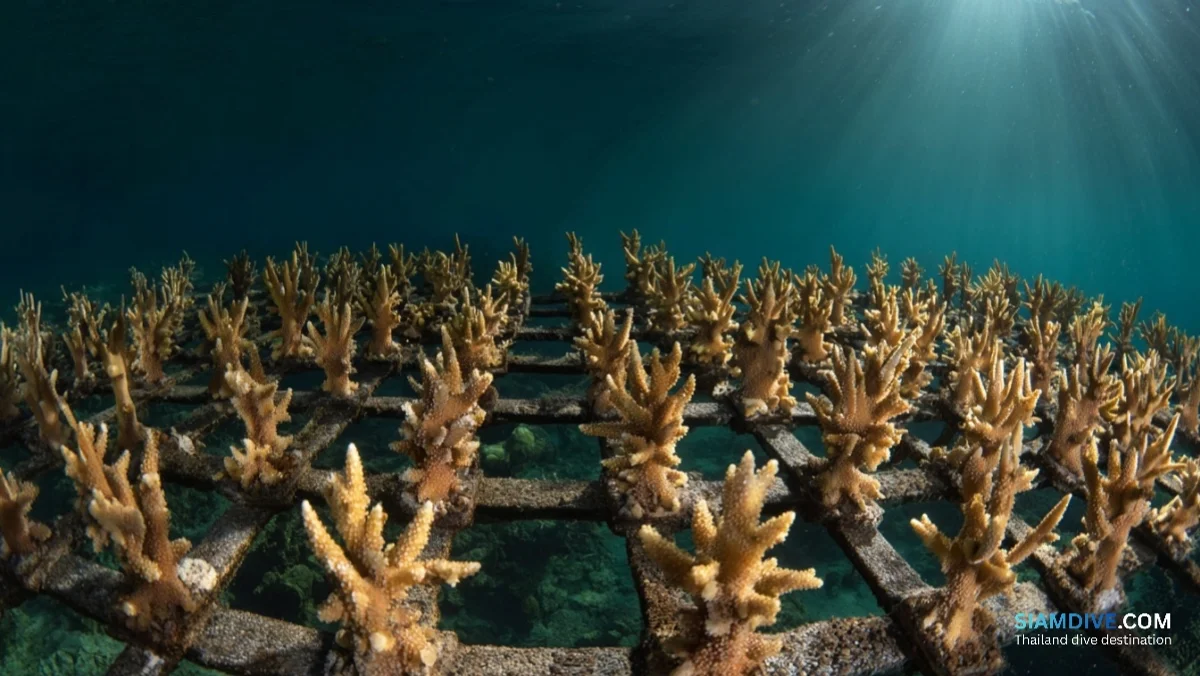
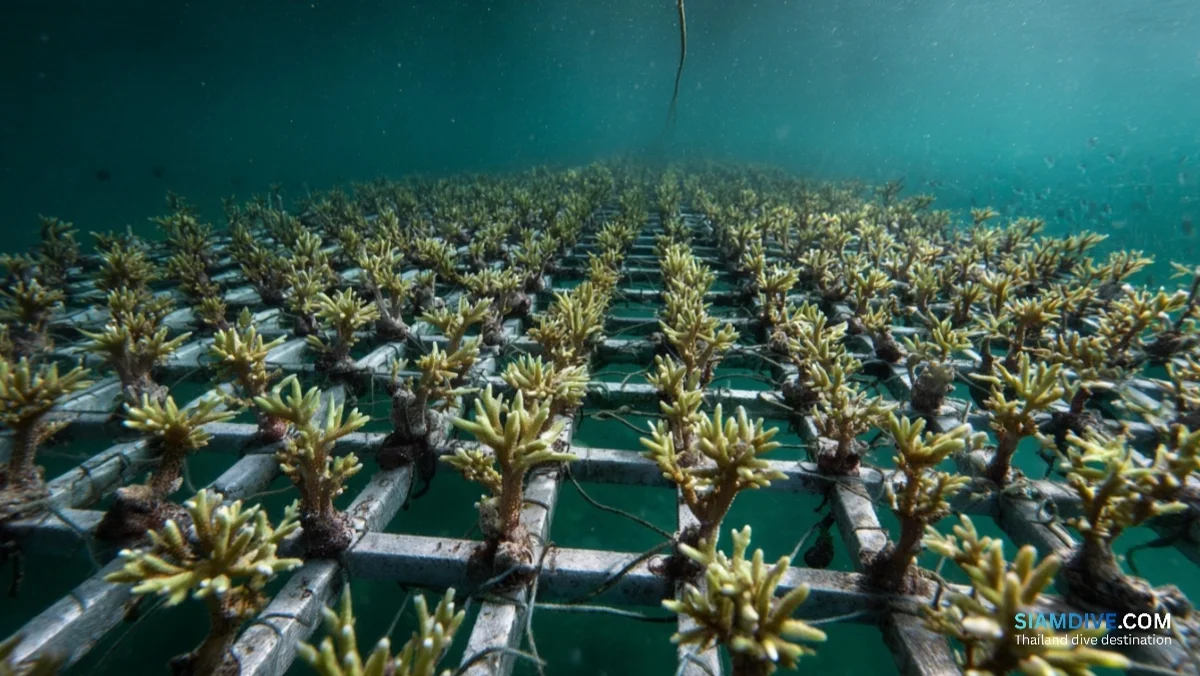
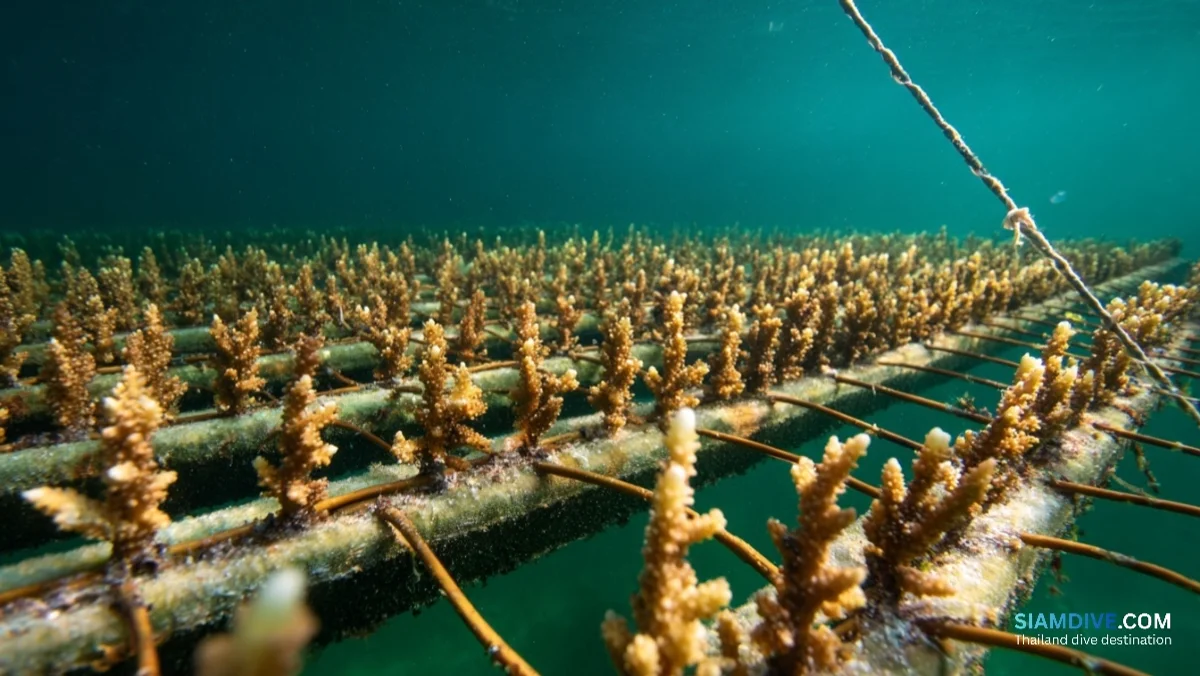
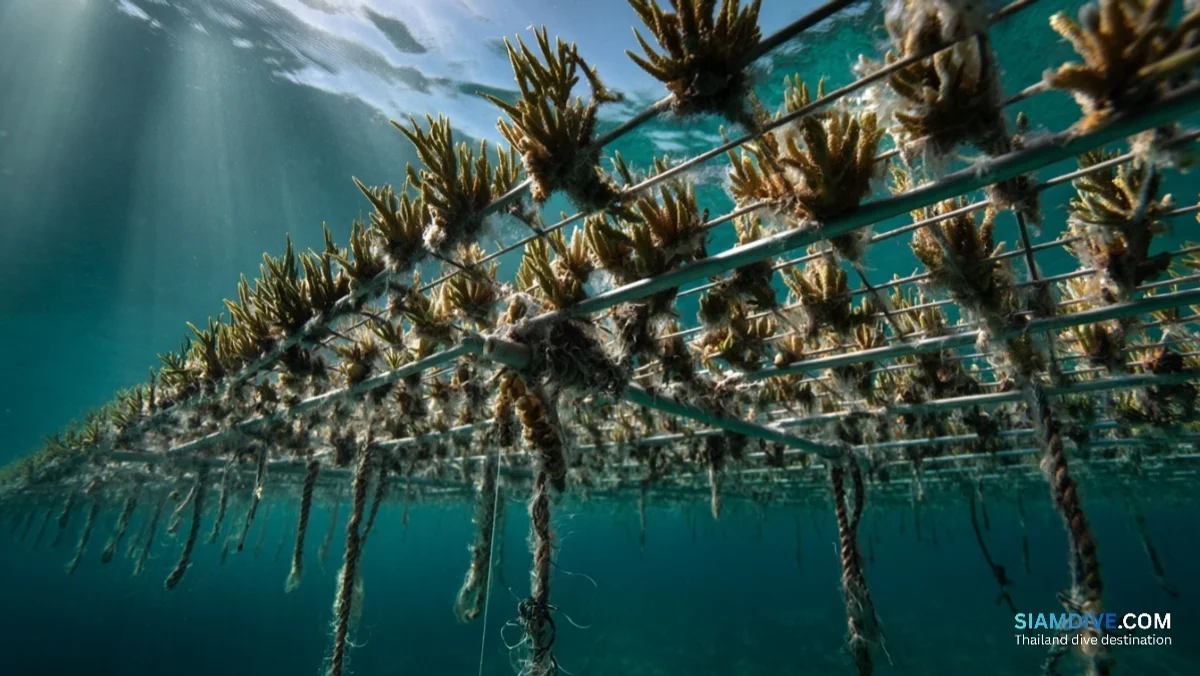
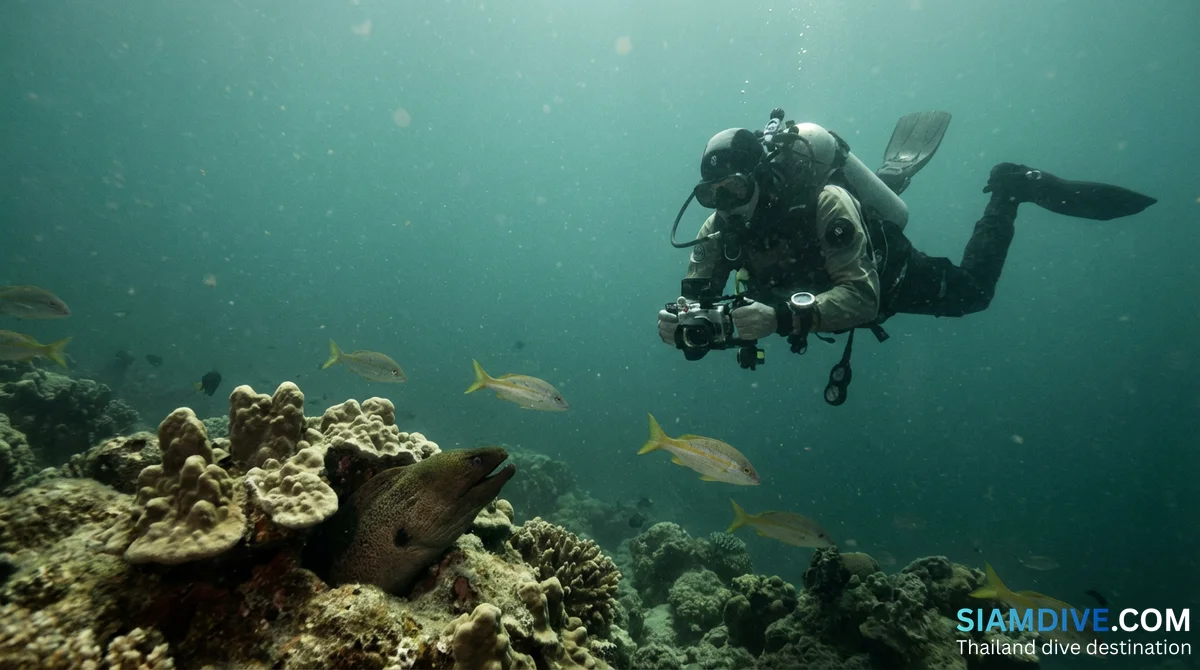
Twenty metres off Hat Chao Lao, a row of PVC frames hangs from a mooring line at four metres depth. Each frame holds dozens of coral fragments — thumb-sized cuttings of Porites lutea, wired in place with fishing line. The fragments are unremarkable to look at: grey-brown nubs no bigger than a domino. But nine out of ten are alive after twelve months in the water. In the Gulf of Thailand, where bleaching wiped out an estimated 90% of shallow corals in May 2024, a survival rate that high is not normal. It is the product of species selection, nursery site placement, and a restoration network that stretches from a Chanthaburi university lab to the seafloor.
After the White-Out
May 2024 hit the Gulf of Thailand harder than any bleaching event in recorded history. Sea surface temperatures exceeded 31°C for weeks straight. DMCR field surveys across the Gulf reported roughly 90% of shallow-water corals affected, with mortality eventually reaching 40% in the months that followed. The remaining 60% recovered — slowly and unevenly — after DMCR implemented a “Reduce, Refrain, Rescue” management policy that restricted coastal construction, limited access to stressed reef zones, and deployed emergency shade structures over critical nursery areas.
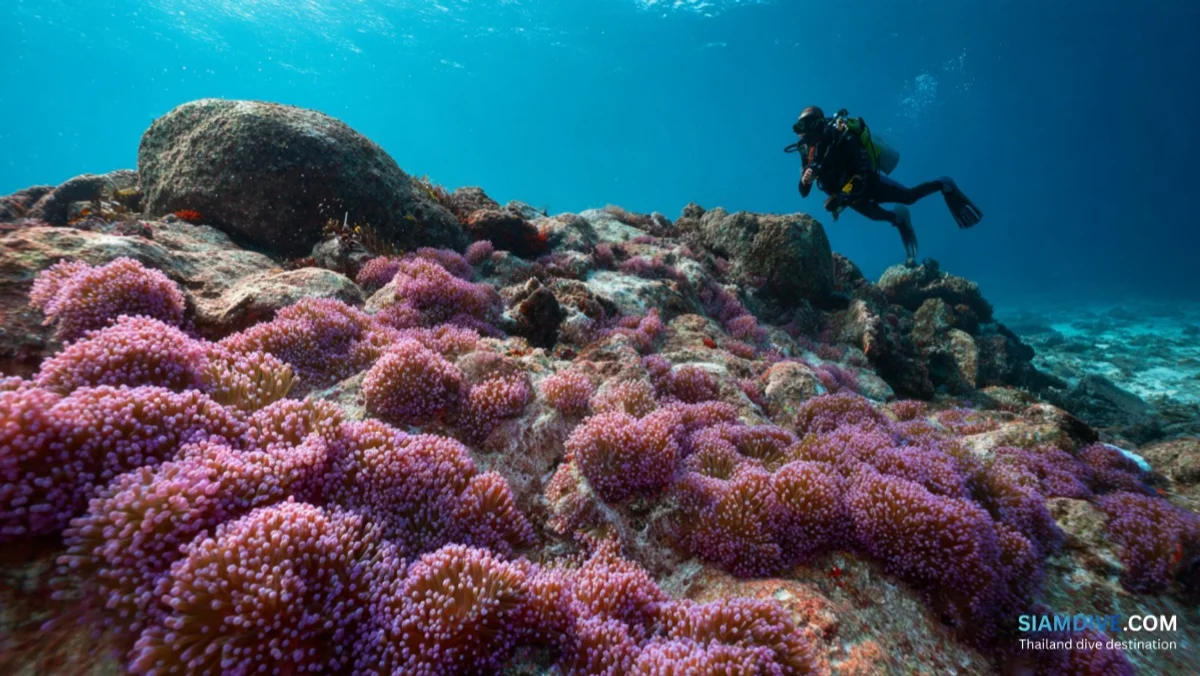
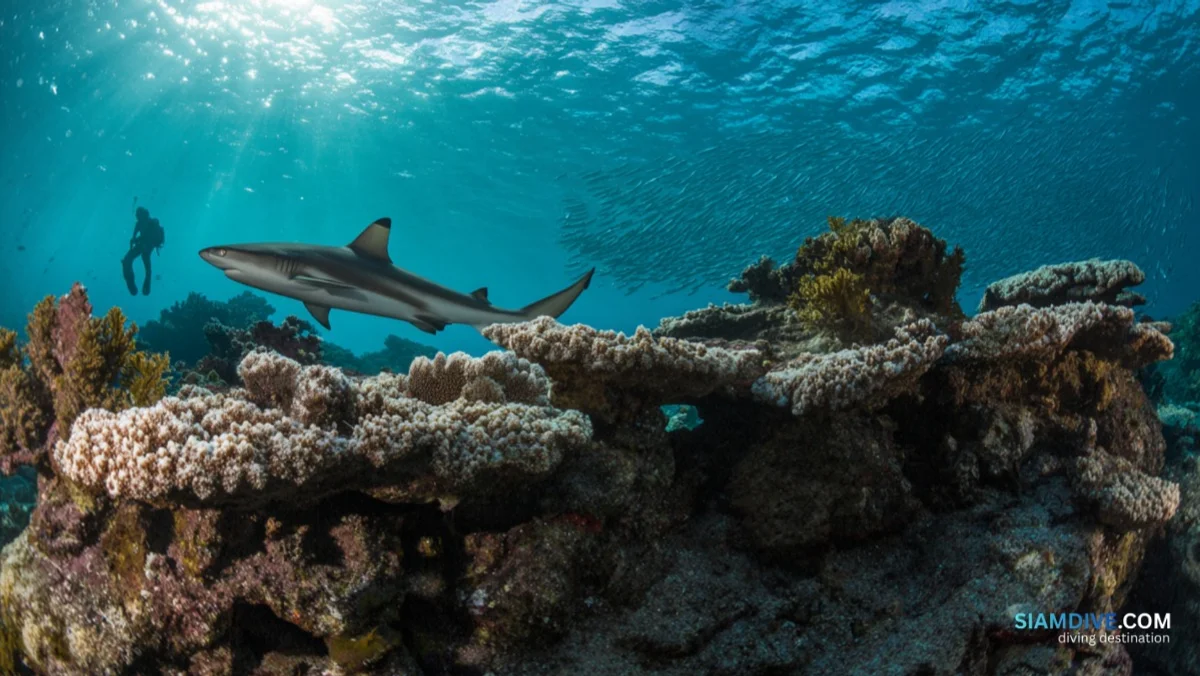
Branching and staghorn corals suffered the worst. A coast-to-coast reef assessment published by Mongabay in January 2026 confirmed what field divers had already reported: Thailand’s reefs are structurally simpler now than a decade ago. The tall, complex branching formations that shelter juvenile fish are giving way to encrusting and plate-forming species — corals that tolerate heat better but offer far less habitat architecture. Reefs that turned white across the Gulf are growing back in cover, but not in shape.
PVC Pipe, Fishing Line, and a Theory
Cut a healthy colony into thumb-sized pieces, wire each one to a PVC frame, hang the frame at four metres. The technique used along Chanthaburi’s coast is that simple — and it works. Frames sit at 3–5 metres depth, shallow enough for good light, deep enough for stable temperature, positioned in moderate current to keep sediment off the living tissue.
Fragment-based coral restoration is not unique to Thailand. Marine biologists worldwide have used the technique since the early 2000s. What made the Chanthaburi projects different was the decision to prioritise species that survive bleaching over species that grow fast.
Early Thai restoration efforts planted whatever was abundant. Many projects chose fast-growing Acropora (branching coral) and Pocillopora (cauliflower coral) because they colonise quickly and look impressive within a year. The numbers told a different story. Transplantation trials conducted by Burapa University recorded twelve-month survival rates across three genera:
- Porites lutea (massive coral) — 95% survival
- Acropora sp. (branching coral) — 83% survival
- Pocillopora damicornis (cauliflower coral) — 42% survival
The trade-off is speed. Porites adds roughly 1–2 cm of skeleton per year, versus Acropora’s 5–10 cm. A nursery stocked with Porites will look sparse for years. But after the 2024 bleaching hit the Gulf, the Porites frames off Chao Lao were still alive. The Acropora racks were white.
From 10,000 to 80,000 Fragments
The numbers behind Chanthaburi’s coral work trace back to 2003. Vinythai PCL and the Marine Science Activity and Conservation Foundation (MACF) committed 10,000 coral fragments for transplantation in the Gulf — one of Thailand’s first large-scale restoration pledges. The partnership pulled in DMCR, Rambhai Barni Rajabhat University (based in Chanthaburi city), Chulalongkorn University, the Royal Thai Navy, and local fishing communities.
By 2007, the project had scaled to 80,000 fragments across five provinces in a campaign commemorating King Bhumibol Adulyadej’s 80th birthday. Chanthaburi was one of the core transplantation sites, with nursery frames deployed along the coast between Hat Chao Lao and Kung Kraben Bay. The Kung Kraben Bay Royal Development Study Centre — a coastal ecosystem research station established under royal initiative — provided nursery staging areas, monitoring infrastructure, and access to mangrove and seagrass habitat data that helped guide fragment placement.
The cost structure for coral transplantation in Thailand, drawn from published research data:
- Transplantation cost
- 1,600–2,300 THB per square metre of reef restored
- Annual maintenance
- 160–230 THB per square metre per year
- Fragment handling capacity
- A trained volunteer team of 4 can prepare and deploy approximately 50–80 fragments in a morning session
For a nursery targeting 10,000 fragments, that initial investment runs into the hundreds of thousands of baht — significant for a provincial project, but manageable when spread across government, academic, and private-sector partners.
What Volunteers Clip, Tag, and Measure
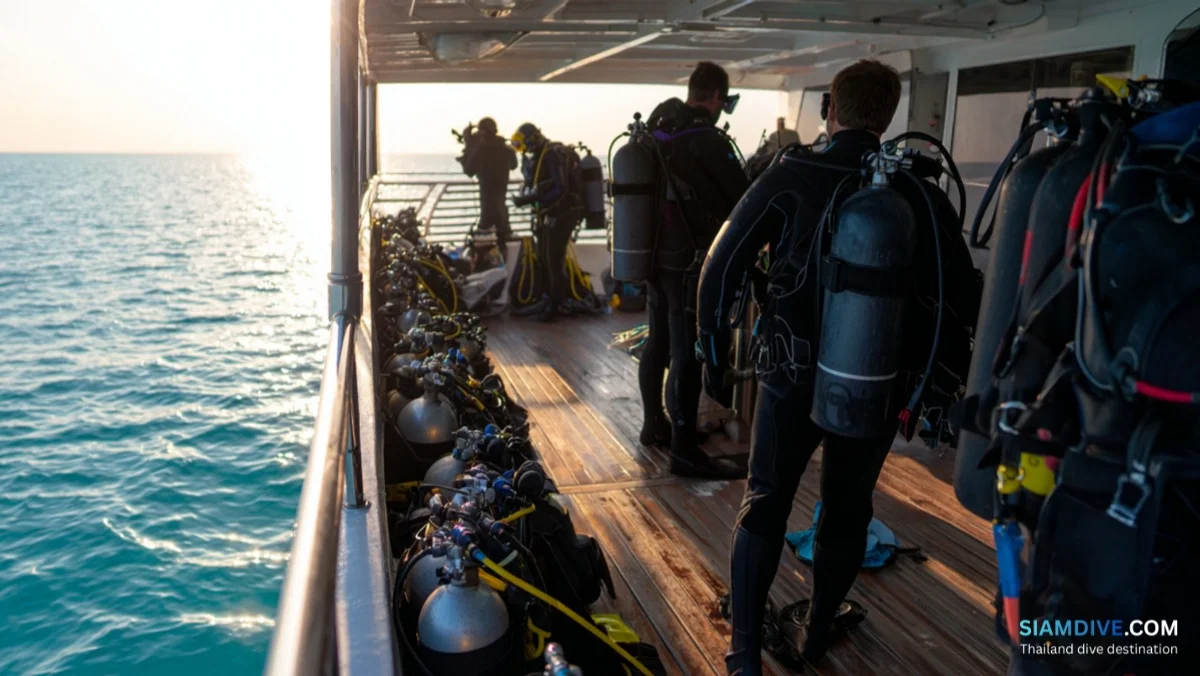
A morning at a Gulf coast nursery starts on shore. The briefing covers fragment handling: how to cut without crushing the skeleton, how to wire pieces to the rack without scraping living tissue off the underside, and how to log tag numbers against a GPS grid. The session runs 45 minutes — longer than most dive briefings, because the data entry matters more than the dive itself.
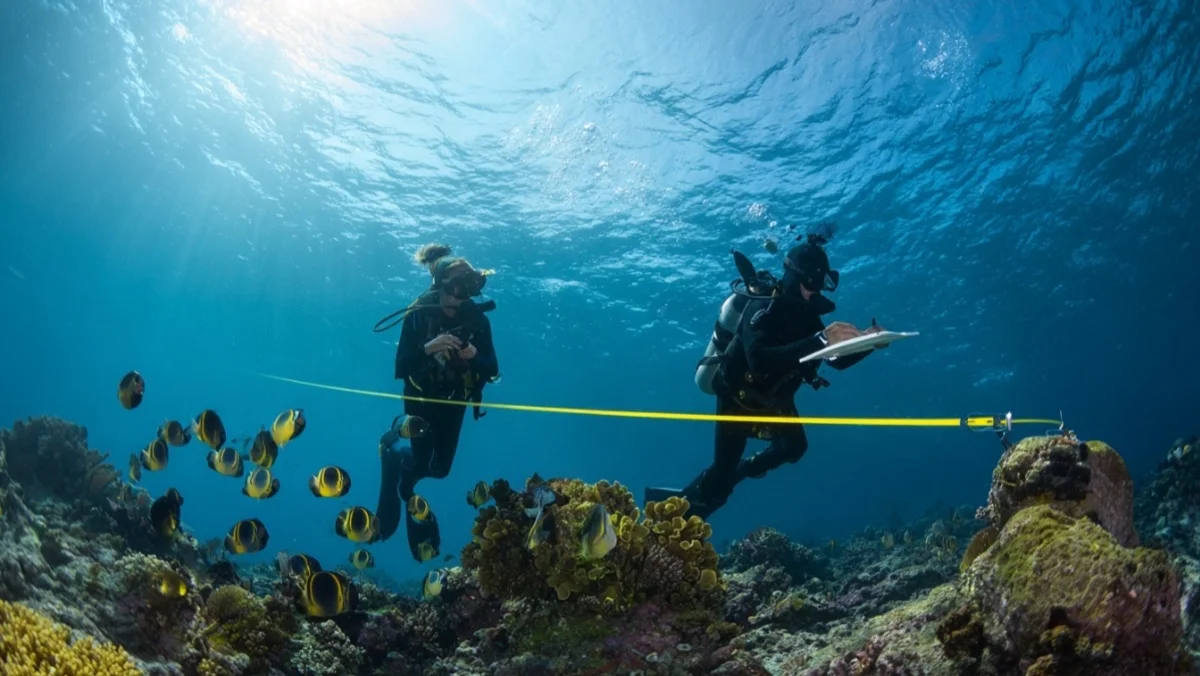
Underwater, volunteers work at 3–5 metres depth. Snorkellers contribute alongside Open Water certified divers. The tasks are repetitive by design: clip a fragment from a marked donor colony, attach it to a numbered position on a PVC frame, photograph the tag, move to the next slot. Return visits — typically monthly — involve measuring fragment growth with a caliper across the widest axis, recording tissue colour on a standardised bleaching chart, and replacing any fragments that died since the last check.
Data collection is the less photogenic but more valuable half. Growth measurements over 6–12 months feed into the survival-rate analyses that guide future species selection. The Burapa University data on Porites versus Acropora survival came directly from this kind of volunteer-assisted monitoring — thousands of monthly measurements, aggregated into the statistics that now steer which species get planted.
Volunteer restoration programmes along the Chanthaburi coast typically run 1–3 day sessions, coordinated through Rambhai Barni Rajabhat University or local fishing cooperatives. Daily costs range from 500–1,500 baht, which covers equipment, boat transport, and data sheets. No advanced dive certification is required for shallow nursery work.
Complexity Keeps Falling
The fragment nursery at Chao Lao is a local success — ten thousand cuttings, most of them alive, contributing new coral tissue to a reef that lost almost half its cover in 2024. But pull the camera back, and the picture gets harder.
That January 2026 Mongabay assessment did not just count bleaching. It measured structural complexity across dozens of Thai reefs in both the Gulf and the Andaman Sea, and found a consistent pattern: the tall, branching architectures that rebuilt themselves after the 2004 tsunami are thinning out. What grows back is flatter, less complex, and supports fewer fish species per square metre. Coral cover statistics can improve while the reef quietly simplifies.
Thai marine scientists are hedging their bets. In February 2026, Mongabay reported on a coral cryobank initiative that freezes coral reproductive cells — eggs and sperm — for future reintroduction. The premise is genetic insurance: if a bleaching event eliminates an entire genotype at a site, cryopreserved material could bring it back decades later. The technology is still experimental, dependent on consistent cryogenic storage infrastructure that Thailand is still building. But its existence signals how wide the gap has become between what fragment nurseries can restore and what rising ocean temperatures can destroy.
Natural recovery offers its own data point. Around Koh Phangan in the Gulf, hard coral cover climbed from 37% to 55% between 2014 and 2022 — a mean increase of 2.2% per year — driven largely by plate-like species without any nursery intervention. The reef rebuilt itself, given time and reduced human pressure. The implication is clear: hands-on restoration works best alongside protection, not as a replacement for it.
Getting to Chao Lao
Four hours east of Bangkok on Route 3, Hat Chao Lao occupies a quiet stretch of sand in Laem Sing district, Chanthaburi Province. The beach is better known for weekend seafood trips and Songkran water fights than for diving, which keeps visitor density low enough that nursery frames remain undisturbed by boat traffic.
Visibility ranges from 3–8 metres depending on runoff and season — best between December and March, when Gulf currents settle and nursery monitoring visits are most frequent. Maximum depths near the nursery sites stay within 8–12 metres, making the area accessible to new divers and snorkellers. For divers chasing better visibility, the Koh Chang archipelago is roughly 90 minutes north and offers wall dives with 10–20 metre visibility during peak season.
Chanthaburi itself is worth the detour beyond the reef. The Kung Kraben Bay mangrove boardwalk, the gem market in town, and the cathedral district add a full day of content for non-diving companions. The combination — a morning clipping coral fragments, an afternoon eating crab on the beach — makes Chao Lao one of the few places where reef conservation doubles as a weekend trip rather than a research expedition.
More on marine life encounters across Thai waters: how Thailand’s mantis shrimp packs 1,500 newtons into 80 microseconds, or why Koh Tao’s nudibranchs steal weapons from their prey.
Sources
- The Nation Thailand — Thailand’s Coral Reefs Stage Comeback After Bleaching Event
- PEMSEA — Cultivation of 80,000 Coral Branches in Honor of His Majesty
- Mongabay — Coast-to-Coast Coral Assessment Reveals Thailand’s Reefs Losing Complexity
- Mongabay — In Thailand, a Coral Cryobank Tries to Buy Time for Dying Reefs
- PMC/NCBI — Reef Recovery Around Koh Phangan, Gulf of Thailand