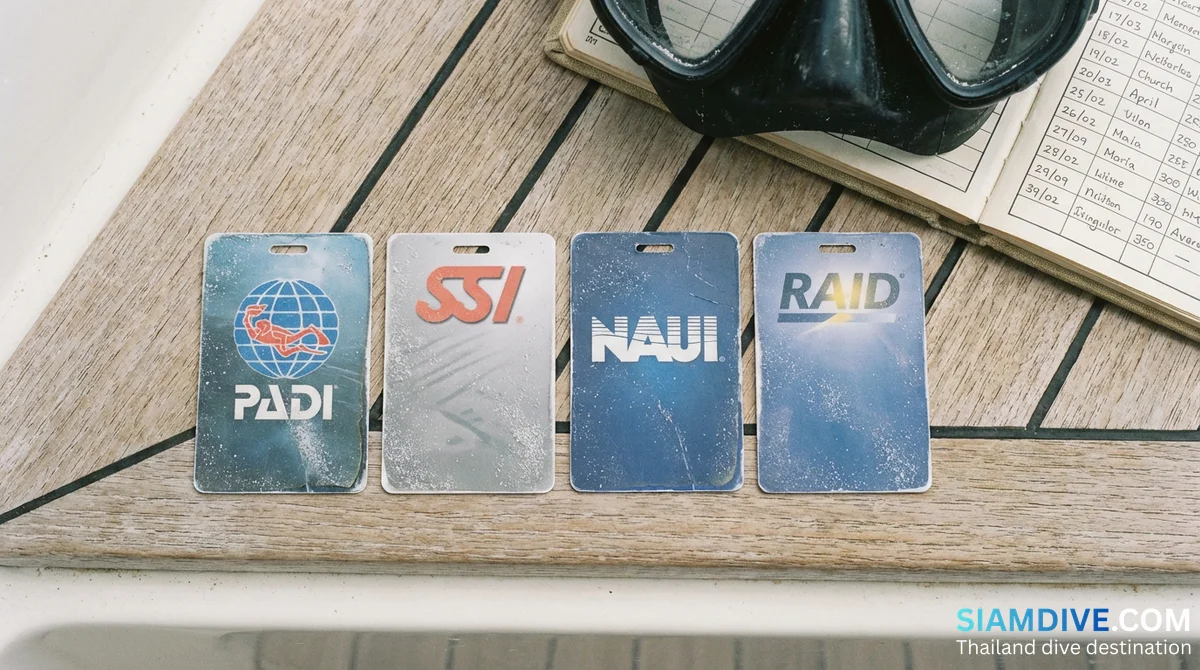
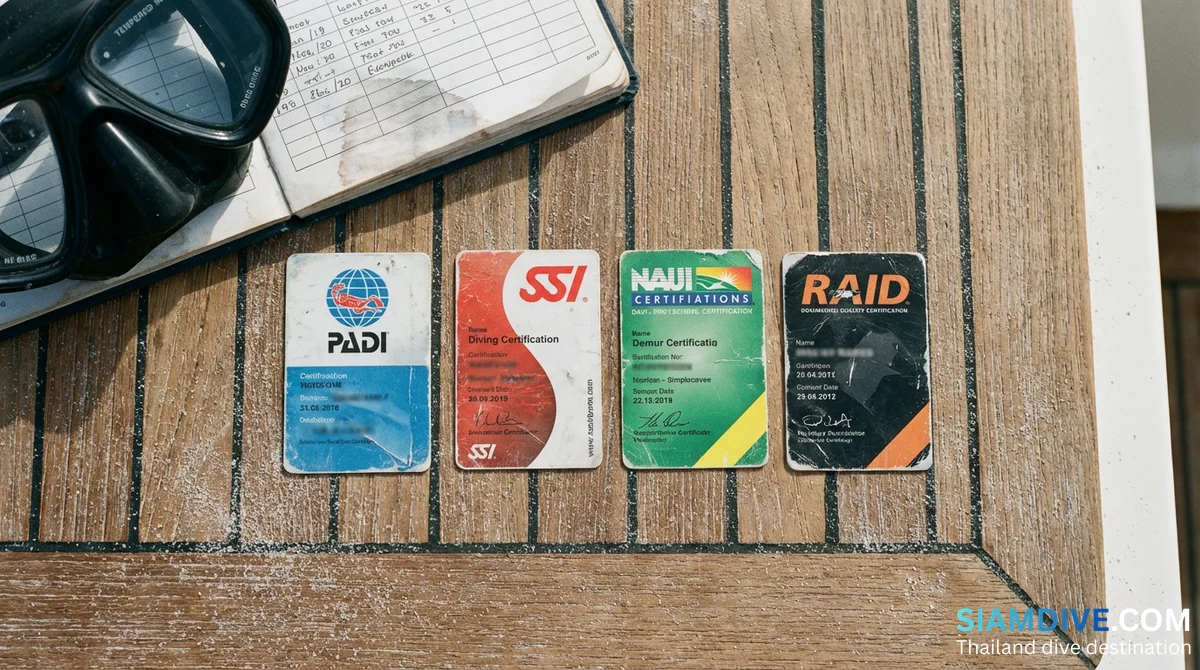
PADI vs SSI vs NAUI vs RAID: Does the Agency on Your Card Actually Matter?
16 เมษายน 2569
A diver's honest, no-marketing breakdown of the four big certification agencies — where they differ, where they don't, and what to actually look for.
Walk into any dive shop in Phuket, Koh Tao or the Similans and you'll see the same four logos on the wall: PADI, SSI, NAUI and RAID. Every beginner asks the same question — does it matter which agency I certify with? After a decade of putting divers in the water across Thailand, here is the honest answer most dive shops won't tell you.
The short answer: at recreational level, barely
All four agencies are members of the WRSTC (World Recreational Scuba Training Council) and meet ISO 24801 standards. Every decent dive operator on earth will accept a card from any of them. You can take Open Water with SSI, Advanced with PADI, Rescue with RAID, and nobody will blink. What actually determines whether you come out a safe, competent diver is the instructor and shop, not the plastic.
PADI — the 800-pound gorilla
The Professional Association of Diving Instructors has certified somewhere between 60% and 75% of all divers on the planet, with more than 27 million cards issued since 1966. The curriculum is rigidly standardized — every skill in a set sequence, same worldwide. This is PADI's greatest strength and its biggest complaint: you know exactly what you're getting, but instructors have limited flexibility to adapt pace to the student. Prices run highest, typically USD 400 to 1,000 for Open Water in resort areas because per-student certification fees are steeper.
SSI — the fastest-growing challenger
Scuba Schools International is now roughly 20% of the market and climbing fast, especially in Southeast Asia. In Koh Tao and Phuket, many high-volume shops have quietly shifted to SSI because the digital learning platform is free for students and the flexible skill sequencing lets instructors skip a difficult skill, move on, and circle back. Standards are equivalent to PADI, the c-card is accepted globally, and courses typically run 10 to 15% cheaper.
NAUI — the academic purist
The National Association of Underwater Instructors is the oldest US-based agency (founded 1960) and the only major non-profit. NAUI has roughly 10% of the global market but a disproportionate presence in military, public safety and scientific diving. Instructors have real autonomy to design training, and courses lean heavier on theory and physiology. Open Water often takes 4 to 5 days instead of 3. Outside North America, NAUI shops are thinner on the ground — you'll find fewer in Thailand than PADI or SSI.
RAID — the digital-first newcomer
Rebreather Association of International Divers started as a technical agency and grew into full recreational training. RAID is the smallest of the four but growing quickly because everything is digital, the online theory is genuinely free, and the course structure is modern. Prices typically come out 20% or more below PADI. Acceptance worldwide is real but not universal — a handful of old-school resorts still ask what RAID is. For most of Thailand and Europe, no issue.
When the agency genuinely matters
Three situations change the math. First, if you plan to go technical — cave, trimix, rebreather — look at TDI, IANTD or RAID's tech track before you start, because crossover is cleaner inside one family. Second, if you want to become an instructor, PADI has the largest pro job market worldwide but SSI offers lower franchise fees to dive shops. Third, military, commercial and scientific divers typically favor NAUI or agency-specific paths.
When it really doesn't matter
If you are a recreational diver who wants to dive the Similans, Richelieu Rock, Komodo, the Maldives or the Red Sea on holiday, pick based on the instructor and the shop, full stop. Walk in, meet the instructor, look at the equipment, check the boats, read recent reviews. A great PADI instructor beats a mediocre SSI one every day of the week, and vice versa. The logo on your c-card will never be checked again after the first dive shop scans it.
Our honest recommendation
For first-time divers coming to Thailand, we suggest SSI or PADI simply because availability is higher and you'll have backup options if you want to continue. Shop on instructor quality and shop safety record first, price second, agency third. If you've already booked a trip with us and are wondering which agency to pick — message our team, and we'll match you to a partner shop that fits your pace and budget, not our commission rate.
Plan your Thailand dive trip with SiamDive — liveaboards, day trips and certification partners across the Andaman and Gulf.