Surface Intervals: The Boring Part of Diving That Keeps You Alive
17 เมษายน 2569
Everything you need to know about surface intervals — why nitrogen off-gassing matters, how long to wait between dives, what to do (and avoid) during your SI, and how dive computers calculate it all for you.
What Is a Surface Interval and Why Should You Care?
A surface interval (SI) is simply the time you spend on the surface between two dives. It sounds mundane — you’re just sitting on a boat, after all — but it’s one of the most critical safety factors in scuba diving. During every dive, your body absorbs nitrogen from the compressed air you breathe. The deeper you go and the longer you stay, the more nitrogen dissolves into your blood and tissues. Your surface interval is when your body gets rid of that excess nitrogen through normal breathing — a process called off-gassing.
Skip or shorten this process, and you risk decompression sickness (DCS), commonly known as “the bends.” It’s not dramatic to say that properly managing your surface interval can literally save your life.
The Science of Nitrogen Off-Gassing
At depth, the increased ambient pressure causes nitrogen to dissolve into your tissues at a rate proportional to the pressure. When you ascend, that pressure decreases, and nitrogen begins to come out of solution. If you ascend too quickly or dive again too soon, nitrogen can form bubbles in your blood and tissues — leading to DCS.
During your surface interval at normal atmospheric pressure (1 ATM), nitrogen gradually leaves your body through your lungs with every breath. The rate of off-gassing varies by tissue type: fast tissues (like blood) release nitrogen quickly, while slow tissues (like fat and cartilage) take much longer. This is why a full 24 hours is needed to completely eliminate all residual nitrogen, no matter how short your dive was.
The good news? A significant amount of nitrogen is off-gassed during the first 60 minutes of your surface interval, which is why one hour is considered the standard minimum for recreational repetitive dives.
How Dive Tables and Computers Handle Surface Intervals
The PADI Recreational Dive Planner (RDP) and its electronic version, the eRDPml, use a letter-based pressure group system (A through Z) to track your nitrogen loading. After your first dive, you’re assigned a pressure group letter. The Surface Interval Credit Table then shows how your pressure group decreases over time on the surface. After your surface interval, you use your new (lower) pressure group to look up adjusted no-decompression limits for your next dive.
Dive computers do the same calculations automatically, but with greater precision. They track multiple tissue compartments in real time (typically 8–16 compartments with different half-times), giving you a more accurate and usually more generous picture of your nitrogen status. Most computers display your remaining surface interval countdown and will warn you if you’re planning to dive again too soon.
Key difference: tables assume your entire dive was at maximum depth (square profile), while computers track your actual depth profile, often allowing longer bottom times on repetitive dives.
How Long Should Your Surface Interval Be?
There’s no single answer — it depends on your dive profile, depth, bottom time, and how many dives you’ve already done that day. But here are practical guidelines:
- Minimum 10 minutes: Any surface interval shorter than 10 minutes means your next dive is treated as a continuation of the first (multi-level rules apply).
- Standard recreational SI: 60–90 minutes. This allows substantial off-gassing and is the typical interval on dive boats worldwide.
- After deep or long dives: 2+ hours. If your first dive was close to no-decompression limits or deeper than 30 meters, extend your SI significantly.
- After 6 hours: Your pressure group resets to “A” on the RDP — you’re essentially starting fresh (though trace nitrogen may remain in slow tissues).
- After 24 hours: Complete nitrogen elimination. Required before flying after diving.
Factors that can lengthen your required SI: deeper dives, longer bottom times, cold water, dehydration, fatigue, age, and high body fat percentage. Factors that shorten it: shallow dives, short bottom times, and good hydration.
What to Do During Your Surface Interval
Your SI isn’t just waiting time — it’s preparation time. Here’s how to make the most of it:
- Hydrate aggressively. Dehydration is a major contributing factor to DCS. Drink water or electrolyte drinks consistently. Aim for at least 500ml during each SI.
- Eat a light snack. Fruit, nuts, crackers, or energy bars keep your blood sugar stable without making you feel heavy. Avoid greasy or spicy foods.
- Rest in the shade. Overheating and excessive sun exposure can promote dehydration and fatigue. Take off your wetsuit, wrap up in a towel, and relax.
- Log your previous dive. While it’s fresh in your memory, record depth, time, air consumption, and any marine life sightings. Your future self will thank you.
- Review the plan for your next dive. Discuss with your buddy: max depth, route, turn pressure, signals, and any special points of interest. Check your adjusted no-decompression limits.
- Check and prepare your gear. Top off your tank, clear your mask, check your BCD inflator, and make sure your computer has reset properly.
- Socialize and learn. Some of the best dive friendships start during surface intervals. Share what you saw, compare photos, and swap tips.
What NOT to Do During Your Surface Interval
Some activities can actually increase your risk of DCS or compromise your safety on the next dive:
- Don’t drink alcohol. Alcohol dehydrates you, impairs judgment, and may affect nitrogen elimination. Save the celebratory beer for after your last dive of the day.
- Don’t do strenuous exercise. Heavy physical activity can promote bubble formation in tissues still saturated with nitrogen. Light stretching is fine; CrossFit on the sundeck is not.
- Don’t sunbathe excessively. Extended direct sun exposure leads to dehydration, fatigue, and heat exhaustion — all risk factors for DCS.
- Don’t freedive or snorkel deep. Going back underwater — even without scuba gear — during your surface interval defeats the purpose. Shallow snorkeling at the surface is generally fine, but breath-hold dives to depth reset your pressure exposure.
- Don’t rush your interval. Peer pressure to “hurry up and get back in” is real, especially on busy dive boats. Your safety is more important than anyone’s schedule.
Repetitive Dive Planning: Why Your Second Dive Should Be Shallower
One of the golden rules of repetitive diving is: plan your deepest dive first, then go progressively shallower. This isn’t just tradition — it’s physics and physiology.
After your first dive, you carry residual nitrogen into your surface interval and then into your second dive. That residual nitrogen reduces your available no-decompression time at any given depth. If you reverse the order — shallow first, deep second — you start your deep dive already nitrogen-loaded, dramatically reducing your safe bottom time and increasing DCS risk.
The RDP enforces this with Rule 9: no repetitive dive may be deeper than the previous one. Dive computers don’t enforce this rule explicitly, but the math works against you — your adjusted no-decompression limit at depth will be noticeably shorter.
For multi-day diving, nitrogen fatigue accumulates. Even with proper surface intervals, residual nitrogen builds up in slow tissues over consecutive diving days. This is why most agencies recommend taking a dive-free day after every 3–4 days of multi-dive schedules, and why your last day of diving should feature the shallowest, most conservative profiles.
Thai Liveaboard Surface Intervals: A Real-World Schedule
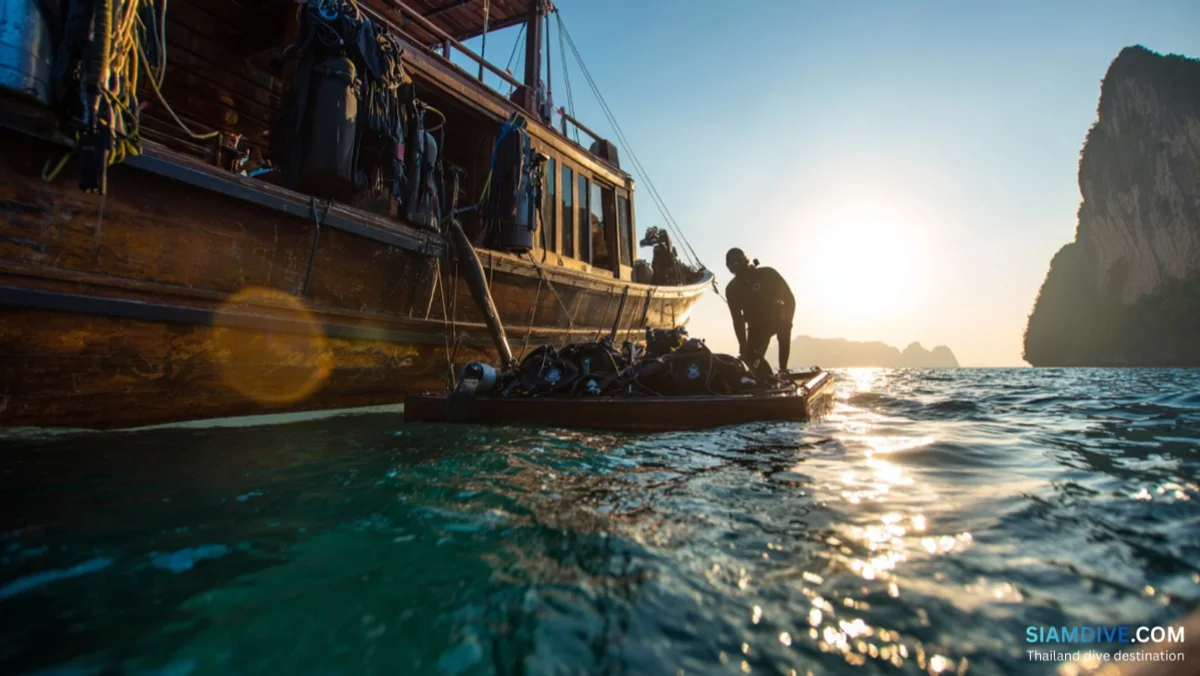
If you’re diving in Thailand — whether it’s the Similan Islands, Richelieu Rock, or Hin Daeng — liveaboard schedules typically feature 3 to 4 dives per day. Here’s what a typical day looks like:
- Dive 1 (6:00–7:00 AM): Early morning dive, usually the deepest of the day (25–30m). Often the best visibility and marine life activity.
- Surface Interval: 1.5–2 hours. Breakfast, briefing for dive 2, gear prep.
- Dive 2 (9:00–10:00 AM): Mid-morning dive, moderate depth (18–25m).
- Surface Interval: 1.5–2 hours. Lunch, rest, log dives, afternoon briefing.
- Dive 3 (12:30–1:30 PM): Early afternoon dive, shallower (12–20m).
- Surface Interval: 2–3 hours. Snack, relax, camera prep.
- Dive 4 (4:00–5:00 PM or night): Sunset or night dive, shallow (10–18m). Perfect for macro photography.
This schedule naturally follows the “deepest first” rule and provides generous surface intervals of 1–2 hours between dives. The longer afternoon break allows significant off-gassing before the final dive. Thai liveaboard crews are experienced at managing these schedules to maximize both safety and underwater time.
Whether you’re on a liveaboard in the Andaman Sea or doing day dives off Koh Tao, your surface interval is your secret weapon for safer, longer, and more enjoyable diving. Use it wisely.
Ready to plan your next diving adventure in Thailand? Explore dive destinations, liveaboard schedules, and expert guides at siamdive.com.