Why Vinegar Fails on Half the Jellyfish in Thai Waters
29 เมษายน 2569
Box jellyfish need vinegar within seconds. Portuguese man-of-war stings get worse with it. Species-by-species first aid for every jellyfish in Thai waters.
Vinegar sits in a bottle at nearly every lifeguard station between Phuket and Koh Samui. For the box jellyfish responsible for at least eight tourist deaths in Thailand since the 1990s, that bottle is a genuine lifesaver — it neutralises thousands of unfired stinging cells within seconds. Pour the same vinegar on a Portuguese man-of-war sting, and the evidence tilts toward making things worse. The right first aid depends entirely on what stung you, and in Thai waters, four common culprits each demand a different protocol.
Four Species, Four Protocols
Thailand's coastline runs more than 3,100 kilometres along two bodies of water — the Gulf of Thailand to the east, the Andaman Sea to the west — and each side attracts different stinging species in different seasons. Confusing them in the moment a tentacle wraps around a wrist turns a manageable sting into something far worse.
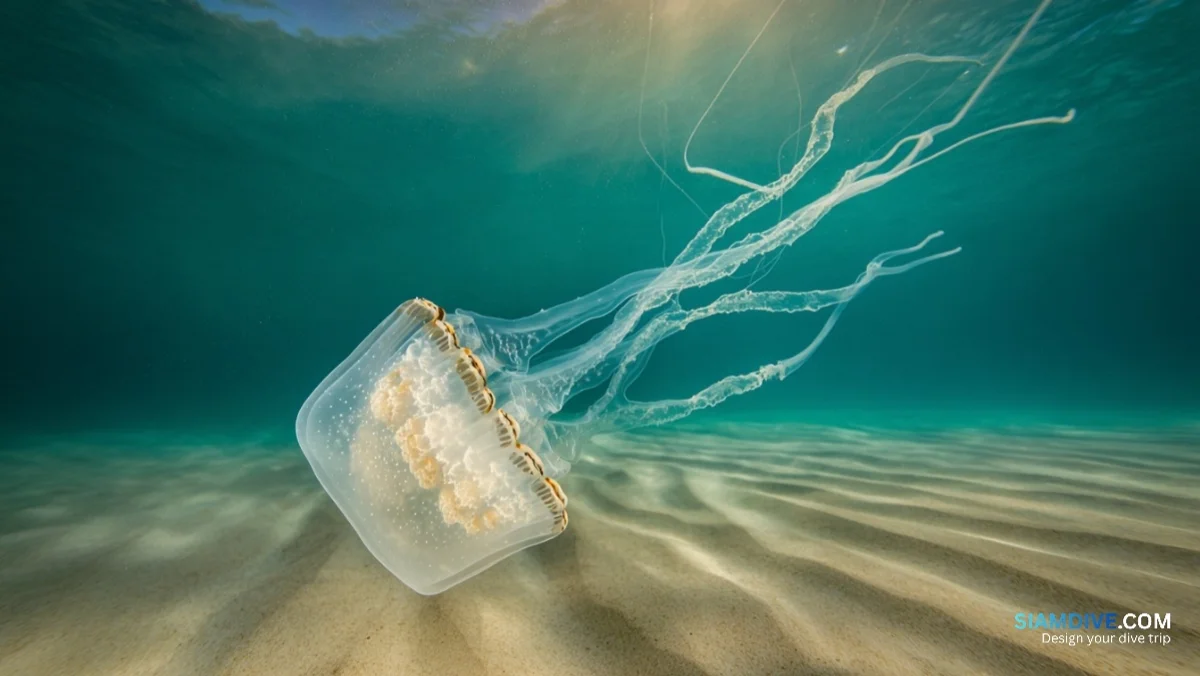
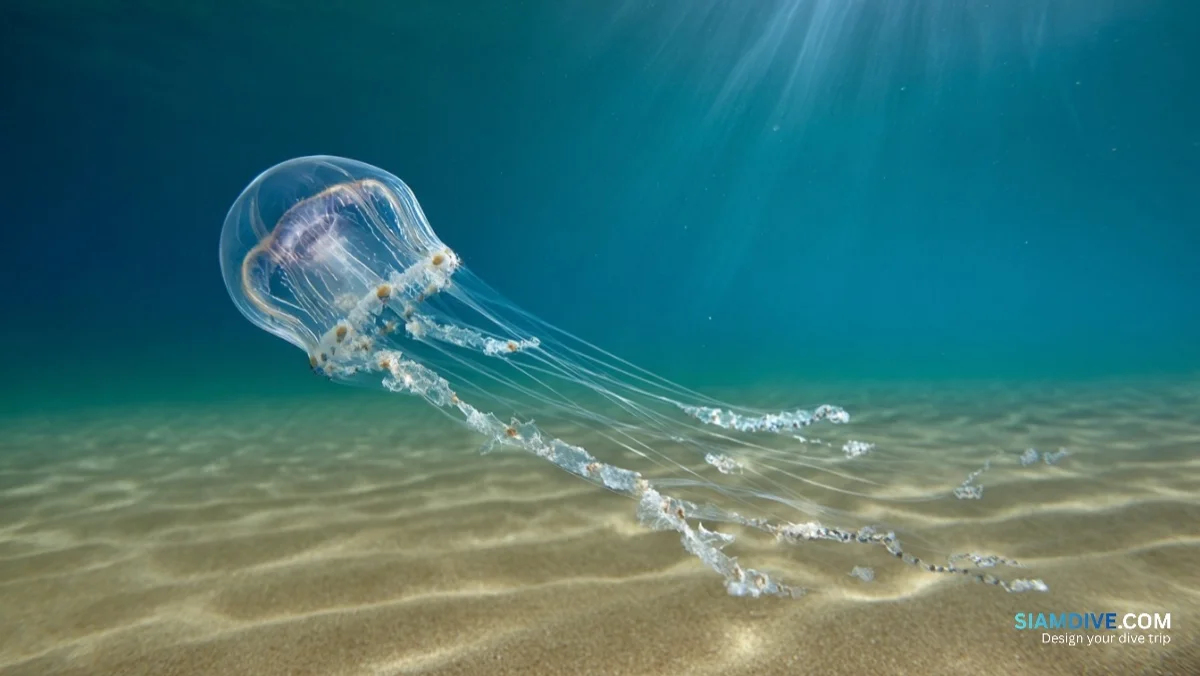
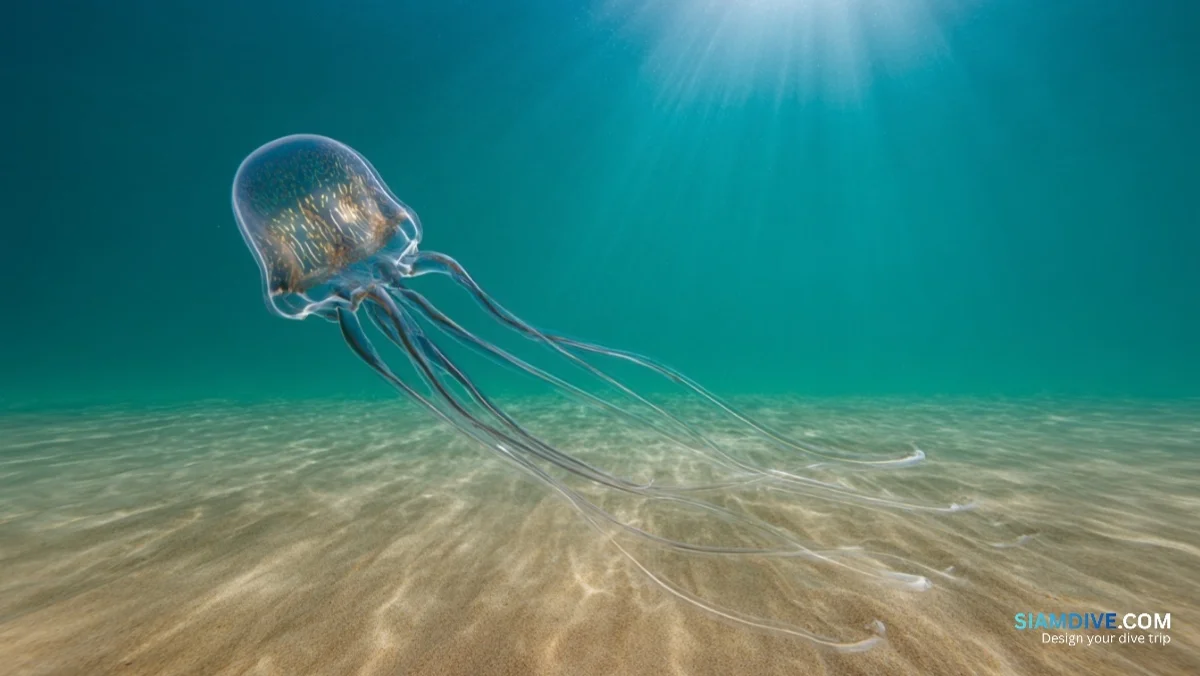
- Box jellyfish (Chironex indrasaksajiae) — translucent cube-shaped bell up to 20 cm across, long ribbon-like tentacles. Gulf of Thailand, peak season July through October.
- Portuguese man-of-war (Physalia) — bright blue-purple gas bladder floating on the surface, trailing tentacles up to 10 metres. Both coasts, more common during monsoon transitions but reported year-round.
- Fire jellyfish (Morbakka fenneri) — small box-shaped bell roughly 5–8 cm, intense pain but rarely lethal. Primarily Andaman coast, peaking April and May.
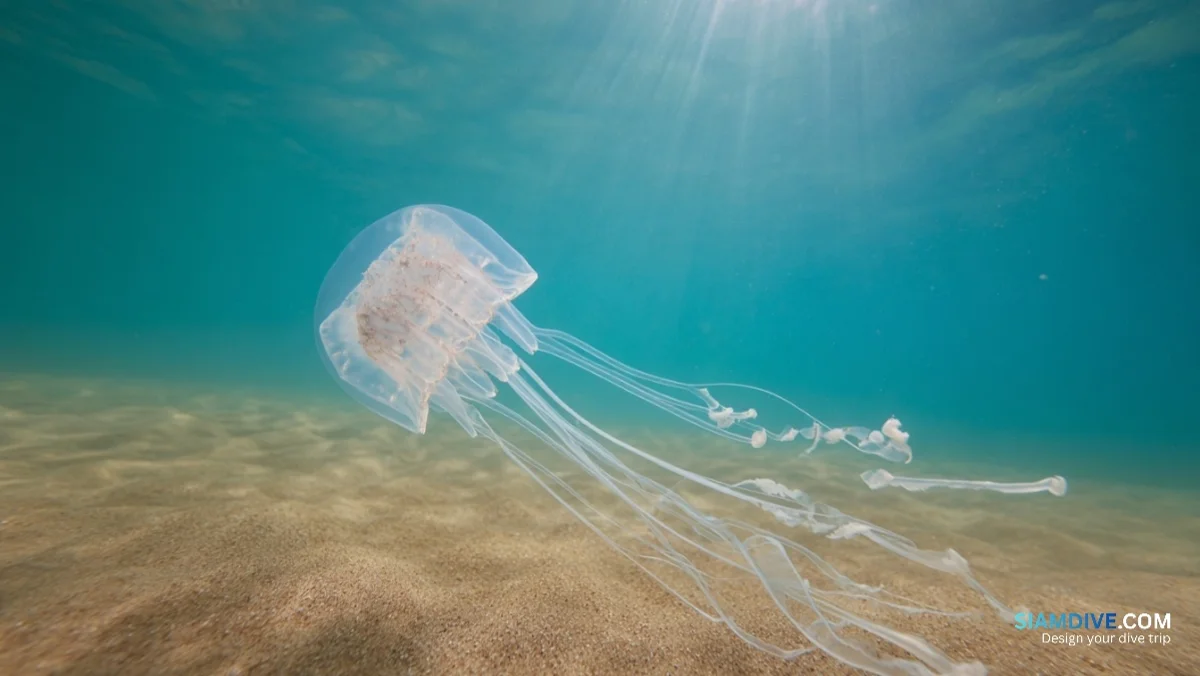
- Moon jellyfish (Aurelia aurita) — flat disc with four visible horseshoe-shaped gonads, translucent white or pale blue. Mild sting. Both coasts, year-round.
Box Jellyfish: Vinegar First, Heat Second, Seconds Count
Two to three minutes. That is the documented interval between a severe Chironex indrasaksajiae sting and potential cardiac arrest. The species — formally described in 2017 from Gulf of Thailand specimens — carries venom that clinical data from Thai hospitals suggests acts faster than its Australian relative, Chironex fleckeri. Surveys across 15 Gulf provinces documented more than 1,500 chirodropid individuals belonging to three species, with Surat Thani province — home to Koh Samui and Koh Pha-ngan — hosting the highest density.
The protocol is sequential and time-critical:
- Call 1669 (Thai emergency services) immediately. In suspected box jellyfish territory, the phone call goes out before anything else.
- Flood the sting site with household vinegar (4–6% acidity) for at least 30 seconds. Vinegar chemically prevents unfired nematocysts — the microscopic stinging capsules embedded in tentacle fragments still on the skin — from discharging additional venom.
- Remove tentacle fragments carefully. A credit card edge, plastic tweezers, or gloved fingers. Bare-handed removal presses nematocysts into the rescuer's skin.
- Immerse in hot water at 42–45 °C for 20 to 40 minutes. Test the temperature on an unstung hand first. A 2025 study in Military Medicine confirmed that vinegar followed by heat application "directly and irreversibly inhibited venom activity" — the heat denatures the proteins responsible for tissue damage and cardiac effects.
- Watch for systemic signs: difficulty breathing, chest tightness, irregular heartbeat, muscle spasms, nausea. Any of these means hospital transport, not beach-side care.
Between 1997 and 2015, researchers documented 15 severe Chironex cases on Koh Samui and Koh Pha-ngan alone, six of them fatal. Every recorded death occurred in shallow water — wading or swimming depth, not at the 10- or 20-metre marks where divers operate. The stings happened close to shore, often at dusk or after dark when the translucent bell becomes effectively invisible against the water.
The Blue Bubble That Isn't a Jellyfish
A bright blue bladder the size of a fist, riding the surface tension like a party balloon that drifted out to sea — until someone swims through the tentacle train trailing behind it. The Portuguese man-of-war is not a single animal but a colonial organism made of specialised polyps, and its treatment protocol diverges sharply from box jellyfish first aid.
The critical split: vinegar is not recommended for Physalia stings. While vinegar stabilises box jellyfish nematocysts, laboratory research indicates it can trigger further discharge from man-of-war stinging cells. A 2025 systematic review of jellyfish first aid found that treatment effectiveness varies substantially by species, with no single protocol safe across all cnidarians.
For man-of-war stings:
- Rinse with seawater only. Fresh water changes osmotic pressure across the nematocyst membrane and triggers mass discharge.
- Lift tentacles off with tweezers or a card edge. Same technique as box jellyfish — never bare-handed.
- Apply hot water at 42–45 °C for 20–40 minutes. Heat-based pain relief works across all stinging species regardless of whether vinegar is appropriate.
- Skip the ice. A 2024 review in Toxins found ice pack application caused more tissue damage than leaving the sting completely untreated.
Man-of-war wash ashore in higher numbers during monsoon transitions when onshore winds change direction. Phuket, Krabi, and Koh Lanta report stings most frequently between May and November, but beached specimens turn up year-round. The tentacles stay venomous for hours after the animal dies — a blue ribbon drying on the sand at a beach you just walked along is still a hazard worth stepping around.
Pain Without the Panic: Fire and Moon Jellyfish
Ankle-deep water, a sudden burn, and the instant thought: box jellyfish? In the vast majority of cases at Thai beach clinics, the answer is no.
Fire jellyfish (Morbakka fenneri) deliver a sting that matches the name. The burn arrives sharp and immediate, raises welts within minutes, and fades over two to six hours. These small box-shaped jellies appear mainly on the Andaman coast during April and May as the southwest monsoon transition begins. Treatment follows the hot-water protocol: immerse in 42–45 °C water for 20 minutes. Vinegar is considered safe for this species, but the primary pain relief comes from heat.
Moon jellyfish (Aurelia aurita) are the translucent discs that occasionally carpet shallow bays by the dozen. Their sting registers as a tingle, a light rash, or nothing at all. Rinse with seawater, apply a warm or cool compress based on comfort, and monitor for any unusual allergic response — rare, but possible in individuals with cnidarian sensitivity. Moon jellyfish generate the majority of sting reports at Thai beach clinics, and nearly all resolve without medical intervention.
Five Myths That Make Every Sting Worse
Bad advice moves at beach speed. Every item below has been tested in clinical or laboratory settings and found harmful or useless — regardless of species:
- Urine. Ammonia concentration in human urine is far too low to neutralise nematocysts. Depending on hydration, urine behaves like dilute fresh water and triggers additional venom release. DAN lists this specifically as a treatment to avoid.
- Fresh water. Osmotic shock causes embedded nematocysts to fire. Always seawater for initial rinsing — even when the nearest shower is three steps away.
- Scraping with sand. Rubbing pushes unfired nematocysts deeper into the dermis and mechanically activates them. A flat edge to lift tentacles works; abrasion does not.
- Ice or cold packs. Intuitive but counterproductive. Research showed cold application increased tissue damage compared to no treatment at all. Heat is the analgesic that also denatures venom; cold slows blood flow and traps toxins locally.
- Alcohol or spirits. Ethanol at the concentrations available on a beach triggers nematocyst discharge across multiple tested species. The whisky is for after the sting heals.
What Washed Ashore at Phuket This Month
The Andaman coast got a double reminder in April 2026. At Siam Bay on Racha Yai — a popular snorkelling stop for day-trip boats out of Chalong Pier — lifeguards counted 20 to 30 moon jellyfish drifting near the surface and washing up on the sand. Authorities posted warnings but classified the risk as low.
More telling was the report from Koh Aeo, a small island off Phuket's east coast, where fire jellyfish (Morbakka fenneri) appeared at roughly 100 individuals per square metre at snorkelling depth. April marks the start of the southwest monsoon transition, and Andaman fire jellyfish blooms reliably peak during this window. Operators in the area responded by stocking extra vinegar on boats and adding species-identification slides to their pre-water briefings.
The seasonal map is worth noting: the Gulf coast faces its highest box jellyfish risk from July through October, while the Andaman coast confronts fire jellyfish surges in April and May. Knowing which coast you are on — and which month — is the first layer of prevention before you touch the water.
What Goes in the Beach Bag
Lifeguard stations stock vinegar. Hotels in box jellyfish zones are supposed to keep it on hand. But "supposed to" and "within arm's reach the moment a tentacle wraps around an ankle" are two different realities. Five items fit in a zip-lock bag and cover every jellyfish scenario in Thai waters:
- 500 ml household vinegar (4–6% acidity) — for box jellyfish and fire jellyfish. Do not use on man-of-war. Label the bottle if travelling with non-divers who might grab it reflexively.
- Instant chemical hot pack (single-use) — activates in seconds, reaches 42–45 °C. Effective across all species when no hot tap water is available on the beach.
- Plastic tweezers or a flat card — for tentacle removal without skin contact.
- Antihistamine tablets (cetirizine or loratadine) — for localised swelling and itch once the acute phase passes.
- Laminated emergency card — 1669 (Thai ambulance) plus the nearest hospital name and number. In box jellyfish territory the call goes out before the vinegar bottle opens.
The same logic carries underwater. Whether the emergency is a regulator free-flow at depth or a tentacle across exposed skin, the correct response in the first seconds determines more than the best hospital 30 minutes away. Jellyfish nets now protect designated swimming zones at Chaweng and Lamai beaches on Koh Samui, installed by the Department of Marine and Coastal Resources — but they cover the swimming lanes, not the open water and not the reef zones where day boats and divers spend their time.
Sources
- DAN — Box Jellyfish: identification, treatment, and prevention
- BMC Research Notes — Severe box jellyfish cases on Koh Samui and Koh Pha-ngan
- Military Medicine (2025) — Evidence-based management of box jellyfish stings
- MDPI (2021) — Species-specific PCR identification of Chironex in Thailand
- TAT Newsroom — Jellyfish safety advice for tourists in Thailand