Safe Diving Techniques: 8 Skills That Prevent Accidents
6 เมษายน 2569
Master the 8 essential safe diving techniques every diver must know — from buoyancy control and air management to emergency ascents and SMB deployment.
Why Safe Diving Techniques Matter More Than You Think
Every year, DAN (Divers Alert Network) analyzes over 1,000 diving incidents worldwide, and the findings are consistent: the vast majority of accidents are preventable. Panic accounts for 30% of incidents, buddy separation for 22%, and rapid ascents for 18%. These are not equipment failures or freak accidents — they are technique failures. Whether you are a newly certified Open Water diver or a seasoned divemaster with hundreds of logs, complacency is the real danger underwater. This guide covers the eight core techniques that, when practiced deliberately, reduce your accident risk by up to 80%. These are not theoretical concepts — they are practical skills you should be executing on every single dive.
Buoyancy Control: The Foundation of Safe Diving
Poor buoyancy is the root cause of most diving problems. Uncontrolled descents lead to ear barotrauma. Uncontrolled ascents cause decompression sickness. Dragging along the bottom destroys coral and stirs up silt, reducing visibility to zero. Mastering buoyancy means mastering your safety.
- Get your weighting right: At the surface with an empty BCD and a normal breath, you should float at eye level. When you exhale, you should sink slowly. If you need to kick to stay down, you are overweighted. If you cannot descend, you are underweighted. Do a proper weight check at the start of every dive trip.
- Breathe to control depth: Your lungs are a natural buoyancy device. Inhale to rise slightly, exhale to sink. Stop using your inflator for small adjustments — use your breathing instead. This is the single biggest skill that separates good divers from beginners.
- Trim matters: Horizontal body position reduces drag, lowers air consumption, and gives you precise control. Tuck your knees slightly, keep your arms still, and let your fins do the work behind you.
Air Management: The Rule of Thirds
Running low on air is a leading cause of diving emergencies, contributing to 25% of all incidents according to DAN's 2025 analysis. The solution is simple but requires discipline: the Rule of Thirds. Use one-third of your air going out, one-third coming back, and keep one-third in reserve. On a standard 200-bar aluminum tank at 20 meters, this means turning the dive at roughly 130 bar — not 70 or 50.
- Check your gauge every 2-3 minutes: Make it a habit, not an afterthought. Some divers check only when they "feel" low, which is too late.
- Know your SAC rate: Surface Air Consumption rate tells you how fast you burn through air at a given depth. A relaxed diver at 20 meters uses 20-25 bar per minute. If yours is higher, focus on slowing your breathing and improving your trim.
- Communicate air levels: Signal your remaining air to your buddy at regular intervals. This is not optional — it is how you prevent out-of-air emergencies as a team.
Controlled Ascents: The 9-Meter Rule
Rapid ascents are responsible for 18% of diving accidents and are the primary cause of decompression sickness (DCS). The rule is straightforward: never ascend faster than 9 meters per minute. Most dive computers will alarm if you exceed this rate, but you should develop a feel for the correct speed without relying on technology. A useful reference is to ascend no faster than your smallest bubbles.
- Always do a safety stop: 3 minutes at 5 meters on every dive, no exceptions. This is your insurance policy against DCS. Even if your computer says you have plenty of no-decompression time remaining, the safety stop gives your body an extra margin to off-gas nitrogen.
- Dump air early on ascent: As you rise, the air in your BCD expands. If you do not vent it progressively, you will accelerate upward. Keep your left hand on the dump valve during every ascent.
- Never hold your breath: The most fundamental rule in scuba diving. Holding your breath during ascent can cause lung overexpansion injury, which can be fatal. Breathe continuously, especially when ascending.
Equalization: Gentle, Early, and Often
Ear barotrauma is the most common diving injury, and it is almost entirely preventable. The key is to equalize before you feel pressure, not after. Start equalizing at the surface before you even begin your descent, and continue every meter on the way down. The Valsalva maneuver — pinching your nose and gently blowing — works for most divers, but if it fails, try the Frenzel technique or jaw thrust.
- Never force it: If you cannot equalize, stop your descent. Ascend a meter or two and try again. Forcing equalization can rupture your eardrum.
- Descend feet-first: This keeps the Eustachian tubes in a favorable position for equalization. Head-first descents make equalization significantly harder.
- No diving with congestion: A cold, allergies, or sinus congestion makes equalization difficult or impossible. Using decongestants underwater is risky because they can wear off at depth, causing a reverse block on ascent.
Buddy System: Your Underwater Safety Net
Buddy separation is involved in 22% of diving incidents. A buddy is not just someone who happens to be in the water at the same time — they are your redundant air supply, your second pair of eyes, and your emergency responder. Staying within arm's reach is the standard, though 2-3 meters is acceptable in good visibility.
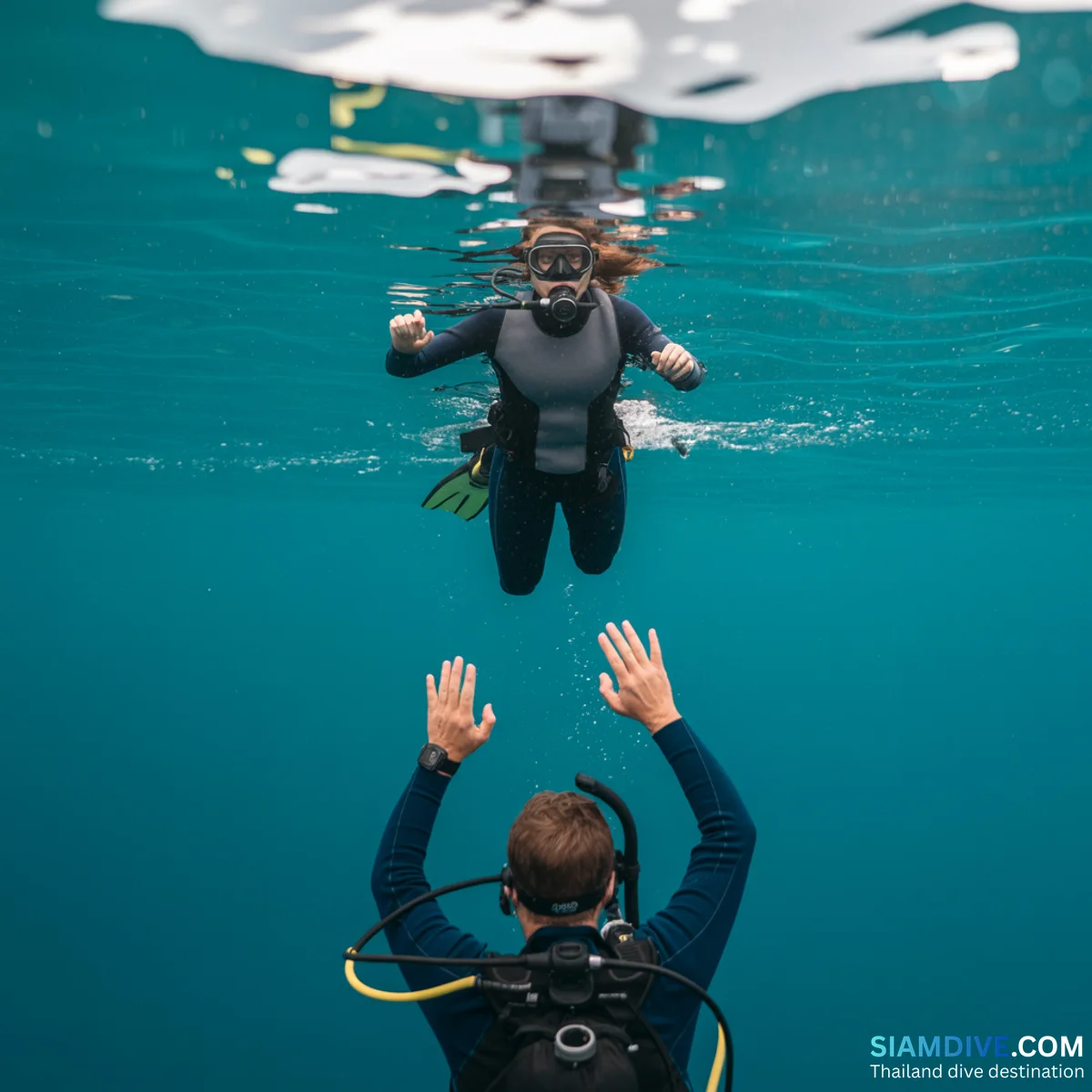
- Pre-dive briefing: Before every dive, agree on maximum depth, turn pressure, hand signals, and what to do if separated (search for one minute, then surface).
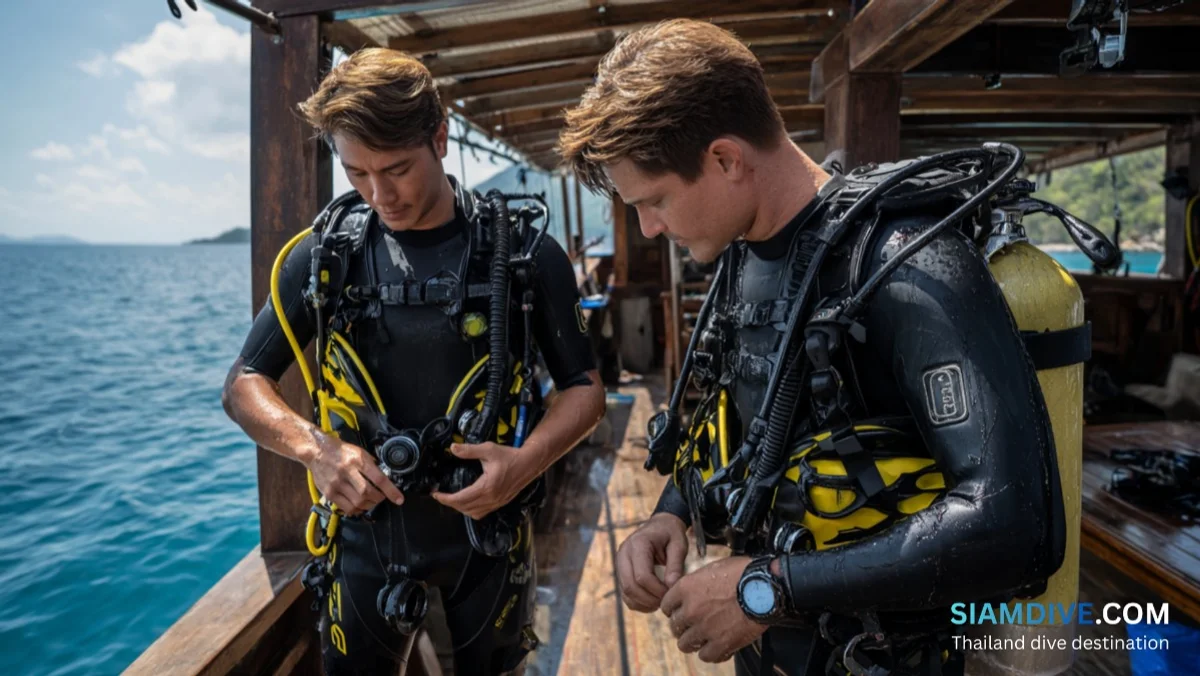
- BWRAF buddy check: BCD, Weights, Releases, Air, Final check. Do this before every single dive. It catches disconnected hoses, closed valves, and missing weights before they become underwater emergencies.
- Signal every 30 seconds: Regular OK signals confirm both divers are comfortable. Do not wait for your buddy to look distressed — check in proactively.
SMB Deployment: Making Yourself Visible
A Surface Marker Buoy (SMB) is not an advanced skill — it is a fundamental safety tool that every diver should carry and know how to deploy. Boat strikes on surfacing divers are a real risk, especially in areas with current or boat traffic. BSAC and RAID updated their guidelines in 2025 to mandate SMB training after several fatalities in European waters.
- When to deploy: At your safety stop (5 meters), or immediately if you are separated from the boat or caught in a current. In drift diving, deploy the SMB before ascending.
- How to deploy: Use a finger spool (not a reel with a handle — handles snag). Hold the spool with your thumb through the center, inflate the SMB with a small burst from your octopus, and let it rise while keeping the line taut. Control your buoyancy as the line pulls you — do not let it drag you up.
- Carry a whistle and mirror: An SMB makes you visible, but a whistle makes you audible and a signal mirror catches attention from kilometers away. These weigh nothing and can save your life.
Emergency Skills: Practice Before You Need Them
Emergency skills deteriorate if not practiced. DAN recommends refreshing these skills at least once a year, and ideally at the start of every dive trip:
- Controlled Emergency Swimming Ascent (CESA): A slow, continuous exhale ascent from depth in an out-of-air scenario. You learned this in Open Water — when was the last time you practiced it?
- Alternate air source breathing: Practice donating and receiving air with your buddy on the surface, then at depth. Fumbling with an octopus at 30 meters during a real emergency is not the time to learn.
- Mask clearing and removal: Water in your mask is not an emergency — unless panic makes it one. Practice flooding and clearing your mask until it is completely routine.
- Cramp release: Grab the tip of your fin and straighten your leg. Simple, but surprisingly hard to remember when pain hits mid-dive.
- Know your emergency contacts: DAN emergency hotline, nearest hyperbaric chamber, local coast guard. Have these saved in your phone before every trip.
Final Thoughts
Safe diving is not about being scared of the water — it is about being prepared for it. The eight techniques in this guide are not advanced skills reserved for technical divers. They are the fundamentals that every diver at every level should practice on every dive. The ocean is an incredible environment, but it does not forgive complacency. Master your buoyancy, manage your air, ascend slowly, equalize early, stay with your buddy, deploy your SMB, and keep your emergency skills sharp. Do these consistently, and you will be a safer, more confident, and more enjoyable dive buddy for everyone around you. Find certified dive operators who prioritize safety training at siamdive.com.