Sea Turtles in Thailand: Species Guide for Scuba Divers
9 เมษายน 2569
Meet hawksbill, green, and olive ridley turtles at Koh Tao, Similan Islands, and more. Species ID, dive sites, conservation, and photo tips.
Sea turtles have been navigating the world's oceans for over 100 million years. They survived the asteroid that killed the dinosaurs. They've outlasted ice ages, continental shifts, and mass extinctions. And yet, today, every single species is classified as vulnerable, endangered, or critically endangered. Thailand's waters are home to several of these species, and for scuba divers, the chance to share a few minutes of underwater time with an animal this ancient is something that stays with you long after you surface.
This guide covers the turtle species you're most likely to encounter while diving in Thailand, the sites where encounters are most frequent, and the conservation efforts that keep these populations viable. It also covers the rules — because how you behave around sea turtles matters more than most divers realize.
Species You'll Find in Thai Waters
Three species account for the overwhelming majority of diver-turtle encounters in Thailand. Each has distinct physical characteristics, habitat preferences, and behavioral patterns.
Hawksbill Turtle (Eretmochelys imbricata)
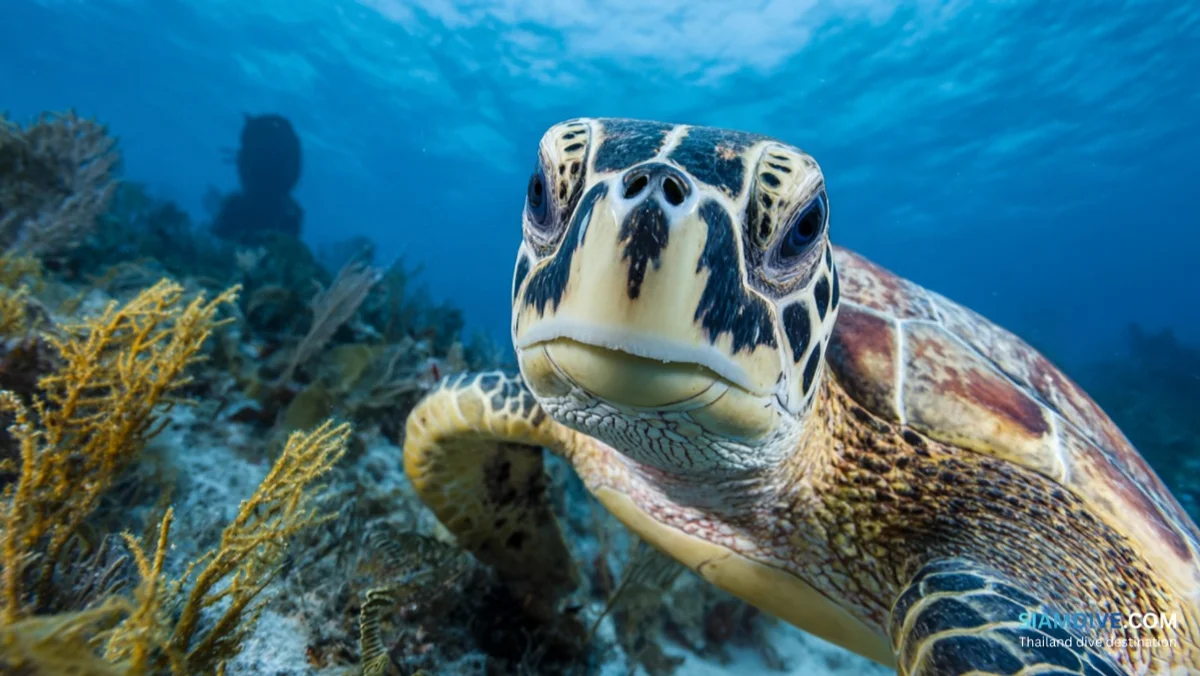
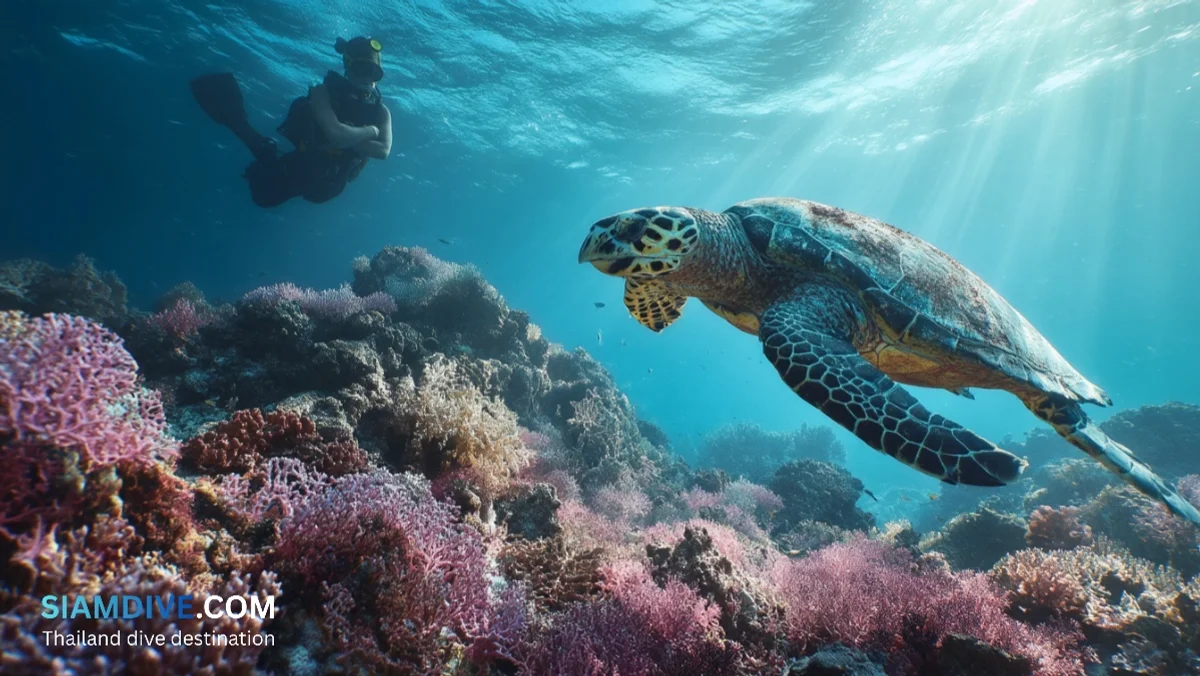
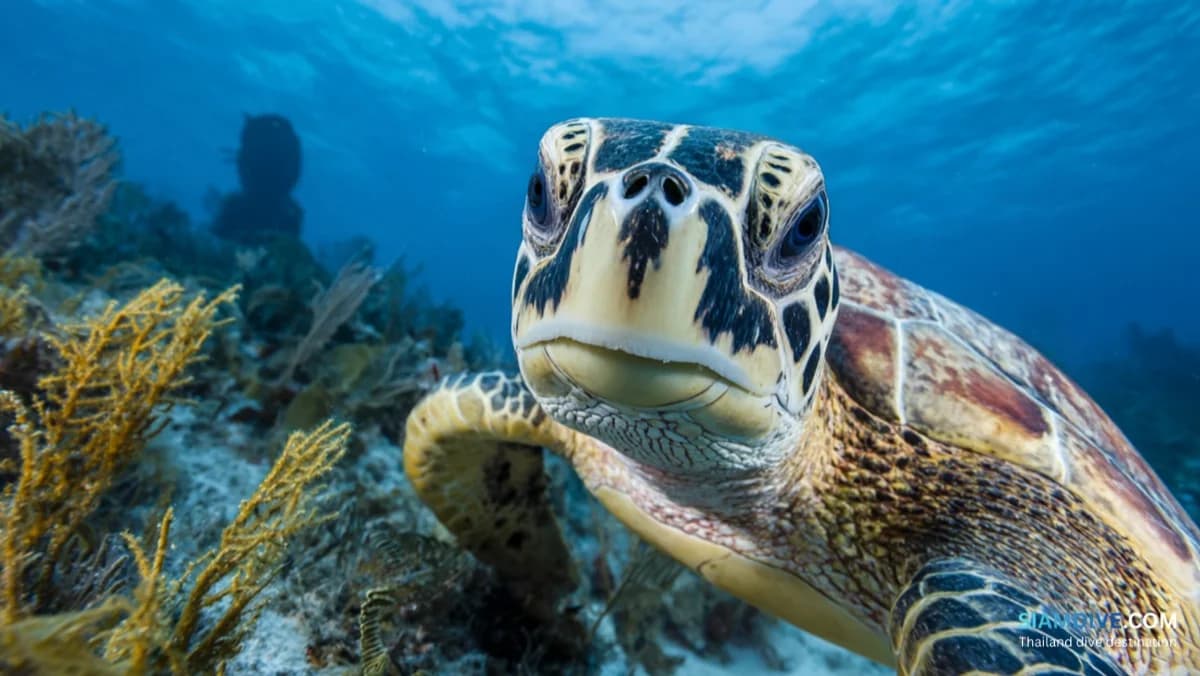
The hawksbill is the one you'll recognize immediately. Its narrow, pointed beak — shaped like a raptor's bill — is unmistakable. Hawksbills are coral reef specialists. They feed primarily on sponges, which makes them ecologically critical: by keeping sponge populations in check, they prevent sponges from outcompeting coral for reef space. An adult hawksbill typically measures 60-90 cm in carapace length and weighs 45-75 kg.
In Thai waters, hawksbills frequent the reef systems around Koh Tao, the Similan Islands, and the Surin Islands. They're not shy — a hawksbill feeding on a reef will often allow a patient diver to observe from 3-4 meters for several minutes. They're also the most photogenic of the three species, with their overlapping shell scutes creating a pattern that photographs beautifully against coral backgrounds.
Green Turtle (Chelonia mydas)
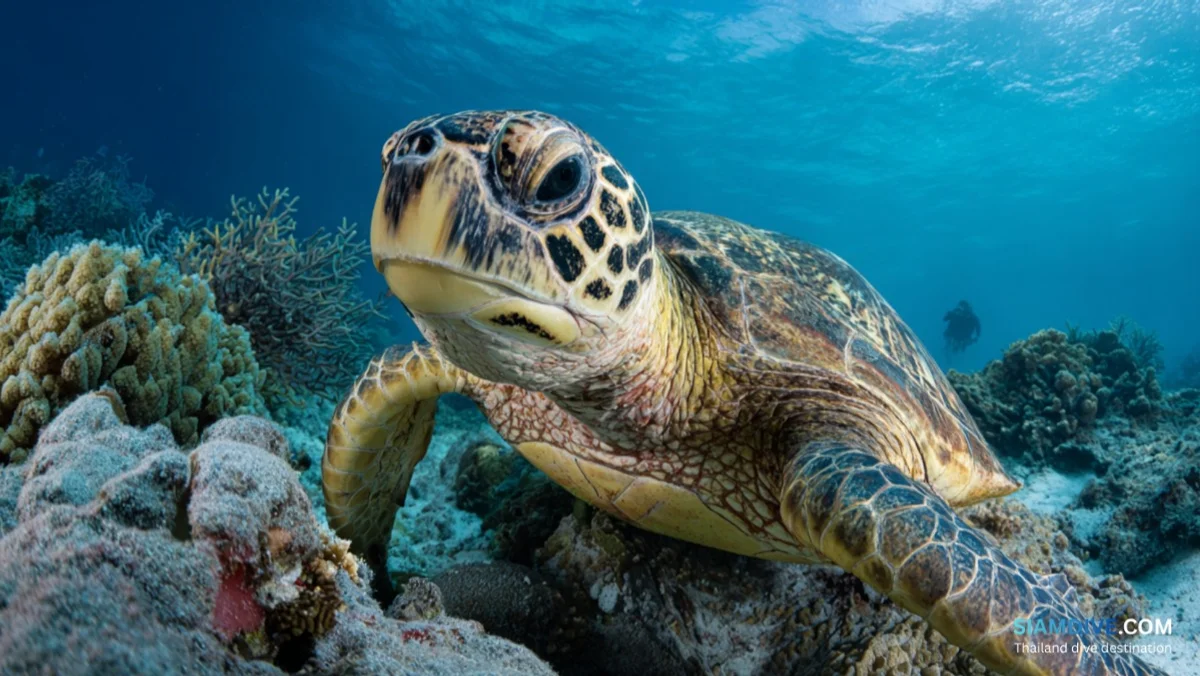
Green turtles are the gentle giants of Thai reefs. Adults can reach 120 cm carapace length and weigh over 150 kg. Despite the name, they're not always green — the name comes from the green color of their body fat, a result of their herbivorous diet. Adults feed almost exclusively on seagrass and algae, which means you'll often spot them grazing in shallow, sandy areas adjacent to reefs.
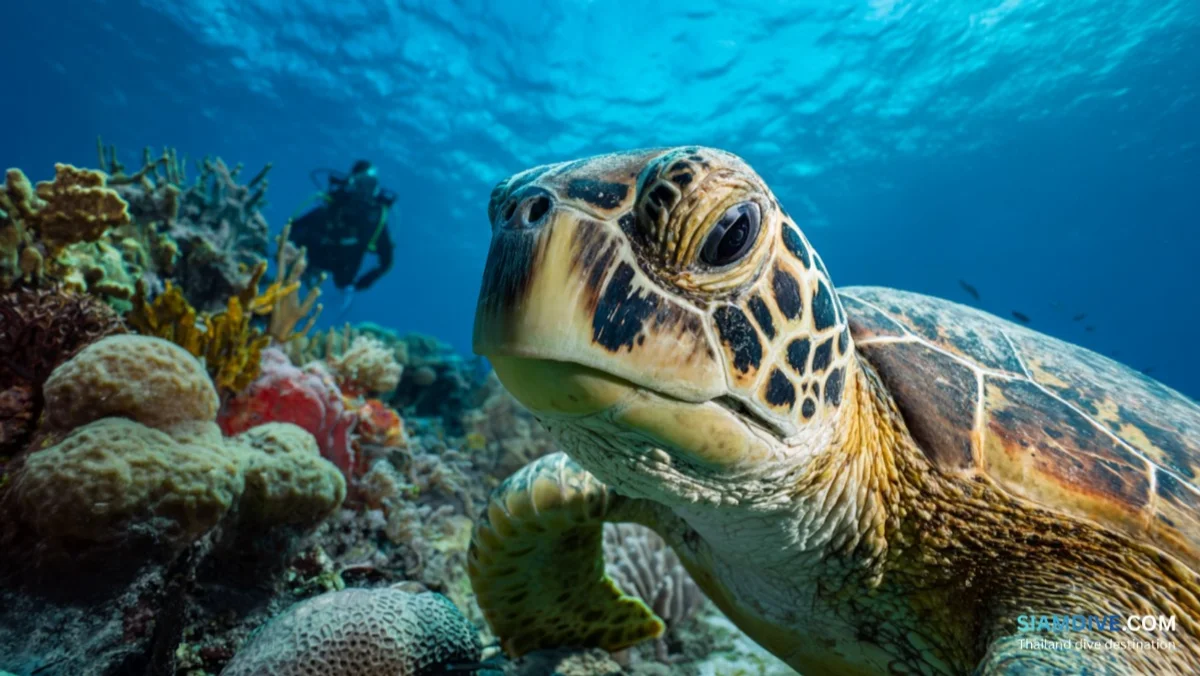
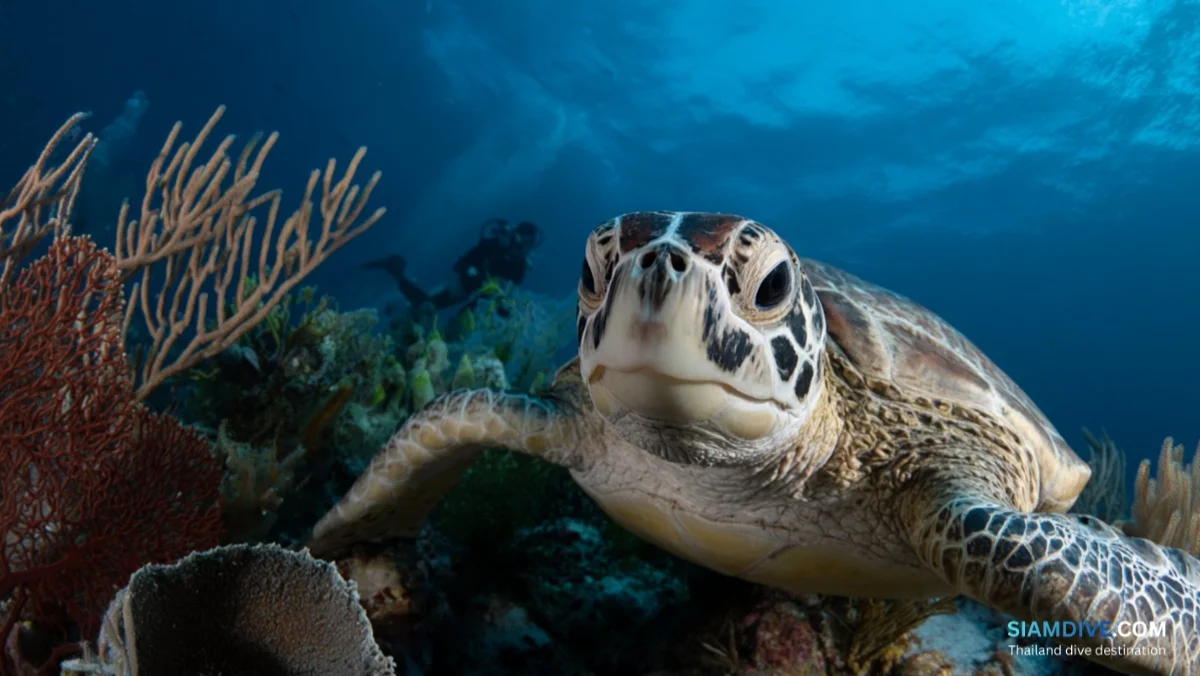
Koh Tao is ground zero for green turtle encounters in Thailand. The island's name literally translates to "Turtle Island," and it earned that name for a reason. Jansom Bay alone can deliver up to 3 turtle sightings in a single 40-minute snorkel session. Green turtles at Koh Tao are remarkably habituated to human presence — they'll glance at you and continue feeding, which gives photographers extended windows for composition.
Olive Ridley Turtle (Lepidochelys olivacea)
The olive ridley is the smallest of the three, with adults typically reaching 60-70 cm and weighing 35-45 kg. They're named for their olive-colored carapace. In Thailand, olive ridleys are primarily found along the Andaman coast, particularly around the Surin and Similan island groups. They're less commonly encountered by recreational divers compared to hawksbills and greens, mainly because they spend more time in open water rather than on reefs.
When you do see an olive ridley while diving, it's usually a transient sighting — the turtle passing through rather than resident on a reef. Their nesting sites along the Andaman coast are more significant from a conservation standpoint.
Best Dive Sites for Turtle Encounters
Thailand's turtle encounters are concentrated in specific areas where reef health, food availability, and protection status overlap.
Koh Tao — The Turtle Capital
Jansom Bay — This is the single most reliable spot for turtle encounters in all of Thailand. The bay's shallow reef, with depths from 2 to 8 meters, supports a resident population of green turtles that feed on the algae-covered rocks. Entry fee is approximately 200 baht. Up to 3 sightings in 40 minutes is not unusual here. The turtles are habituated and relaxed, making this an ideal location for beginners and photographers alike.
Sai Nuan Beach — The reef off Sai Nuan extends from shore in a gentle slope, and green turtles regularly cruise the sandy channels between coral patches. Morning dives tend to produce the best encounters, as turtles are more active during feeding hours.
Sai Daeng Beach — The southern tip of Koh Tao, Sai Daeng has a healthy reef that attracts both green and hawksbill turtles. The site has good coral coverage and the turtles here tend to rest in the same spots repeatedly, making them somewhat predictable.
Shark Island — Don't let the name mislead you. Shark Island is excellent for turtles. The rocky reef around the small island supports both species, and the currents bring nutrient-rich water that sustains the sponge populations hawksbills depend on.
Mango Bay — A protected bay on the north side of Koh Tao, Mango Bay's calm conditions and healthy reef make it a regular turtle haunt. Snorkeling here is productive too, with turtles often visible from the surface in water as shallow as 3 meters.
Tanote Bay — The large boulder formations at Tanote create overhangs where turtles rest during the day. Late afternoon dives catch turtles transitioning from rest to feeding, offering some of the most relaxed encounter conditions on the island.
Andaman Sea
Similan Islands — The national park status of the Similans provides a level of protection that directly benefits turtle populations. Both hawksbill and green turtles are regularly seen across multiple dive sites. The water clarity here — often exceeding 25 meters — makes for spectacular turtle photography.
Surin Islands — Less visited than the Similans, the Surins offer excellent turtle encounters in more pristine conditions. The marine park includes both healthy reef systems and seagrass beds, supporting all three species. Conservation patrols here are active and effective.
Nesting Season and Life Cycle
Sea turtles nest on beaches, not underwater, so divers rarely witness nesting behavior directly. But understanding the cycle adds depth to every underwater encounter.
In Thailand, nesting season runs from November through March, with peak activity in December through February. Female turtles return to the same beach where they hatched — a navigation feat that still isn't fully understood scientifically. They crawl ashore at night, dig a body pit and egg chamber, deposit 80-120 eggs, cover the nest, and return to the sea. The entire process takes 1-3 hours.
Incubation lasts 45-70 days, depending on sand temperature. Here's a detail that should concern every diver: the sex of hatchlings is determined by incubation temperature. Warmer sand produces more females. As global temperatures rise, sea turtle populations face a growing sex-ratio imbalance that threatens long-term viability.
Hatchlings emerge at night, orient toward the brightest horizon (historically the ocean reflecting moonlight), and scramble to the water. Artificial lighting from coastal development disorients them — they head inland instead of seaward, with fatal results. This is why beachfront lighting regulations near nesting sites exist, and why they matter.
A sea turtle that survives to adulthood — maybe 1 in 1,000 hatchlings — can live 50-80 years. Sexual maturity arrives between 20 and 35 years of age. The animal you see resting on a reef at Koh Tao may have been born before you were.
Conservation Efforts in Thailand
Thailand's turtle conservation landscape is a mix of government protection, marine park enforcement, and community-driven programs.
Maya Bay (Koh Phi Phi Leh) — The famous beach, closed from 2018 to 2022 for ecosystem recovery, saw blacktip reef sharks return and sea turtles begin nesting again on the beach for the first time in years. The bay now operates under strict visitor caps and time limits. It's a case study in what happens when you actually give marine ecosystems space to recover.
Surin Islands — The marine national park conducts regular patrols and maintains turtle monitoring programs. Nesting beaches are off-limits during laying season, and park rangers collect data on nesting frequency, clutch sizes, and hatching success rates. This data feeds into national population assessments.
Tarutao National Park — In southern Thailand near the Malaysian border, Tarutao has some of the least disturbed nesting beaches in the country. The park runs a hatchery program for nests at risk from predators or tidal inundation, relocating eggs to protected enclosures where hatching success rates are significantly higher.
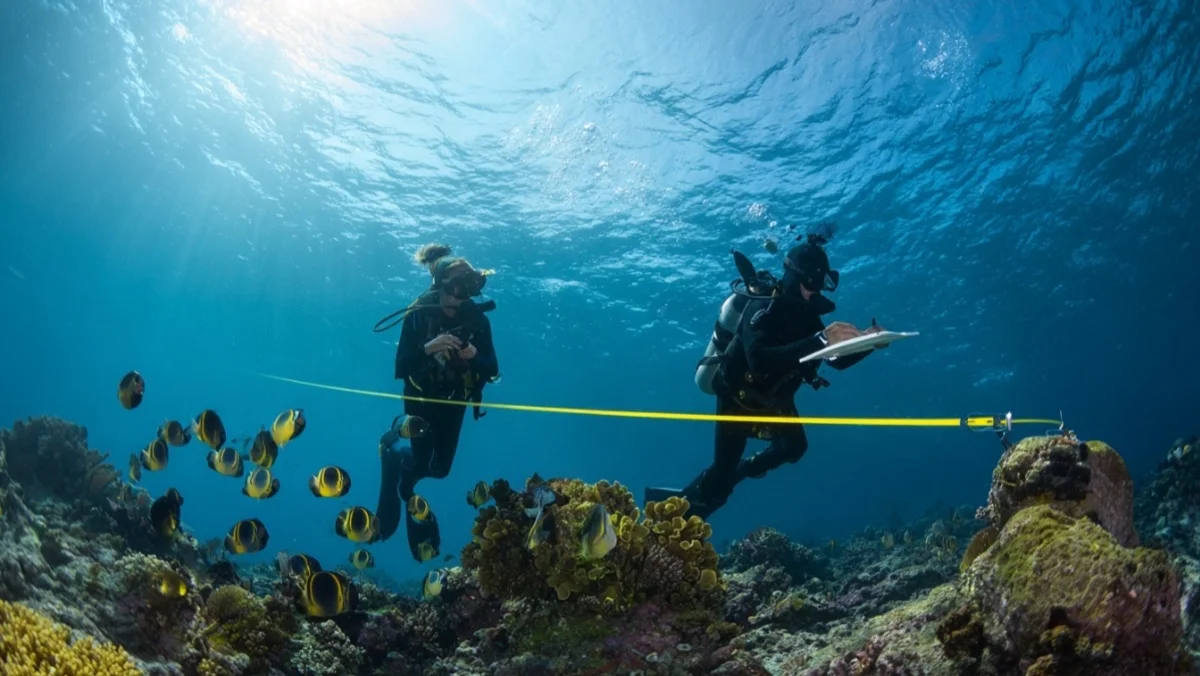
Koh Tao — Multiple dive shops and conservation organizations on the island run turtle identification programs. Divers photograph turtles they encounter, and the images are matched against a database of known individuals using facial scale patterns (each turtle's facial scales are unique, like a fingerprint). This citizen-science approach has built a population inventory that would be impossible through professional research alone.
The results are measurable. Protected areas with active enforcement show higher turtle densities, better reef health, and more successful nesting outcomes than unprotected areas. Conservation works when it's actually enforced.
Responsible Diving with Turtles: Rules That Matter
Sea turtles are air-breathing reptiles. They need to surface to breathe. A stressed turtle that feels trapped or pursued will burn through its oxygen reserves faster, which can lead to drowning in extreme cases. That alone should be reason enough to follow encounter guidelines, but there's more to it.
- Maintain 5 meters distance. Turtles that are approached too closely will stop feeding and swim away. You get a 3-second glimpse instead of a 10-minute observation. The math is simple: distance gives you more time.
- No flash photography. Strobes can disorient turtles and are especially harmful near nesting sites. Use natural light. Modern cameras with high ISO capability handle underwater ambient light better than most divers think.
- No chasing. If a turtle swims away, let it go. Following it just pushes it further away from its feeding or resting spot, adding stress and wasted energy.
- No riding. This should not need to be said in 2026, but social media still circulates images of people grabbing turtles. Riding a sea turtle is illegal in Thailand and can result in fines and imprisonment. Beyond legality, it's straightforward cruelty.
- Control your buoyancy. Hovering above a resting turtle is fine. Kicking up sand onto it because your buoyancy control is poor is not. If you can't maintain stable neutral buoyancy, you shouldn't be close to any marine life.
- Respect nesting areas. If you're on a beach during nesting season, avoid using flashlights or phone screens near the waterline after dark. Light pollution kills hatchlings. This isn't hyperbole.
Photography Tips for Turtle Encounters
Turtle photography rewards patience over aggression. The best shots come from divers who wait for the turtle to come to them, not the other way around.
Lens choice: A wide-angle setup in the 10-24mm range is ideal. It lets you capture the turtle with its reef environment, telling a richer visual story than a tight crop on the head alone. For compact cameras, the widest setting plus a wet wide-angle adapter works well.
Shutter speed: Use 1/500s or faster when the turtle is swimming. Turtles in motion — especially during the upstroke of their front flippers — create compelling action shots, but only if you freeze the movement. For resting turtles, 1/125s to 1/250s is sufficient.
Light: Natural light only. No strobe, no video light aimed at the eyes. Position yourself so that ambient sunlight illuminates the turtle's face. Shooting toward the surface with the turtle silhouetted against sunbeams is a classic composition that works consistently.
Approach technique: Descend to the turtle's level or slightly below. Shooting upward toward a turtle against the blue or the surface is far more dramatic than shooting downward. Move slowly. Avoid direct eye contact during your approach — turtles interpret a direct stare as threatening. Look slightly to the side, and the turtle is more likely to tolerate your presence.
Composition: Include the environment. A turtle resting on a coral head with reef stretching behind it tells a story. A turtle face filling the entire frame is just a portrait. Both have value, but the former communicates the animal's world in a way that drives conservation awareness.
Near nesting sites: Never photograph nesting turtles with flash. Red-filtered flashlights are permissible from a distance at some managed sites, but check regulations first. The hatchling emergence — tiny turtles scrambling toward the moonlit sea — is one of nature's most moving spectacles, but your desire for a photo should never take priority over the animals' survival.
Final Thoughts
Every turtle you see underwater in Thailand is a survivor. It beat 999-to-1 odds just reaching adulthood. It navigates thousands of kilometers of open ocean, returns to the exact beach of its birth to nest, and contributes to a reef ecosystem that millions of marine organisms depend on. The least we can do as divers is give it space, follow the rules, and support the conservation programs that protect it.
Find your next turtle dive at siamdive.com — explore Koh Tao operators, check Similan liveaboard schedules, and connect with conservation-focused dive centers across Thailand.