Where Giant Trevally Hunt in Koh Tachai's Strongest Current
23 เมษายน 2569
Koh Tachai Pinnacle sits in open blue between Similan and Surin, swept by currents that draw giant trevally, barracuda, and seasonal mantas to its granite dome.
A Granite Dome in Open Blue
Halfway between the Similan archipelago and the Surin Islands, a submerged granite dome rises from the sand at 35 metres to within 12 metres of the surface. No reef flat cushions the approach. No sheltered bay softens the sea state. There is only current, rock, and whatever swims through the gap — and at Koh Tachai Pinnacle, what swims through tends to be large, fast, and numerous.
Known locally as Twin Peaks, Koh Tachai Pinnacle sits roughly 500 metres south of Koh Tachai island, the northernmost point of the Mu Ko Similan National Park. The site has earned a reputation among Andaman Sea liveaboard regulars as the wildest ride in Thailand's premier marine park — a place where pelagic encounters rival those of Richelieu Rock and the current can change a dive plan in seconds.
Reading the Rock: Topography and Depth
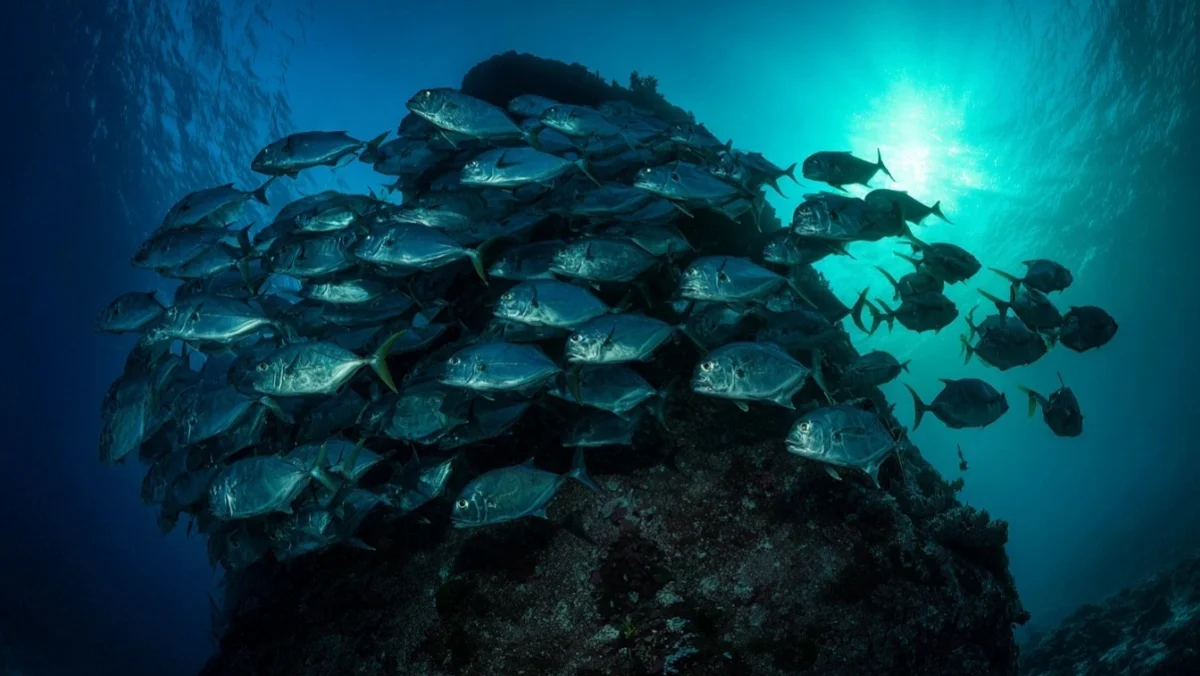
The main pinnacle is a single enormous granite boulder ringed by smaller satellite rocks. Its summit sits at roughly 12–14 metres, marked by a mooring buoy and descent line — a lifeline in every practical sense when the current runs hard. To the north, a second pinnacle tops out at around 18 metres, separated from the main dome by a sandy channel. A third cluster of boulders extends the ridge further north, creating a chain that runs approximately 200 metres.
- Summit depth: 12–14 m (main pinnacle)
- Northern pinnacle: 18 m top
- Sandy base: 30–35 m
- Maximum recorded depth: 40 m+ (eastern slope)
- Topography: granite dome with satellite boulders, swim-throughs, coral plateaus
- Mooring: single buoy on main pinnacle summit
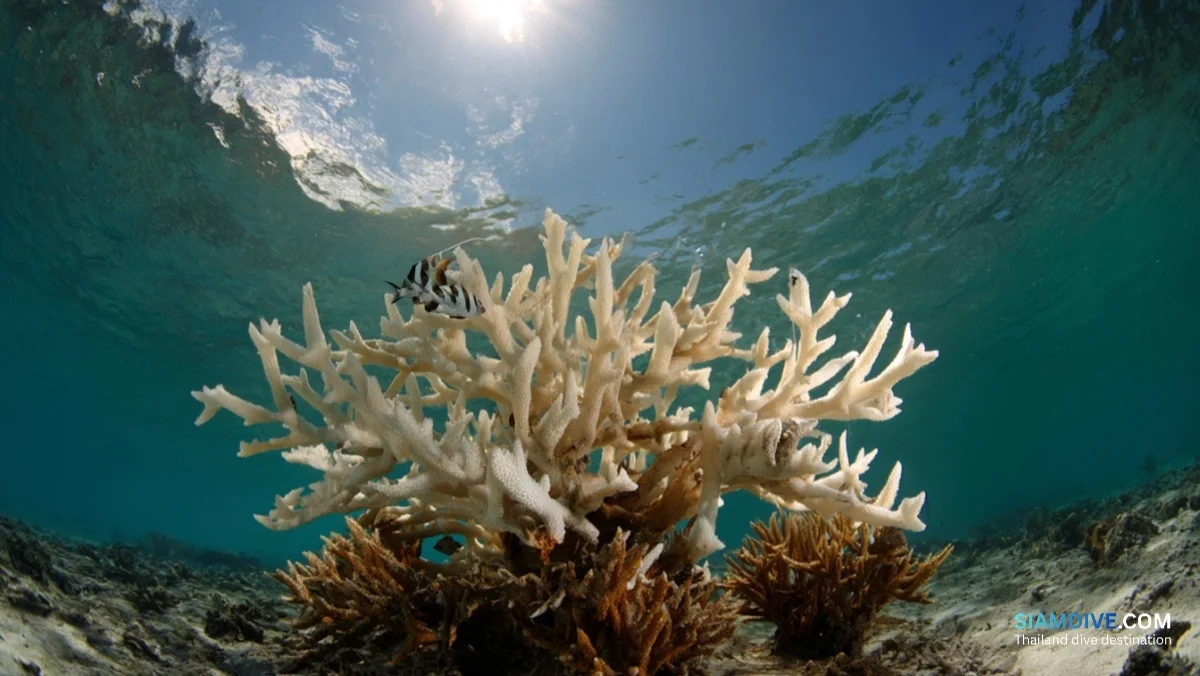
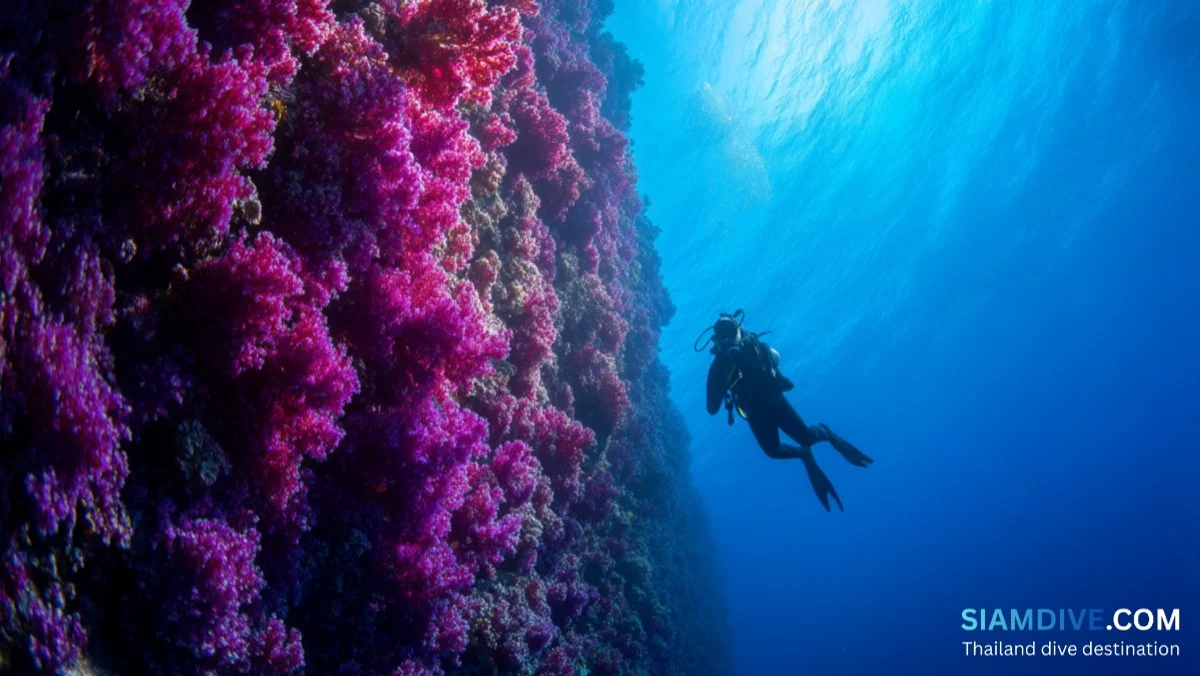
Between the boulders, channels and swim-throughs thread through the granite at various depths. Hard coral crusts much of the upper rock, while gorgonian sea fans and soft corals colonise the deeper overhangs facing into the prevailing current. The exposed position — open water on every side — means the site receives whatever the Andaman pushes through, which is exactly what makes it productive.
The Green Monster and What It Brings
A cold, nutrient-dense upwelling known among Thai dive guides as the "Green Monster" periodically sweeps through the northern Similans. When it hits Koh Tachai, visibility can drop from 30 metres to 10 in a matter of minutes, the water temperature falls several degrees, and the plankton bloom that follows triggers a feeding event visible from the surface. Baitfish cloud the upper pinnacle. Behind the baitfish come the hunters.
Even on standard current days, the flow at Koh Tachai is notably stronger than at sites like East of Eden or Christmas Point further south in the Similan chain. The pinnacle's isolation in open water means current has no reef structure to dissipate against before reaching the rock. Divers who have logged time at Koh Bon Pinnacle will find Koh Tachai a step up in intensity — same open-water exposure, but with less predictable flow direction.
Pelagic Traffic: What Shows Up and When
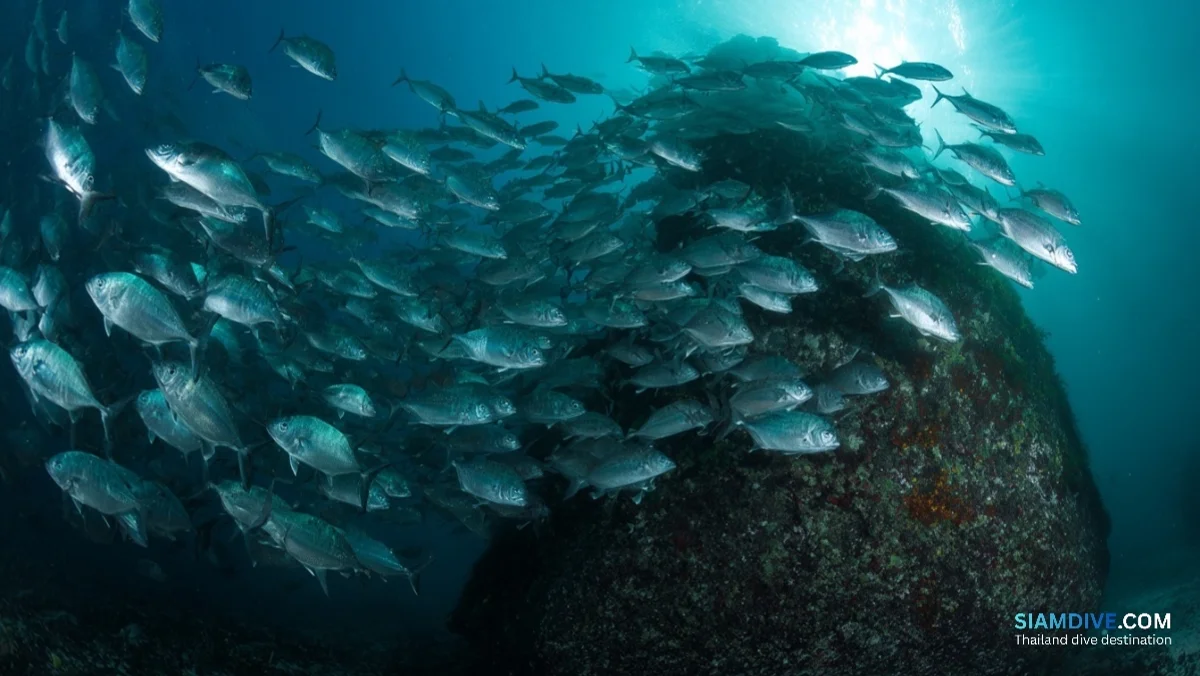
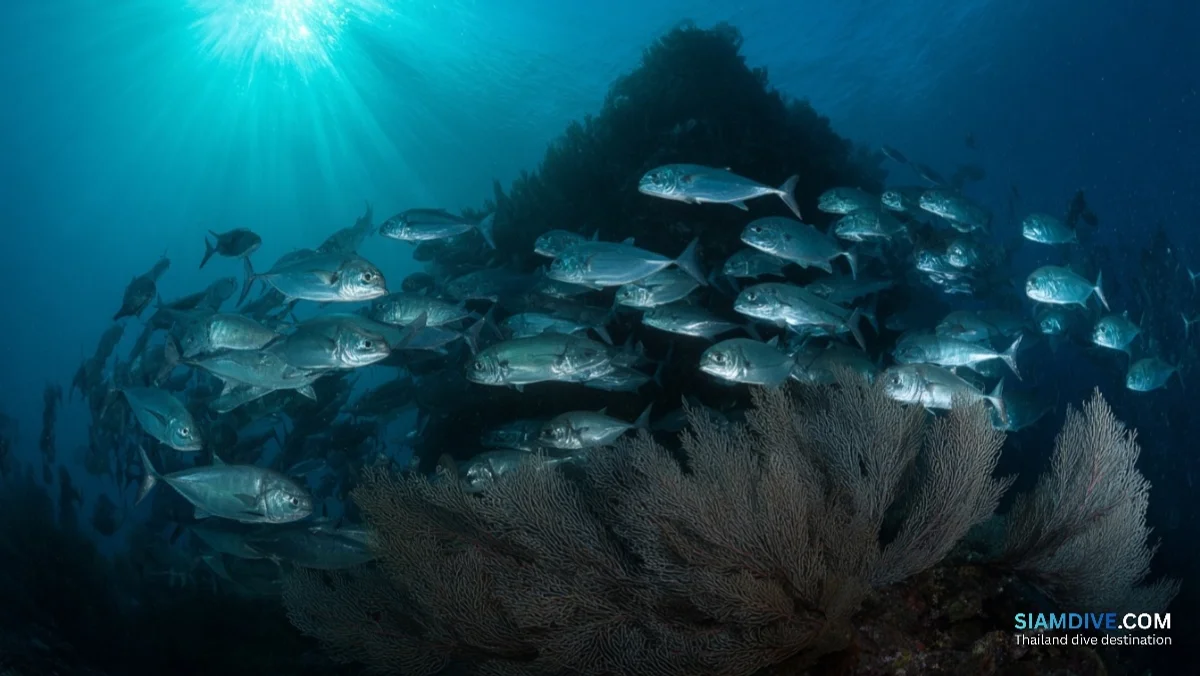
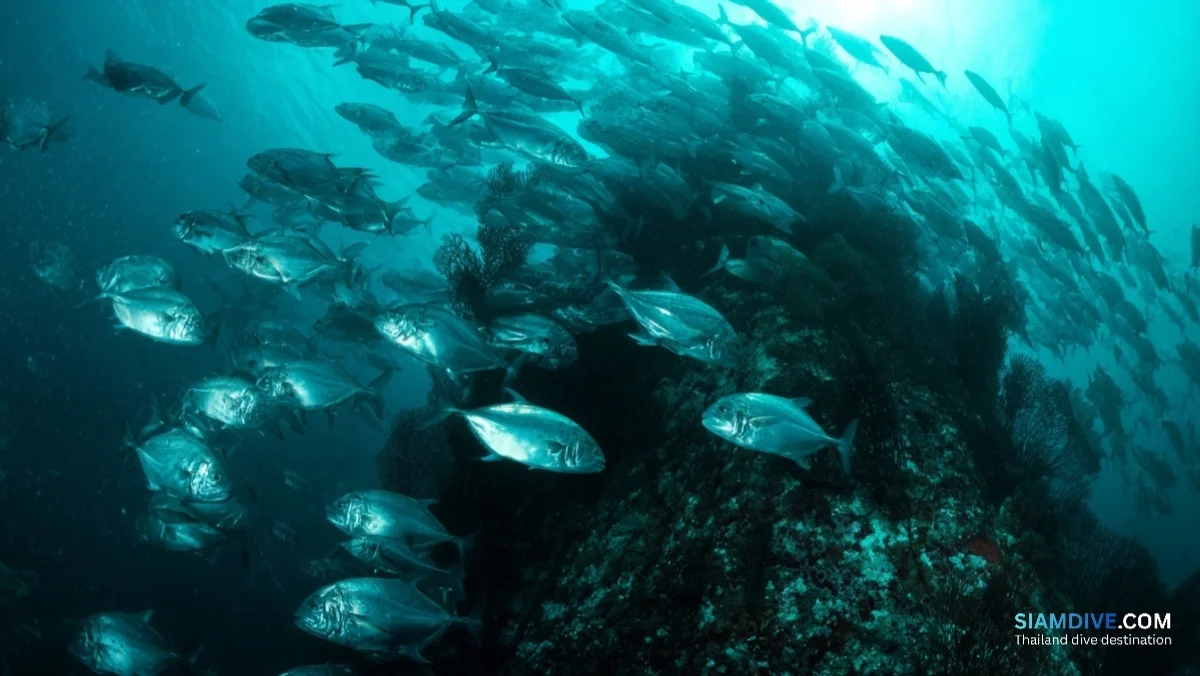
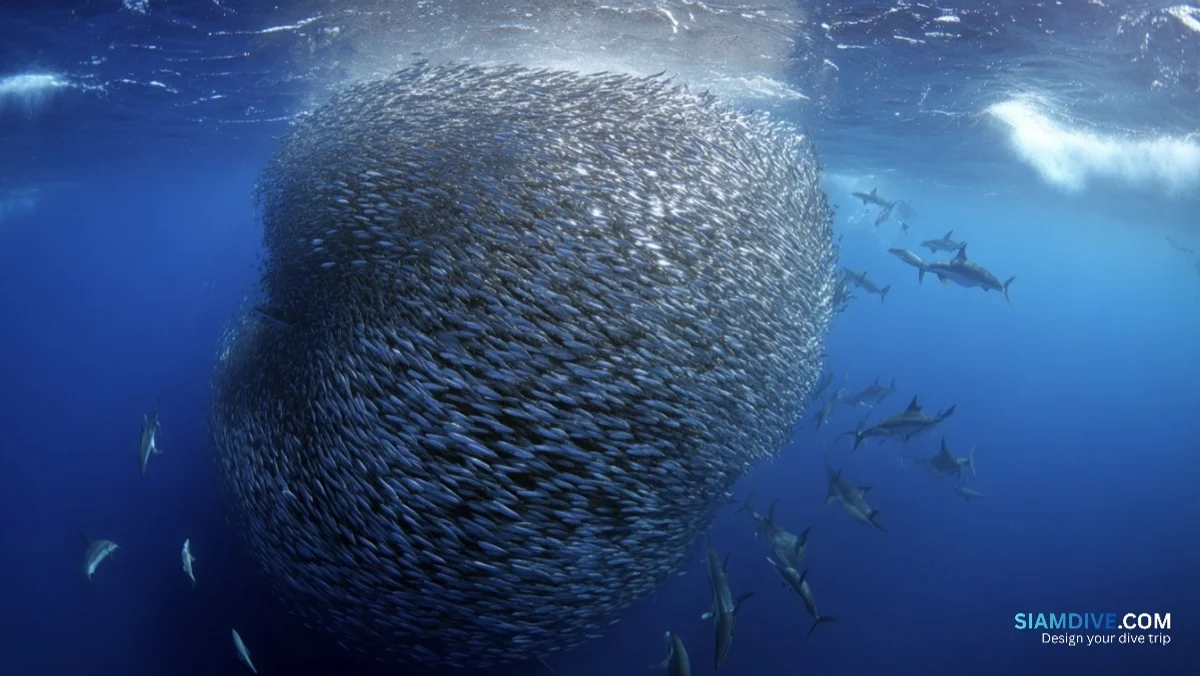
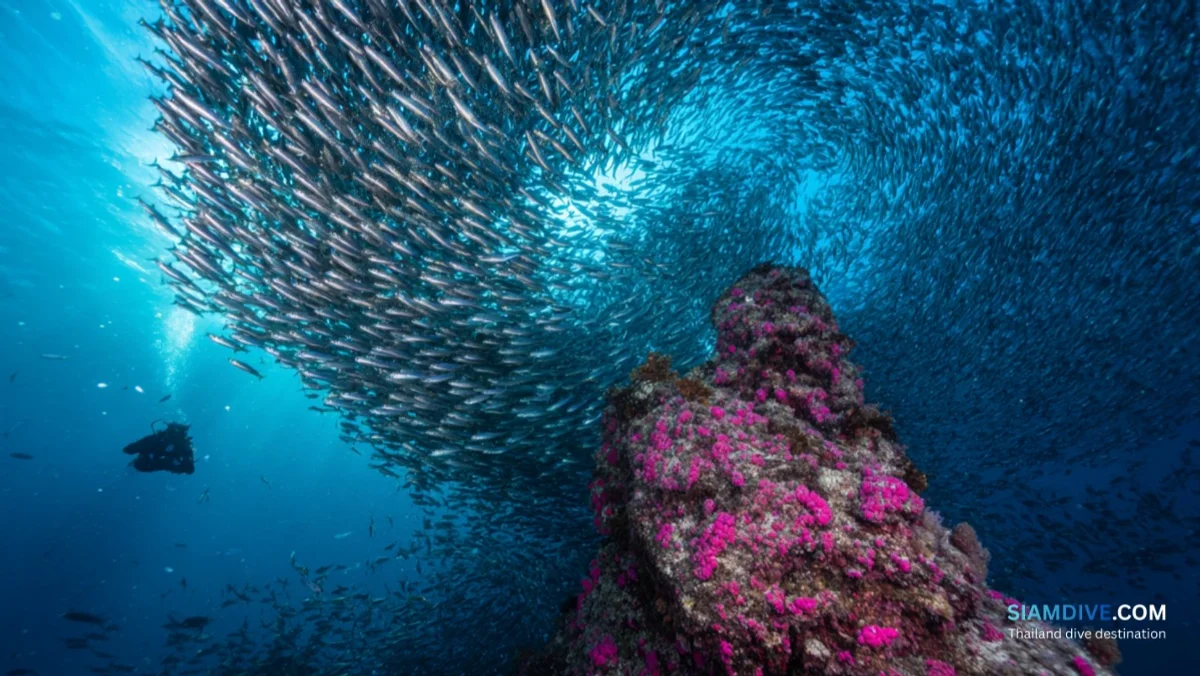
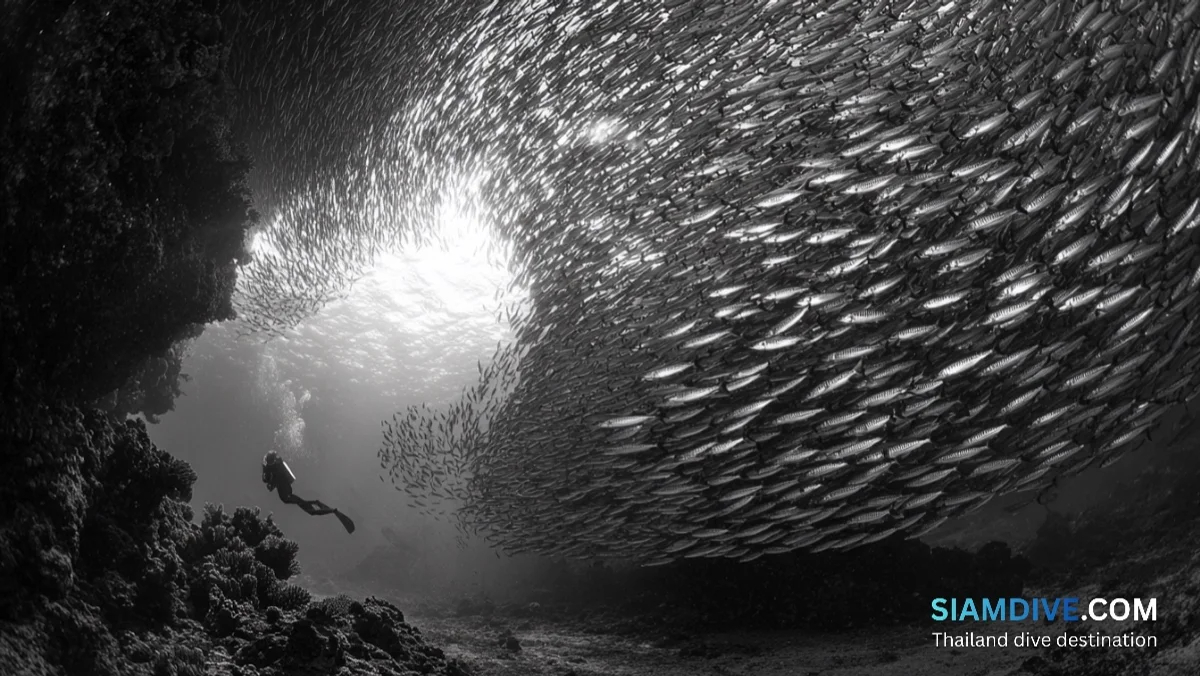
Giant trevally own this rock. Schools of 30 to 50 individuals patrol the upcurrent side of the main dome, their silver flanks catching light as they turn in unison. Bluefin trevally, dogtooth tuna, and rainbow runners share the water column, often working baitballs against the pinnacle's eastern face. A resident school of chevron barracuda — sometimes numbering in the hundreds — spirals above the northern pinnacle in a slow vortex that has become one of the site's signature images.
- Year-round residents: giant trevally, bluefin trevally, chevron barracuda, dogtooth tuna, rainbow runners, batfish
- Seasonal visitors (Jan–May): oceanic manta rays, whale sharks
- Reef species: moray eels, lionfish, scorpionfish, kuhl's stingray on sand patches
- Occasional sightings: blacktip reef sharks, leopard sharks, banded sea kraits
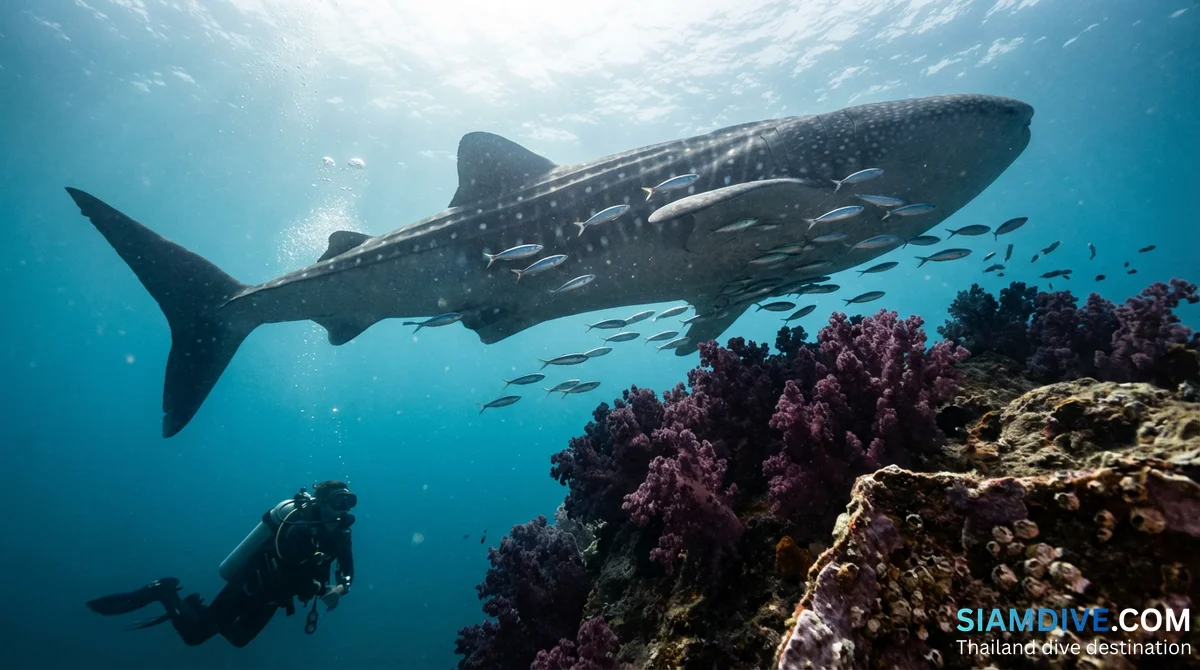
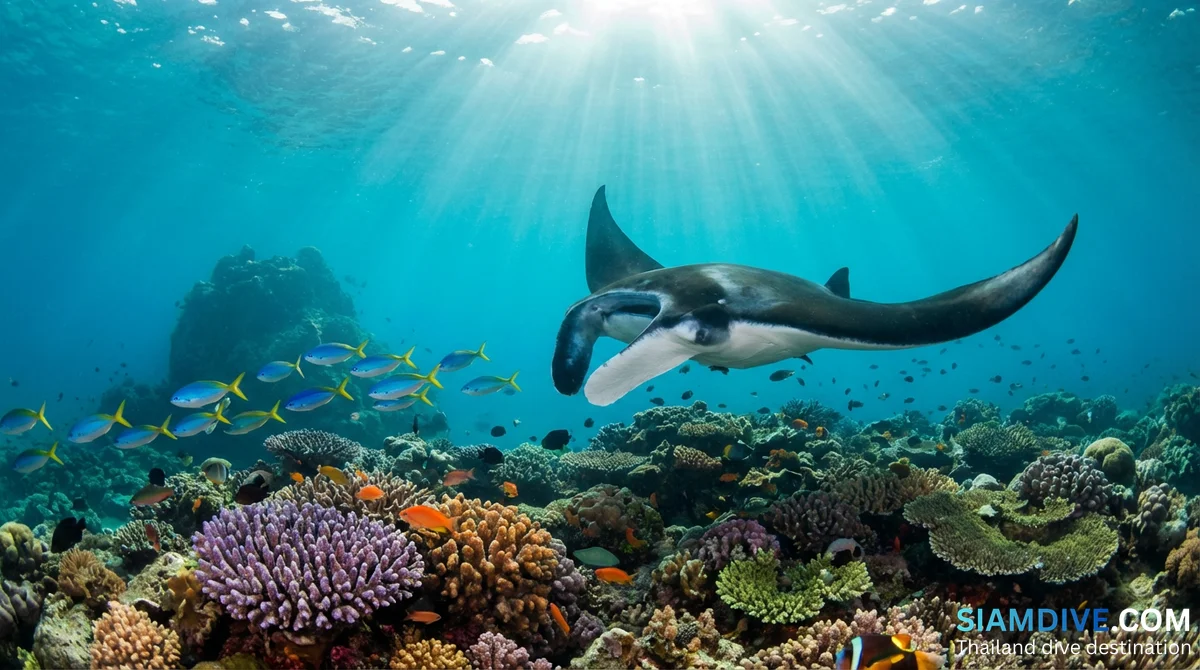
Manta ray sightings at Koh Tachai tend to cluster between January and May, with peak probability in February and March — mirroring the pattern at nearby Koh Bon. The 2024–2025 season saw an increase in manta encounters across both sites, according to aggregated reports from Khao Lak-based liveaboard operators. Whale sharks appear less frequently than at Richelieu Rock, but when one passes through, the combination of current-delivered plankton and clear granite backdrop makes for encounters that divers talk about for years.
Current Management: How to Dive Koh Tachai Safely
This is not a site where poor buoyancy goes unnoticed. The current at Koh Tachai can shift from manageable to fierce in under a minute, and the open-water setting means there is no shallow reef to hide behind. Experienced dive guides in the Similans typically recommend a minimum of Advanced Open Water certification and at least 30 logged dives before attempting the pinnacle.
Descent technique matters. Most guides brief a negative entry — giant stride, immediate descent along the mooring line to the summit. Hesitation on the surface risks a drift away from the pinnacle before reaching shelter behind the rock. Once on the dome, the standard approach is to stay low, use the lee side of boulders as current breaks, and let the rock do the work.
- Recommended certification: Advanced Open Water or equivalent
- Minimum experience: 30+ logged dives (many operators enforce this)
- Entry technique: negative entry, fast descent on mooring line
- Current strategy: stay low behind boulders, use rock as shield
- Reef hook: some guides allow use; check briefing policy
- Abort protocol: if swept off pinnacle, deploy SMB, ascend safely, wait for boat pickup
DAN's guidelines on current diving emphasise maintaining physical fitness and carrying adequate air reserves — both particularly relevant at Koh Tachai, where elevated breathing rates from current exposure can cut bottom time by 15 to 20 minutes compared to a sheltered reef dive. Nitrox is worth considering for any repetitive dives on the pinnacle during a multi-day liveaboard itinerary.
The Island Above: Closed Beaches, Open Water
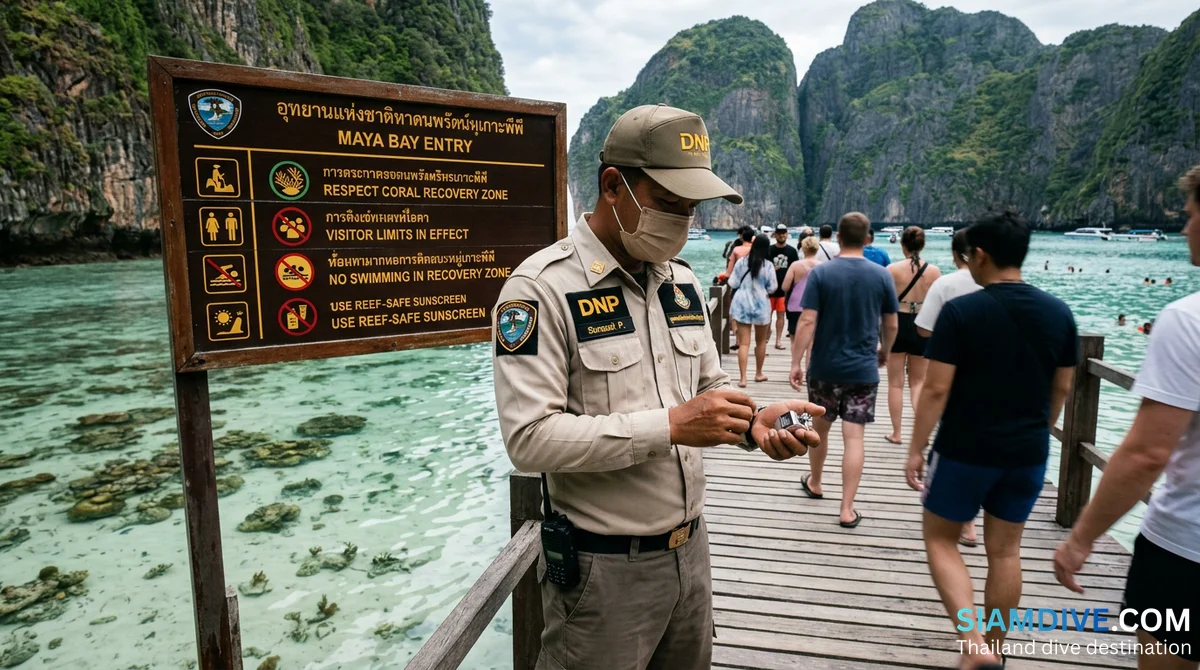
Koh Tachai island itself has been closed to all beach and shoreline access since May 2016. The Thai Department of Marine and Coastal Resources (DMCR) shut down the island after years of environmental damage from mass tourism — at peak, hundreds of speedboats delivered day-trippers daily, overwhelming the small island's fringing reef and white-sand beach. The closure remains indefinite.
Diving, however, was never restricted. The two deep-water sites off Koh Tachai — the Pinnacle to the south and the Plateau (also called The Dome) to the southeast — remain open to liveaboards and day boats operating under national park permits. The distinction matters: the damage that closed Koh Tachai was shoreline erosion and reef trampling, not diver impact on the deeper pinnacle sites.
For the 2025–2026 season, the Similan National Park season runs from October 15 to May 15. The current foreign visitor entry fee is 400 THB, with liveaboard divers paying a separate marine park fee of approximately 2,300 THB for the duration of the safari.
Planning the Dive: Timing, Access, and Conditions
Koh Tachai sits roughly 70 kilometres northwest of Thap Lamu Pier in Khao Lak — too far for most standard day trips, which typically cover the main Similan group (Islands 1–9). The pinnacle is a staple of 4-day/3-night and longer liveaboard itineraries that combine the Similans with Koh Bon, Koh Tachai, and Richelieu Rock.
- Access: liveaboard from Khao Lak (4D/3N minimum itinerary recommended)
- Season: October 15 – May 15
- Best visibility: December – April (25–40 m typical)
- Water temperature: 28–30°C (can drop to 25°C during Green Monster upwelling)
- Park entry fee (foreigners): 400 THB
- Liveaboard marine park fee: ~2,300 THB
February and March tend to deliver the best combination of visibility, calm seas, and pelagic activity. The 2025–2026 season has seen water clarity often exceeding 30 metres during these months across the northern Similan sites, with sea conditions remaining diveable on most days. April can still produce excellent dives but brings increasing wind and occasional early-season swells from the southwest.
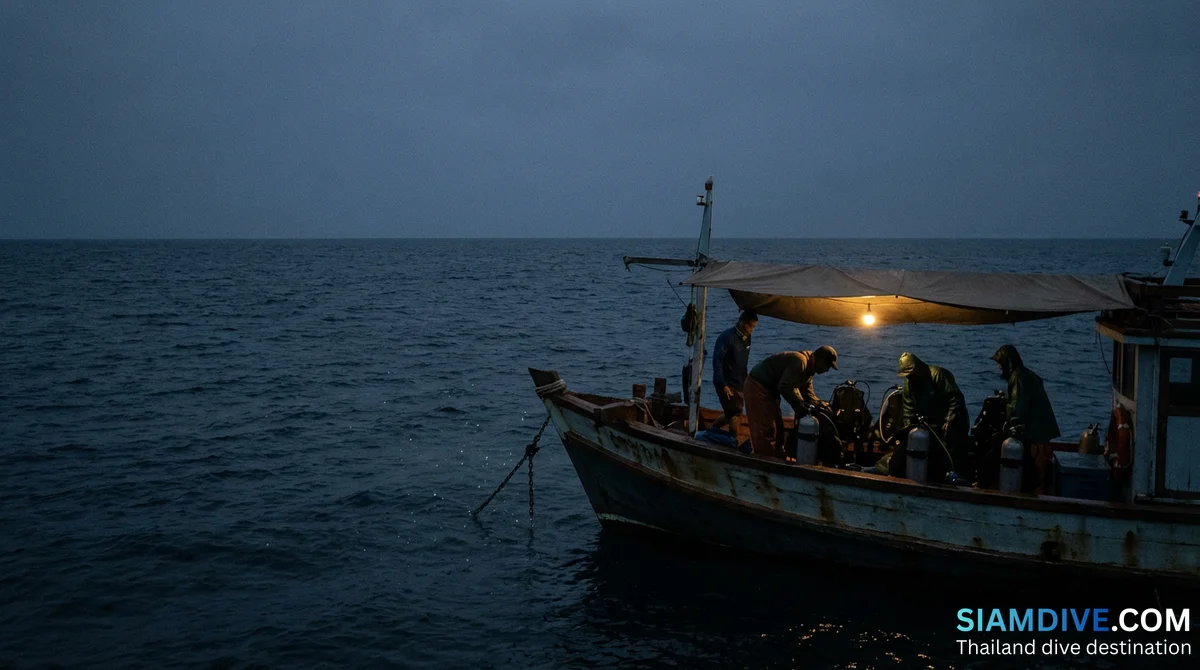
Most liveaboard operators schedule Koh Tachai for the morning, when current tends to be at its most predictable. Afternoon dives here are less common and generally reserved for days when conditions are unusually calm. A second dive at the nearby Koh Tachai Plateau — a more sheltered site with a broad coral terrace starting at 12 metres — often follows as a more relaxed alternative.
Where Koh Tachai Fits in a Similan Itinerary
The standard northern Similan liveaboard route runs south to north: Similan Islands 1–9 on the first day, Koh Bon on the second, Koh Tachai and Richelieu Rock on the third, then a return south with possible stops at Elephant Head or Hin Daeng depending on the operator's route.
Koh Tachai typically falls on day two or three of a safari, after divers have warmed up on gentler sites and guides have assessed the group's current-handling ability. A strong group may get two dives on the pinnacle; a mixed-experience group may get one pinnacle dive and one on the plateau. The guide's call on this is final, and for good reason — sending an under-experienced diver into full current at Koh Tachai creates risk for the entire group.
For divers building toward Koh Tachai, the progression through the Similan chain serves as a natural training ground. The moderate currents at East of Eden and Christmas Point in the central Similans provide a baseline. Koh Bon Pinnacle adds open-water exposure. Koh Tachai takes both elements and amplifies them. The payoff — a pinnacle teeming with pelagic life in quantities that few Andaman sites can match — is earned, not given.