Thailand Had 280 Dugongs — Now Fewer Than 100 Survive
2 พฤษภาคม 2569
Thailand's dugong count dropped from 280 to under 100 in three years. Seagrass collapse — not boats, not nets — is starving the Andaman's last herds.
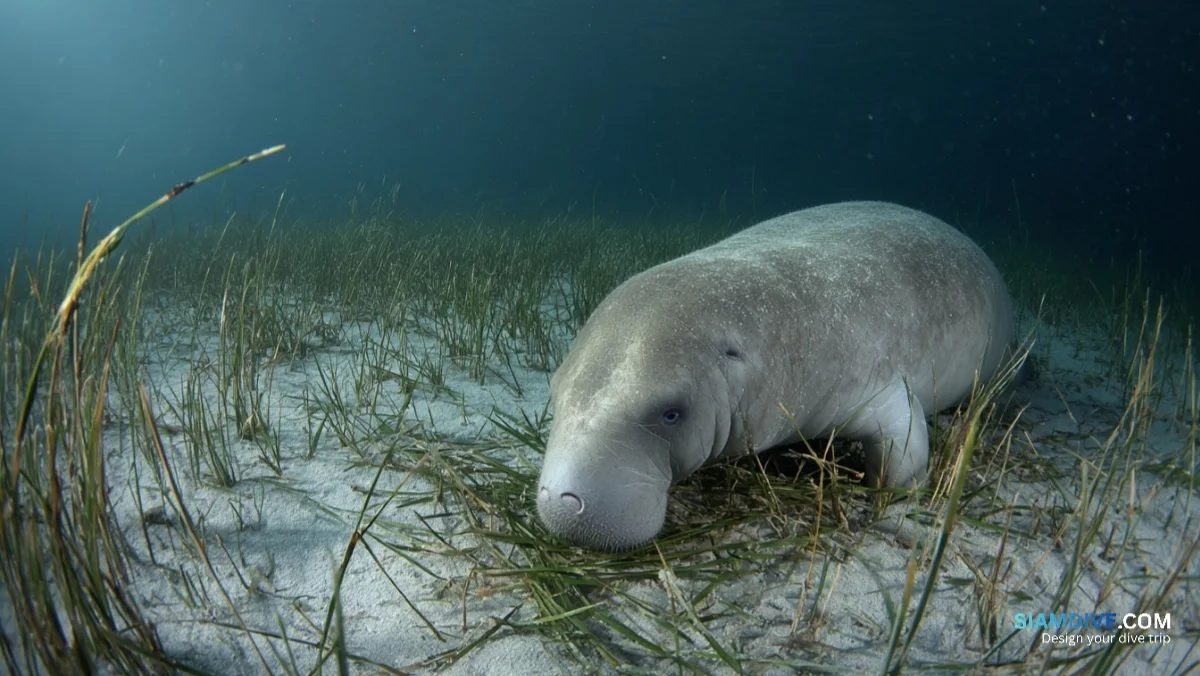
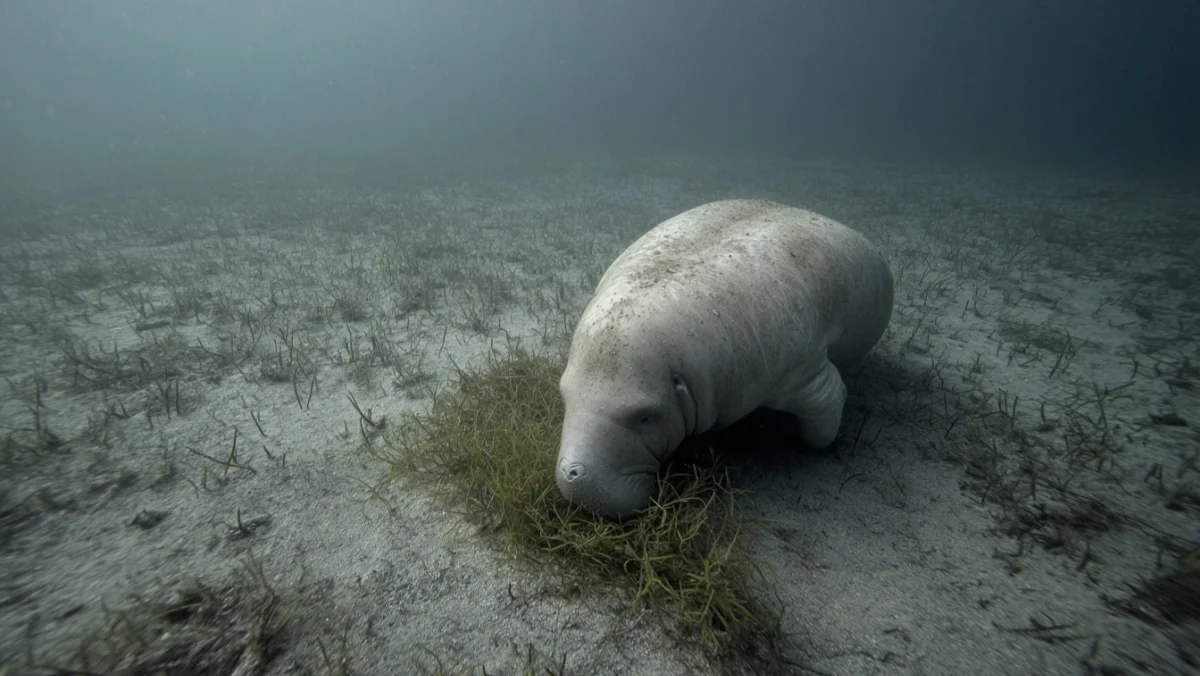
At first light off Libong Island, when the longtail engines have not yet started, a grey shape rolls at the surface and exhales — a sound somewhere between a sigh and a wet cough. Below it, the seafloor tells a different story. Where knee-high beds of Halophila ovalis once rippled with the tide, bare sand stretches to the edge of visibility. The dugong takes a breath and descends into what remains: a shrinking patch of green surrounded by nothing.
Thailand once counted 280 of these animals. The latest field estimates put the Andaman Sea population below 100. The drop happened in under five years, and the cause was not poaching, not boat strikes, not fishing nets — though all three play a part. The primary driver is simpler and harder to fix: the food disappeared.
The Count That Keeps Falling
A national aerial survey in 2017 logged 221 dugongs across both the Andaman Sea and the Gulf of Thailand. By 2022, the Department of Marine and Coastal Resources (DMCR) recorded approximately 280 — a number that briefly suggested recovery. Then the curve reversed. A subsequent DMCR survey returned 203 individuals: 187 in the Andaman, just 16 in the Gulf. That is a 27.5% decline in three years.
The trajectory has not stabilised. A March 2025 aerial pass over Phang Nga province spotted 30 dugongs across two sites — a snapshot, not a census, but the kind of number that makes field biologists recalibrate downward. By early 2026, Thai media and DMCR officials began using the phrase "fewer than one hundred" when discussing the Andaman population.
- 2017 national survey: 221 individuals (Andaman + Gulf)
- ~2022 peak estimate: approximately 280
- Latest DMCR count: 203 (187 Andaman, 16 Gulf) — 27.5% drop
- 2026 working estimate: fewer than 100 in the Andaman Sea
Dugongs are listed as Vulnerable on the IUCN Red List. Thailand's population, though small by global standards, represents one of the most significant herds remaining in Southeast Asia — and one of the few where long-term monitoring data exists.
A Meadow Stripped to 1%
Seagrass meadows do not collapse the way coral reefs bleach — in one visible, photogenic event. They thin out over months, blades shortening, gaps widening, until what was once a continuous undersea lawn becomes a patchwork of stubble and bare sediment. Between 2020 and 2024, seagrass cover at monitored sites along the Thai Andaman coast shrank by up to 70%.
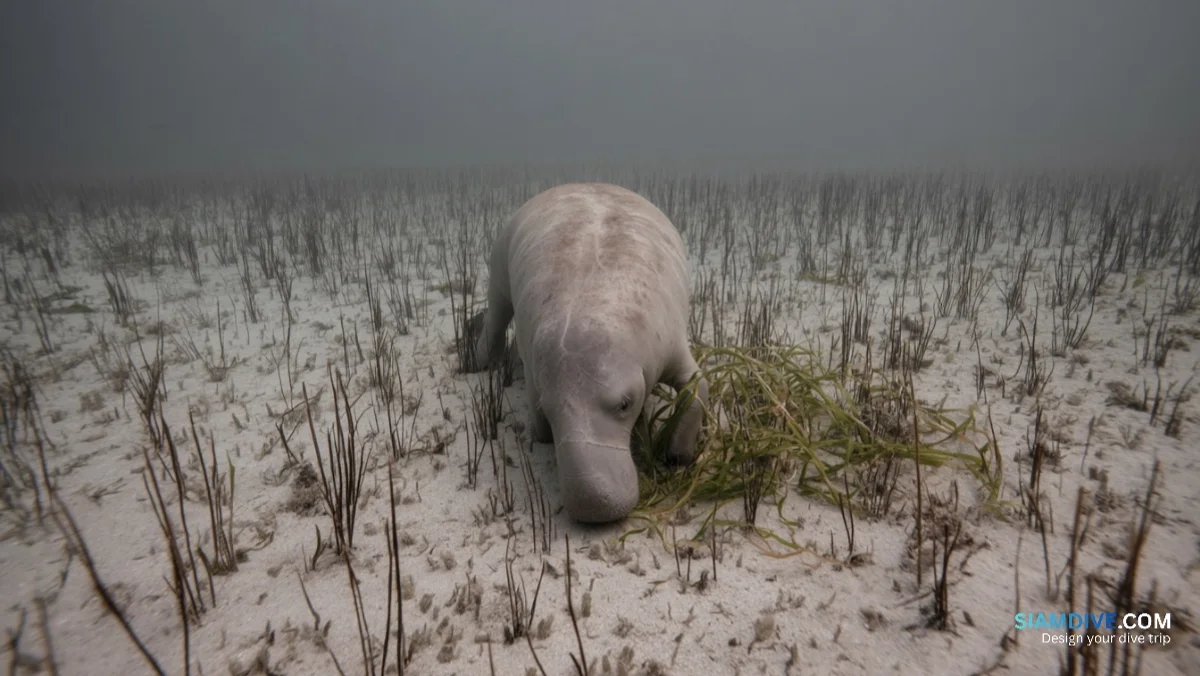
The starkest number comes from Ao Nammao Bay in Krabi. In the early 2020s, coverage there sat at roughly 60%. By 2024, surveys recorded 1%. Field researchers described meadows of blackened stubs where green blades had been — an underwater landscape that looked more like a burnt field than a marine habitat.
The causes stack. Dredging at river mouths increases silt loads that smother seagrass. Agricultural runoff feeds nutrient loading that triggers algal blooms, blocking the light seagrass needs to photosynthesise. Unusually low tides — increasingly common as weather patterns shift — expose entire beds to air and sun, killing them in hours. And dugongs themselves, grazing what little remains, accelerate the decline of their own food source. It is a feedback loop with no easy exit.
These meadows are not just dugong food. Seagrass beds serve as nurseries for commercially important fish, crabs, and shrimp. They sequester carbon at rates comparable to terrestrial forests — so-called Blue Carbon that, when the meadow dies, re-enters the water column. Across the Indo-Pacific, seagrass ecosystems support the livelihoods of up to one billion people through inshore fisheries.
42 Bodies a Year — And What Their Stomachs Said
Between 2019 and 2022, Thailand lost roughly 20 dugongs per year to all causes combined. In 2023, the number doubled. DMCR recorded an average of 42 fatalities per year across 2023 and 2024 — a rate of 3.75 deaths per month, two to three times the historical baseline. By April 9, 2025, another 12 carcasses had already been logged.
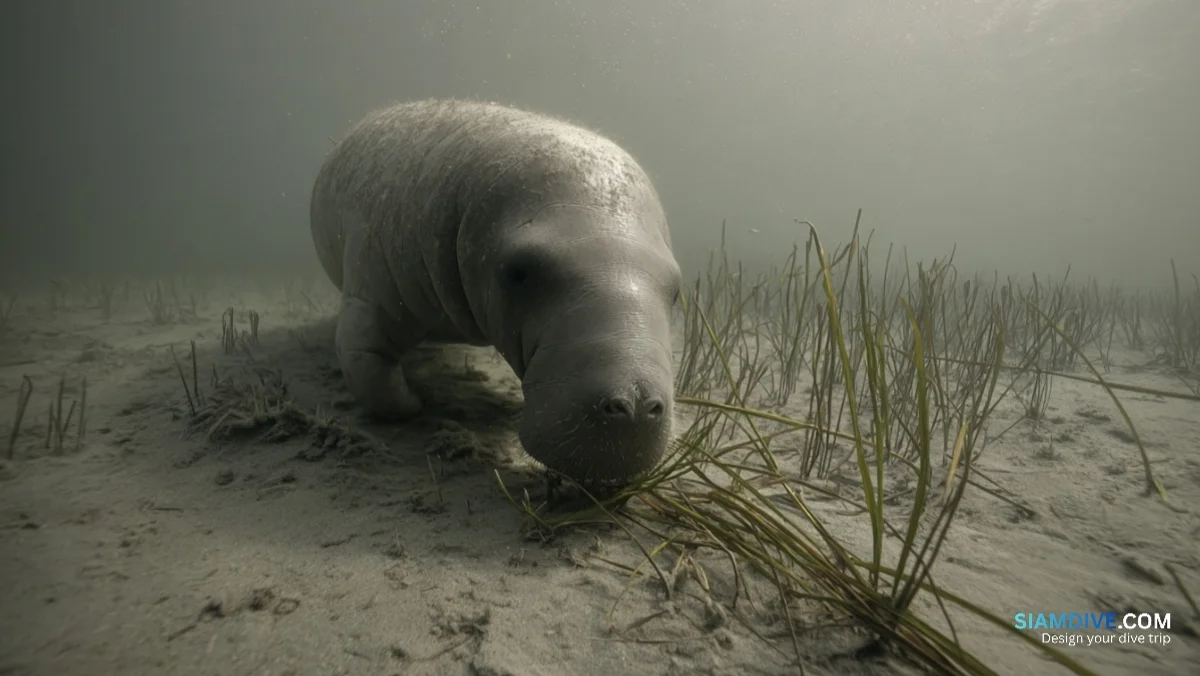
Autopsy data told a consistent story. At least 40% of the 2024 deaths were linked to starvation: animals found severely emaciated, stomachs empty or containing only sediment. Stranding hotspots clustered around Trang province — near Mook and Libong islands — where seagrass beds had receded to fragments.
- 2019–2022 average: ~20 deaths per year
- 2023–2024 average: 42 deaths per year (2–3x baseline)
- By April 9, 2025: 12 deaths already recorded
- Primary cause (2024): starvation — 40%+ of necropsies
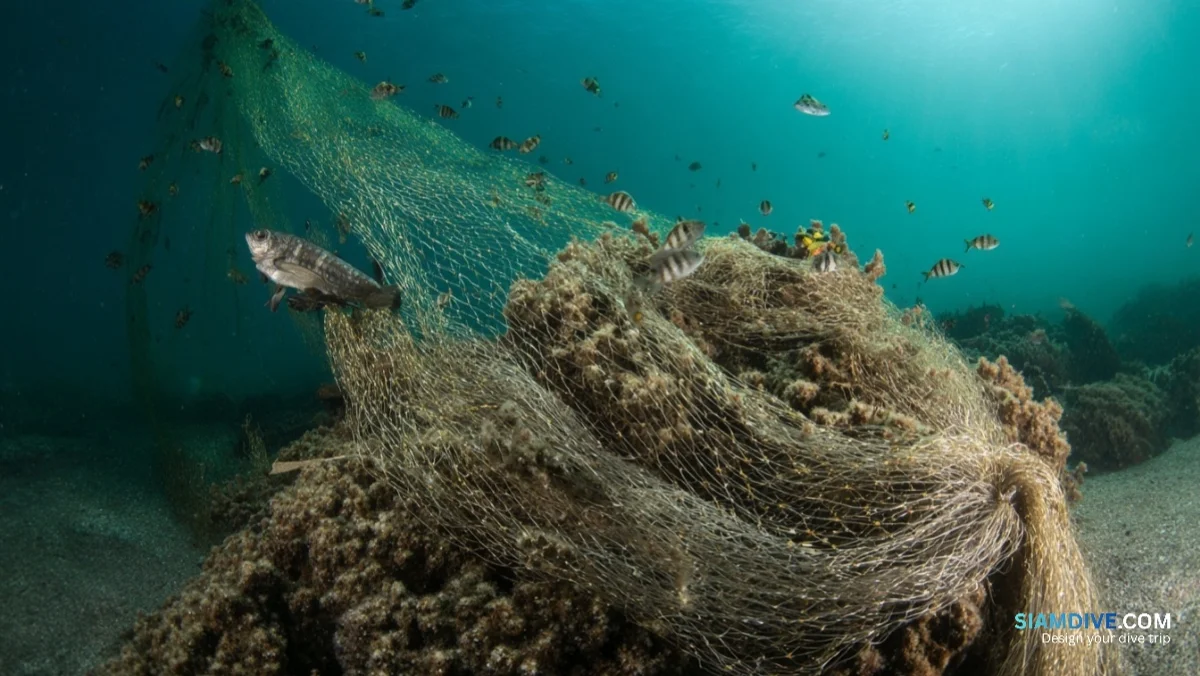
Not every death is starvation. Entanglement in fishing gear, boat propeller strikes, and — in at least one 2026 case — suspected mutilation continue to take animals. But the shift toward hunger as the dominant killer marks a fundamental change: from direct human violence, which enforcement can address, to habitat collapse, which demands a different kind of response entirely.
Libong's Last Grazing Ground
More than half of Thailand's remaining dugongs depend on the shallow waters around Libong Island in Trang province — a low, mangrove-fringed island where fishing villages sit within a few hundred metres of the country's most critical seagrass habitat. A 2026 study published in Marine Mammal Science mapped how dugongs at Libong shift between beds of Halophila and Halodule as tides change, documenting narrow feeding corridors the animals return to season after season.
The research underscores a fragile dependency. Dugongs here do not range widely. When their corridors thin, they have limited ability to relocate. Unlike manta rays travelling between cleaning stations across the Similan chain, dugongs are tied to the bottom — specifically, to the top few centimetres of sediment where their food grows.
Libong is also where DMCR's emergency monitoring is most concentrated. Drone overflights, GPS-tagged individuals, and a network of local fishermen reporting sightings form the backbone of surveillance. In November 2024, the DMCR drafted a four-part emergency response: count remaining individuals, track new migration routes, restore seagrass, and — in a measure that signals how dire the situation has become — consider temporary feeding shelters for starving animals.
Drones, LMMAs, and 1,000 Rai of Replanting
Protecting a dugong from a fishing net means nothing if there is nothing left for it to eat. That calculation is reshaping conservation strategy across the Andaman — from enforcement-first to habitat-first.
The most ambitious initiative targets the seagrass itself. DMCR has identified over 1,000 rai (160 hectares) of degraded seagrass beds for active rehabilitation, including replanting programmes in former shrimp ponds along the Trang coast. The work is slow — seagrass transplants take years to establish, and success depends on water quality improvements that lie upstream, literally, in agricultural and land-use policy.
A parallel strategy scales Locally Managed Marine Areas (LMMAs), where coastal communities lead conservation rather than waiting for central government directives. A February 2026 IUCN report highlighted southern Thailand as a regional pioneer, noting that LMMA communities in Trang had reduced illegal fishing pressure on seagrass beds while maintaining local livelihoods.
Technology adds another layer. The Connected Conservation Foundation, with satellite support from the Airbus Foundation, uses high-resolution imagery and drone surveillance to map seagrass health across the Andaman coast — aiming for a near-real-time monitoring system that can flag die-offs before they become irreversible. The five-year BOBLME II project (2023–2028), funded by the Global Environment Facility, supports these efforts across seven Bay of Bengal countries, giving Thailand's seagrass work a regional framework and additional funding.
After Mariam — What the Public Forgot
In April 2019, a baby dugong washed ashore in Krabi. Named Mariam, she became a national sensation — hand-fed by marine biologists, watched by millions on a live webcam. A second orphan, Jamil, joined her weeks later. Both died in August 2019, their stomachs lined with plastic fragments. The public outcry was immediate: Thailand moved to ban single-use plastic bags within months.
Seven years on, the crisis facing Mariam's species has deepened, but the cameras have moved elsewhere. In April 2026, a dugong carcass was found floating near Koh Yao Noi in Phang Nga — its head severed and tail tied to a stone. Autopsy results attributed death to illness, not foul play, but the image shocked biologists who saw it as a symptom of deeper neglect: a population so small that every single death is a measurable loss to the species' viability in Thai waters.
The same entanglement threats that claim sea turtles continue to take dugongs. But unlike turtles, which nest on beaches where people can see them, dugongs live entirely underwater — in turbid coastal shallows where they are invisible to everyone except the fishermen and divers who share their habitat.
What Divers See That Satellites Miss
Satellite imagery maps meadow boundaries. Drones count grey shapes from the air. Neither tool captures what a diver notices at water level: the condition of individual seagrass blades, the presence of small organisms that signal ecosystem health, the feeding trails where a dugong grazed overnight, or the absence of trails where one should be.
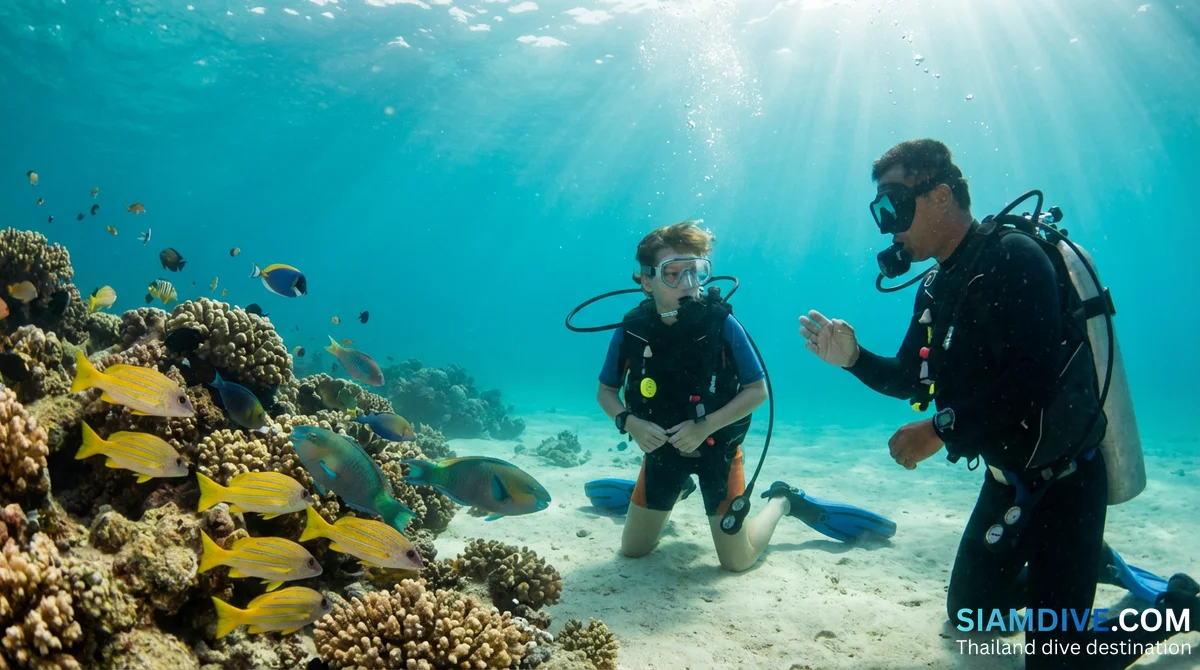
Citizen science from divers and snorkellers has become an increasingly important data stream for DMCR monitoring. Operators running day trips from Trang and Koh Lanta ask clients to report dugong sightings, GPS-stamped, through a shared reporting system. The animals are shy, the water in their preferred habitat rarely clearer than five metres, and an encounter is never guaranteed — but each data point helps biologists track where the last individuals are feeding.
For the dive community, the dugong crisis is a reminder that marine conservation extends beyond the coral walls and open-water spectacles that fill logbooks. Some of the most consequential ecosystems sit in chest-deep water, look like an underwater lawn, and sustain an animal most divers will never see. The seagrass beds of the Andaman are not on anyone's bucket list — but their survival may determine whether Thailand's last dugongs have a future at all.
Sources
- Mongabay — Dugong numbers plummet amid seagrass decline in Thailand's Andaman Sea (April 2025)
- IUCN — Southern Thailand pioneering community-led marine conservation (February 2026)
- DMCR — Dugong Survey in Thailand
- Marine Mammal Science — Spatial and seasonal variation of dugong feeding grounds, Libong Island (2026)
- Pattaya Mail — Thai dugong population drops nearly 30% in three years