Ghost Nets Kill for 600 Years After the Boat Leaves
25 เมษายน 2569
A single lost net traps, kills, and re-traps marine life for centuries. Thailand's citizen scientists are fighting back — but the Gulf needs more hands underwater.
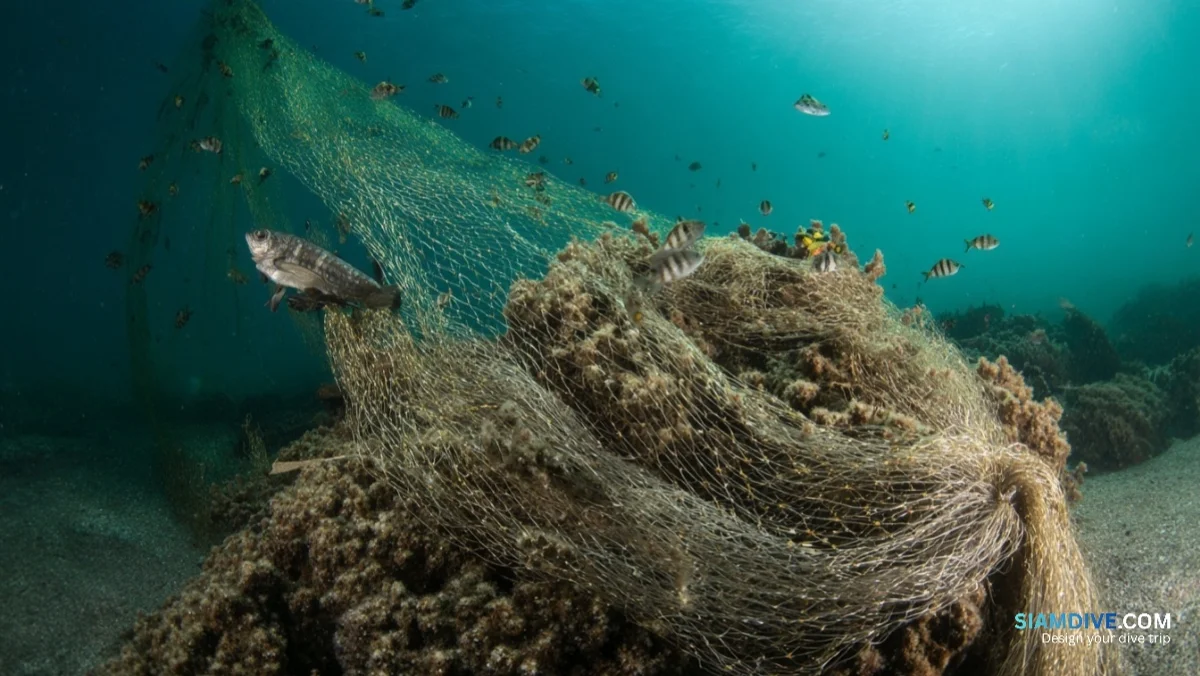
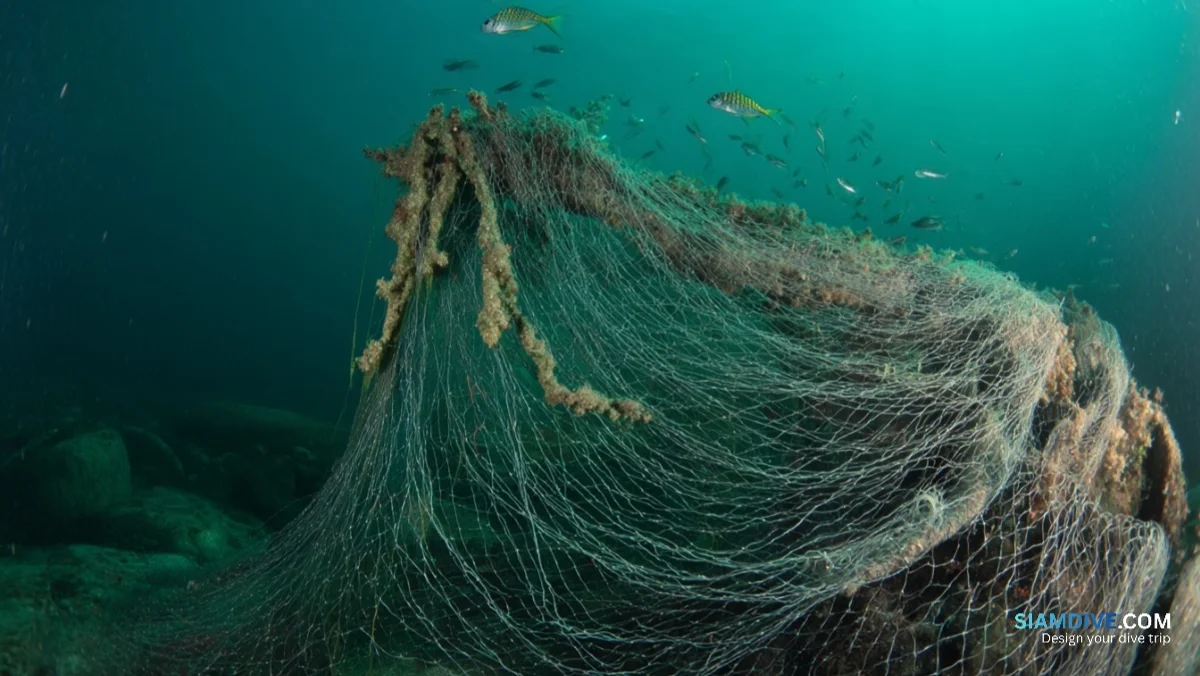
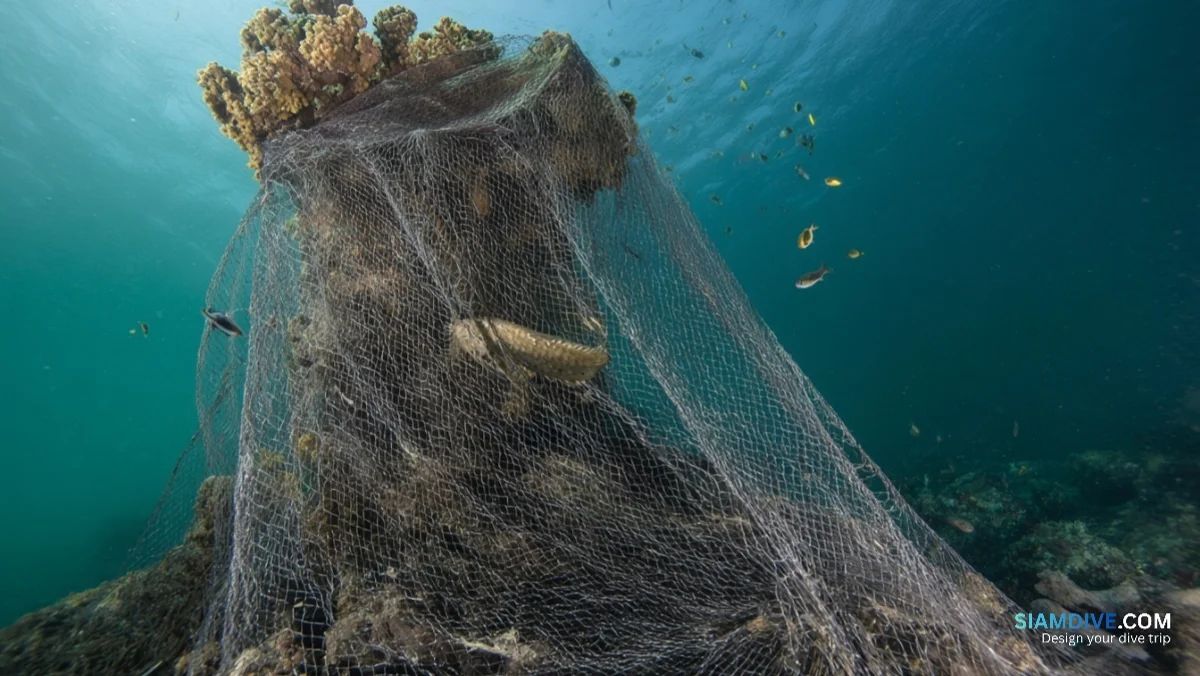
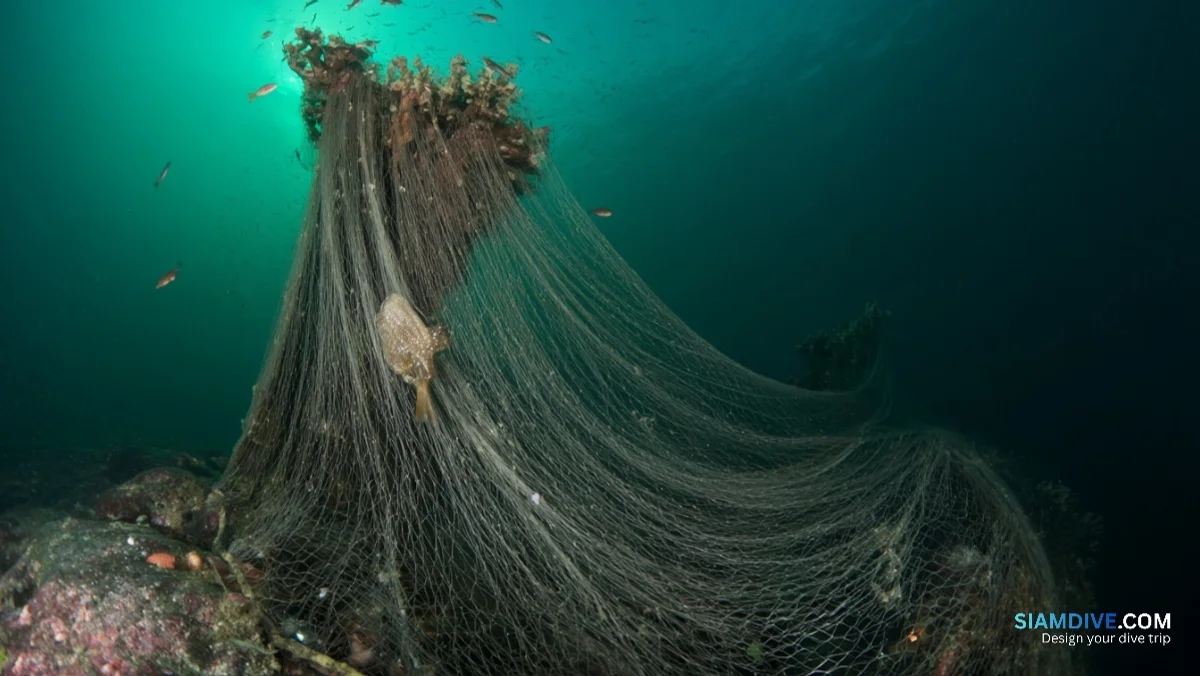
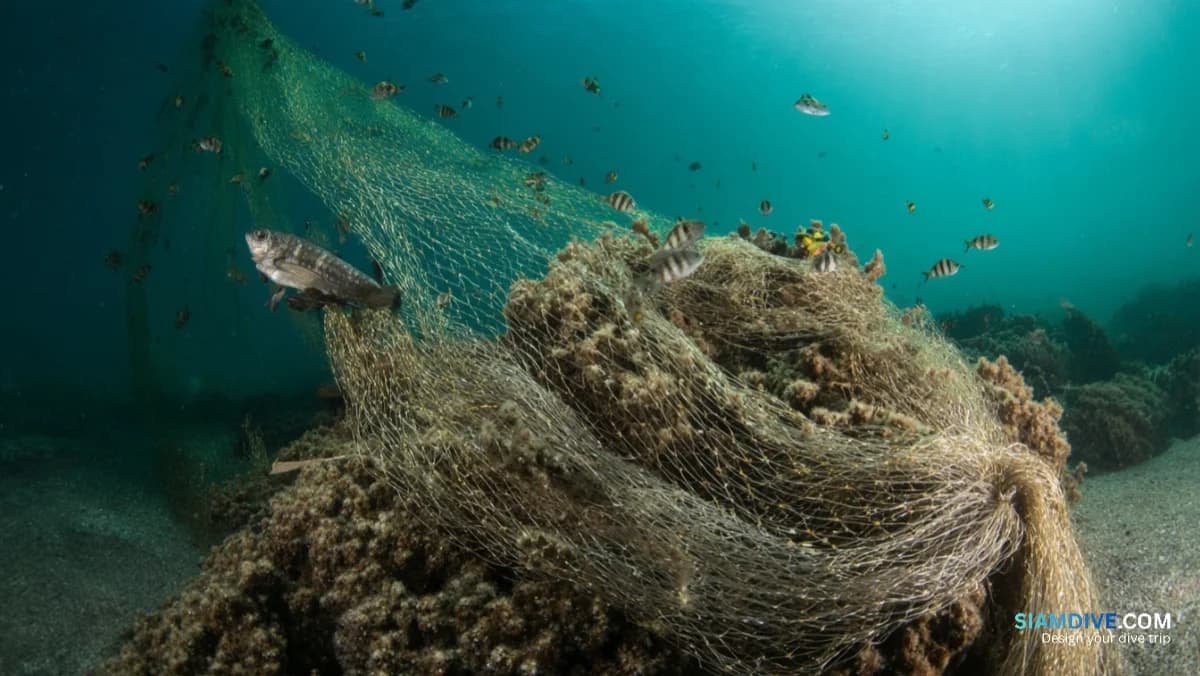
Forty metres below a Chumphon dive boat, a monofilament gill net hangs from a barrel sponge like a grey curtain nobody drew back. A dead triggerfish dangles near the top fold, half-stripped by scavengers that will themselves get tangled before the week ends. Farther down the same pinnacle, rope coils around staghorn coral in a slow tourniquet, bleaching the branch it touches.
The net's owner has not fished these waters in years — maybe a decade. The net does not care. It keeps catching.
This is ghost fishing: the slow, unwitnessed harvest that continues long after a vessel returns to port. In Thailand's Gulf waters, researchers have now documented hundreds of abandoned nets draped across pinnacles, coral heads, and sandy flats, each one operating as an autonomous trap powered by nothing but current and the bad luck of anything that swims too close. A 2025 survey put the first hard numbers on the problem — and the figures should worry anyone who has ever clipped into a descent line over a Thai reef.
How a Net Becomes a Ghost
The industry calls it ALDFG — abandoned, lost, or otherwise discarded fishing gear. The category covers gill nets, trawl mesh, crab traps, longlines, and rope. Gear gets lost in storms, snagged on rocky substrates, or cut free when it fouls a propeller shaft. Some is dumped deliberately: worn-out nets tossed overboard because hauling them back to port costs fuel and deck space, and no Thai law currently requires fishers to account for the gear they carry out and bring back.
The materials are what make the problem permanent. Modern commercial nets are woven from nylon 6 or high-density polyethylene — polymers engineered to resist salt, UV radiation, and abrasion. A cotton net from the 1950s rotted in weeks. A nylon net manufactured today will persist for an estimated 600 to 800 years before it fully decomposes, according to NOAA's Marine Debris Program. During that span it does not sit idle. Currents carry it across the seabed, rocks snag and reshape it, tides fold it into new configurations — and every new configuration is a new trap geometry.
Globally, between 500,000 and one million tonnes of fishing gear enter the ocean every year. Ghost gear now makes up roughly 10 percent of all marine litter by weight — around 640,000 tonnes annually, per a WWF analysis. In the Gulf of Thailand, where thousands of artisanal and commercial vessels operate year-round, the accumulation concentrates on the same underwater structures that divers travel hours to reach.
1,200 Square Metres of Netting, 606 Pieces
The first hard count came from a citizen-science campaign reported by Mongabay in January 2025. Teams using the MARsCI (Marine Science through Citizen Involvement) protocol logged ghost gear at dive sites across both the Gulf and the Andaman coast.
The tally was blunt: 606 discrete pieces of derelict gear, spanning more than 1,200 square metres of netting, plus hundreds of metres of rope and monofilament line. Among the entangled fauna, 96 percent were non-target species — invertebrates, reef fish, and juveniles that no fisherman intended to catch. A dead barracuda, still wrapped in mesh, was among the documented finds.
- Netting area documented: over 1,200 m²
- Discrete gear pieces: 606
- Non-target species caught: 96%
- Gear successfully removed: 98% of what teams encountered
- Gear suitable for recycling: just 1%
That last number is the one that lingers. Survey teams hauled 98 percent of every net they found back to the surface — an impressive recovery rate. But of that material, only one percent was clean enough for automated recycling. The rest, encrusted with marine growth and fouled beyond what machines can process, went straight to municipal landfills. Most of the ghost gear that volunteers risk their safety to remove ends up in the same waste stream as household rubbish.
The pattern holds across regions: Koh Kham's protected coral fields and the open pinnacles off Chumphon both showed gear accumulation, suggesting the problem tracks reef structure rather than proximity to any single fishing port.
The Loop That Never Breaks
A ghost net does not catch once. It catches, kills, attracts, and catches again in a self-reinforcing cycle marine biologists call the ghost fishing loop.
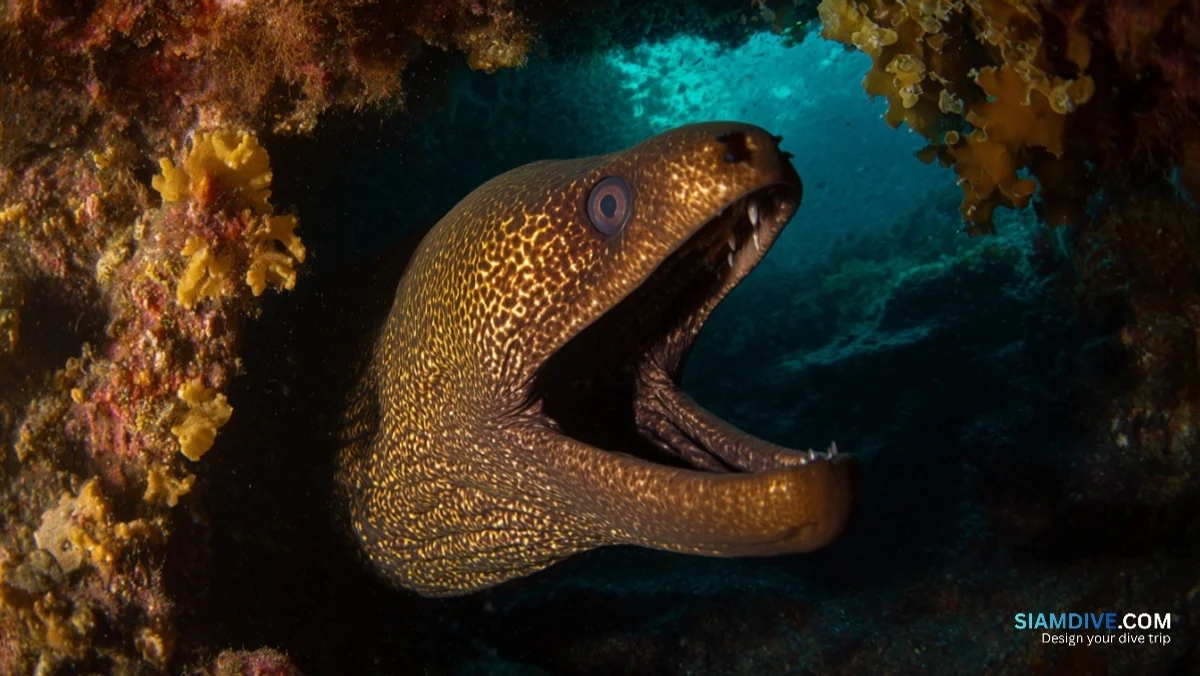
The sequence runs like this. A net traps a reef fish or invertebrate. The trapped animal struggles, sending distress signals into the water column. Predators — barracuda, jacks, moray eels — move in to feed. The predators themselves become entangled. Their carcasses attract scavengers: crabs, sea cucumbers, smaller reef fish. The scavengers get caught. The loop restarts, cycling through trophic levels with mechanical patience, day after day, season after season.
Beyond entanglement, ghost nets smother coral. A net draped across a reef head blocks light, restricts water flow, and introduces disease vectors. Invasive species and parasites colonise the mesh, turning discarded nylon into a delivery system for reef pathogens. A single large net can kill a coral formation that took decades to build — and with it, the nursery habitat that hundreds of juvenile fish depend on. The current-fed reefs near Samae San are exactly the kind of high-flow environment where ghost gear snags and holds.
The mortality numbers compound fast. An estimated 300,000 cetaceans — dolphins, porpoises, and small whales — die from entanglement every year worldwide. In Thai waters, dive reports and social-media documentation show whale sharks, Bryde's whales, and hawksbill turtles caught in discarded nets. Systematic mortality data for the Gulf remains thin, which is itself part of the problem: without consistent reporting, policymakers have no baseline to act on.
Thirteen Sites, Six Provinces, One Problem
The most recent peer-reviewed snapshot comes from a 2025 Frontiers in Marine Science study that mapped ALDFG on underwater pinnacles across the Gulf. Fieldwork ran from November 2024 to April 2025, covering 13 sites in six provinces: Trat, Chanthaburi, Rayong, Chonburi, Chumphon, and Surat Thani.
Divers swam belt transects of 50 × 1 metre and conducted roving surveys to map gear types and distribution. The findings confirmed what the citizen-science data suggested at smaller scale: ghost gear clusters disproportionately on pinnacles — the same underwater formations that concentrate marine life and draw divers from Bangkok and beyond. Nets, mesh panels, fishing lines, hooks, and crab traps were all documented.
The downstream hazard is chemical. As nylon and polyethylene degrade under UV exposure and mechanical stress, they fragment into microplastics small enough to enter the food chain through filter feeders — sponges, bivalves, and manta rays ingest them first. From there, microplastics bioaccumulate through reef fish and pelagics into the seafood supply that coastal communities depend on.
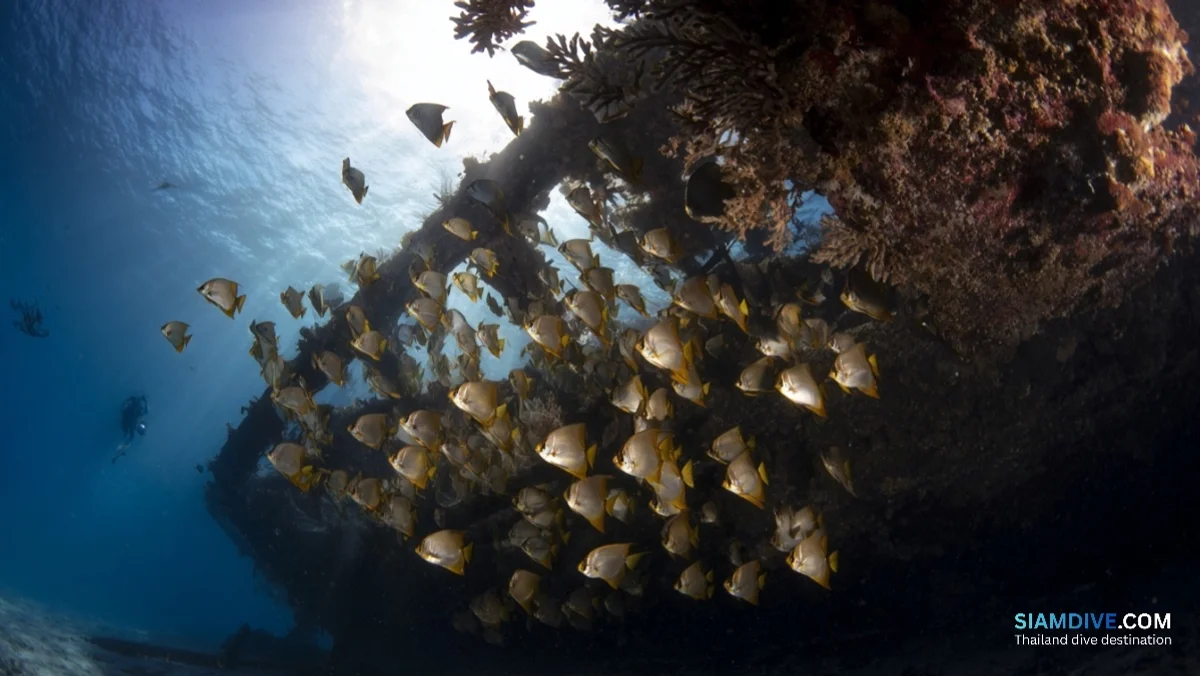
For recreational divers, the overlap is uncomfortable. The pinnacles in the study — rocky outcrops off Koh Chang, formations near Chumphon's black-coral sites, and scattered rocks in the Samae San archipelago — are also popular dive destinations. The same topography that makes a pinnacle worth visiting for its barrel sponges and schooling fish is exactly what snags a trawl net and holds it for generations.
Who Picks Up the Bill
Three groups are doing most of the cleanup work. None of them caused the problem.
The Environmental Justice Foundation's Net Free Seas programme, launched in 2019, partners with Thai artisanal fishing communities to collect and recycle ALDFG. As of 2025, 47 coastal villages participate. The programme has recycled roughly 130 metric tonnes of old fishing gear into products ranging from electronic components to kitchen utensils. Thai sustainable-design company Qualy has manufactured over 50,000 consumer items from recovered nets — commercial proof that ghost gear has an afterlife beyond landfill.
Scale, however, remains the gap. Net Free Seas aims to establish 40 permanent collection hubs and process 100 tonnes per year by 2027. For context, global ghost-gear input runs closer to one million tonnes annually.
On the policy front, SEAFDEC (Southeast Asian Fisheries Development Center) convened a regional workshop in Bangkok on 31 March 2026 to develop technical guidelines for assessing, preventing, and removing ALDFG across Southeast Asia. The workshop produced a draft framework — an important step — but binding national regulation remains absent. Thailand currently has no law assigning financial responsibility for ALDFG to vessel owners, which means the cost of cleanup defaults to volunteers, NGOs, and the marine environment itself.
- Net Free Seas communities: 47 across Thailand
- Gear recycled to date: ~130 metric tonnes
- 2027 target: 40 hubs, 100 tonnes/year
- Products from recovered nets: 50,000+ items (via Qualy)
- National ALDFG liability law: does not yet exist
The unanswered question from the March workshop: who should pay? Trawler operators who lost the gear? Seafood exporters whose supply chains benefit from low-cost fishing? The dive tourism industry that absorbs the ecological damage? Or the Thai taxpayer, through expanded marine-department budgets? Until legislation assigns that cost, the answer keeps defaulting to the same volunteer divers who haul nets to the surface one cut at a time.
What a Diver Can Actually Do
Reporting matters more than removal. Most recreational divers lack the training and equipment to safely extract a ghost net from a reef without causing additional coral damage. Cutting a tensioned net in current can whip loose mesh back into the diver's path — an entanglement risk that turns rescuer into victim.
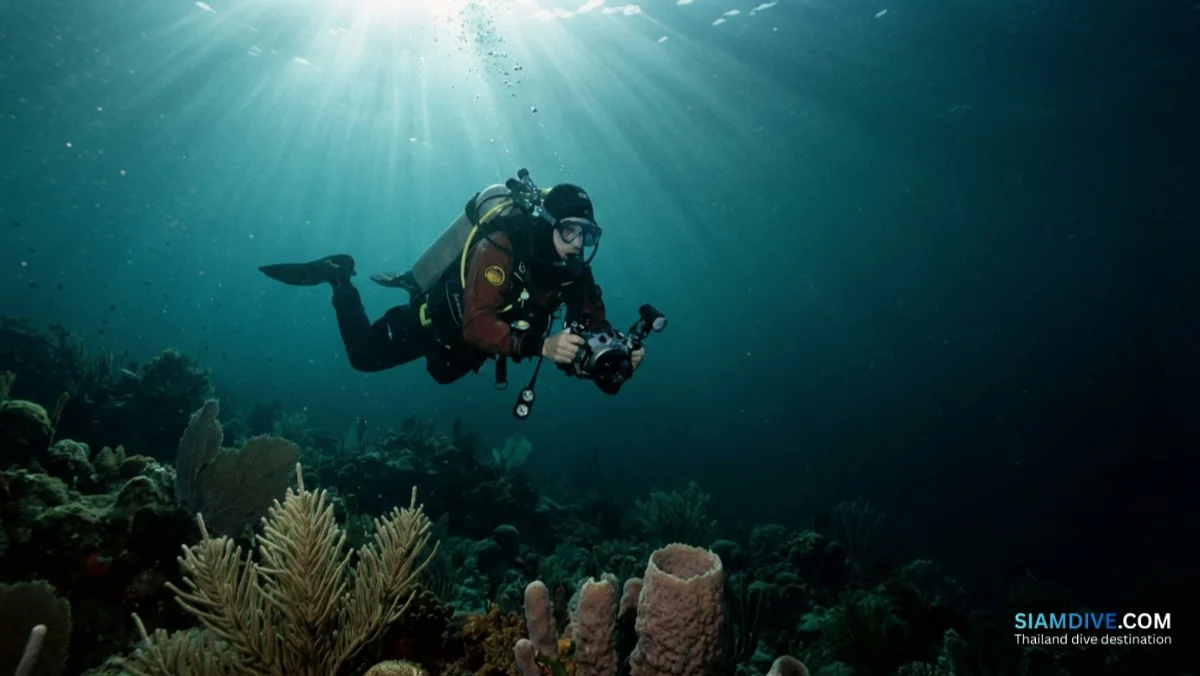
The MARsCI protocol — the same system behind the 2025 Thailand-wide survey — offers a way to contribute without touching anything. Divers photograph the gear, estimate its area, note any entangled fauna and the substrate type, and submit reports through a central database. That data feeds directly into research papers and helps cleanup teams prioritise which sites to hit first.
For trained cleanup divers, a few ground rules:
- Minimum team of three — one diver as dedicated safety, never solo
- Carry line cutters, not dive knives — a serrated blade near tensioned monofilament is a tangle waiting to happen
- Cut from the outside in — work away from the coral structure to minimise breakage
- Bag and surface immediately — loose netting on the bottom simply relocates the problem
- Log every removal through MARsCI, Ghost Diving, or local marine park authorities
Even a diver who never touches a net contributes by documenting it. In a country with thousands of dive sites and limited survey funding, a single GPS-tagged photograph can put a cleanup crew on the right Gulf pinnacle weeks faster than a research vessel could locate it. The sites divers love and the sites ghost nets destroy are, more often than not, the same rock.
Sources
- Mongabay — Underwater citizen science reveals the specter of ghost fishing in Thailand (January 2025)
- Frontiers in Marine Science — Environmental effects of ALDFG on Gulf of Thailand pinnacles (2025)
- NOAA Marine Debris Program — Wildlife entanglement and ghost fishing
- Environmental Justice Foundation — Net Free Seas project
- SEAFDEC — Abandoned, lost or otherwise discarded fishing gear (ALDFG)