The Alien Jaws Hiding in Every Crevice at Richelieu Rock
24 เมษายน 2569
Giant morays carry a second set of jaws in their throat — the only vertebrate alive with this mechanism. Richelieu Rock hosts five species in one reef.
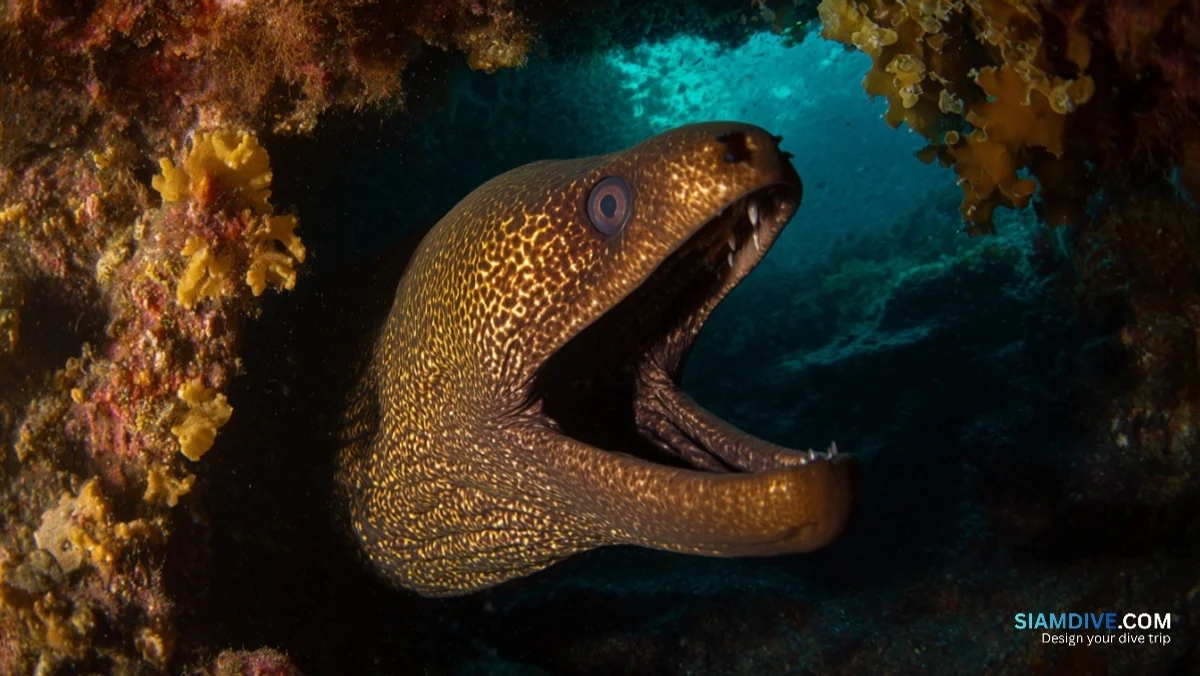
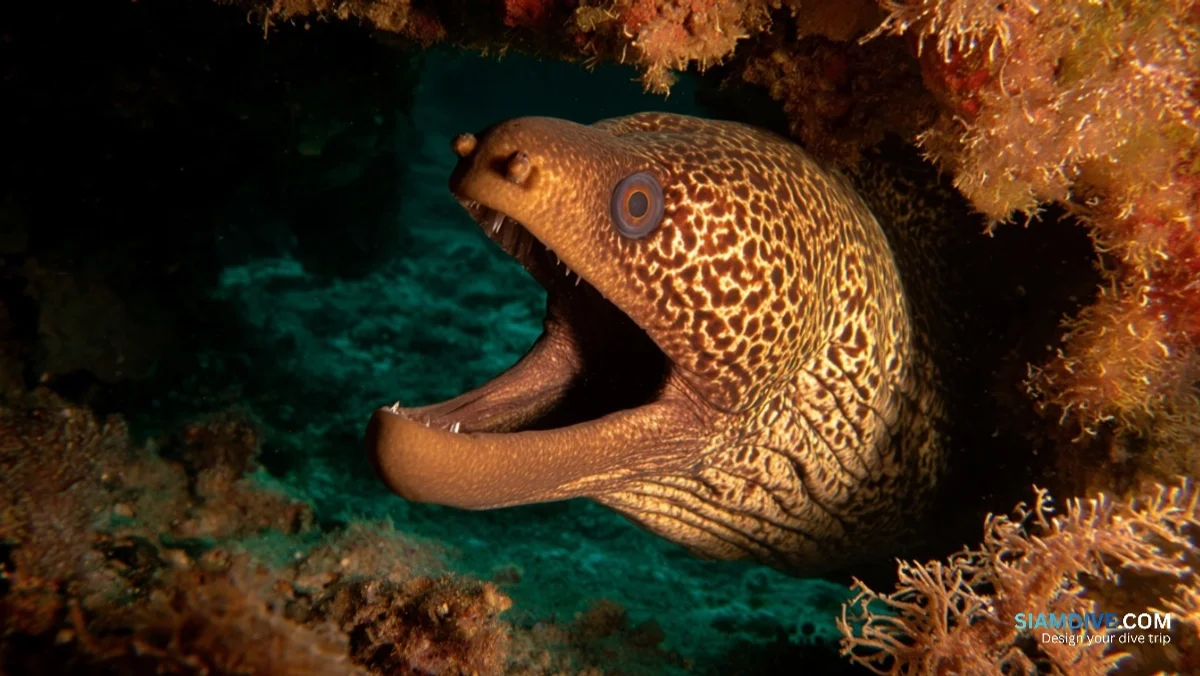
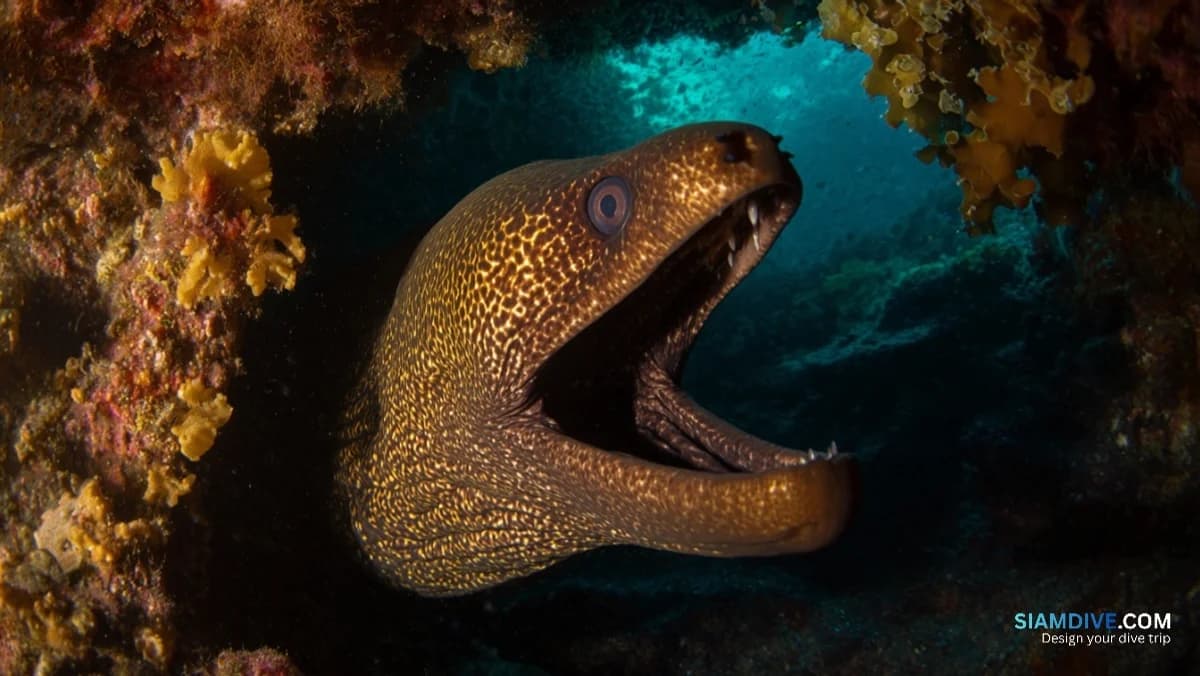
Somewhere between 12 and 18 metres, where Richelieu Rock's limestone folds into crevices barely wider than a wetsuit boot, a giant moray opens its mouth. Two rows of curved teeth flash white against mottled brown skin. Then something else moves — deeper, behind the tongue — a second set of jaws lunging forward to meet the first. No other back-boned animal on the planet feeds like this.
The giant moray eel, Gymnothorax javanicus, is not just the largest moray by body mass. It is one of the most misunderstood animals on any coral reef — feared for a mouth that is simply breathing and overlooked for a predation mechanism that inspired a horror-film franchise. At Richelieu Rock, Thailand's most species-dense pinnacle, five different moray species thread through the same reef structure, and the giant moray sits at the top of that crevice hierarchy.
A Second Set of Jaws
Most bony fish swallow prey using hydraulic suction — expanding the oral cavity to create negative pressure that pulls food inward. It works beautifully in open water. Morays cannot use it. Their heads are laterally compressed, shaped like a flattened wedge to slip through reef crevices, and the suction method requires a wide oral chamber that a limestone crack simply does not allow. Evolution solved the engineering problem with a structure found nowhere else among vertebrates: raptorial pharyngeal jaws housed deep in the throat.
When the oral jaws clamp down on prey, the pharyngeal set launches forward from the throat into the mouth cavity, grips the food with backward-pointing teeth, and drags it down the oesophagus. The entire sequence takes a fraction of a second. A 2007 study by Rita Mehta and Peter Wainwright at UC Davis captured the mechanism on high-speed video — the first documented case of any vertebrate using a second set of jaws to both restrain and transport prey.
If the mechanism sounds familiar, it should. The xenomorph in Ridley Scott's 1979 Alien used an identical double-jaw attack. The difference: moray eels had it first, by roughly 100 million years. And unlike the xenomorph, the giant moray has no interest in anything larger than a reef fish.
Three Metres, Thirty Kilograms, No Scales
A fully grown giant moray can exceed three metres in length and weigh more than 30 kilograms, making it the heaviest moray species in the world. The slender giant moray (Strophidon sathete) is technically longer, but Gymnothorax javanicus carries far more mass — a distinction that matters when one fills a crevice opening at arm's length from your mask.
The body lacks scales entirely. A thick layer of protective mucus coats the skin instead, allowing the eel to slide through rock gaps without abrasion. Juveniles are tan with large dark blotches; adults darken to brown or olive-black, with leopard-like spotting concentrated behind the head. The pattern is individually unique — no two giant morays carry the same markings.
Hunting happens almost exclusively by smell. Brain studies reveal an unusually small optic tectum — the visual processing centre — paired with a highly developed olfactory system. At night, giant morays leave their daytime crevice to patrol the reef, tracking chemical trails left by sleeping fish, octopuses, and crustaceans. Working depth ranges from 1 to 50 metres, though most encounters at Richelieu Rock happen between 8 and 25 metres, where the pinnacle's structure offers the densest crevice network.
Five Morays in One Pinnacle
Richelieu Rock hosts at least five moray species — an unusually high density for a single submerged pinnacle. Each occupies a slightly different niche within the rock's layered crevice system, and on a single dive it is common to encounter three or four of them. The reef also supports nudibranchs that steal their prey's chemical weapons and seahorses that hide among the same soft corals the morays patrol beneath.
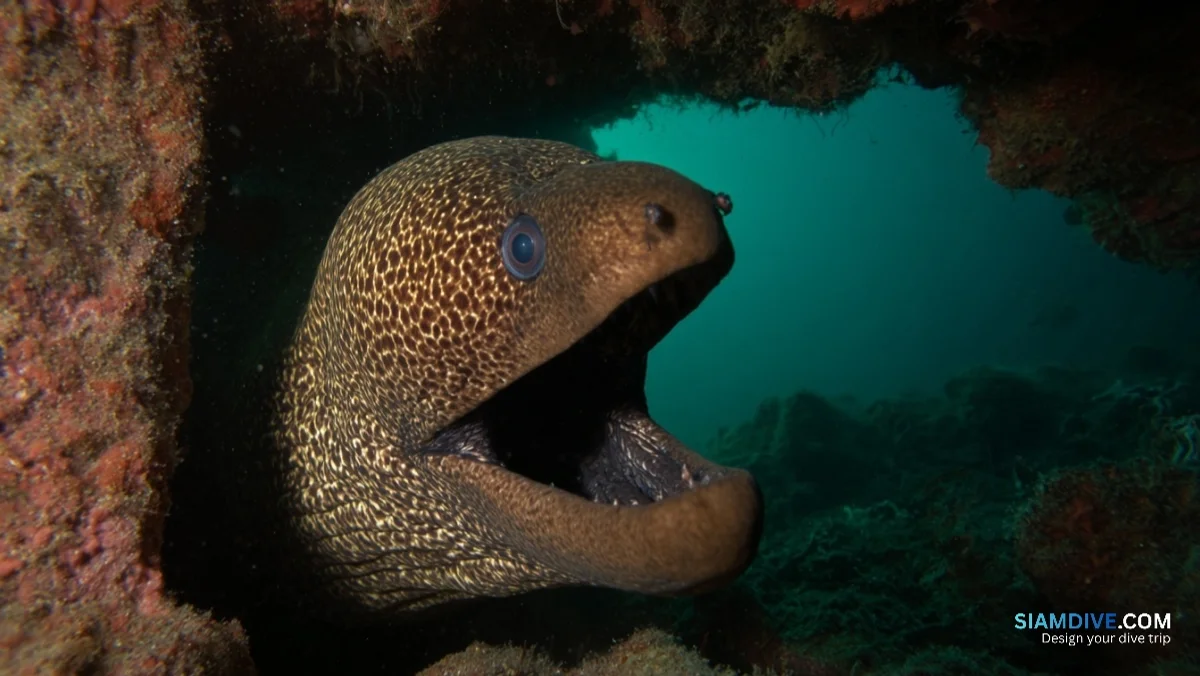
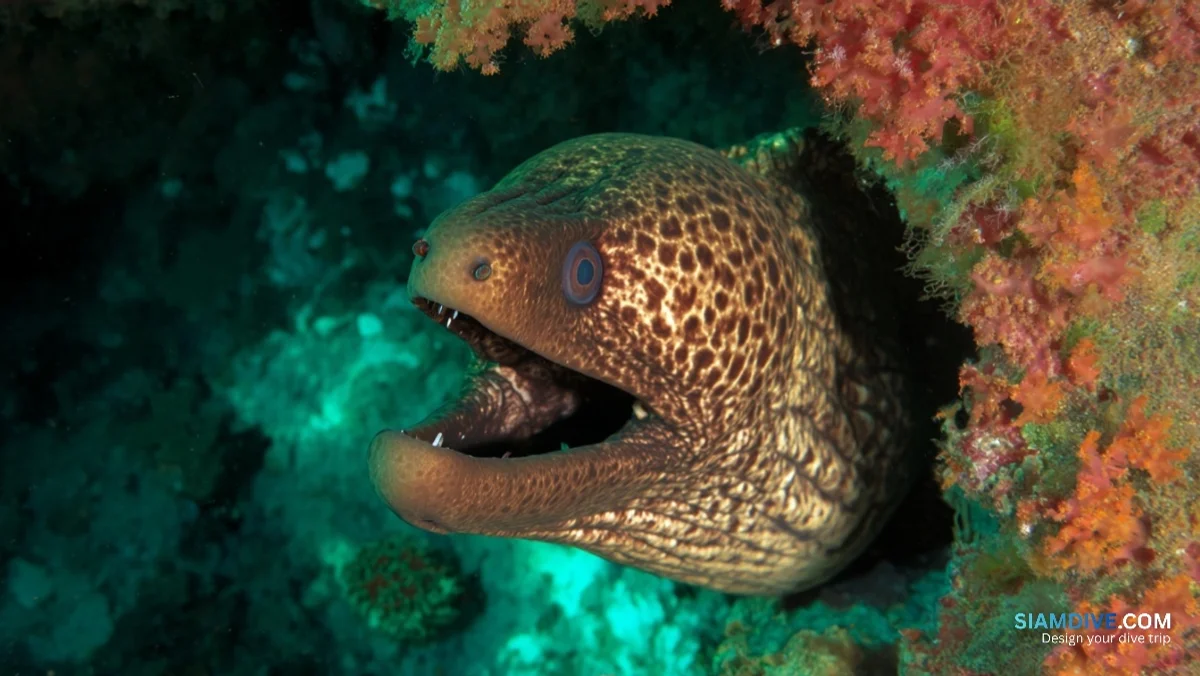
- Giant moray (Gymnothorax javanicus) — The flagship. Up to 3 metres. Favours larger openings in the rock's mid-section between 10 and 20 metres. Often seen with mouth agape during the day, recycling water over its gills.
- White-eyed moray (Gymnothorax thyrsoideus) — Smaller and more reclusive, wedged into cracks that larger species cannot reach. Identifiable by pale, almost luminous eyes against a dark face.
- Fimbriated moray (Gymnothorax fimbriatus) — Yellow-green body with dark spots scattered irregularly. Common across the Andaman and frequently photographed on night dives when it emerges fully from its crevice to hunt.
- Zebra moray (Gymnomuraena zebra) — Bold dark-and-white bands wrap the entire body — impossible to confuse with any other species. Unlike its relatives, the zebra moray feeds primarily on crabs, sea urchins, and other hard-shelled crustaceans, using flattened molar-like teeth rather than the pointed fangs that define other morays. It is arguably the most photogenic of the five, and divers who spot one tend to burn through memory cards fast.
- Honeycomb moray (Gymnothorax favagineus) — Dark body covered in pale honeycomb-patterned spots. Can exceed 2 metres and shares the larger crevices with giant morays, though the two species rarely occupy the same hole at the same time.
That Open Mouth Is Just Breathing
A two-metre eel sitting in a crevice with its mouth rhythmically opening and shutting looks aggressive — the visual equivalent of a dog baring its teeth. It is not. Morays lack the opercular plates that other bony fish use to pump water over their gills. They compensate by opening and closing the mouth in a continuous breathing cycle. The gape is respiration, not a threat display.
Bite incidents are rare, and when they occur the cause is almost always human error: a diver reaching into a crevice without looking, or a guide hand-feeding fish and having a moray mistake fingers for food. Giant morays have poor eyesight — their strike reflex is chemical, triggered by scent rather than by the sight of a hand. A diver who keeps hands visible and away from crevice openings has no reason for concern. Compare that to the titan triggerfish, which actively charges divers who wander too close to its nest — morays show none of that territorial aggression.
One persistent myth worth retiring: morays are not venomous. They carry no toxin glands and deliver no chemical payload when they bite. Some large moray species do accumulate ciguatera toxin in their flesh through the food chain, which makes eating them a serious health risk — but that is a bioaccumulation problem, not a venom delivery system, and it concerns fishermen, not divers.
The Grouper Handshake
A roving coral grouper (Plectropomus pessuliferus) approaches a resting giant moray and shakes its head in rapid, exaggerated bursts — not random swimming, but a specific recruitment signal. The moray responds by leaving its crevice and following the grouper across the reef. What follows is one of fewer than a dozen documented cases of cooperative hunting between fish species, and the only one involving an eel.
The division of labour is clean. The grouper patrols open water, driving prey toward the reef structure. If the target fish dives into a crack, the grouper cannot follow — but the moray can. The eel enters the crevice and either catches the fish inside or flushes it back into open water for the grouper to intercept. Both predators eat more over the course of a hunt than either would manage alone, which is the evolutionary payoff that keeps the partnership intact.
The head-shake signal is remarkably specific. Researchers found that groupers will swim directly to a moray's crevice, position themselves vertically, and perform the shimmy only when they have located prey they cannot reach. Morays that do not respond are visited again. The behaviour has been documented across the Indo-Pacific, including sites along Thailand's Andaman coast where groupers and giant morays share territory on pinnacles like Hin Daeng and Richelieu Rock.
Shooting the Gape
Giant morays cooperate with photographers almost as reliably as they cooperate with groupers. They hold position for minutes, face pointing outward from a crevice, mouth cycling open and shut in a predictable rhythm. The challenge is not finding the subject — it is framing it well.
- Lens choice: A fisheye (Tokina 10-17mm or Canon 8-15mm) works best for close-focus wide-angle shots that place the eel inside its reef context. For tighter head portraits, a 60mm macro fills the frame with jaw detail.
- Orientation: Shoot vertical. The eel's tapered body loses impact in landscape framing. Vertical composition fills the frame from jaw to mid-body without awkward cropping.
- Focus point: Lock autofocus on the eye. A tack-sharp eye anchors the image; soft eyes kill the shot regardless of how strong the composition is.
- Strobe angle: Angle strobes slightly outward to avoid lighting up the mucus layer into a white glare. Final approach distance for a fisheye: 15-30 centimetres from the port to the subject.
- Timing: The breathing cycle gives a natural shooting rhythm. Wait for maximum gape, fire, wait for the next cycle. Two or three cycles are usually enough to nail the shot.
The April Plankton Trade-Off
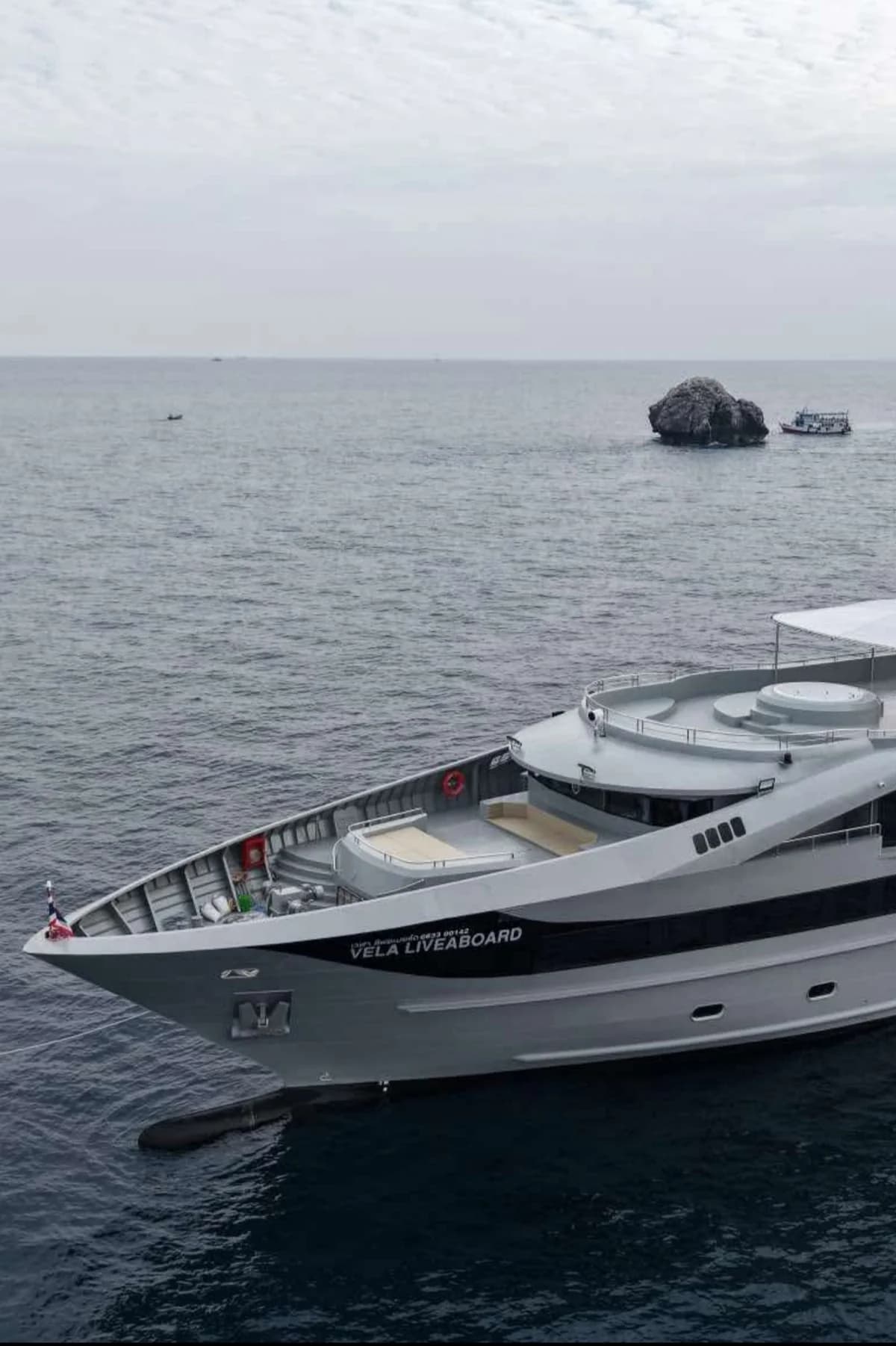
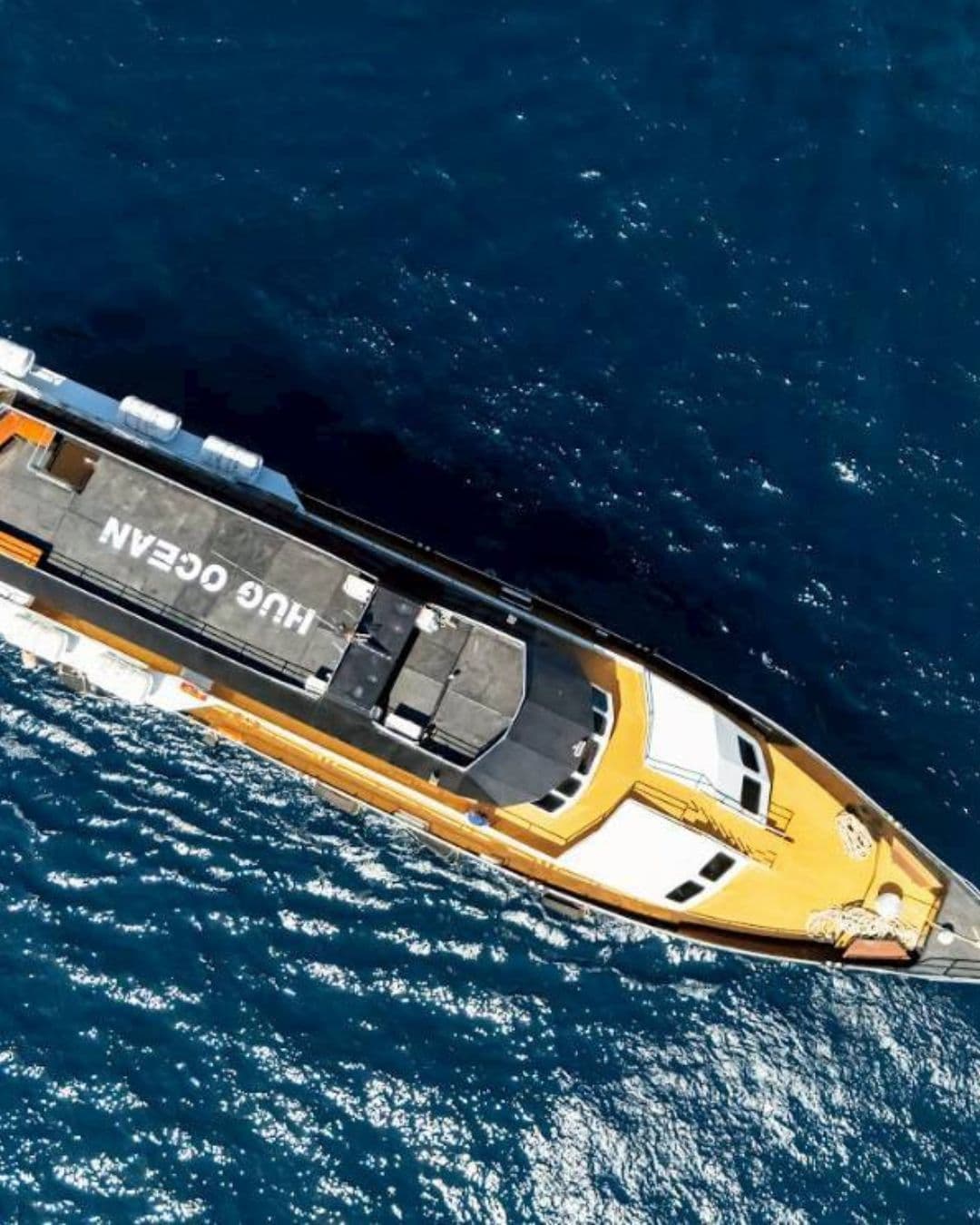
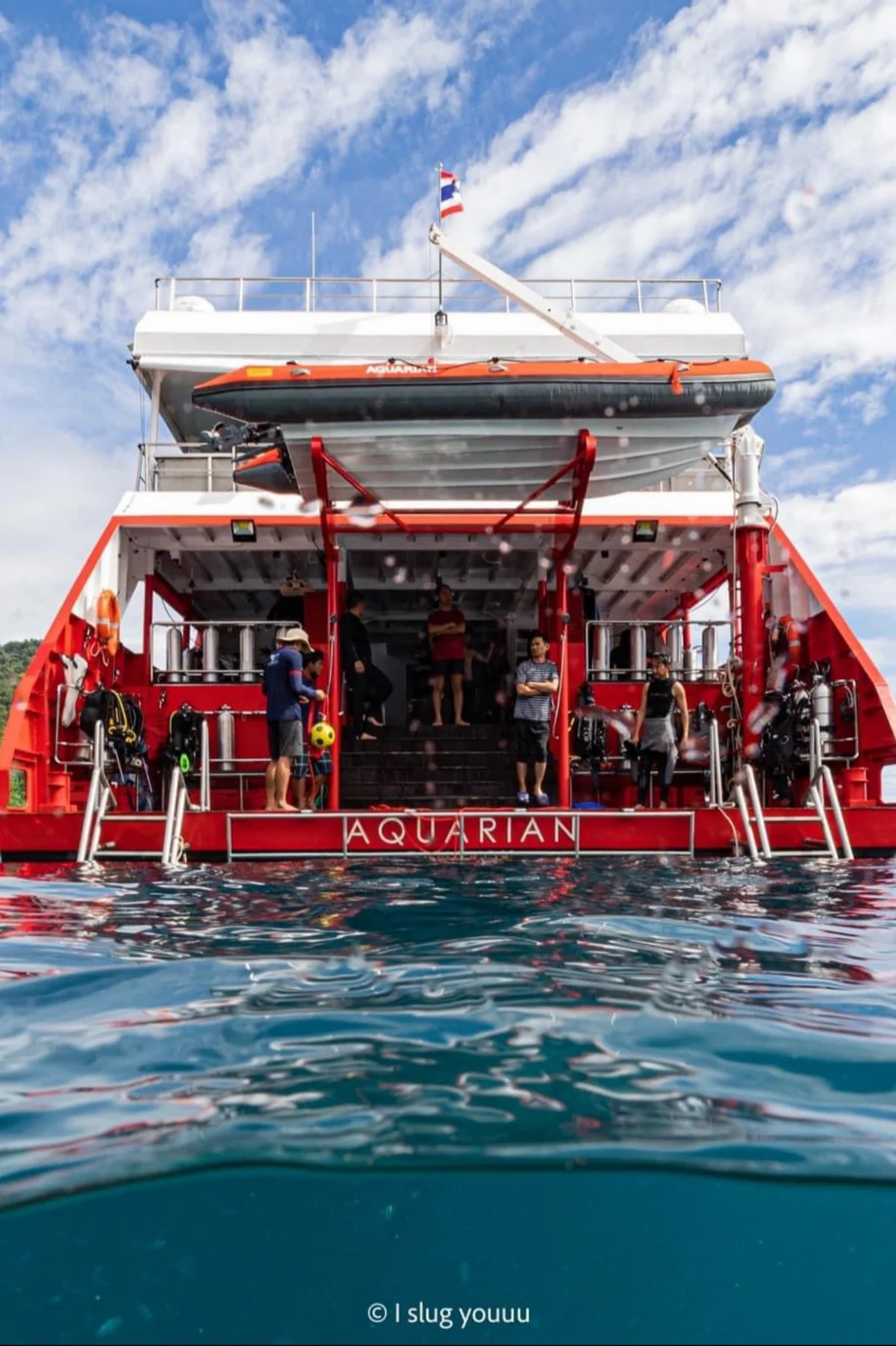
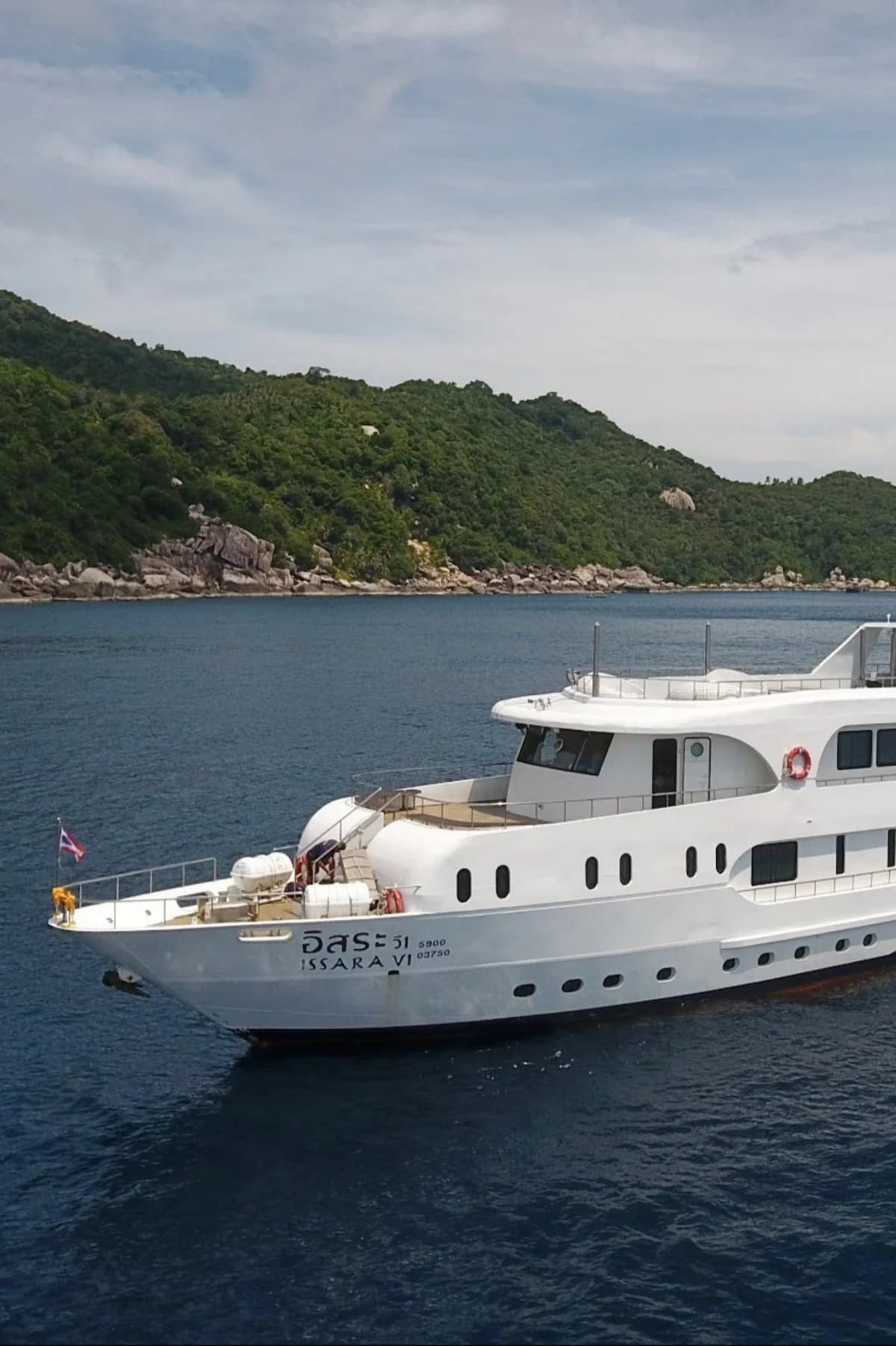
Richelieu Rock sits inside Mu Ko Surin National Park, which opens annually from mid-October to mid-May. The 2025-2026 season runs from 15 October 2025 to 15 May 2026. Most divers reach it by liveaboard from Khao Lak — typically four- to six-night itineraries covering the Similan Islands, Koh Bon, Koh Tachai, and the Surin group — though long-range day trips by speedboat are also possible (roughly five hours each way).
Moray encounters are consistent throughout the season. The eels are resident, not migratory, and individual animals occupy the same crevices week after week — guides on repeat liveaboard trips often recognise specific morays by their spot patterns. But April introduces a variable worth planning around: plankton density increases sharply, dropping visibility from the February-March peak of 25-35 metres down to 10-20 metres. The trade-off is worthwhile for many divers — that same plankton draws whale sharks and manta rays into the area, turning Richelieu Rock into a pelagic convergence zone during the final weeks before the park closes in mid-May.
- Depth range: 5-35 metres (seabed surrounding the pinnacle at 30-38 metres)
- Water temperature: 27-30°C throughout the open season
- Park fees (2025-2026): 500 THB per foreign adult (day trip) or approximately 2,700 THB per liveaboard diver (combined Similan and Surin park fees)
- Daily visitor cap: 3,850 people across the park
For macro shooters chasing moray portraits, the reduced visibility of March-April is an advantage — dark-water backgrounds isolate the subject naturally, and the eels are entirely unaffected by plankton levels. For wide-angle photographers who want Similan swim-throughs on the same trip, the cleaner water of December-February is the safer bet.
Sources
- Mehta & Wainwright 2007 — Raptorial jaws in the throat help moray eels swallow large prey (PubMed/Nature)
- Thailand National Parks — Giant moray (Gymnothorax javanicus) species profile
- PADI — Richelieu Rock dive site reference
- DAN Southern Africa — Marine life bite prevention and treatment
- Thailand National Parks — Mu Ko Similan National Park fees and season