25 Metres, Zero Bar, 4 Seconds to Decide
22 เมษายน 2569
Insufficient gas triggers 41% of dive fatalities. Four risk factors at depth decide which emergency ascent gives the best chance of surfacing safely.
The gauge needle sits on zero. Or maybe the digital display blinks a warning you have never seen outside a classroom. Twenty-five metres of seawater press down from above — 3.5 bar of ambient pressure squeezing every air space in the body — and the next breath you pull through the regulator comes thin, then stops. Everything that happens in the next four to six seconds depends on decisions made long before this dive: how close the buddy is, how familiar the alternate air source configuration feels under the hands, and whether the ascent procedure drilled in confined water survives the reality of depth. Four risk factors determine which procedure applies and whether it ends well.
What Happens in the Lungs When Supply Stops
At surface pressure, a healthy adult lung holds about six litres of air. At 25 metres, the same lung holds the equivalent of roughly 1.7 litres in surface-air terms. When supply ceases, carbon dioxide concentration spikes faster at depth than it would in a swimming pool — not because the body suddenly demands more oxygen, but because elevated partial pressure of CO₂ under 3.5 bar of ambient pressure triggers the breathing reflex sooner and more violently. The diver does not get a polite five-minute warning. The urge to inhale hammers the chest in seconds.
That urgency is what makes emergency ascents dangerous. Arterial gas embolism — AGE — is the primary medical threat. DAN data associates AGE with emergency ascent in 96 per cent of cases where the injury occurs. The mechanism is mechanical: expanding air in the lungs during ascent ruptures alveoli and forces gas bubbles into the bloodstream, where they can reach the brain or heart within moments. The single most effective countermeasure is continuous exhalation throughout the ascent — a steady, open-airway exhale that lets expanding gas escape. It is also the hardest thing to execute when every reflex screams hold your breath and kick.
Depth — The Factor That Shrinks Every Option
Depth does not just add drama to an out-of-air scenario. It narrows the list of viable responses and widens the penalty for each mistake.
At six metres, a diver who runs dry has roughly ten seconds of controlled swimming to the surface. Pressure drops from 1.6 bar to 1 bar, residual air in the lungs expands by about 60 per cent, and a controlled emergency swimming ascent from this depth is a textbook exercise — literally, since PADI trains the skill between 6 and 9 metres during Open Water certification. The physics are forgiving. The timeline is short. The margin is wide.
At 25 metres, the arithmetic shifts hard. Residual air expands by 3.5 times over the full ascent. At the maximum recommended rate of 18 metres per minute, the trip to the surface takes roughly 80 seconds. For those 80 seconds, the diver must exhale continuously, manage accelerating buoyancy as the wetsuit and BCD expand, and fight the impulse to sprint. A CESA from 25 metres is survivable — but it is no longer a drill. It is a high-stakes manoeuvre with a thin margin for error.
Below 30 metres, most training agencies treat a solo CESA as borderline non-viable for recreational divers. Ascent time exceeds 100 seconds, buoyancy changes grow extreme, and the probability of lung over-expansion injury rises steeply. At these depths, the conversation shifts from "which ascent procedure?" to "why is there no redundant gas on this rig?"
- 0–9 m — CESA within training range; low AGE risk with continuous exhalation
- 10–20 m — CESA viable but demands discipline; alternate air source strongly preferred
- 21–30 m — CESA high-risk; alt-air or normal ascent is the priority
- 30 m+ — CESA near last resort; redundant gas supply should already be part of the configuration
Where Is the Buddy? Two Metres Changes Everything
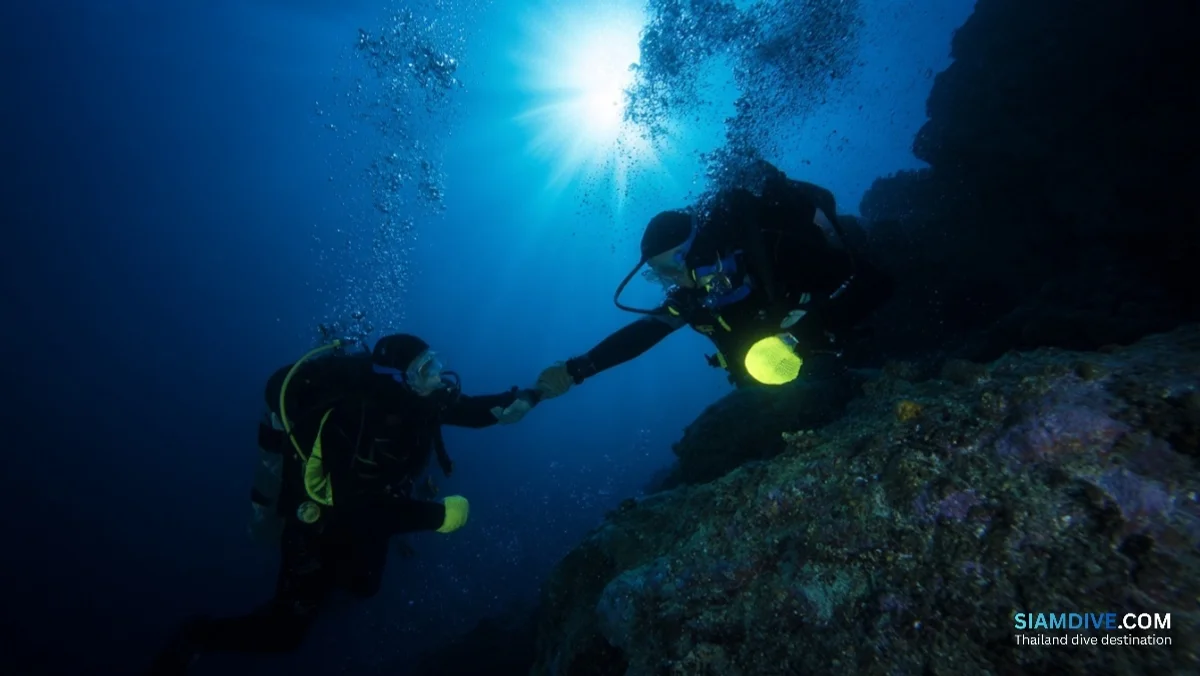
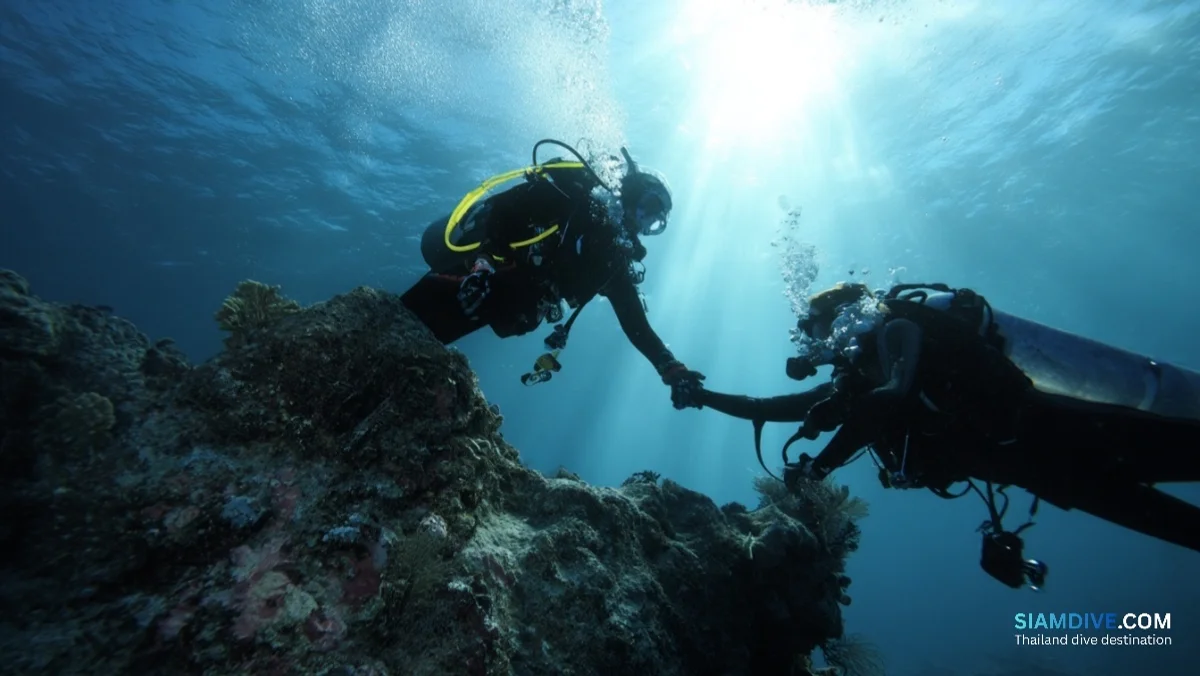
Two metres of open water between a diver and the buddy's octopus — that is all it takes for the second-best emergency option to vanish. An alternate air source ascent ranks second on every agency's priority list because both divers maintain a controlled rate, neither breathes from an empty cylinder, and the out-of-air diver can focus entirely on buoyancy rather than lung mechanics. But the option exists only when the buddy is within arm's reach at the moment supply fails.
Research compiled by the former National Underwater Accident Data Center found that more than half of failed buddy-breathing attempts occurred at depths greater than 20 metres. The technique itself does not break down at depth — stressed divers do. Under the CO₂ hammer, the impulse to bolt for the surface overwhelms the lateral swim to a buddy hovering three metres away. Proximity is not a convenience. It is the line between the second-best option and the third.
Three habits keep the equation workable:
- A pre-dive agreement on alternate air configuration — who carries what, where it clips, which hand grabs it
- A well-maintained regulator setup — a free-flowing octopus discovered mid-emergency is not an alternate air source, it is a second problem
- Buddy checks that include physically locating the alternate second stage, not just confirming it exists somewhere on the harness
Low on Air vs. Zero Air — Two Different Emergencies
Thirty bar at 25 metres is a problem with a simple solution. Zero bar at 25 metres is an emergency with no good options — only less-bad ones. The gap between these two states can close in under a minute at depth, and most divers do not watch it happen because they are not checking the gauge often enough.
A diver with 30 bar at 25 metres has roughly two to three minutes of breathing gas at a typical surface-equivalent consumption rate. That is enough to signal the buddy, begin a controlled ascent, and even execute a shortened safety stop at five metres if gas allows. PADI's priority list calls this a normal ascent — the first and best option, ranked above every emergency procedure because it avoids the emergency entirely.
DAN identifies insufficient gas as a contributing factor in 41 per cent of recreational diving fatalities — a figure that has barely moved in two decades of reporting. The pattern is consistent: the diver had air, then had less air, then had none, and at no point made the call to ascend. The transition from "manageable" to "critical" is silent. The gauge does not beep. The buddy does not notice. The only safeguard is habit.
Below 20 metres, a gauge check every 60 seconds is the standard recommendation. Above 20, every two minutes. Nitrox divers are sometimes more vulnerable because enriched air extends bottom time but does nothing for total gas volume — a diver on EANx32 can stay longer and run dry just as easily if consumption outpaces supply.
Rehearsal — The Factor Nobody Sees Until It Matters
The last risk factor is invisible on the surface and decisive at depth. Not knowledge. Not certification card count. Physical rehearsal — the muscle memory of performing an emergency procedure until it fires on reflex rather than thought.
PADI Open Water students practise a CESA once, horizontally in confined water (a 9-metre swim) and once vertically from 6–9 metres. Advanced Open Water adds depth but not necessarily additional emergency repetition. By the time a diver routinely visits the 25-to-30-metre range, the gap between that single classroom rehearsal and real conditions can be vast. The skill was drilled in warm, calm, shallow water with an instructor at arm's length. At depth, in current, with adrenaline flooding the bloodstream, it must execute cold.
Some specialty courses build more rehearsal into the programme. Deep diving specialties often include emergency-scenario walkthroughs at working depth. But the simplest form of rehearsal costs nothing: a two-minute mental run-through before every dive. Where is the buddy? Where is the alternate air source? If supply stops at this depth, what is step one? Divers who can answer all three without hesitation have already shortened the four-second decision window to almost nothing.
PADI's Four-Rung Ladder
Four procedures, ranked by survivability and simplicity. Every recreational diver should be able to recite the order without thinking:
- 1. Normal Ascent
- If any gas remains — even 10 bar — ascend now. Signal the buddy, move up at 18 m/min or slower, and breathe from whatever air the cylinder still delivers. A regulator keeps working until the tank is truly empty; "50 bar" is not an emergency, but "10 bar at 25 m" demands action within the next 60 seconds.
- 2. Alternate Air Source Ascent
- Zero air, buddy within reach. Grab the octopus or pony bottle, establish breathing, secure a grip on each other, and ascend together. This is the default zero-air response. One diver's gas supply feeds two, and neither has to manage the physics of exhaling from empty lungs.
- 3. Controlled Emergency Swimming Ascent (CESA)
- Zero air, no buddy in reach. Look up, push off, and swim upward while exhaling continuously — a steady "aaahh" that confirms the airway stays open and expanding air escapes the lungs. At depth, the margin narrows with every additional metre below the training ceiling.
- 4. Buoyant Emergency Ascent
- Drop the weight system and ride positive buoyancy to the surface. Ascent rate is uncontrolled. AGE risk is high. This procedure exists because any ascent is better than remaining at depth without air.
One notable absence: buddy breathing — the legacy technique of passing a single regulator back and forth — no longer appears on PADI's list. The agency retired it after decades of incident data showed that sharing one second stage under stress created more problems than it solved. Modern alternate air source configurations made the practice obsolete, and removing it simplified the decision tree when simplicity matters most.
The Numbers Behind Every Pre-Dive Briefing
Forty-one per cent of fatal dives involve one trigger that every diver has the power to prevent. That figure, drawn from DAN's annual fatality reports compiled over decades, sits at the centre of the out-of-air problem:
- 41 % — proportion of fatal dives where insufficient gas was a contributing trigger
- 55 % — fatalities in which emergency ascent was the most frequent disabling event
- 96 % — AGE cases associated with emergency ascent
- ~2 per 100,000 dives — the overall recreational fatality rate, essentially unchanged for 20 years
One thread connects those figures: most out-of-air deaths are not equipment failures. They are planning failures — divers who did not monitor supply, did not maintain buddy proximity, or did not rehearse ascent procedures until the response was automatic. The gear works. The training framework works. The gap is practice frequency.
Thailand addressed part of this gap in April 2025 when new regulations under the Marine and Coastal Resources Management Act took effect. Introductory dives now require a 1:2 student-to-instructor ratio; certified courses maintain 1:4. Tighter numbers mean more supervised air-management practice per student during training dives — the phase where high-volume dive schools historically ran large groups on a single instructor. Operators across Khao Lak and Phuket restructured boat manifests for the 2025–2026 Andaman season to comply.
Whether tighter ratios reduce out-of-air incidents over time is a question the next DAN reporting cycle may begin to answer. The policy is sound. The test, as always, is enforcement — and habit.