The Slug That Steals Weapons: Koh Tao's Nudibranch Obsession
21 เมษายน 2569
Koh Tao hosts 146 nudibranch species — slugs that steal stinging cells, sequester poison, and defy every rule about defenceless invertebrates. Here is what lives on the reef you keep swimming past.
Somewhere on a hydroid colony at Green Rock, a slug no bigger than a fingernail is doing something that should be impossible. It is eating stinging cells — the same nematocysts that leave welts on a swimmer's arm — swallowing them whole, routing them through its gut undetonated, and parking them at the tips of its cerata like loaded cartridges. The slug weighs less than a gram. It moves at roughly two metres per minute. And it is armed.
Koh Tao has 146 documented nudibranch species — more than many entire countries can claim. The island sits in the western Gulf of Thailand, a patch of warm, shallow sea that mixes coral reef, sand flat, and artificial structure into the kind of habitat mosaic that sea slugs exploit better than almost any other invertebrate group. Divers who learn to slow down here find a parallel reef: one measured not in metres of visibility but in millimetres of colour.
How 146 Species Ended Up on One Island
The number comes from a peer-reviewed inventory published in ZooKeys in 2021, covering a decade of SCUBA surveys led by researchers based at Koh Tao. The study recorded 191 heterobranch sea slugs in total, of which 146 qualified as true nudibranchs. That figure more than doubled the known taxa from the island and pushed Thailand's national sea-slug count well past previous estimates.
Two factors explain the density. First, habitat variety: approximately half the species turned up exclusively on coral reef, while 36 per cent were found only on soft sediment — sand, rubble, fishing nets, even discarded rope. The remaining 28 species used both habitats, crossing between reef and sand depending on prey availability. Second, survey effort. Before systematic diving surveys began in 2012, the last major collection from the Gulf of Thailand was the Danish Expedition to Siam in 1899–1900, which logged 22 species across the entire Gulf. A century of near-zero sampling meant the baseline was artificially low. Once researchers started counting, the list exploded.
Research hasn't stopped. A 2025 paper in Marine Biodiversity described a new species of Doto from hydroid-associated nudibranchs in the Gulf, surveying over 2,000 hydroid colonies across reef and sediment habitats. The inventory is still growing.
The Weapon Thieves — Aeolid Nudibranchs
A hydroid looks like a dead white plant to most divers. To an aeolid nudibranch, it is a buffet and an armoury. Aeolids feed on hydroids and their relatives, digesting the tissue but sparing the nematocysts — microscopic harpoons that cnidarians use to sting prey. The stolen cells, called kleptocnidae, travel through the nudibranch's digestive tract without firing, eventually reaching storage sacs (cnidosacs) at the tips of the cerata. Touch an aeolid's back and you may trigger a borrowed sting.
The process, known as kleptocnidy, is one of the more elegant thefts in marine biology. The nudibranch has no stinging cells of its own. It cannot manufacture them. It simply eats them from one animal and redeploys them against another — a strategy documented across dozens of aeolid species worldwide and well-represented at Koh Tao's hydroid-rich sites like Tanote Bay and Hin Wong Pinnacle.
When threatened, some aeolids go further. They curl toward the disturbance and flail their cerata, directing the loaded tips at whatever provoked them. Others retract their rhinophores — the sensory horns on the head — and stiffen their bodies, presenting a bristling wall of armed cerata to anything that presses closer.
- Pteraeolidia semperi — the "blue dragon," up to 15 cm, hosts symbiotic zooxanthellae in its cerata and photosynthesises like a coral
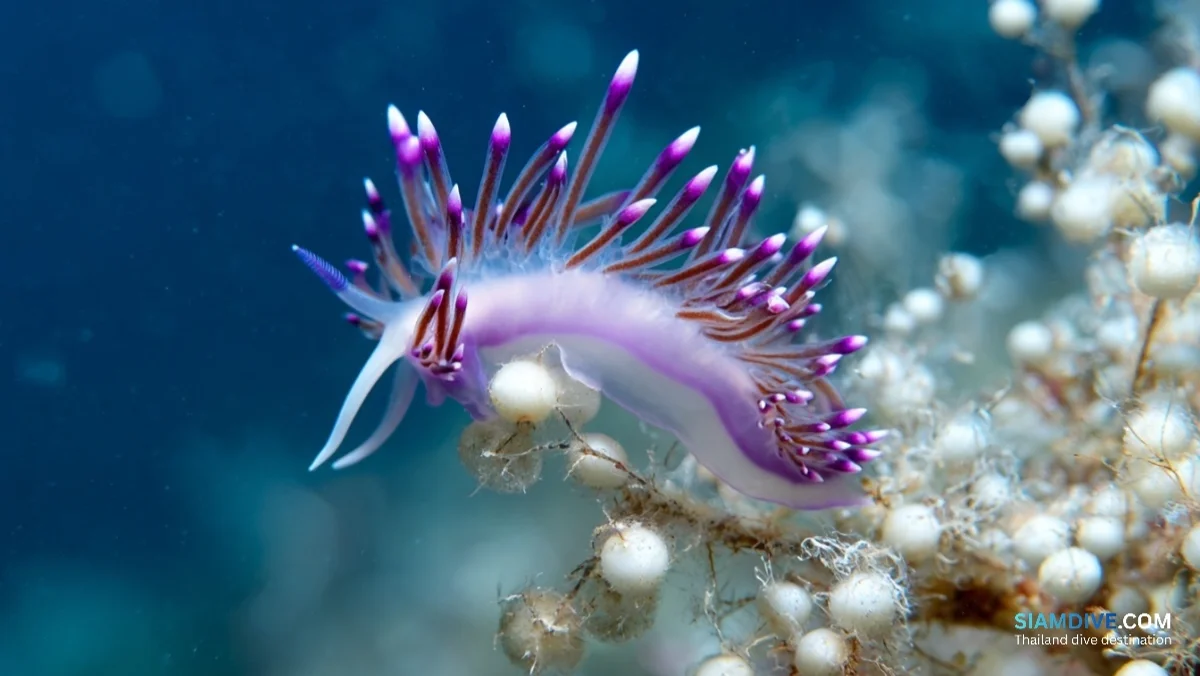
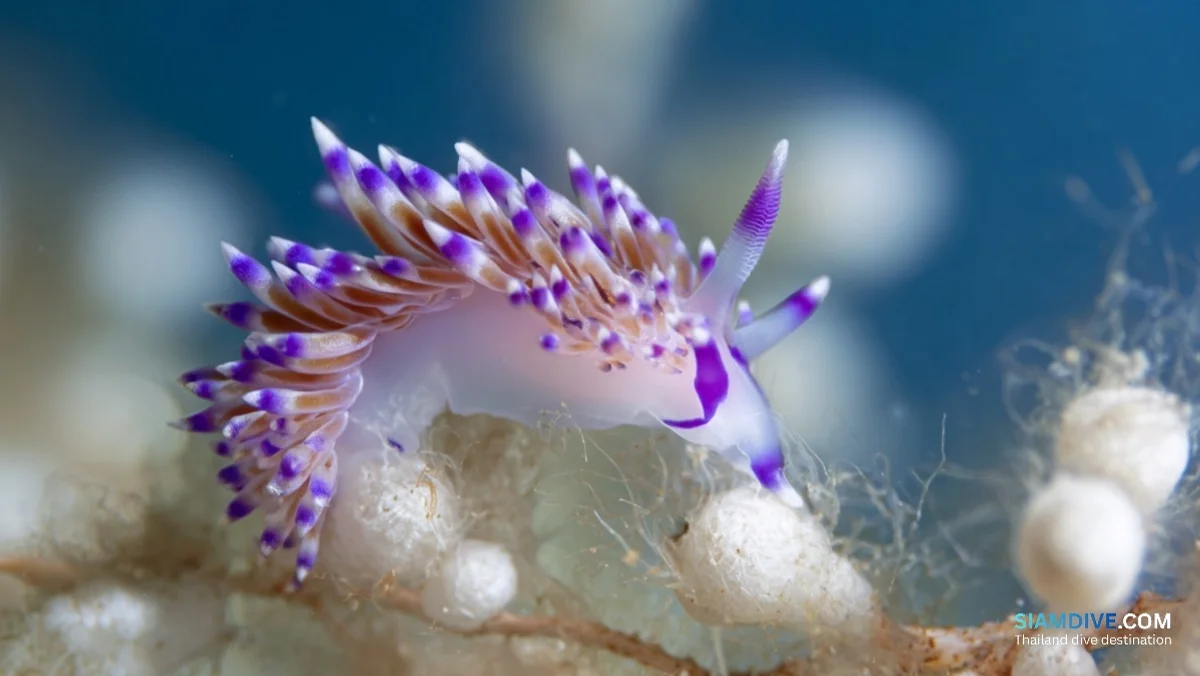
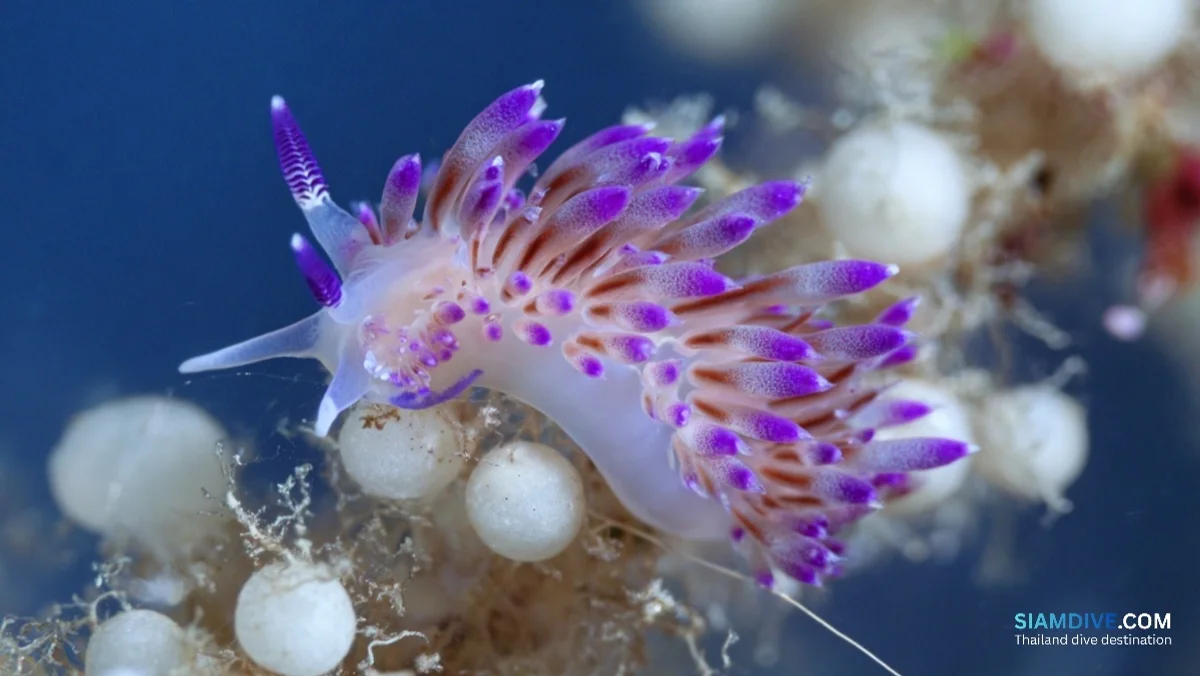
- Flabellina spp. — small, purple-tipped, common on hydroids at 8–15 m depth across most Koh Tao sites
- Favorinus spp. — an egg predator that eats other nudibranchs' egg masses, sometimes from its own species
Walking Poison Factories — Phyllidia and the Toxic Sponge Eaters
Flip the defence strategy. Instead of stealing weapons, dorid nudibranchs absorb chemical toxins from the sponges they eat and store them in glands across their mantle. Phyllidia varicosa — the species Thai divers sometimes call the "fried egg nudi" for its lumpy yellow-and-black pattern — is so saturated with sponge-derived toxins that placing one in a bucket of seawater can kill the fish sharing the container. The bright colour is aposematic: a visual warning that says don't.
Phyllidiids are among the easiest nudibranchs to spot at Koh Tao because they feed in the open during the day, unlike many species that emerge only at night. Their bold patterns make them the gateway species for divers just learning to look small. A first sighting of Phyllidia varicosa on a sponge-covered boulder at 10 metres tends to recalibrate what a diver thinks is worth hovering over.
- Phyllidia varicosa — black with raised yellow tubercles, 6–12 cm, found on sponge-covered boulders at almost every Koh Tao site
- Phyllidia ocellata — pink-grey body with black-ringed bumps, common at Green Rock and Laem Thian
- Phyllidiella pustulosa — grey-black with pink-tipped tubercles, the single most-photographed phyllidiid on the island
Chromodoris: The Ones Everyone Photographs First
At eight metres on a boulder at Ao Leuk, a Chromodoris annulata crosses a patch of encrusting sponge. Its mantle is white rimmed with orange, its gills a translucent rosette pulsing faintly with each breath. It moves with the unhurried confidence of an animal that tastes terrible — which it does, thanks to the same sponge-sequestered chemicals that protect its dorid cousins.
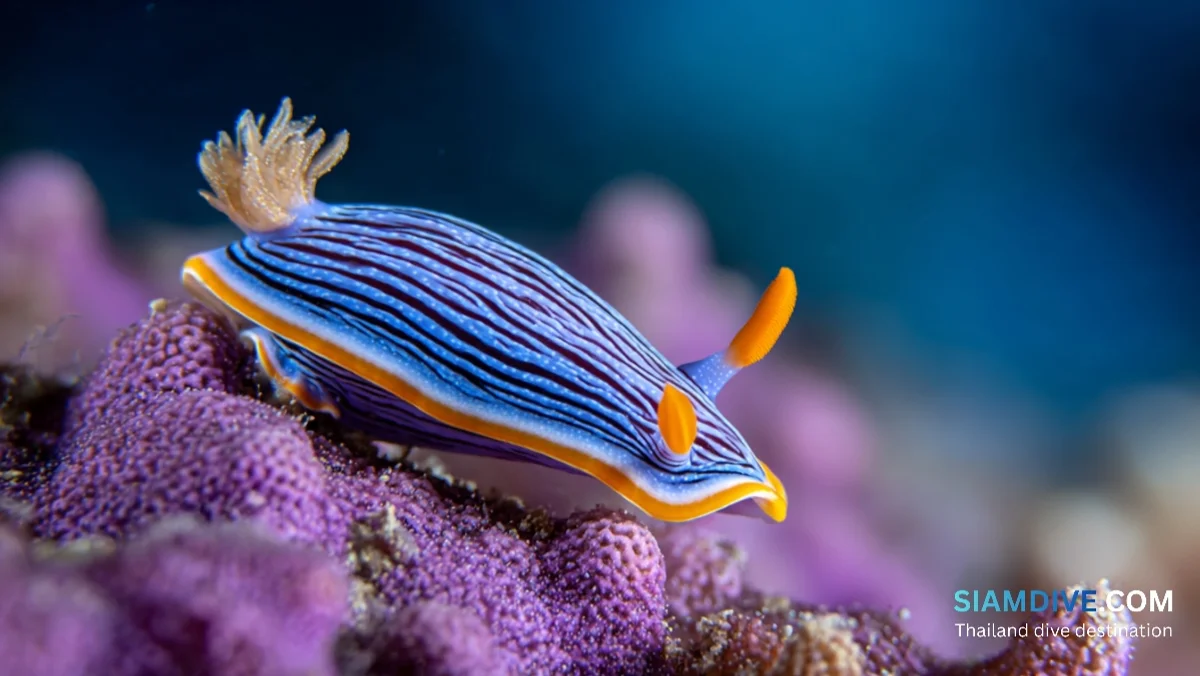
Chromodorids are the poster children of nudibranch photography: vivid, slow, and usually out in the open. Koh Tao's reefs host several species, and telling them apart requires looking at details most divers skip — the shape of the rhinophores (the two club-shaped sensory organs on the head that detect chemical cues in the water), the gill arrangement, and the exact colour of the mantle border.
- Chromodoris annulata — white body, orange mantle border, common across all depths
- Chromodoris lochi — blue body with black and yellow longitudinal lines, a favourite at macro-focused sites
- Goniobranchus spp. — closely related genus, often misidentified as Chromodoris in field conditions
Nembrotha: Bold, Bright, and Hard to Miss
Where chromodorids are delicate, Nembrotha species are blunt instruments — large (up to 12 cm), vividly patterned, and visible from a metre away without a macro lens. Nembrotha kubaryana, with its black body streaked in green and orange, feeds on colonial tunicates and carries enough sequestered toxins to discourage any predator that ignores the colour warning. Divers at Chumphon Pinnacle and Southwest Pinnacle occasionally find them on the deeper sections of the reef where tunicates cluster on vertical rock faces between 18 and 28 metres.
The genus is worth watching for behaviour, too. Nembrotha species are among the few nudibranchs large enough to observe feeding in real time — their radula scraping across a tunicate colony produces visible damage in the span of a single dive. Mating behaviour is equally conspicuous: as simultaneous hermaphrodites, two individuals align head-to-tail and exchange sperm in both directions at once, a process that can last 15 minutes and happens in full view on the reef.
A Species Found Nowhere Else
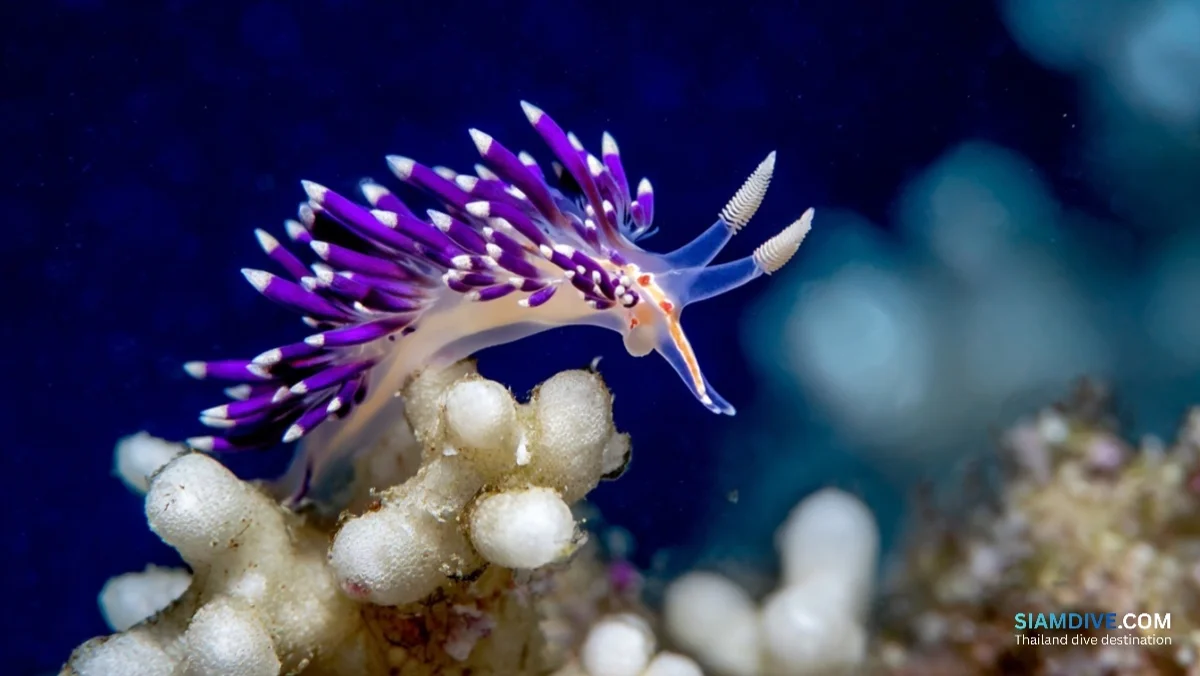
In 2009, divers working on a coral nursery near Chalok Ban Kao — a bay on Koh Tao's southern shore — noticed a small aeolid nudibranch they couldn't match to any field guide. Cream-yellow body, cerata banded in violet with white tips, a violet line running along the dorsum. Specimens kept turning up on artificial reef structures, nursery frames, old fishing nets, and marine debris around the island. Ten years of collection and taxonomic work later, Zootaxa published the formal description in 2019: Unidentia aliciae, named after researcher Alicia Hermosillo of the University of Guadalajara.
As of the most recent surveys, Unidentia aliciae has been recorded only at Koh Tao. Whether the species exists elsewhere and has simply gone unnoticed is an open question — but for now, it belongs to this island alone. Its preference for artificial substrates suggests it may be a coloniser of disturbed habitats, which makes Koh Tao's mix of natural reef and human-made structures an ideal hunting ground for researchers and macro-obsessed divers alike.
Where to Go Slow
Not every Koh Tao dive site rewards the nudibranch hunter equally. The best spots share a few traits: mixed substrate (coral rubble meeting sand or artificial structure), healthy hydroid growth, and enough sponge cover to support dorids. Five sites stand out.
- Green Rock — swim-throughs and overhangs coated in sponge and hydroids; strong Phyllidia and Chromodoris diversity at 10–25 m
- Laem Thian — shallow, sheltered, loaded with caves and crevices; ideal for long macro dives at 5–14 m without current stress
- Ao Leuk — gentle slope with rubble patches between coral heads; one of the island's most reliable spots for Chromodoris and flatworms at 6–18 m
- Hin Wong Pinnacle — deeper (12–22 m) granite boulders with encrusting invertebrates; aeolids on hydroids along the east face
- Tanote Bay — hydroids on the sandy margin between 6–12 m attract aeolid species harder to find on coral-dominated sites
The universal rule: move at half your normal pace. Most nudibranchs are 1–5 cm long. At a standard drift speed, they blur into background texture. Drop to a crawl, hover over a single boulder for five minutes, and the reef reveals what you've been swimming past on every previous dive.
What April 2026 Looks Like Underwater
April sits squarely in Koh Tao's peak window. Water temperatures hover around 30 °C, visibility stretches to 20–30 metres on good days, and seas stay calm enough for sites that are washed out during monsoon months. A February 2026 field guide published by New Heaven Dive School confirmed that nudibranch diversity remains strong heading into the hot season, with Phyllidia and aeolid sightings reported across most surveyed sites.
For macro hunters, the timing is practical as well as biological. Calm water means less surge on shallow sites like Laem Thian and Ao Leuk, which translates directly into steadier camera work and longer hover time over a single subject. The tradeoff: April's heat pushes water temperatures to the upper end of nudibranch comfort, and some species shift to deeper, cooler zones below 15 m as the season progresses. Checking conditions with local dive operations before booking a macro-focused day is worth the five-minute conversation.
Sources
- PMC/ZooKeys — An updated inventory of sea slugs from Koh Tao, Thailand (2021)
- Marine Biodiversity — Hydroid-associated nudibranchs and a new species of Doto from the Gulf of Thailand (2025)
- New Heaven Reef Conservation — New species of sea slug discovered at Koh Tao
- Smithsonian Ocean — Aeolid nudibranch defense mechanisms
- PADI — Diving in Koh Tao site reference