The 4-Second Fix When Your BCD Won't Stop Filling
23 เมษายน 2569
A stuck BCD inflator can launch you to the surface in seconds. Three faults cause it — salt, sand, and O-rings — and one disconnect ends it in four.
Somewhere around 22 metres, with a quarter tank left and a clean safety stop ahead, the left shoulder starts lifting. Not much at first — just enough to tilt the rig slightly starboard. Then the hiss. Air forcing its way into the bladder without anyone touching the inflate button, the BCD swelling tight in seconds, and the depth gauge numbers dropping fast. A stuck power inflator is one of the quickest mechanical failures in recreational diving. It is also one of the simplest to solve — four seconds, three moves, no tools — provided the hands move before the adrenaline takes over.
Inside the Valve
Eight to ten bar of intermediate pressure — that is all a power inflator needs from the first stage to fill a BCD bladder. Press the inflate button and a spring-loaded piston lifts off its seat, letting LP air flood in. Release the button and the spring pushes the piston back down, sealing the valve shut. The mechanism is deliberately simple: fewer moving parts, fewer failure points.
But simplicity cuts both ways. Anything preventing the piston from fully reseating keeps the valve open. Sand grains smaller than a millimetre can wedge between piston and seat. Salt crystals bond to the spring coils and shorten their travel. A degraded O-ring swells past its groove and blocks the seal physically. The valve does not have a "partially stuck" state — it is either sealed or it is not.
Most sport-diving inflators use a Schrader-type valve, the same basic architecture found in bicycle and car tyres. These valves corrode fast in saltwater. Unless rinsed and dried between dives, the spring mechanism gradually binds. A valve that sealed perfectly on the morning dive can jam on the afternoon dive after an hour of Thai sun on a Similan day-boat deck.
Three Faults, Same Result
Every stuck inflator traces back to one of three mechanical problems. The symptoms are identical — continuous, unwanted inflation — but the root cause determines whether a freshwater rinse fixes it or the whole mechanism needs replacement.
- Salt crystal binding — The most common trigger in tropical diving. Seawater enters the valve during the dive; when the BCD sits on a sun-baked deck between dives, the water evaporates and leaves crystalline deposits on the spring and piston face. Andaman coast operators running daily Similan trips during the November–April season see this fault more than any other in rental fleets, because turnaround times between dives leave little opportunity for thorough freshwater rinses.
- Sand or silt ingress — Shore entries at sites like Racha Yai's bays, Koh Tao's shallow training grounds, or Ao Nang's limestone shoreline drag gear through fine sediment. One grain lodged against the piston seat is enough to prevent a full seal. The inflator may close almost completely — no audible hiss, no obvious leak — until depth pressure shifts the grain into the exact wrong position.
- O-ring degradation — Power inflator O-rings (typically 8–12 mm, silicone or Buna-N) endure constant compression cycling. Over seasons, the material hardens, cracks, or swells. A swollen O-ring extrudes past its groove and physically blocks the piston. DAN's incident database notes that field repairs using softer O-ring compounds carry elevated risk — the softer material can blow out under intermediate pressure, jamming the valve fully open.
All three faults share one trait: they are preventable with regular maintenance and impossible to diagnose by looking at the outside of the inflator.
The Emergency Sequence: Dump, Disconnect, Inflate
Confined water, session three — most divers practise this drill once during their Open Water course and never again. The sequence is designed to arrest an ascent before it becomes uncontrolled, and it works at any recreational depth. Four seconds, three moves.
Second 1–2: Dump air
The moment unexpected buoyancy hits — the shoulder lifts, the depth reading drops — raise the left arm and hold the deflate button on the corrugated hose. Keep it pressed. If the left shoulder dump is not accessible, reach for the rear dump valve, usually a toggle pull on the lower right of the bladder.
Here is the design fact that makes the whole sequence viable: modern BCDs are engineered to exhaust faster than they fill. The dump valve or oral deflator outlet is physically larger than the LP feed orifice. Even with the power inflator stuck fully open, holding one dump valve open prevents further net inflation. The diver does not continue ascending as long as at least one exhaust path stays open.
Second 2–3: Disconnect the LP hose
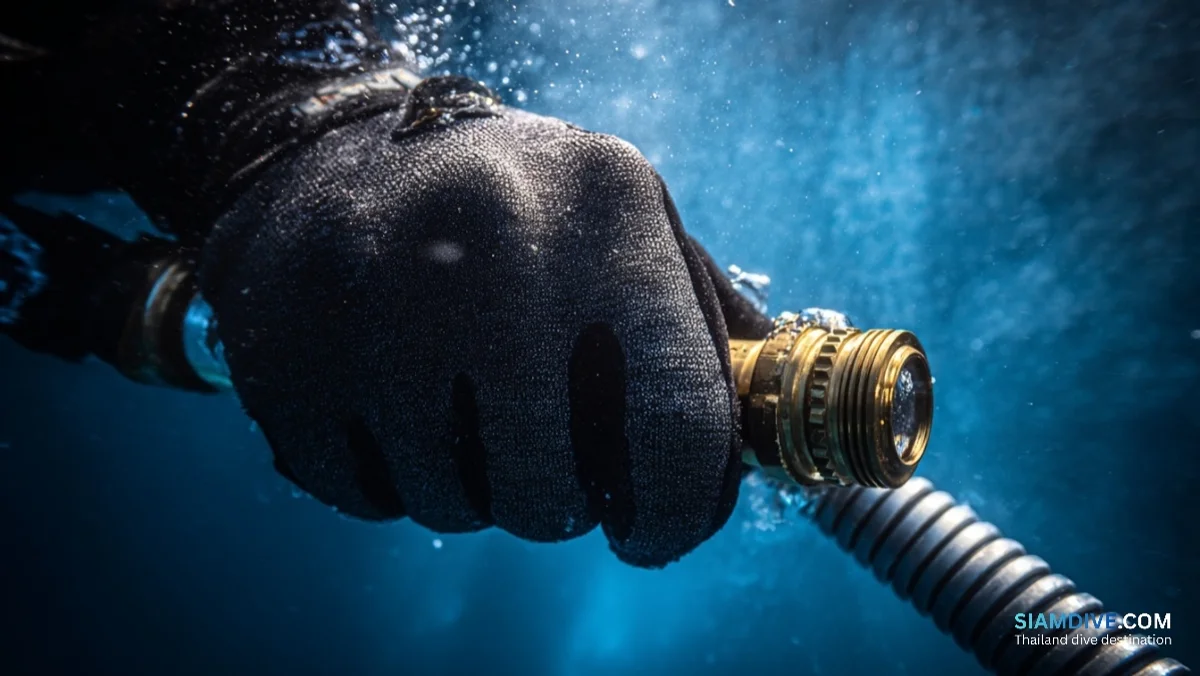
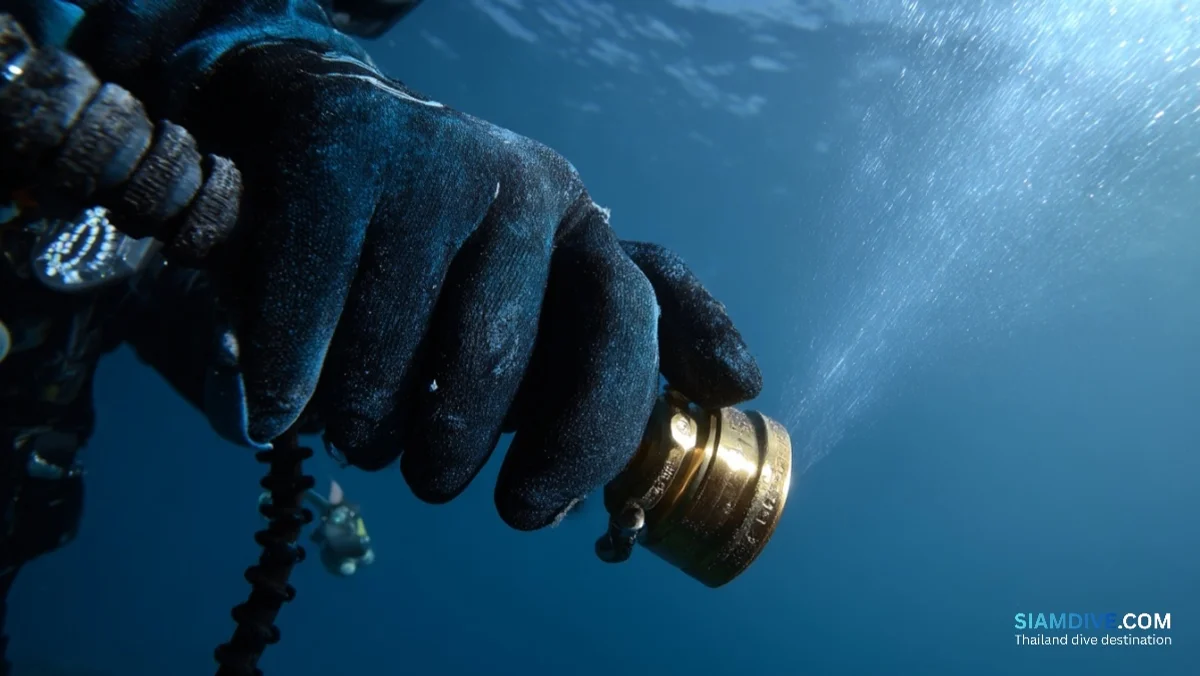
With the right hand, trace the corrugated hose down to the LP connection — where the rubber low-pressure hose from the first stage meets the inflator body. Grip the quick-disconnect fitting (a spring-loaded collar, typically brass or chrome-plated), pull the collar back, and pull the hose away. There may be a sharp pop as residual air vents from the fitting. Normal.
Once disconnected, the first stage can no longer feed air into the BCD. The problem is mechanically solved. Anyone who has practised the out-of-air emergency drill recognises the pattern: the trained response finishes before the adrenaline peaks.
Second 3–4: Switch to oral inflation
Release the dump valve. Check depth, buddy position, and remaining air. For the rest of the dive, use the oral inflate function on the corrugated hose — press the button, blow into the mouthpiece, release. It works at any depth, though it demands more lung effort below 15 metres. Diving on a nitrox mix does not change the oral inflation procedure, but it does affect how aggressively you should plan the remainder of the dive profile.
- Step 1 — Dump: raise left arm, press and hold deflate; dump valve exhausts faster than the LP inflator fills
- Step 2 — Disconnect: right hand to quick-disconnect collar, pull back and pull hose away; one pop, done
- Step 3 — Oral inflate: blow into corrugated hose mouthpiece for the remaining dive; more effort below 15 m but fully functional
- After the sequence: signal buddy, check depth and air supply, continue dive or begin controlled ascent at 9 m/min
Why the Design Is Already on Your Side
BCD manufacturers build in a deliberate flow asymmetry. The LP feed orifice into the inflator is narrow — typically 2–3 mm internal diameter — while the dump valve opening runs 8–12 mm. Exhaust flow rate exceeds intake by a ratio of roughly 3:1 to 5:1, depending on the model and ambient pressure at depth.
This is not a happy accident. ISO 23740, the international standard governing BCD construction, requires that the exhaust system vent gas faster than the maximum inflation rate. Every BCD sold through a certified dealer passes this test. The physics guarantee that a diver who opens a dump valve can always outpace a stuck inflator.
The variable is human. Divers who have not practised the disconnect since their Open Water course — sometimes years ago — tend to freeze for 5–10 seconds before acting. That delay translates to 3–5 metres of uncontrolled ascent. Those who ran the drill recently, or tested the disconnect during a pre-dive gear check, typically finish the sequence within the four-second window. The gap between trained and untrained is roughly six metres of altitude — and potentially a call to DAN's emergency line.
After the Dive: Check, Rinse, Replace
A stuck inflator that has been disconnected underwater should not simply be reconnected for the next dive. The valve demonstrated a failure mode. Without intervention, it will fail again under the same conditions — possibly sooner, since the fault was already progressing.
On the boat (immediately)
- Flush the inflator mechanism with fresh water. Use the deck hose or a bottle. Run water through the inflate button, the deflate button, and the LP connection port for at least 30 seconds.
- Test: reconnect the LP hose and press the inflate button 5–10 times. Watch for sluggish release (the piston returning slowly) or any hissing after the button comes up.
- If it sticks again during testing, do not dive with that BCD. Switch to rental gear or a buddy's spare.
At the shop (within 48 hours)
- Disassemble the inflator head. Most brands require a proprietary spanner or hex key. A certified technician will have the right tool for your model.
- Inspect piston, seat, spring, and O-rings. Replace any O-ring showing hardening, cracking, or deformation. Replace the spring if corrosion is visible — a corroded spring loses tension and will not fully reseat the piston.
- Service kit cost: inflator O-ring and spring kits run 800–1,500 THB (roughly $22–$42 USD) for most major brands. Full mechanism replacement: 2,500–4,500 THB ($70–$125 USD).
SCUBAPRO's April 2026 recall of Monorail weight pockets — affecting units sold November 2025 through February 2026 — addresses an unrelated fault (a D-ring handle that can detach), but it reinforces the principle: check manufacturer recall databases quarterly. New gear is not automatically safe gear.
Keeping Salt Out in Tropical Water
Thailand's warm, salty water accelerates every corrosion pathway. A BCD that runs three seasons in a temperate European lake can develop inflator problems within a single Andaman season of daily use.
- After every dive: press and hold the inflate button while running fresh water over the valve for 15–20 seconds. This forces water through the piston chamber and dissolves salt deposits before they crystallise.
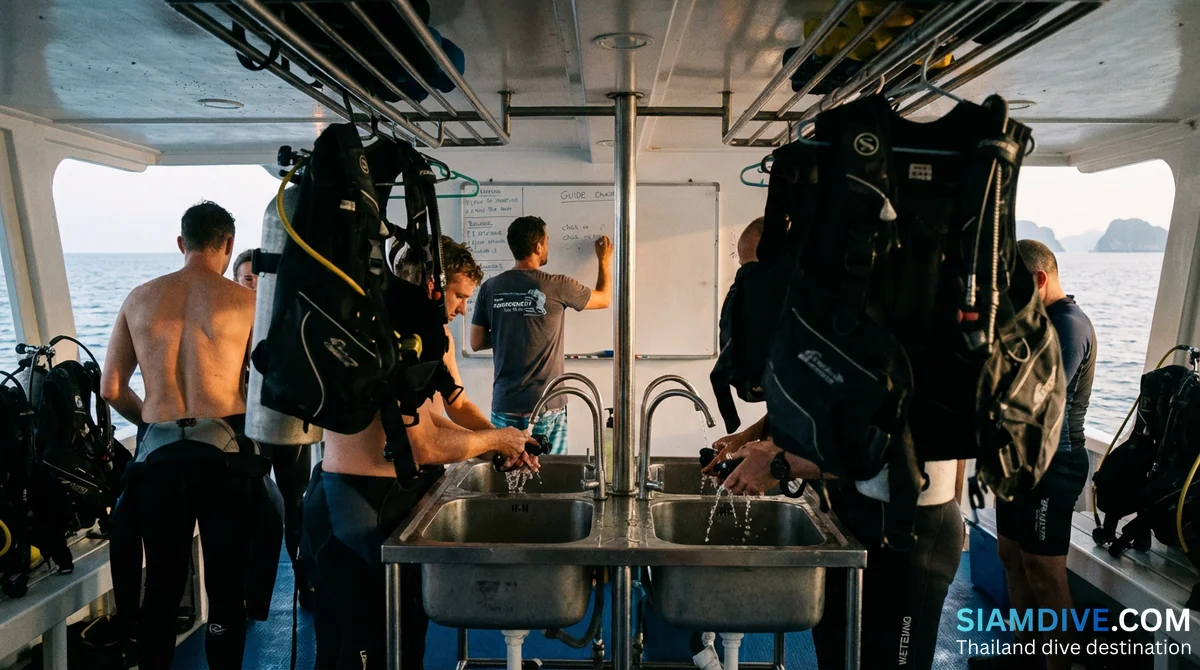
- Between dives on a day boat: if no deck hose is available, pour drinking water over the inflator button and work it several times. Even 200 ml through the mechanism beats nothing.
- Weekly (daily divers): soak the inflator in fresh water with mild white vinegar (5% acetic acid) for 15 minutes. Avoid citric acid above 10% — it attacks brass fittings. Cycle the buttons 10–15 times while submerged.
- Every 100 dives or annually: full inflator service including O-ring replacement, spring inspection, and piston reseating. On the Andaman coast during October–May, two dives per day hits that mark in about 50 days.
For more on how tropical conditions affect first-stage performance, see our breakdown of intermediate pressure creep and that hard pull at 30 metres.