500 Metres from Shark Point, the Reef Nobody Books Alone
29 เมษายน 2569
Anemone Reef hides 500 metres north of Shark Point — a single rock carpeted in colour that most Phuket day boats treat as a bonus dive, never the main event.
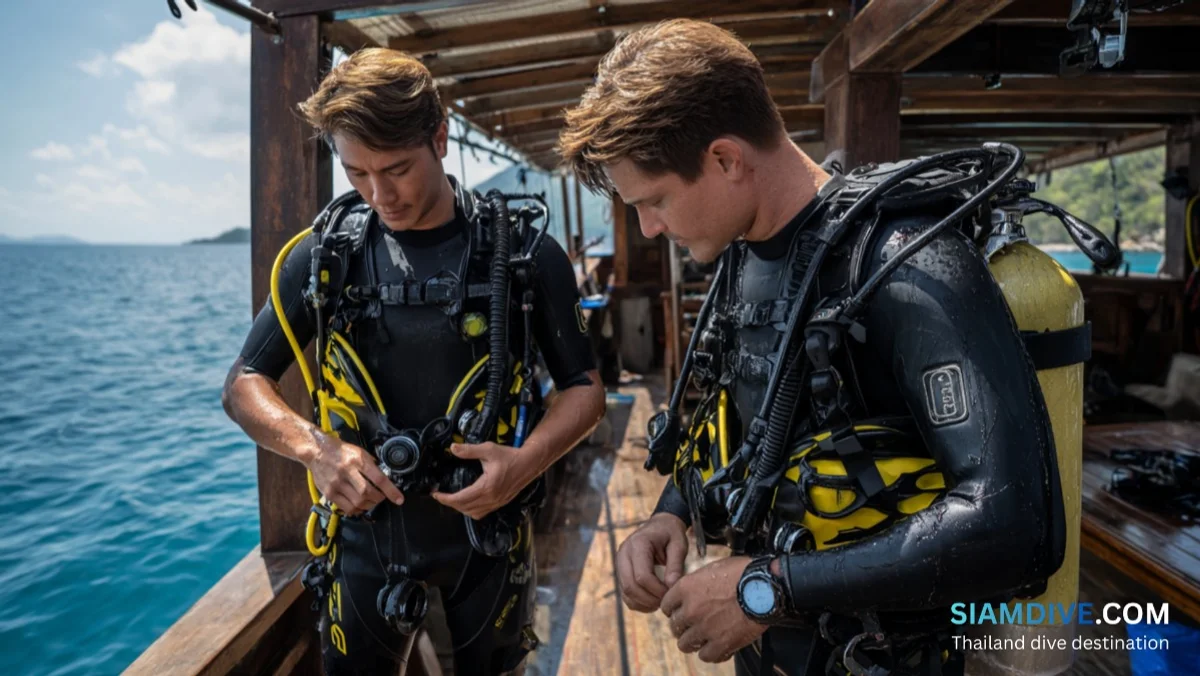
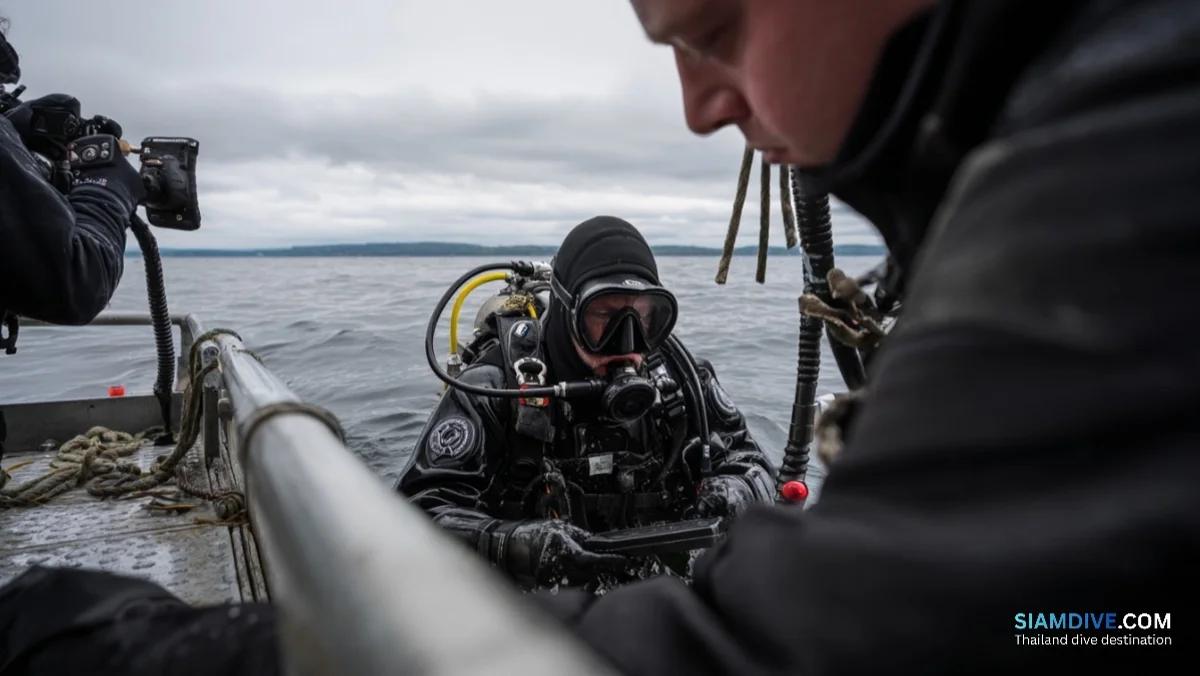
The speedboat idles 500 metres north of Shark Point, engines still rumbling, and the divemaster points at the sonar screen. A single green spike rises from 26 metres of sand to within five metres of the surface. “Anemone Reef,” he says, already clipping the tag line. Half the boat is still pulling on wetsuits — this is the stop between headline dives, the filler, the one that never appears first on any day-trip itinerary. Which is exactly why the divers who pay attention surface grinning wider here than anywhere else on the route.
A Limestone Pillar from 26 Metres to Daylight
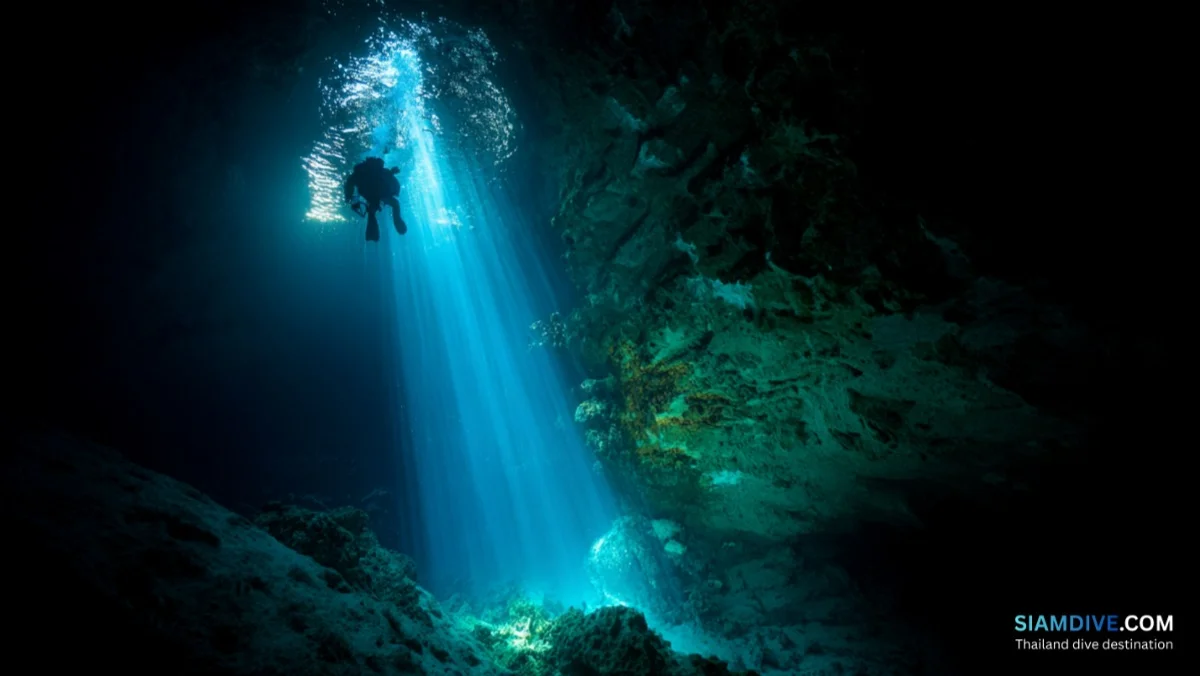
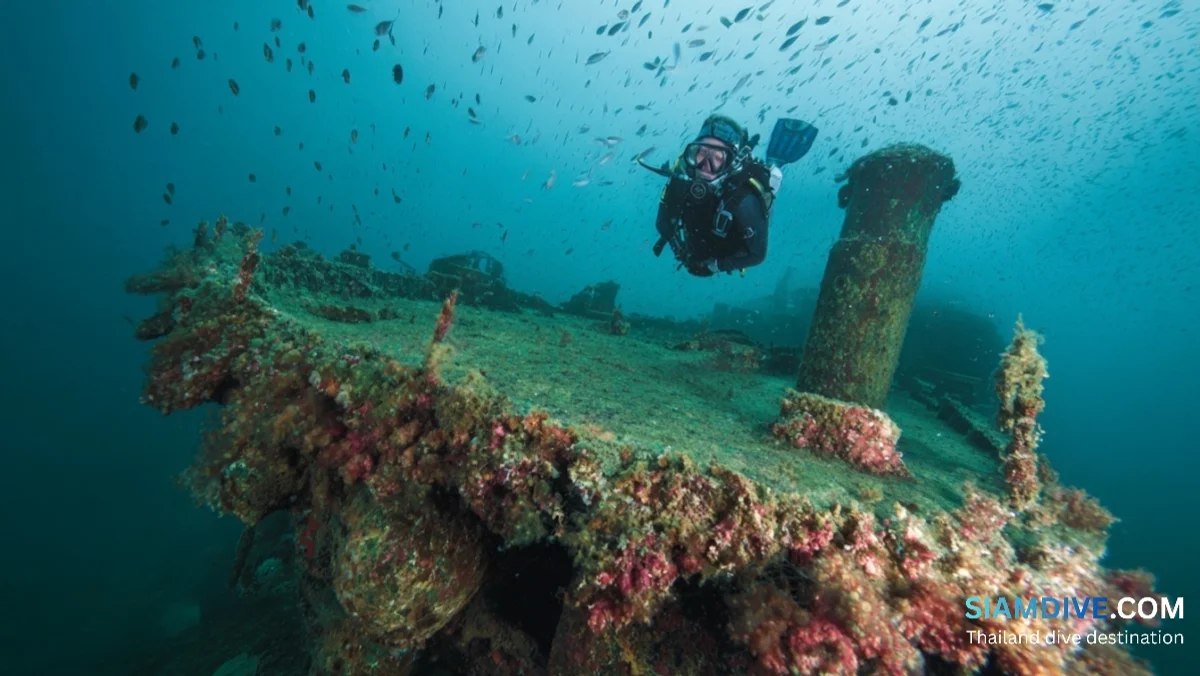
Anemone Reef — known in Thai as Hin Jom, “the submerged rock” — is a single limestone pinnacle rising from a sandy seabed east of Phuket. Unlike its famous neighbour Shark Point, which spreads across three separate pinnacles, Anemone Reef compresses everything into one vertical column roughly 20 metres tall.
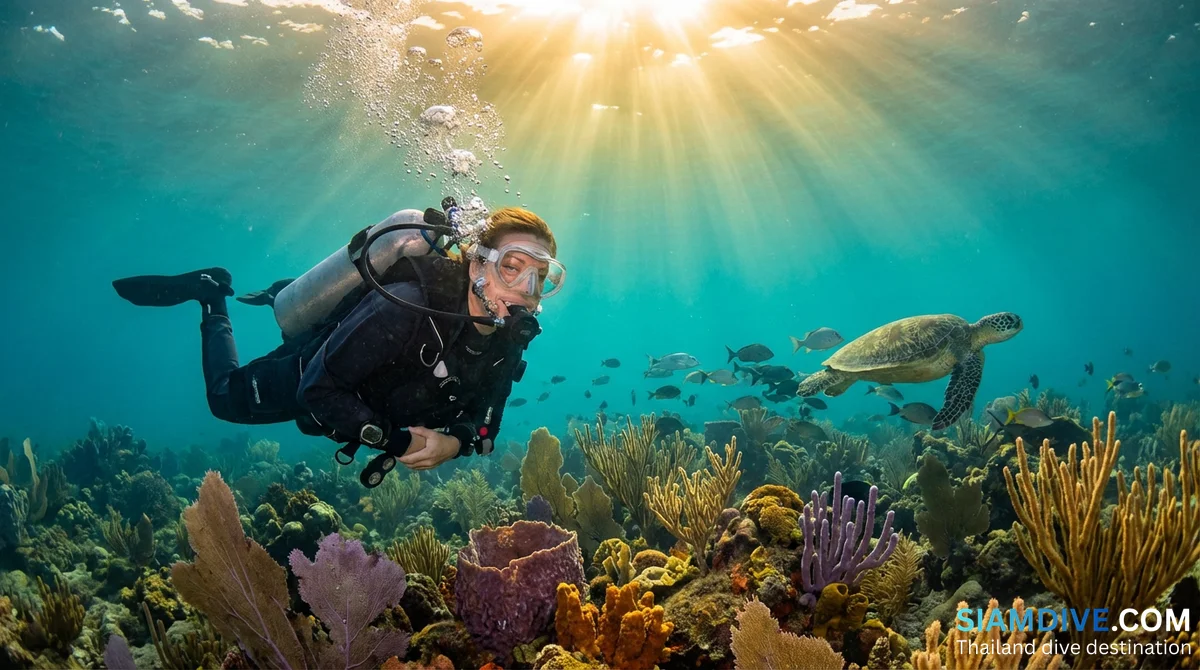
The top sits at four to five metres, shallow enough for sunlight to flood the upper surfaces in morning green and gold. The base fans out onto sand between 24 and 26 metres, depending on which side of the rock a diver descends. A smaller rock formation detaches from the southern flank, separated by a narrow channel — its walls lined with gorgonian sea fans and clusters of purple and red soft coral that catch the ambient current like flags.
- Summit depth
- 4–5 metres
- Base depth
- 24–26 metres on sand
- Structure
- Single limestone pinnacle + detached southern rock
- Distance from Shark Point
- Approximately 500 metres north
- Distance from Phuket
- ~28 km east (Chalong Bay departure)
That compactness is part of the appeal. Where Shark Point rewards roaming — drifting between its three heads — Anemone Reef rewards patience. Every surface centimetre hosts something alive.
Carpet, Colour, Clownfish
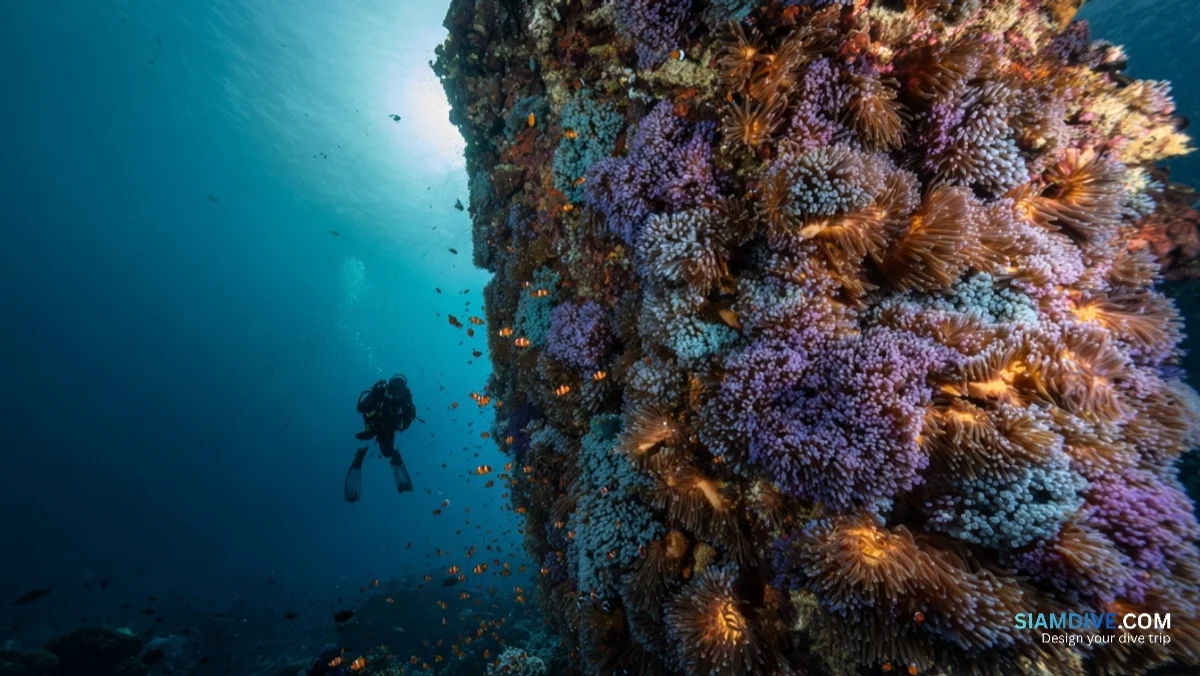
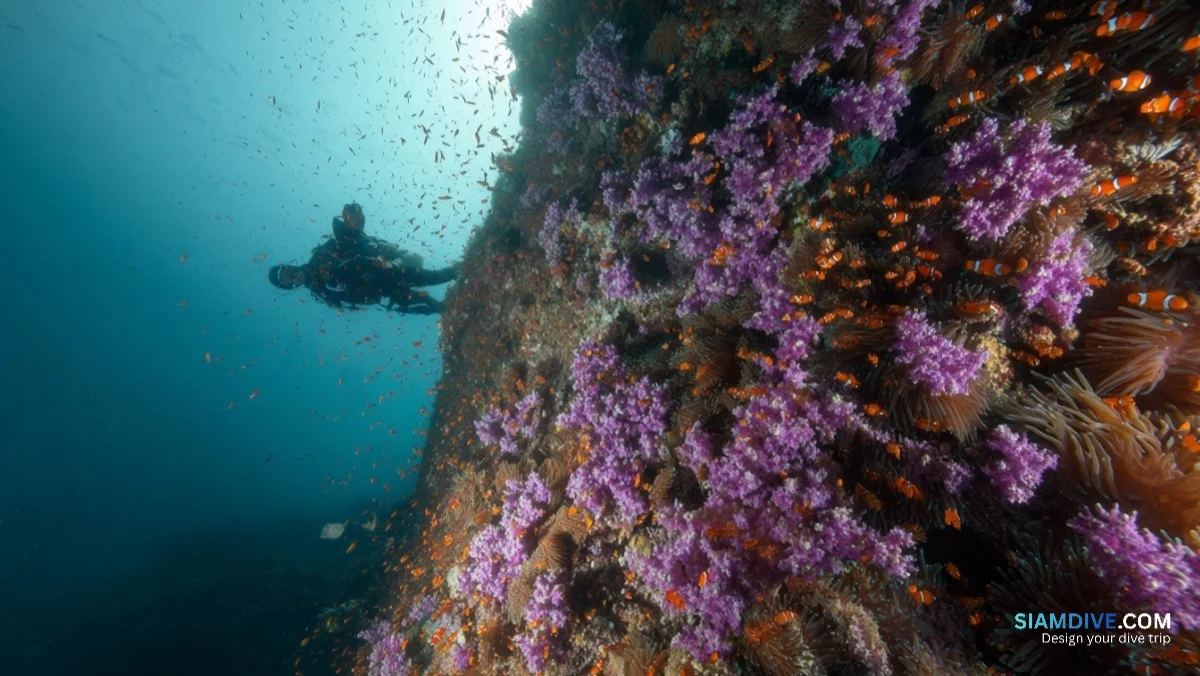
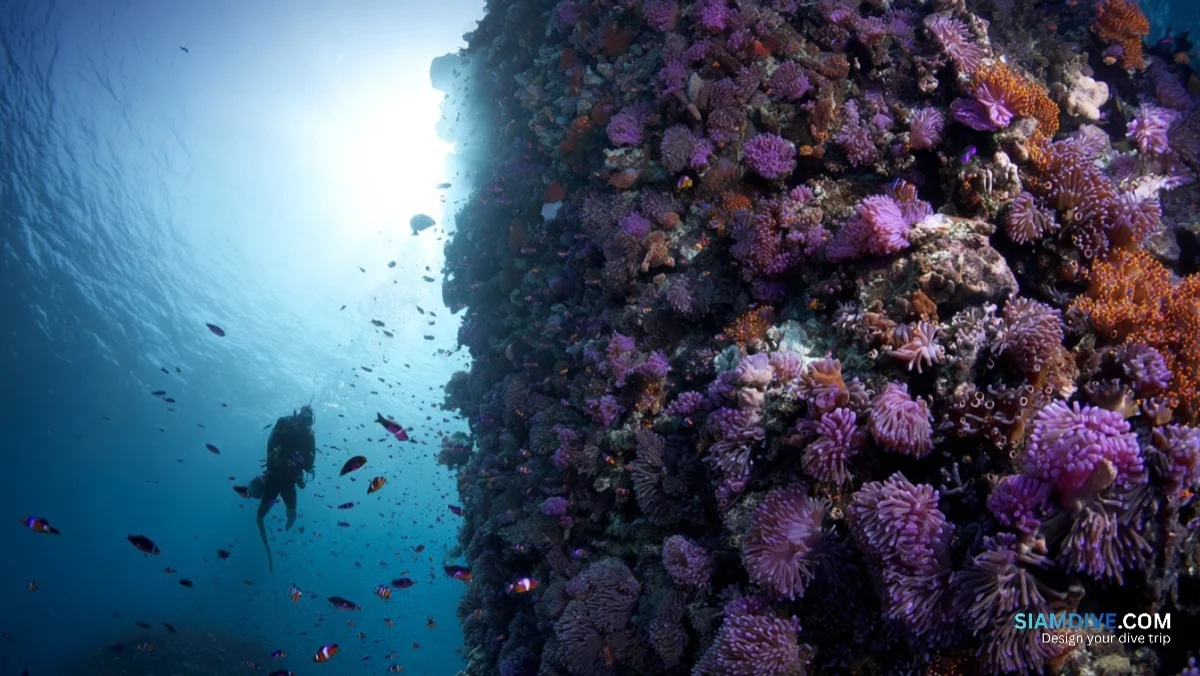
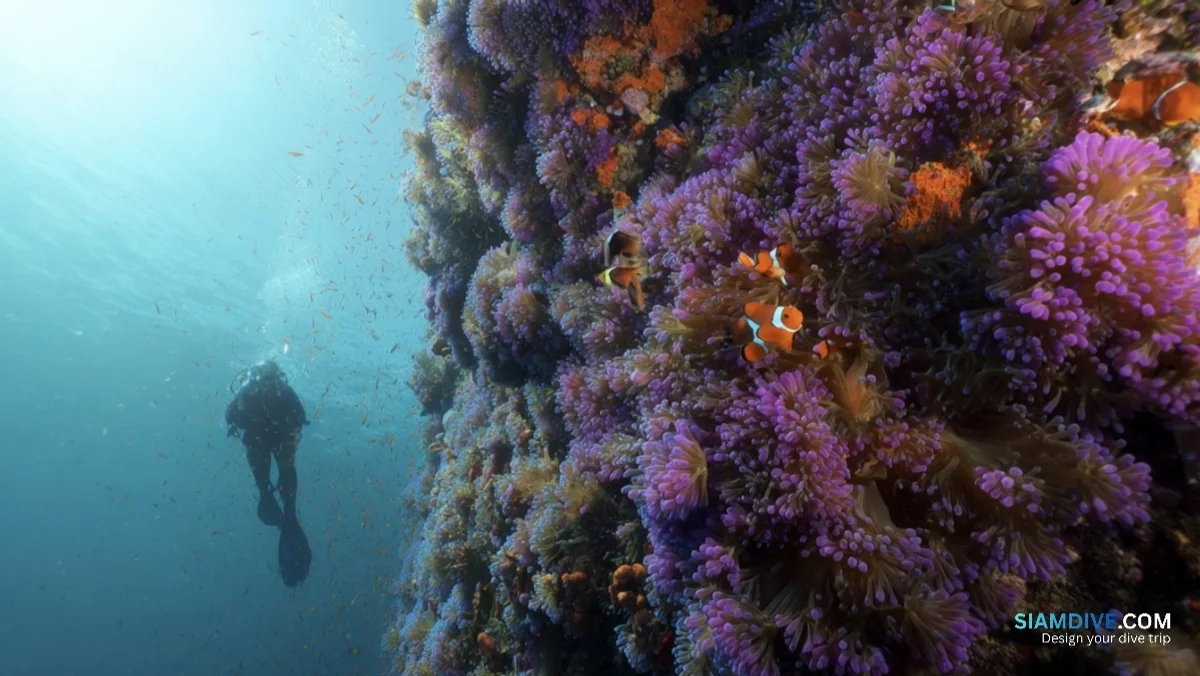
The name is not a metaphor. From roughly 18 metres upward, every exposed face of the rock disappears under a continuous carpet of sea anemones — predominantly magnificent anemones (Heteractis magnifica) and carpet anemones (Stichodactyla species) — whose tentacles sway in unison with the passing current. On peak-visibility days, when the water opens to 20 or even 30 metres, the view from mid-water is a single pulsing wall of colour: lavender, teal, burnt orange, cream.
Nestled inside the tentacles, clownfish dash and posture. At least three species work these anemones — Clark’s anemonefish, skunk anemonefish, and the common clownfish (Amphiprion ocellaris) — each staking territory on a different host. The symbiosis is textbook: anemone provides shelter and stinging defence, clownfish provides ventilation and nutrient scraps. But on this rock, the density turns the textbook into spectacle. There are so many anemone–clownfish pairs stacked on top of one another that the entire upper pinnacle buzzes with territorial bickering.
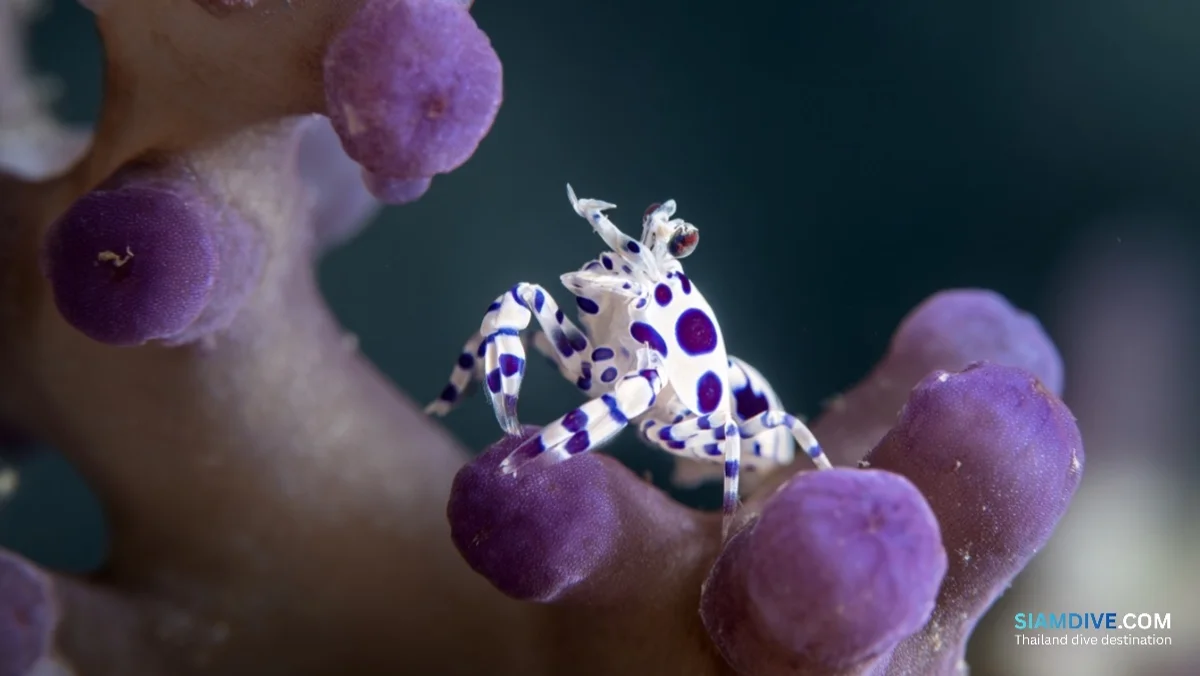
Look closer at the anemone carpet and the supporting cast appears. Translucent Periclimenes shrimp sit on the disc of nearly every large anemone, their purple-tipped claws almost invisible against the host's tentacles. Porcelain crabs wedge themselves into the base folds, filter-feeding with feathery mouthparts that unfurl only when they sense plankton in the water column. These animals are easy to miss on a fast pass — the clownfish grab all the attention — but they represent the second layer of a symbiotic community stacked three or four species deep on a single host.
Below the anemone zone, soft corals take over — whites and yellows on the shaded overhangs, reds and purples on the current-facing surfaces. Gorgonian fans stretch up to half a metre across on the southern rock, oriented perpendicular to the prevailing flow to maximise plankton capture.
Down on the Sand — Leopard Sharks and Stingrays
At the junction where limestone meets sand, the mood shifts. The colour fades, the rock gives way to rubble, and the visibility often drops a few metres near the bottom. This is where patient divers look down, not up.
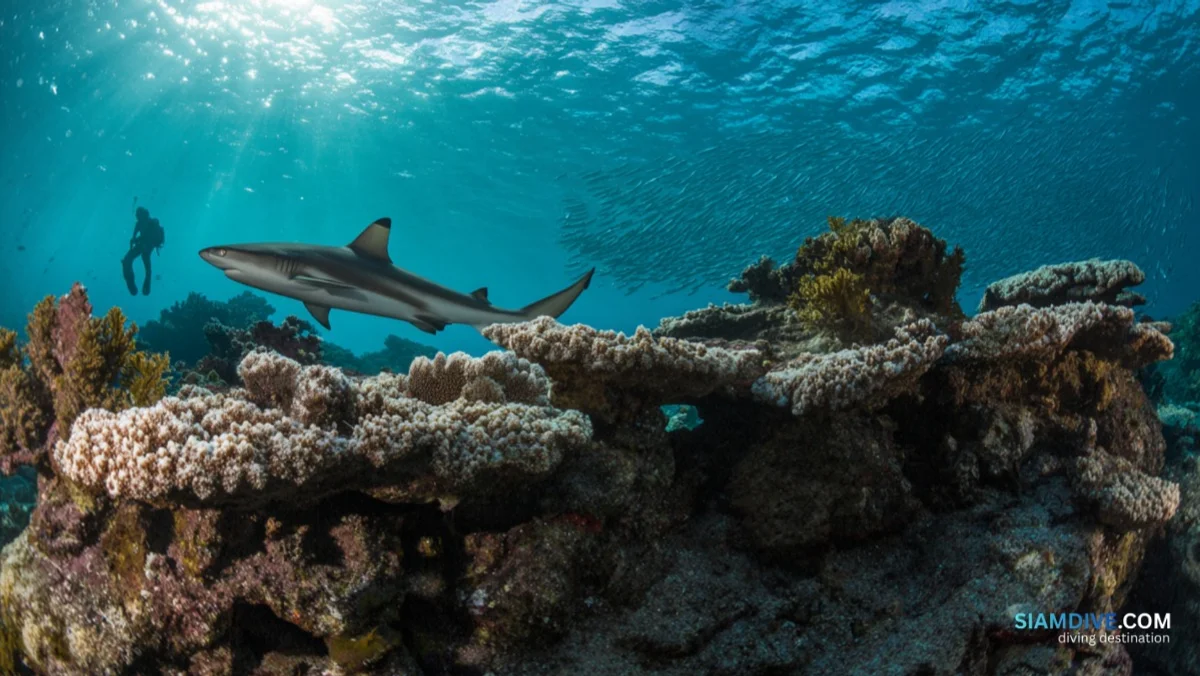
Leopard sharks (Stegostoma fasciatum) — often called zebra sharks in scientific literature — rest on the sandy floor around the base. These are the same population that draws crowds at Shark Point; the two sites share a corridor of sand between them, and the sharks move freely between both pinnacles. Sightings are most consistent from November through March, when water temperatures hover around 27–28 °C and the northeast monsoon keeps the current moderate.
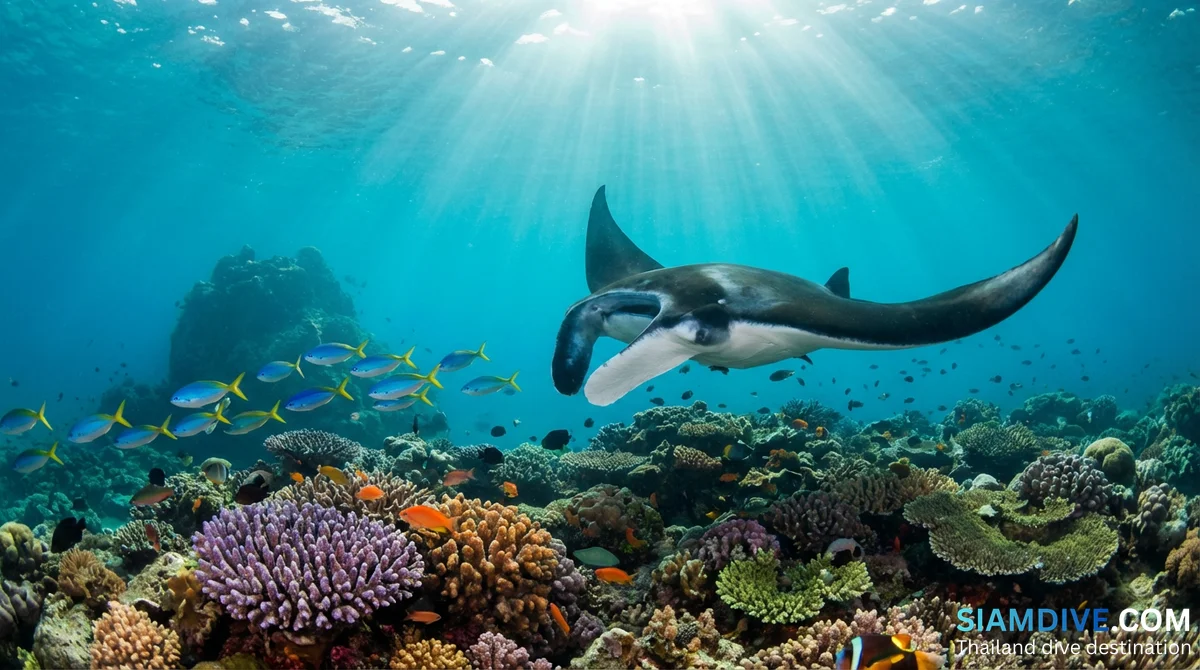
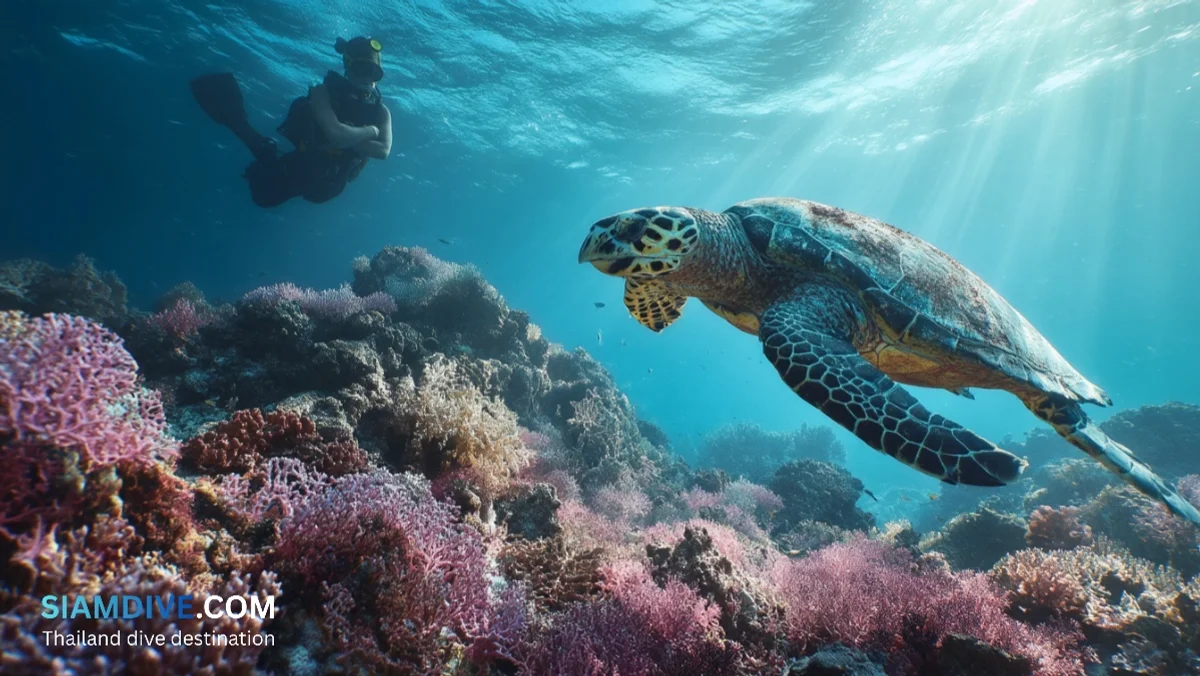
Blue-spotted stingrays tuck under rock ledges just above the sand line, their electric-blue spots visible from a metre or two away. Scan the rubble patches between the main rock and the southern spur for them — they prefer the quiet side, away from the current. Green turtles occasionally cruise past the base of the pinnacle as well, using the rock as a navigation landmark between feeding grounds — sightings are sporadic but well-documented by dive teams operating in the area year-round.
The channel between the two rock formations also funnels larger pelagics on occasion. Schools of yellowtail barracuda circle the outer edge, and trevally flash silver when hunting baitfish pushed against the rock by the flow. These appearances are unpredictable but common enough that experienced dive teams factor them into briefings.
Macro Hunters’ Rock
A camera fitted with a 60 mm or 100 mm macro lens earns its keep here faster than at any other site on the Phuket day-trip circuit. The concentration of invertebrate life per square metre is remarkable.
- Yellow tiger-tail seahorse — documented on the rock at depths between 12 and 18 metres, clinging to soft coral branches. Sightings confirmed in multiple dive logs and aggregate review data from 2024–2025.
- Porcelain crabs — filter-feeding inside anemone hosts, visible on nearly every large Stichodactyla carpet.
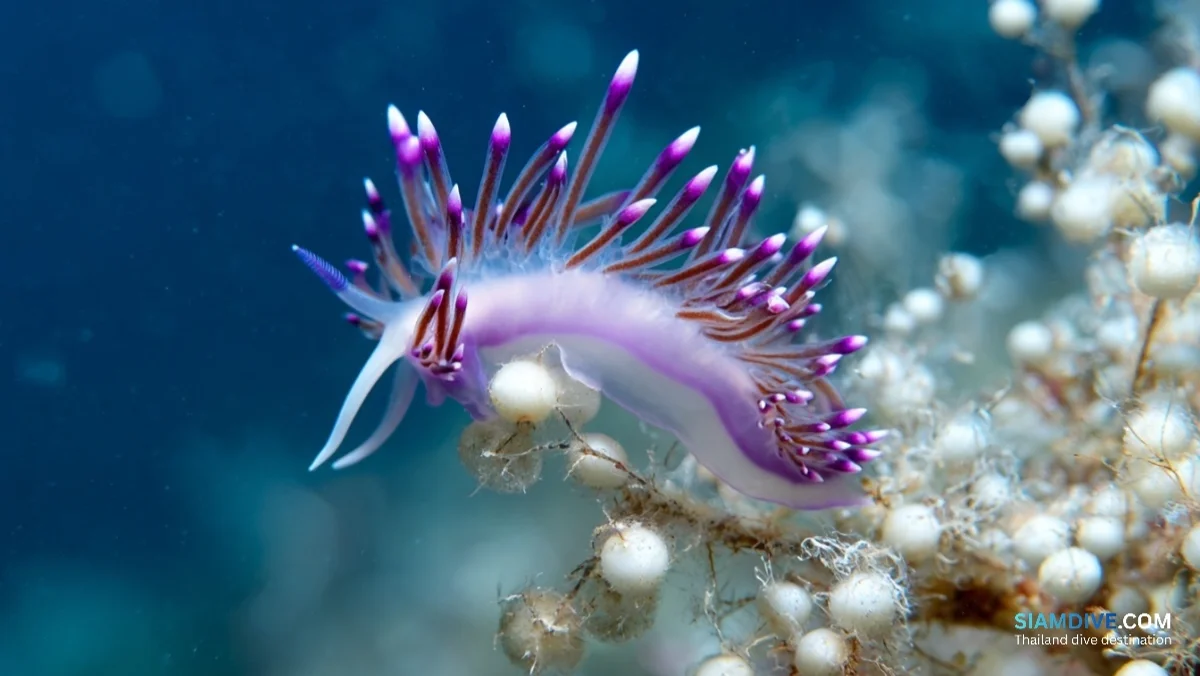
- Nudibranchs — at least a dozen species, including Chromodoris and Phyllidia varieties, grazing on sponge and soft coral.
- Painted frogfish — occasionally spotted tucked into crevices on the main rock’s western face, matching the surrounding sponge colour exactly.
- Ornate ghost pipefish — seasonal, more likely December through February, hovering near crinoids at 15–20 metres.
Shark Point offers better wide-angle opportunities — the three pinnacles stacked against blue water create drama at 14 mm. Anemone Reef does the opposite. It rewards the slow pass, the hover, the second look at what first appeared to be a clump of algae.
Reading the Current Before You Drop
Currents at Anemone Reef range from negligible to strong enough to make a safety stop interesting. Because the rock sits on open sand with no neighbouring reef to break the flow, tidal shifts hit it directly. Slack tide delivers the easiest conditions — near-zero current and often the best visibility. Dive teams who know the site time their drop to coincide with slack or the first hour of incoming tide.
- Peak season — November to April (northeast monsoon): calmer seas, visibility 15–30 metres, water temperature 27–29 °C
- Shoulder months — May and October: diveable but unpredictable; visibility 5–15 metres, occasional strong southwesterly surge
- Off-season — June to September: most dive centres skip the site; wave height and reduced visibility make the trip less worthwhile
Day-trip pricing from Phuket for the standard three-dive combo — typically Shark Point, Anemone Reef, and King Cruiser wreck or Koh Doc Mai — runs 3,600 to 4,000 baht per certified diver with equipment, based on rates published for the 2025–2026 season. Non-divers join for around 2,900 baht. Equipment rental adds roughly 500 baht if not included.
Strong flow occasionally sweeps divers off the pinnacle and into open water — a scenario covered in detail in our guide to handling surface currents.
A note on park fees: Anemone Reef itself does not fall inside a national marine park boundary, so no park entrance fee applies — unlike Phi Phi dive trips that require the 600-baht Hat Noppharat Thara–Mu Ko Phi Phi park fee.
Always the Second Dive — Why That Should Change
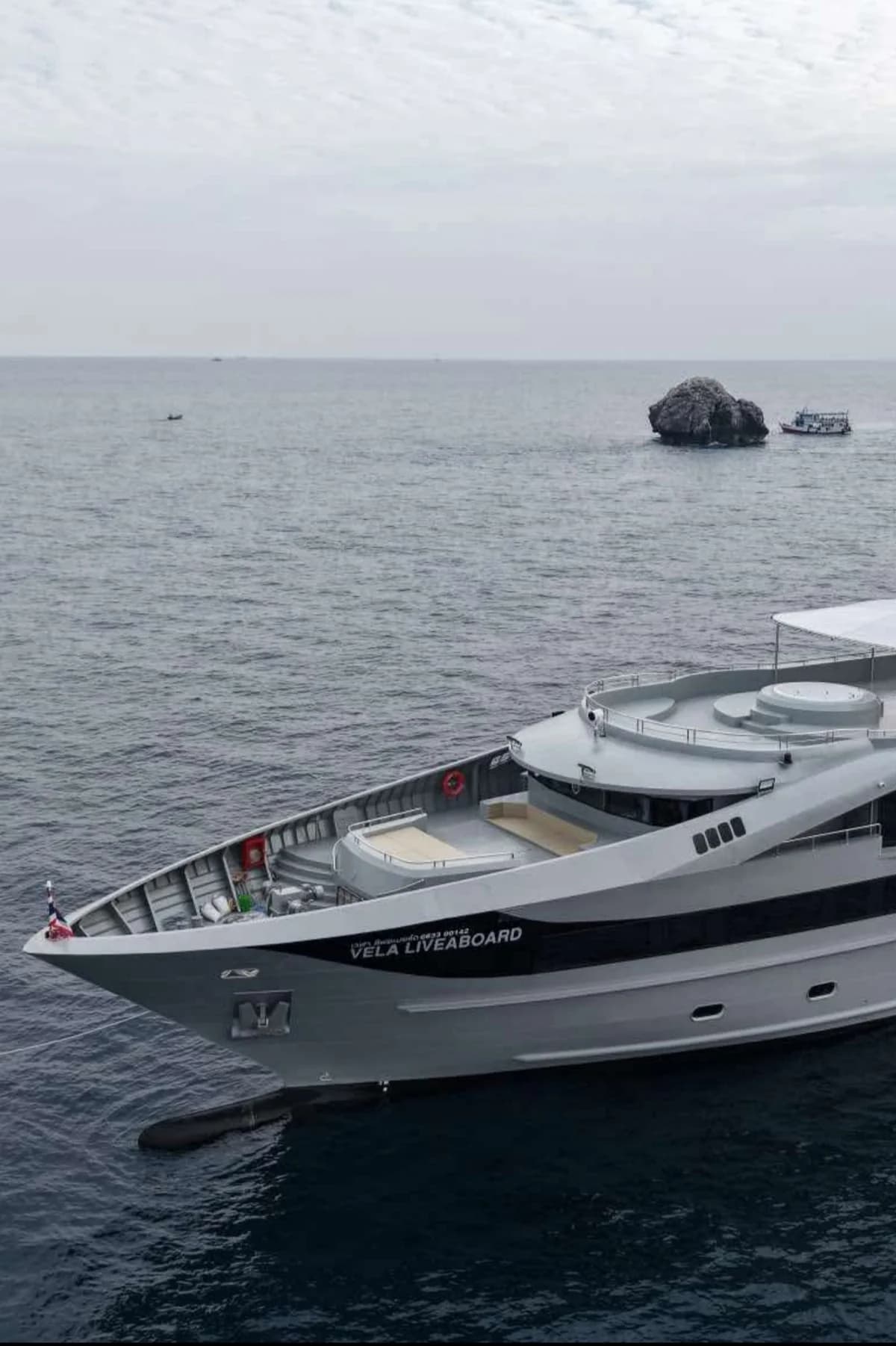
On a standard Phuket day boat, the schedule goes like this: first dive at Shark Point (the name sells), second dive at Anemone Reef or the King Cruiser wreck, surface interval with lunch, third dive wherever conditions allow. Anemone Reef lands in the middle slot — 40 to 45 minutes, sometimes less if the current picks up or the group’s air consumption runs high.
That timeframe shortchanges the site. Sixty minutes on Anemone Reef — dropping to the sand at 24 metres, spiralling slowly up the rock, finishing in the anemone shallows at 5 metres — reveals layers that a quick bounce dive misses. The macro life in particular demands a slow ascent rate not just for decompression safety but because the best subjects sit at eye level only when a diver hovers still long enough for them to re-emerge from hiding.
A practical dive plan for a dedicated Anemone Reef immersion: descend on the current-sheltered side to the sand at 24 metres, spend five minutes scanning for leopard sharks and stingrays, then begin a slow counterclockwise spiral up the rock. Between 18 and 12 metres the anemone density peaks — this is where the seahorses and ghost pipefish hide, so budget at least 15 minutes in this band. Finish with a long safety stop at five metres, hovering over the shallowest anemone clusters where the light is best and the clownfish are boldest. Total bottom time: 55–60 minutes on a standard air fill with moderate consumption.
Some dive centres now offer a dedicated two-dive Anemone Reef package — two drops on the same rock, one deep and one shallow — paired with a single Shark Point dive instead of the wreck. It costs the same. The only difference is intent: treating the reef as the main event instead of the intermission.
A Pinnacle That Outlasts the Heat
A coast-to-coast reef assessment published by Mongabay in January 2026 confirmed what Thai marine biologists had feared: repeated marine heat waves between 2022 and 2024 have pushed many Andaman Sea reefs toward simpler structures, with average coral cover at 35 % — down from the Gulf of Thailand’s 54 %. Branching Acropora corals, the complex architects of reef systems, are declining across the region.
Underwater pinnacles, however, tell a different story. A 2024 study in the Ramkhamhaeng International Journal of Science and Technology found that pinnacles off Krabi Province — sites structurally similar to Anemone Reef — showed only 13–18 % coral bleaching prevalence, well below the broader regional average. The likely explanation: current flow around isolated pinnacles creates natural cooling and nutrient exchange that buffered the worst of the thermal stress.
None of this guarantees immunity. The Phuket Rajabhat University coral cryobank, established in June 2025, is preserving genetic material from Andaman Sea corals as a hedge against future mass bleaching events. For now, though, sites like Anemone Reef remain structurally intact — a small limestone pillar still thick with life, 500 metres from where everyone else is looking.