Surface Current Swept You Past the Boat — Now What?
27 เมษายน 2569
In March 2026, two divers drifted ten nautical miles from their boat. A seven-step protocol and a 2,000 THB signaling kit separate a quick rescue from a twelve-hour ordeal.
On March 14, 2026, two divers dropped into Pasir Akar Marine Park off Pulau Redang, Malaysia. Neither surfaced where they planned. A tidal current swept them northeast, past the park boundary, past the visual range of their dive boat, and into open water. Twelve hours later, rescue boats found them drifting near Pulau Yu — ten nautical miles from the dive site. Both survived. The difference between that outcome and the alternative came down to a handful of decisions made in the first five minutes on the surface.
How 400 Metres Becomes 10 Nautical Miles
Surface currents in Southeast Asian waters routinely hit 1 to 3 knots during tidal changes. At just 2 knots, a diver floating passively covers about 3.7 kilometres per hour — more than a nautical mile every twenty minutes. A 400-metre gap between you and the dive boat turns into a multi-mile separation in the time it takes the crew to run a headcount, reorganize, and begin searching.
In Thailand's Andaman Sea, the problem sharpens during the northeast monsoon season from November to April. Liveaboard sites like Koh Bon Pinnacle, Richelieu Rock, and Elephant Head see thermocline-driven currents that shift speed and direction without warning. Drift dives are standard here — but drift without a pickup plan is how divers disappear.
The BSAC Annual Diving Incident Report for 2024 logged 239 incidents in UK waters and 92 internationally. Six of twelve fatalities that year involved solo diving or buddy separation — a pattern that holds globally. A diver surfaces expecting the boat to be where it was. It isn't.
Seven Steps Between You and the Pickup Boat
Every piece of this protocol exists because someone, somewhere, learned it the hard way. Run through it once on dry land and the sequence sticks when the adrenaline hits.
Step 1 — Stop Swimming and Get Buoyant
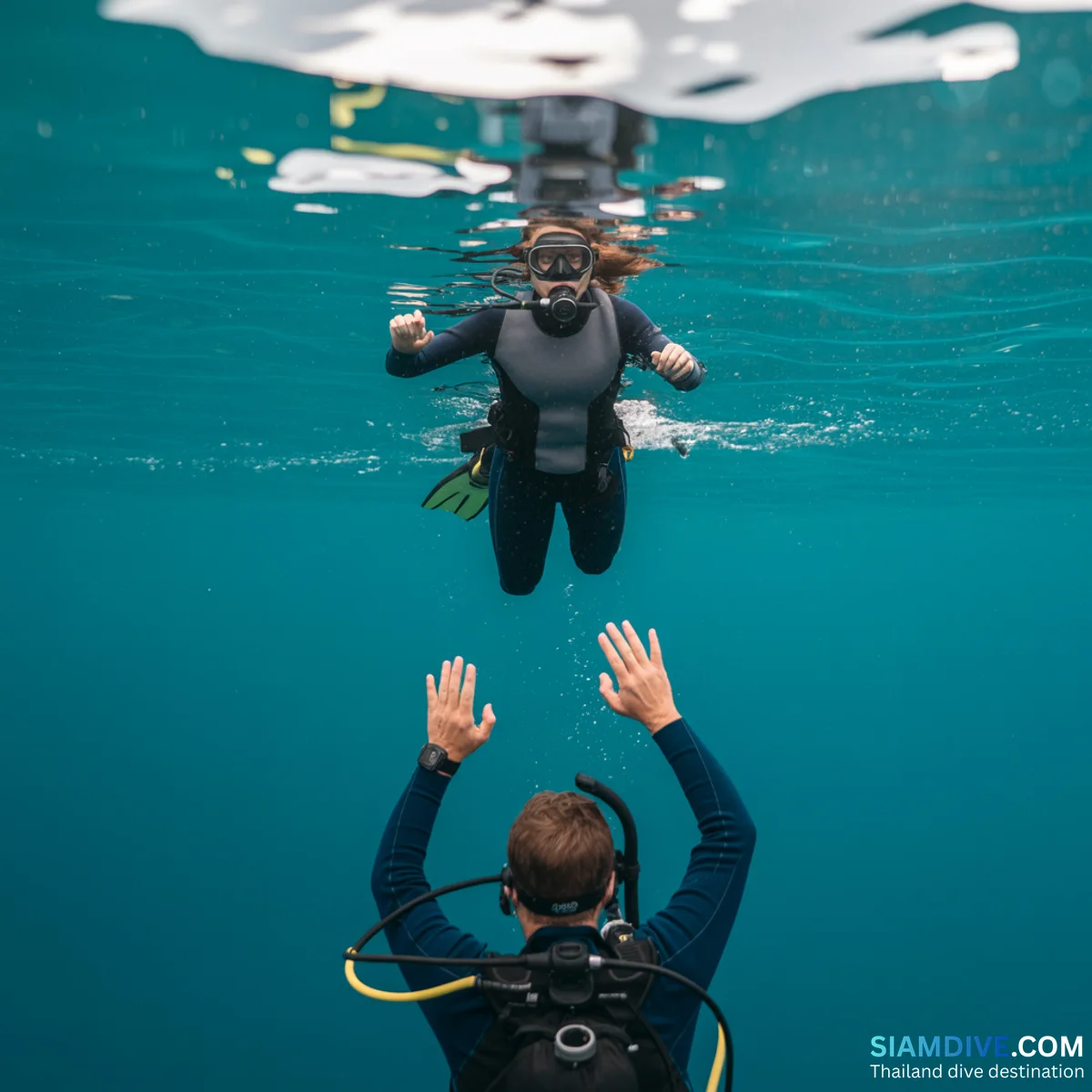
A recreational diver in full gear generates perhaps 1.2 knots of swim speed against the surface. Fighting a current stronger than half a knot burns through energy reserves fast and gains almost nothing. Inflate your BCD fully. If buoyancy is marginal, dump your weights — they are replaceable, you are not. Settle into a stable float with your head and shoulders as high above the waterline as possible. The higher you sit, the farther the boat crew can spot you between swells.
Step 2 — Deploy Your SMB
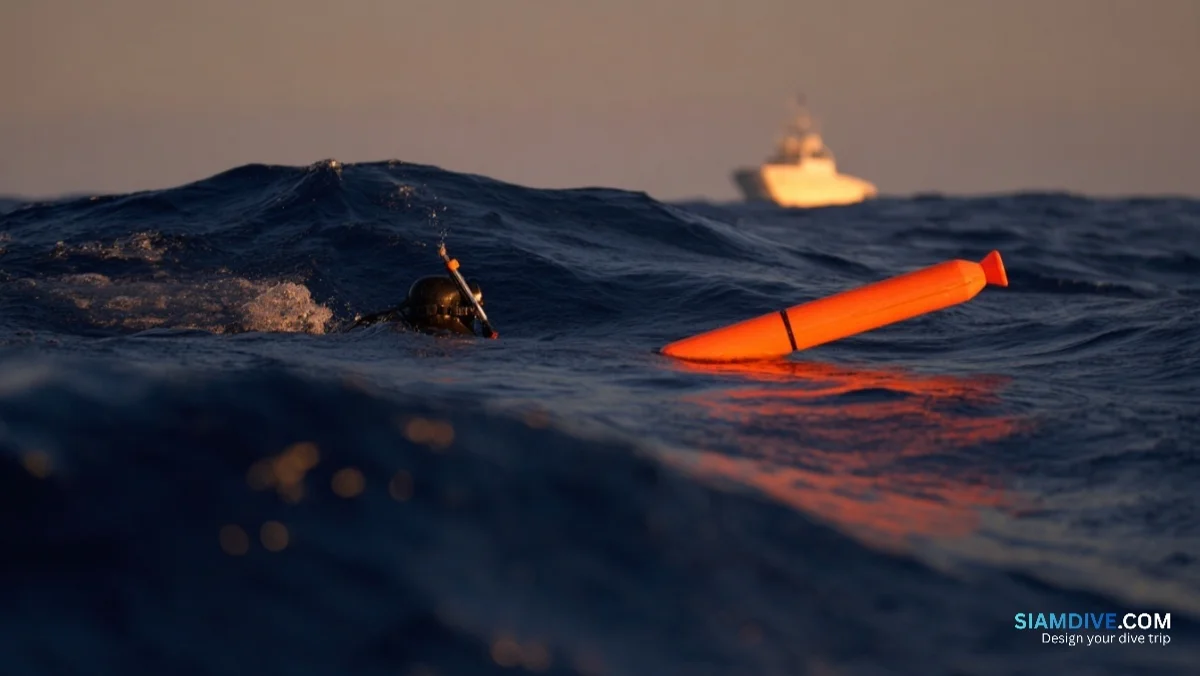
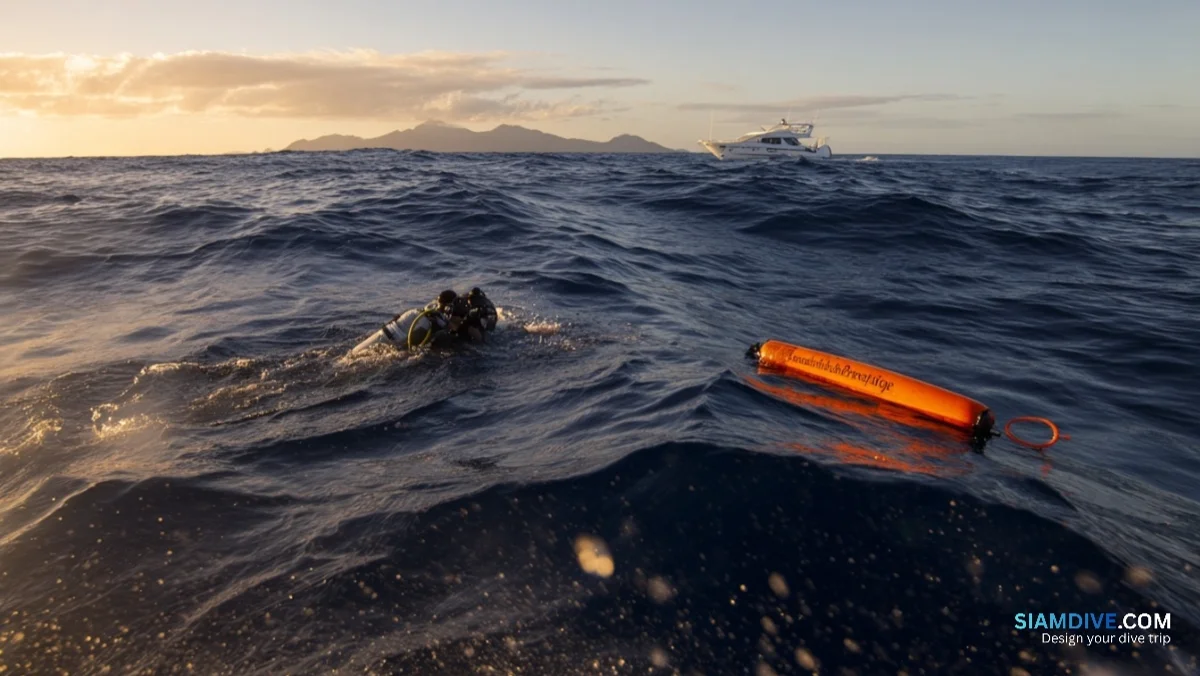
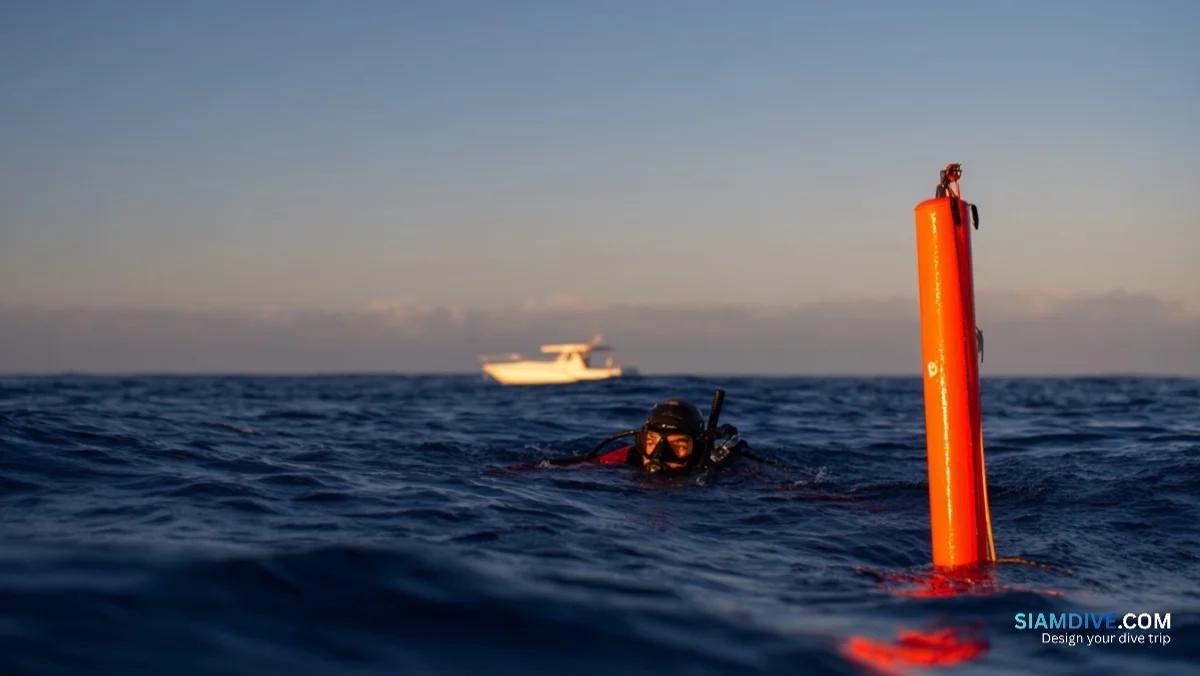
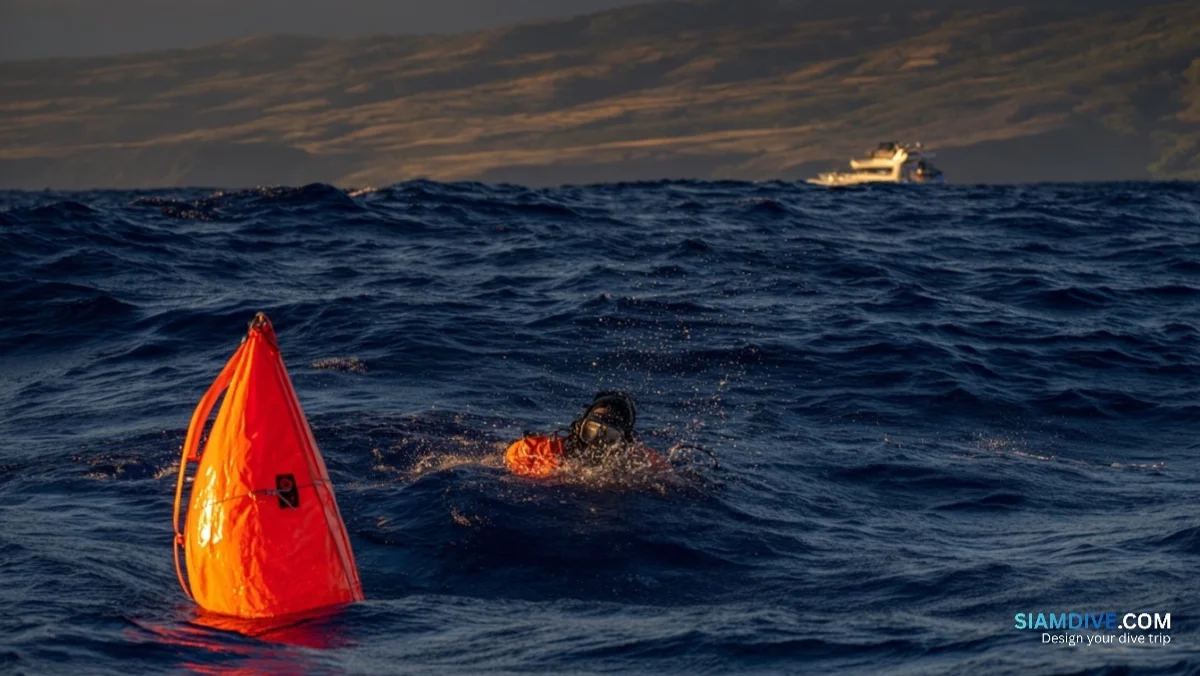
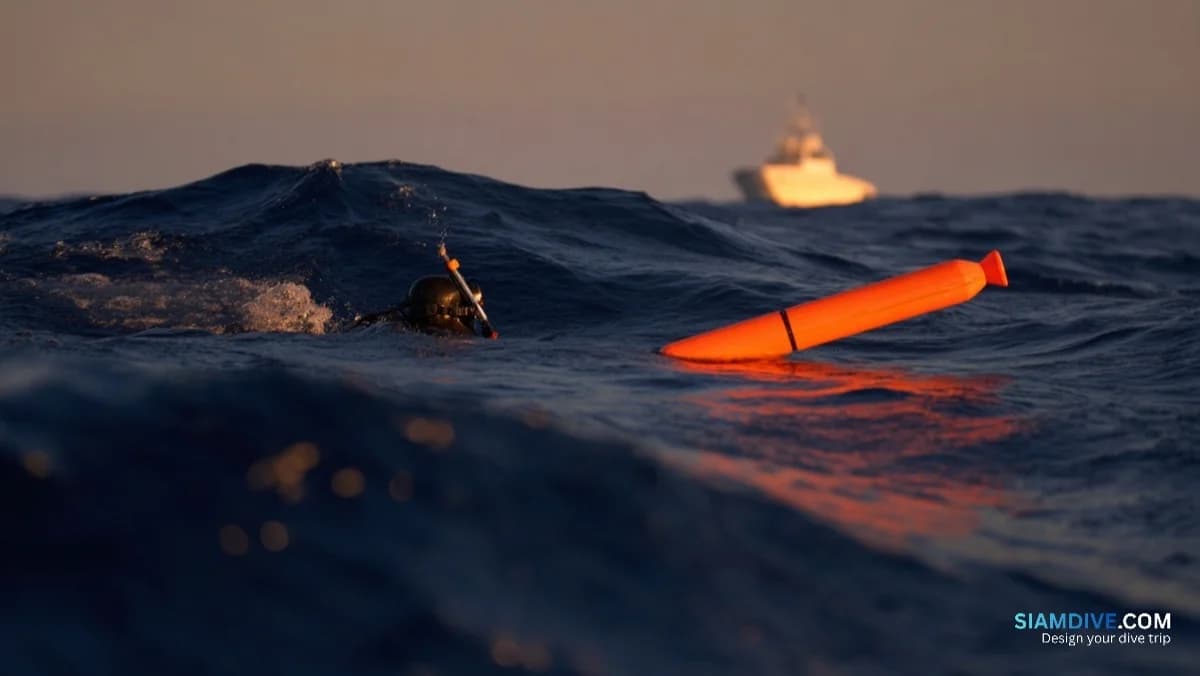
A delayed surface marker buoy is the single most effective tool in your signaling kit. The bright tube stands 1.2 to 1.8 metres above the water, visible at distances where a diver's head vanishes in the troughs. If you sent it up during your safety stop, the boat already has a fix on your position. If not, inflate and launch it now. One critical rule from every buoyancy course worth taking: never clip the reel to your body. A snagged reel combined with the tube's lift equals an uncontrolled ascent — exactly the kind of emergency you do not need layered on top of the first one.
Step 3 — Sound First, Then Light
A whistle carries farther than a shout and costs zero energy. An air horn reaches roughly a mile downwind. Three short blasts — the universal distress signal — repeated every thirty seconds sets a rhythm that cuts through engine noise and wind. Once you have the audio pattern running, add the mirror. A signal mirror can flash reflected sunlight across several miles in clear conditions, even when your head barely clears the surface. Alternate between whistle and mirror. Let the search crew triangulate on sound and light together.
Step 4 — Stay With Your Buddy
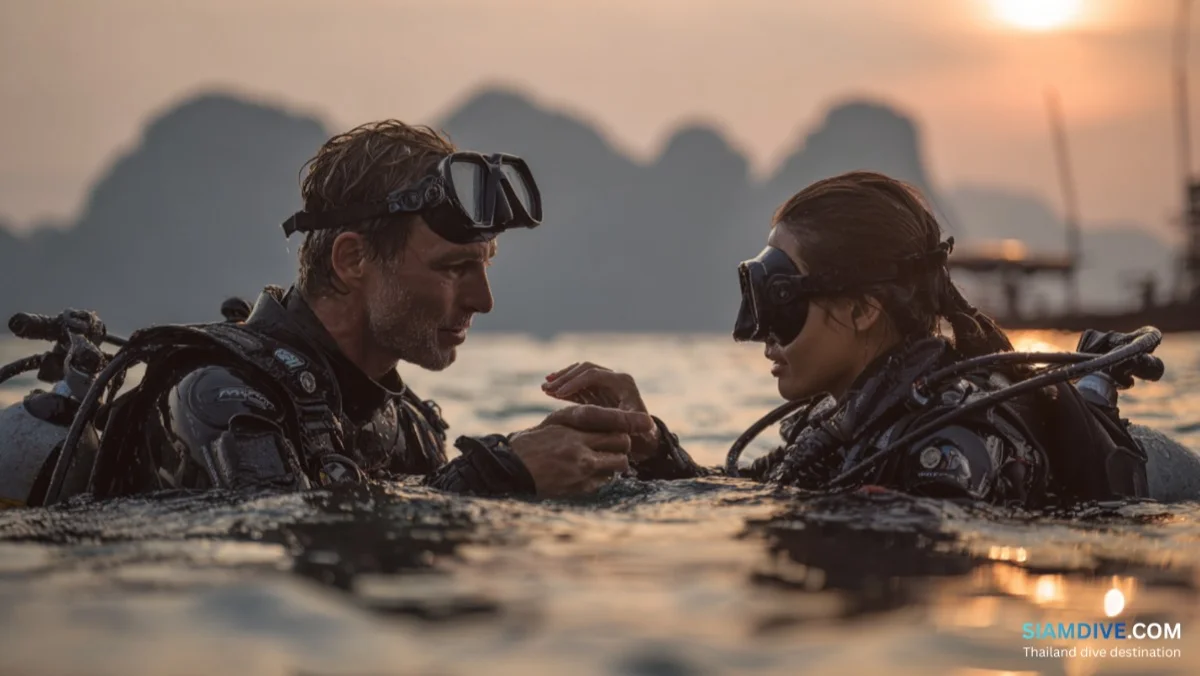
Two divers are easier to spot than one. Two SMBs, doubly so. Link arms or hold a shared line between you. Surface separation is a second emergency inside the first — it splits the search area and halves the visual target. The Redang pair survived their twelve-hour drift in part because they refused to separate. That single decision likely saved both their lives.
Step 5 — HELP Position
Heat Escape Lessening Posture: cross your arms over your chest, pull your knees toward your torso. This reduces heat loss through the high-flow zones — armpits, groin, sides of the chest. Thai waters typically sit around 28–29 °C, and hypothermia feels like a distant concern. But after several hours of passive floating, core temperature drops faster than most recreational divers expect. With a buddy, huddle together. Shared body heat extends the survival window considerably.
Step 6 — Activate Your Electronic Beacon
Personal locator beacons like the Nautilus LifeLine broadcast your GPS position — accurate to 1.5 metres — via AIS to every equipped vessel within 34 nautical miles. A simultaneous DSC distress call hits your own boat's VHF radio directly. GPS lock takes about 20 seconds on the current-generation nexGen model. No subscription, no fees — the signal travels on standard maritime emergency channels that every commercial vessel monitors. If you carry one, this is the moment it earns back its price several times over.
Step 7 — Wait, Conserve, Repeat
Rescue takes time. The more remote the dive site, the longer the response window. Keep signaling at regular intervals: mirror when the sun is up, whistle every few minutes, SMB always vertical. Sip water if you have any. Minimize unnecessary movement — every kick spends energy and generates heat loss. Your BCD and wetsuit are your life raft now. Trust them.
If daylight fades before pickup arrives, switch to audio signals and your strobe if you carry one. An LED strobe visible at over a mile gives search boats a target when mirrors become useless. The Redang divers were found after dark — roughly ten hours past sunset conditions. Night changes the equation, but it does not end it. Stay calm, stay together, keep the whistle going.
The Gear That Closes the Gap
Every item on this list fits inside a BCD pocket or clips to a D-ring. None of it requires special certification to carry, and all of it works without batteries except where noted.
- SMB or DSMB (1.2–1.8 m, orange or yellow) — 800–2,500 THB
- Finger spool or reel (15–30 m line) — 500–1,500 THB
- Storm whistle (rated 100+ dB) — 200–400 THB
- Signal mirror (credit-card size, no batteries) — 150–300 THB
- Cutting device (EMT shears or line cutter) — 300–800 THB
Total for the basic kit: under 2,000 THB — less than half the cost of a single Similan day trip.
For remote sites, liveaboards, or any environment where currents routinely exceed 1 knot, add:
- Nautilus LifeLine nexGen (GPS + AIS + DSC) — depth rated to 130 m, 98-hour battery, GPS lock in 20 seconds — approximately 8,000–10,000 THB
- LED strobe light (visible 1+ mile at night) — 1,000–3,000 THB
- Compressed air horn canister — 300–600 THB
The advanced kit pushes the total to around 12,000 THB. For context, that is roughly the price of a two-dive day trip from Khao Lak. The gear lasts years. The alternative lasts as long as the current lets it.
What Happens on the Boat While You Drift
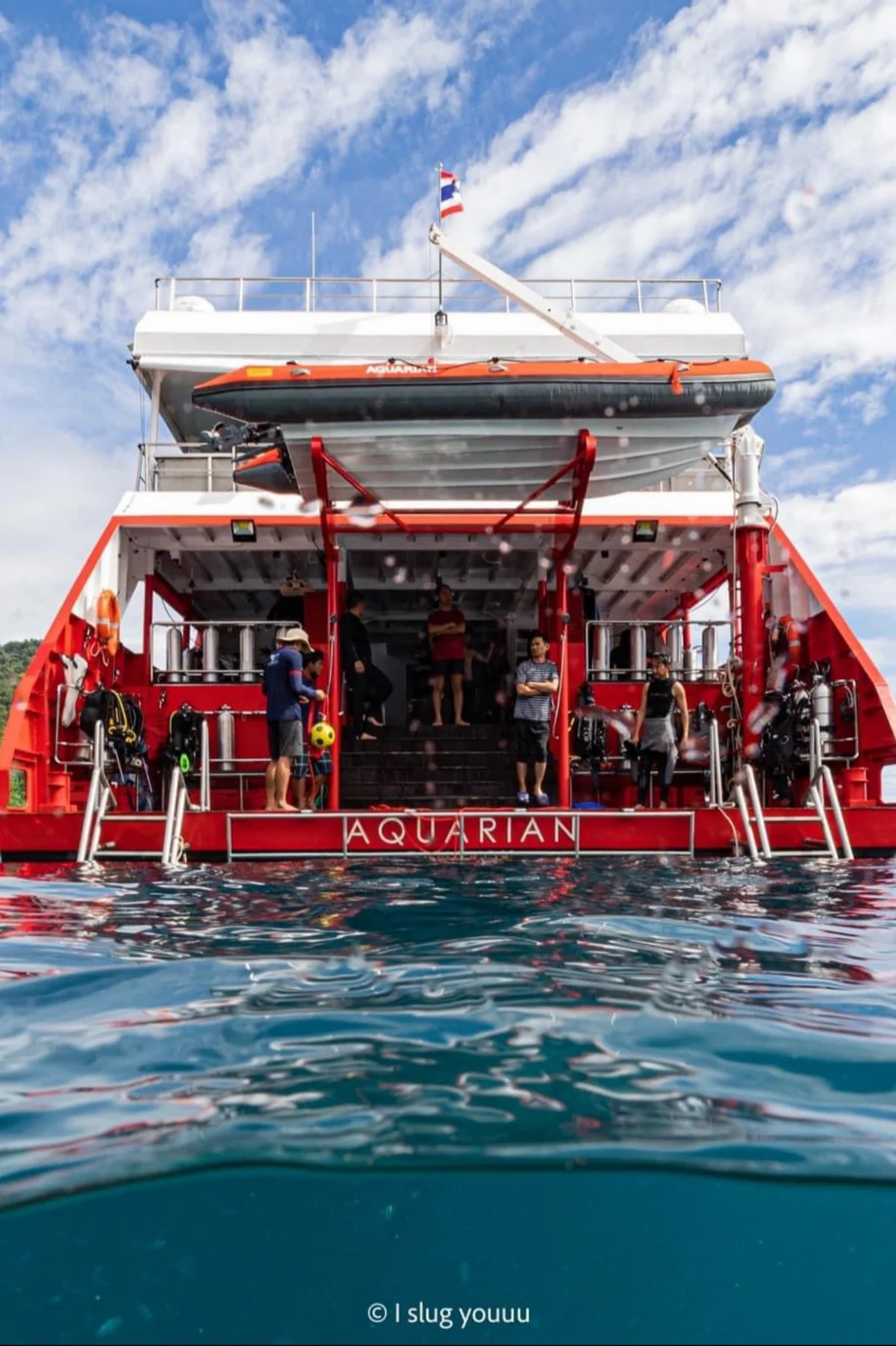
A competent dive operation counts heads before and after every dive — no exceptions, no shortcuts. When the count comes up short, the clock starts and the protocol kicks in immediately.
Standard boat-side response on Thai liveaboards follows a predictable sequence:
- Visual sweep — from the highest point on the vessel (flybridge or sun deck), scanning downstream of the current first
- Tender deployment — the RIB or dinghy launches downstream of the last known position, covering ground the main vessel cannot
- Radio call — VHF Channel 16 (international distress) and Channel 9 (Thai maritime working frequency) simultaneously
- Authority alert — Royal Thai Navy and Marine Police contacted if the diver is not located within 30 minutes
- Fleet coordination — liveaboard captains operating in the Similan National Park share dedicated radio channels for exactly this kind of emergency
The best operations do not wait for a diver to go missing before acting. They station a dedicated surface lookout during every dive, track bubble trails from the sundeck, and keep the tender idling in the water ready for an immediate downstream pickup. If your operator does not brief the lost-diver procedure before the first dive of the trip, ask for it. The answer — or the absence of one — tells you what you need to know about the operation.
March 2026: Ten Nautical Miles of Proof
The Redang incident was not a freak event. It was a textbook demonstration of what unfolds when current speed, thin safety margins, and a familiar dive site collide. A dive master and a student diver entered the water at a site they had dived before, in conditions that appeared routine. The current disagreed.
Royal Malaysia Police, Marine Police, and volunteer dive operators from the island searched through the afternoon and into darkness. The pair were located near Pulau Yu at approximately 9:45 PM — roughly ten nautical miles from their entry point, according to The Star (Malaysia). Both were treated at Setiu Hospital and released in stable condition.
What kept them alive: they stayed together, maintained positive buoyancy, conserved energy, and waited for rescue instead of exhausting themselves swimming against the flow. What they lacked — personal locator beacons and high-visibility SMBs — might have cut the rescue window from twelve hours to under one. That gap is worth considering before your next current-prone dive.
Habits That Keep the Boat in Sight
Prevention costs nothing but attention, and it is more reliable than any piece of rescue gear in your pocket.
- Check the current before entry. Ask the dive guide for the tide state. If the mooring line pulls hard to one side, the current is running — plan your ascent upcurrent of the boat, not above it.
- Deploy your DSMB at 5 metres. Send it up during your safety stop, not after you surface. This gives the boat crew a three-minute visual lead before you break the waterline.
- Agree on a separation protocol with your buddy before the dive. Where to ascend, which direction to swim, when to surface independently. One minute of planning on the boat prevents hours of searching in open water.
- Carry your signaling kit on every dive — not just drift dives. Currents do not consult the dive briefing before they shift.
- On Andaman liveaboard trips, confirm the boat has a dedicated surface lookout and a working tender. A vessel without a tender on a current-prone site is a vessel that cannot pick you up quickly if you surface downstream.