Why Cave Divers Fly to Russia for 5 km of White Silence
4 พฤษภาคม 2569
Orda Cave hides 5 km of white gypsum passages under the Urals — 46-metre visibility, 4°C water, and walls older than dinosaurs.
Five kilometres of passage carved through white gypsum, water so clear the far wall glows forty-six metres away, and a year-round temperature that never rises above 5°C. Orda Cave sits beneath a wheat field in Russia's Perm Krai — unremarkable from the surface, otherworldly below it. No tropical reef, no blue hole, no kelp forest on Earth offers quite the same combination: the longest underwater gypsum cave ever mapped, with visibility that rivals open ocean and walls that look like they were cut from marble by a patient god.
What 280 Million Years of Dissolving Rock Looks Like
The Ural Mountains were already ancient when the Permian-age seabed beneath them began to dissolve. Gypsum and anhydrite — two of the most water-soluble minerals in geology — started yielding to groundwater roughly 280 million years ago, during an era when the supercontinent Pangaea was still assembling. The result is not a narrow tube or a muddy crawl. It is a labyrinth of cathedral-scale galleries, some reaching sixty metres in diameter, with walls polished smooth by a quarter-billion years of patient dissolution.
Tectonic fractures from the Uralian Orogeny — the collision that built the Urals themselves — guided water along fault lines and joints, creating the branching architecture that modern explorers are still mapping. Each passage follows a fracture. Each gallery marks a point where two fractures met and dissolution accelerated. The result is a system with geometry that feels designed: right-angle turns, parallel corridors, domed chambers at intersections.
Unlike limestone caves, which develop dark grey surfaces and sharp dissolution features, gypsum dissolves into soft, pale contours. The walls inside Orda are white to cream, occasionally tinged blue where anhydrite dominates. Ceilings curve in smooth arcs. Silt barely exists because gypsum does not produce the clay residue that limestone leaves behind. The visual effect underwater is a subterranean cathedral built entirely of alabaster — and the water inside it acts like glass.
The Numbers That Define Orda
- Total mapped length
- 5.1 km (3.2 mi) as of the most recent surveys — roughly 4.8 km of that is underwater
- Maximum depth
- 20 metres — well within recreational limits, though access is restricted to certified cave divers
- Ceiling depth
- 6 metres at the shallowest flooded section; average passage depth 15–18 metres
- Visibility
- 40–46+ metres in undisturbed conditions — among the highest of any cave system globally
- Water temperature
- 4–5°C (39–41°F) constant year-round, regardless of season above ground
- Longest single siphon
- 935 metres — the longest in the former Soviet Union
- Largest gallery diameter
- ~60 metres across — wider than most swimming pools are long
- Dry section
- ~300 metres of walk-in passage before the first submerged lake
Those numbers explain the magnetism. Twenty metres maximum means no decompression obligation even on extended penetrations. Forty-six metres of visibility means a diver can see farther inside this cave than in most open-water tropical sites. And the constant cold — while demanding a proper drysuit — keeps the water biologically inert. No algae, no particulate bloom, no seasonal turbidity cycle. The clarity is not a lucky day; it is the permanent state.
A History Written in Cold Water
Local residents near the village of Orda always knew about the pit. Schoolboys found the entrance in the early 1970s — a modest hole at the bottom of a collapsed depression on a plateau between the Iren and Kungur rivers. Nothing about the surface suggested five kilometres of flooded passage beneath. The first scientific documentation came from Georgiy Maksimovich at Perm State University in 1969, though at that stage only the dry galleries had been surveyed and the cave bore a different name: Kazakovskaya.
Twenty-five years passed before anyone entered the water. In March 1994, cave diver Viktor Komarov dropped into a hidden lake inside the dry portion and swam forward into the unknown. What he found — white walls receding into seemingly infinite clarity, passage after passage branching from a central corridor — would reshape Russian cave diving overnight. Word spread through the small community of Soviet-era technical divers. By 2000, trained cave divers began arriving regularly.
The decade that followed was Orda's golden age of exploration. Each season extended the known map: new side passages, new galleries, new connections between previously dead-end tunnels. The total mapped length grew from under 2 km in 2000 to over 5 km by 2020, with new discoveries still being logged annually. GUE (Global Underwater Explorers) established ongoing survey projects, and Russian speleological teams continued extending survey lines deeper into the system's far reaches.
Photographer Viktor Lyagushkin brought the cave to international attention. Between 2010 and 2011, he led roughly 150 dives over six months, producing the Orda Cave Awareness Project — a book and media campaign that placed the system alongside Mexico's cenotes and Florida's cave systems in the global diving imagination. In 2013, Lyagushkin and the AirPano team created the world's first underwater spherical panorama, shot at seventeen metres depth. The cave received All-Russia natural monument status and was submitted for UNESCO World Heritage consideration in 2008. Inscription remains pending as of 2026 — the Russian UNESCO Commission still lists the site as an "underwater labyrinth" of global geological significance.
What the Cave Demands
Orda does not require trimix, staged decompression, or propulsion vehicles. The maximum depth is a modest twenty metres. But it demands three non-negotiable qualifications: full cave certification from a recognised agency (TDI, GUE, IANTD, or equivalent), demonstrated sidemount proficiency, and cold-water drysuit competence proven through logged experience. Applicants must submit certification documentation in advance — walk-up dives do not exist here.
- Exposure protection — Drysuit with heavy undergarments rated for 4°C; hood and dry gloves essential rather than optional. Wetsuit attempts appear in older trip reports but are universally described as dangerously cold beyond thirty minutes.
- Configuration — Sidemount is strongly preferred for narrower restrictions and secondary passages. Backmount doubles work in the main galleries but restrict access to the smaller tunnels where new discoveries tend to happen.
- Gas planning — Air or nitrox; the 20-metre maximum makes gas logistics straightforward. The real planning variable is thermal exposure — gas consumption rises significantly in 4°C water, and longer penetrations require careful calculation of both air supply and hypothermia onset.
- Line protocol — Permanent guidelines are installed in all primary passages. Personal reels are mandatory for any deviation into side tunnels. The branching architecture means losing orientation is easy even in perfect visibility.
- Propulsion technique — Modified flutter kick or frog kick only. No scissors kick, no helicopter turns. Gypsum dust is fine and white — when lifted by careless finning, it scatters light uniformly rather than blocking it, creating a whiteout instead of a blackout.
That whiteout risk is the cave's most counterintuitive danger. In a limestone system, disturbed silt creates darkness — divers feel the line, read the reel, and follow touch-contact protocols back to open water. In Orda, disturbed gypsum creates a uniform white glow. Contrast disappears. The guideline — also white — becomes invisible against white walls in white water. Discipline trumps bravery in any cave, but in Orda the margin for fin-technique error is measured in seconds rather than minutes.
Inside the White Labyrinth
The dry entrance descends through a modest shaft into a walking passage — three hundred metres of it, temperature dropping steadily, breath condensing in torch light. Then the first lake appears. Water so clear that many divers report not realising they have crossed the surface until cold hits exposed skin around the mask seal. The ceiling drops to six metres, the walls pull back to twenty, thirty, forty metres apart, and the white corridor opens ahead like a hallway built for something much larger than a human.
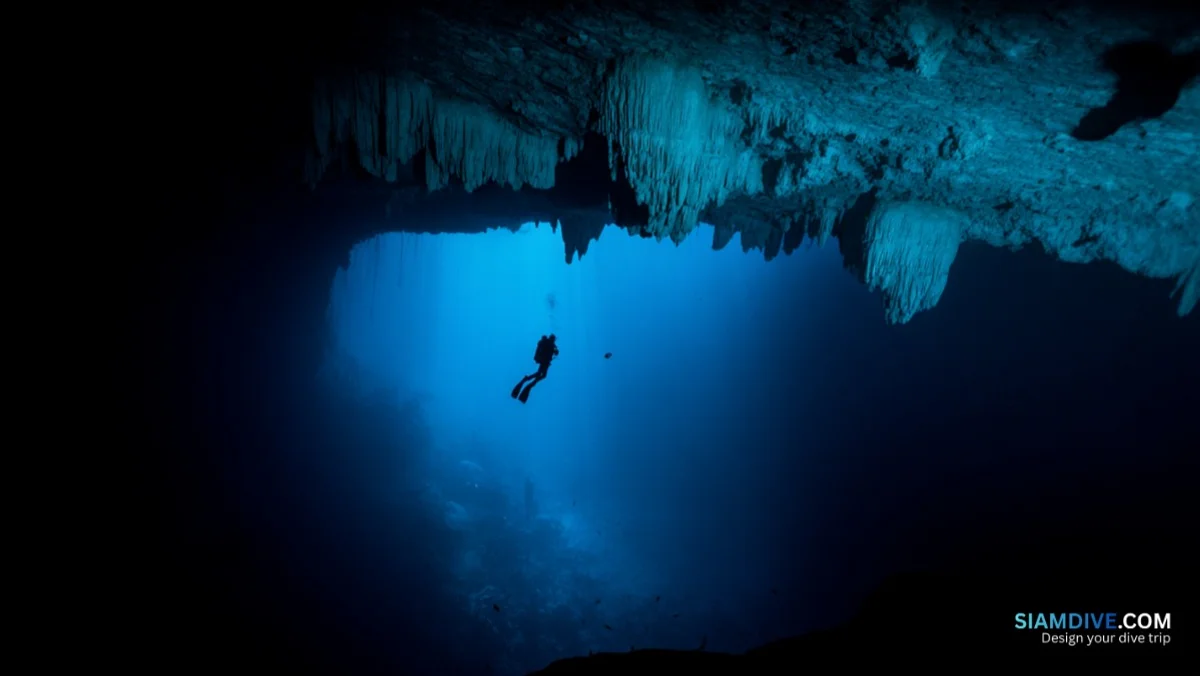
Three main passages branch from the entry lake. The left corridor — the longest — runs 935 metres without surfacing, the siphon record for the former Soviet Union. The right leads into a series of domed chambers connected by lower restrictions. The centre passage opens into the largest known galleries, where a diver's torch cannot reach both walls simultaneously. In these rooms, reaching sixty metres across, the sensation is less cave and more submerged basilica: arched ceilings catching exhaled bubbles that roll along stone grooves, smooth walls returning strobe light with even diffusion, and absolute silence broken only by the diver's own breathing.
There is no marine life. No fish, no invertebrates, no coral, no algae, no bacteria mats — nothing. The water is too cold, too mineral-saturated, and too isolated from surface ecosystems to support biology. What exists is pure geology in pure water. And that emptiness is precisely the appeal. Without biological complexity, the architecture dominates completely. Every dissolved pocket, every smooth fold in the gypsum, every slight colour shift from white to cream to pale blue becomes the visual subject. Photographers working in Orda describe it as the most forgiving cave system for lighting — the white walls reflect strobes like a studio backdrop, shadows are soft rather than harsh, and the absence of biological distraction focuses every frame entirely on form, scale, and the small human figure suspended in the middle of it all.
Getting There
Perm is the gateway — a city of one million on the Kama River, served by direct flights from Moscow (about two hours). From Perm, the village of Orda lies roughly 115 km southeast, a two-hour drive through flat agricultural landscape. The cave entrance sits 1.5 km northwest of the village on the plateau between the Iren and Kungur rivers. There is no resort at the entrance, no dive shop with rental gear, no booking website with a calendar widget. This is expedition-grade access: visiting divers arrange logistics through local contacts, Russian diving organisations, or GUE's Russia chapter.
- Best window — January to March offers the least agricultural runoff and most stable surface conditions, though the cave itself barely changes season to season. Air temperature above ground drops to −20°C in winter — the walk from the car to the entrance shaft is its own thermal challenge before any diving begins.
- Accommodation — Basic options in Orda village; more comfortable hotels in Kungur city, thirty minutes away. No on-site facilities beyond a changing area near the entrance.
- Gas logistics — No on-site fills. Cylinders must be transported from Perm or arranged through local diving contacts. Most visiting teams bring their own rigs complete.
- Permits and access — Advance application required with proof of cave certification. The natural monument designation means access is managed and limited, not commercial. Expect correspondence in Russian; English-language coordination typically requires an intermediary.
For qualified cave divers willing to embrace 4°C water, expedition logistics, and a Russian village with no tourist infrastructure, Orda delivers something no warm-water system can replicate: five kilometres of sculpted white silence, visibility measured in tens of metres, architecture older than complex life on land, and the rare experience of swimming through rock that was dissolving before the first dinosaur drew breath. The cave asks for preparation and respect. What it returns is unlike anything else underwater.
Sources
- Wikipedia — Orda Cave geological and exploration history
- Russian UNESCO Commission — Orda Cave as underwater labyrinth candidate
- Geology Page — Orda Cave Permian formation and karst geology
- DIVER Magazine — The Cave That Changed The Game In Russia
- International Show Caves Association — Orda Cave profile and status