Why Whale Sharks Return to Hin Muang's 60-Metre Purple Wall
3 พฤษภาคม 2569
Thailand's deepest dive wall drops 60 m into the Andaman Sea — draped in purple soft coral and visited by whale sharks every February through April.
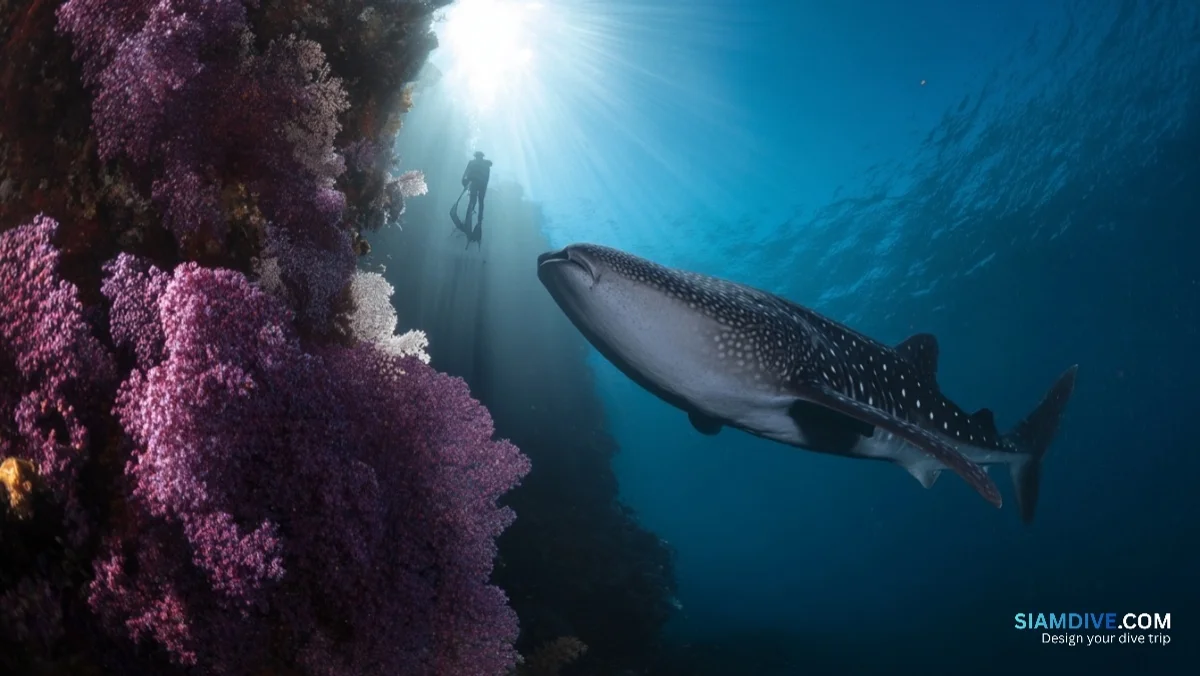
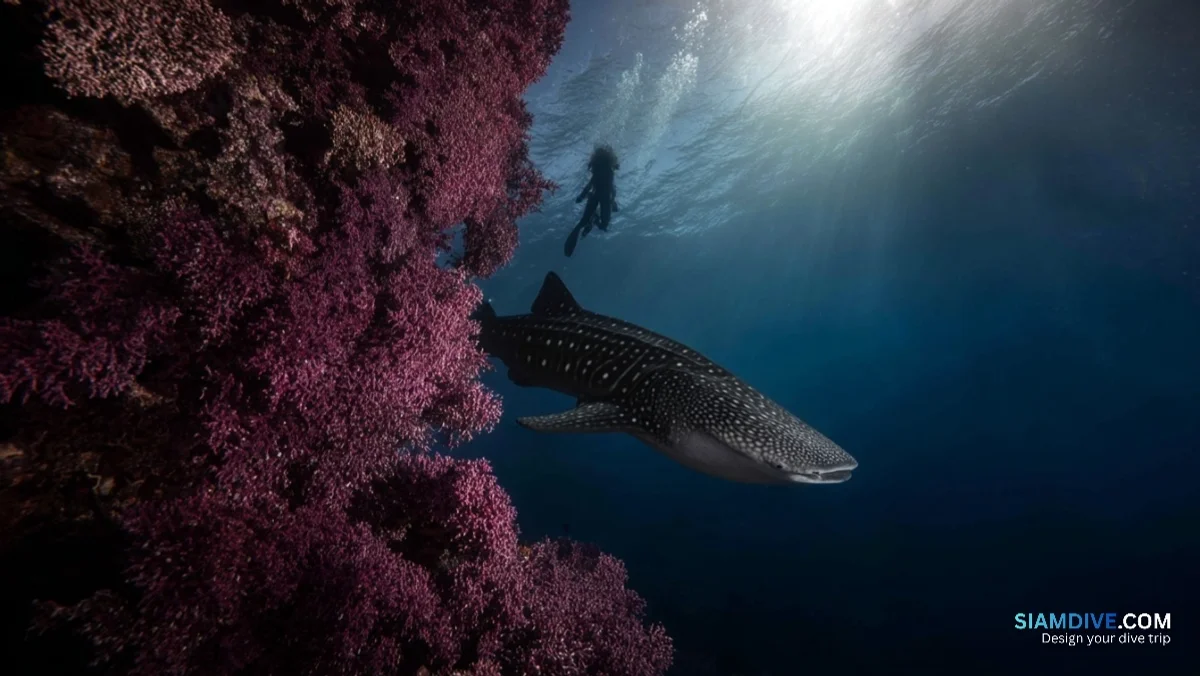
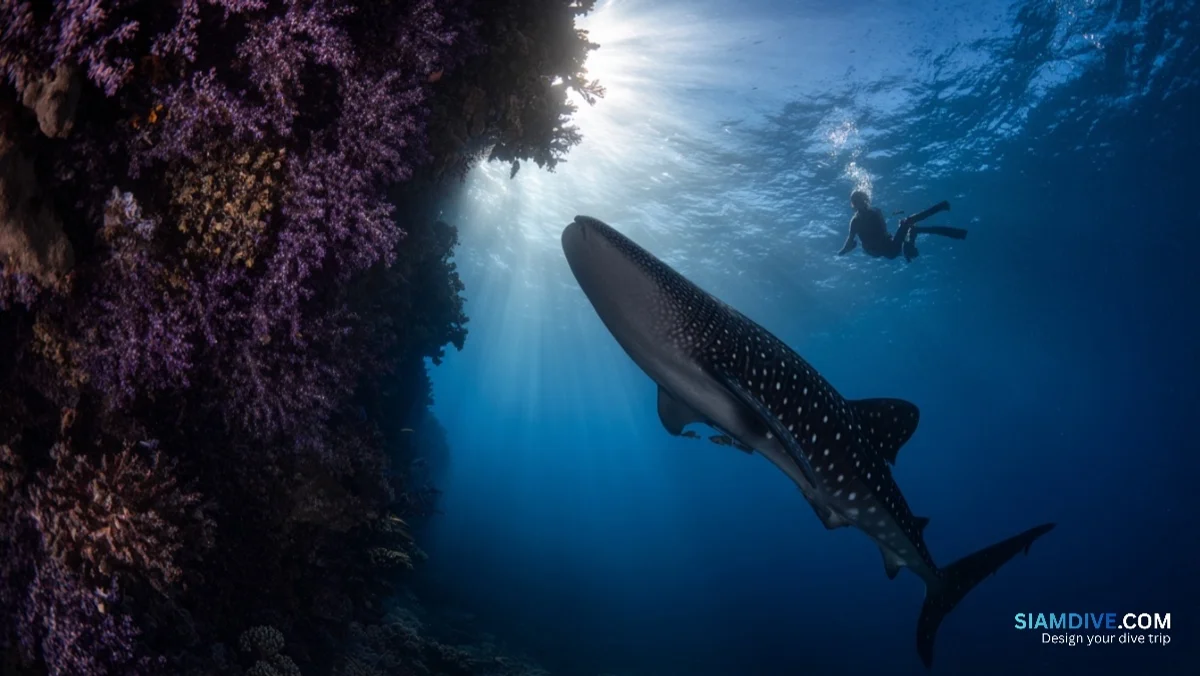
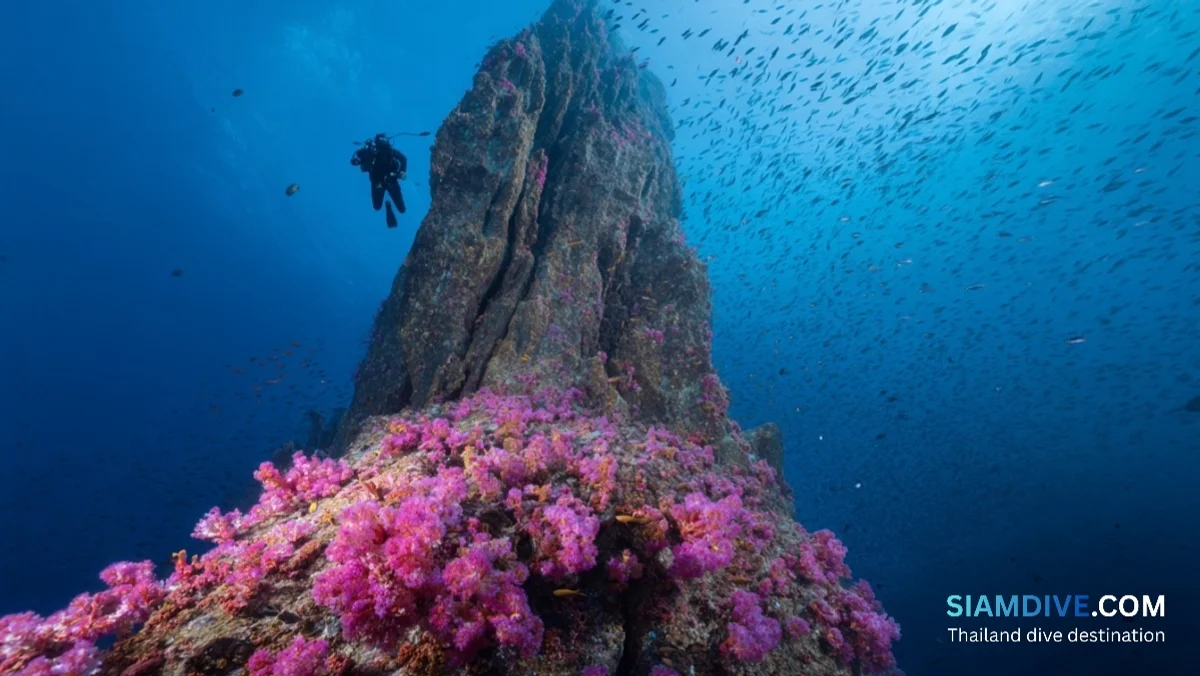
Sixty metres below the surface, the rock keeps falling. The wall at Hin Muang does not ease into sandy slope or fade into gentle reef — it drops, sheer and unapologetic, into water too deep for recreational regulators. Every square centimetre of that vertical face is purple.
This is Thailand's deepest dive wall: a 200-metre submerged ridge sitting alone in the open Andaman Sea, roughly 60 kilometres southwest of Koh Lanta. No island shelters it. No reef connects it to shore. Hin Muang is a seamount in the truest sense — and between November and April, whale sharks treat it like a refuelling stop on a migratory highway they share with manta rays, leopard sharks, and schooling trevally. The question is not whether the site deserves its reputation. The question is what makes a lonely ridge in open water pull this much life to its walls.
What Lies Beneath the Purple?
The name translates literally: หินม่วง, purple rock. Drop from the boat and the ridge's shallowest point appears at roughly eight metres — close enough to the surface that on calm days the corals glow in unfiltered sunlight. From there, a long east-west spine stretches more than 200 metres, its crest stepping down in a series of peaks from 10 to about 22 metres. Think of it as a submerged mountain range in miniature, except that the terrain on either side could not be more different.
On the northern flank, the wall angles steeply to around 50 metres before meeting a rubble-and-sand base. On the southern side, it plunges past 60 — vanishing into blue water that recreational divers have no business entering. That southern face is what earns Hin Muang the unofficial title of Thailand's deepest recreational drop-off, and it is the face that catches the strongest current.
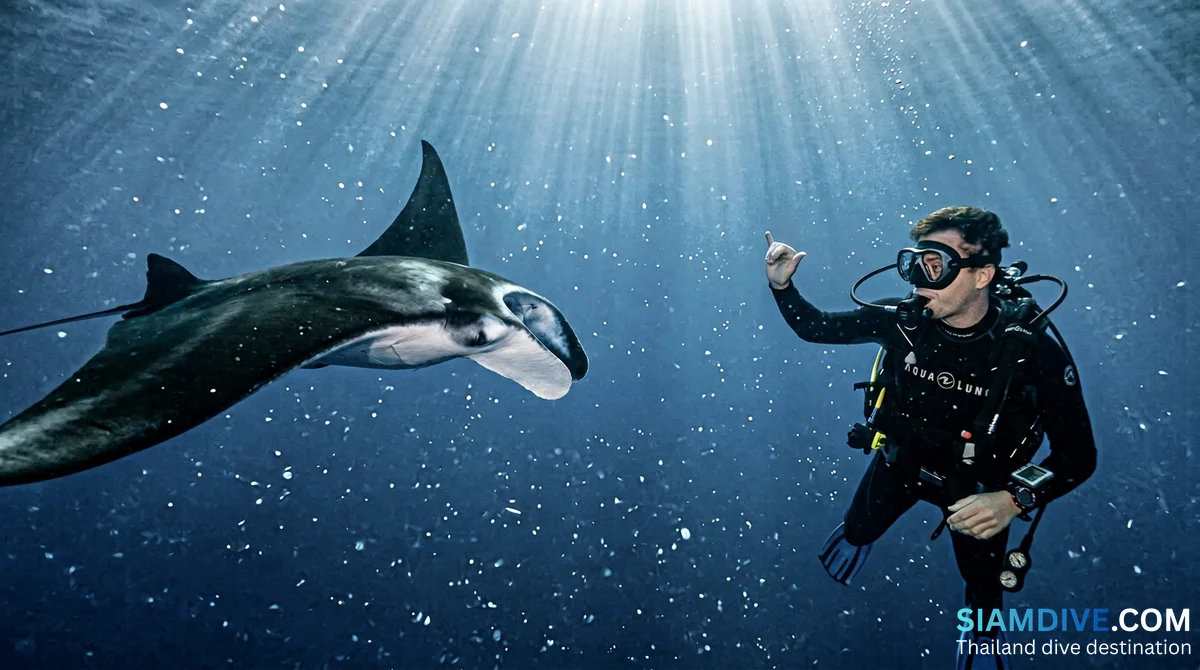
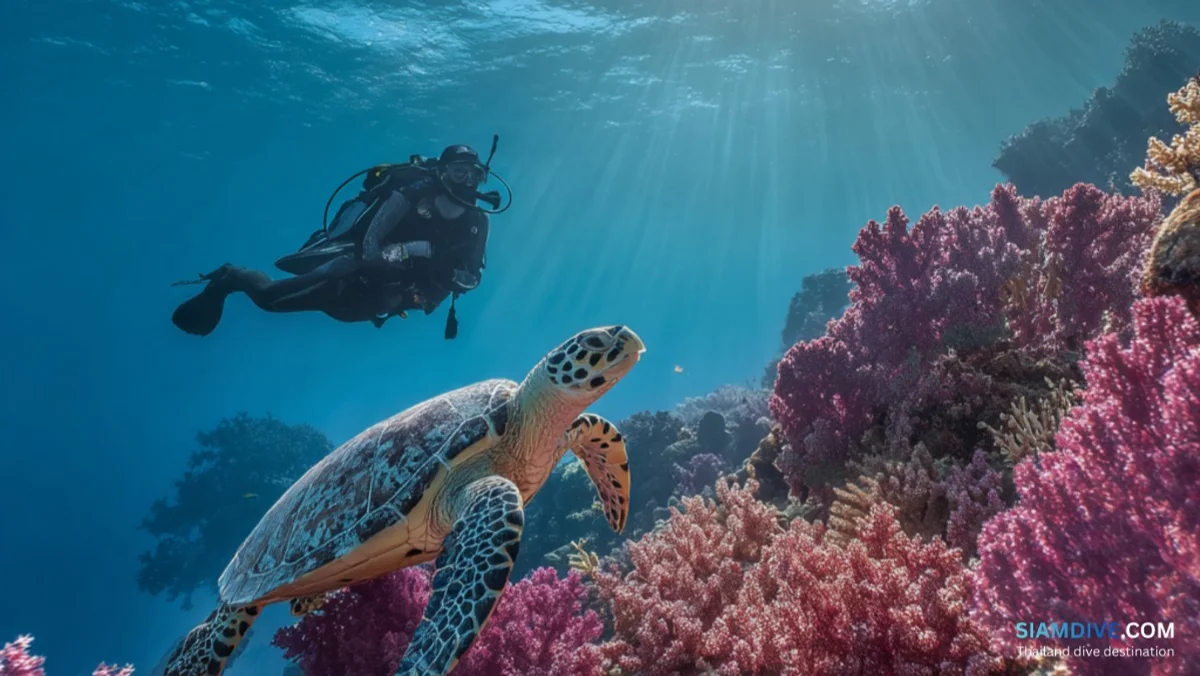
The geology creates a hydrodynamic funnel. Open-ocean currents strike the ridge and deflect upward, dragging nutrient-rich water from depth. That upwelling feeds the soft corals that gave the site its name — dense colonies of Dendronephthya in violet, magenta, and maroon — coating the wall so thickly that bare rock is almost impossible to find below 15 metres. Red gorgonian fans and black coral trees punctuate the purple carpet, and at the ridge's eastern tip, where the structure narrows and current intensifies, a cleaning station draws manta rays close enough that divers at 18 metres routinely watch them circle from below.
Why Do Whale Sharks Keep Coming Back?
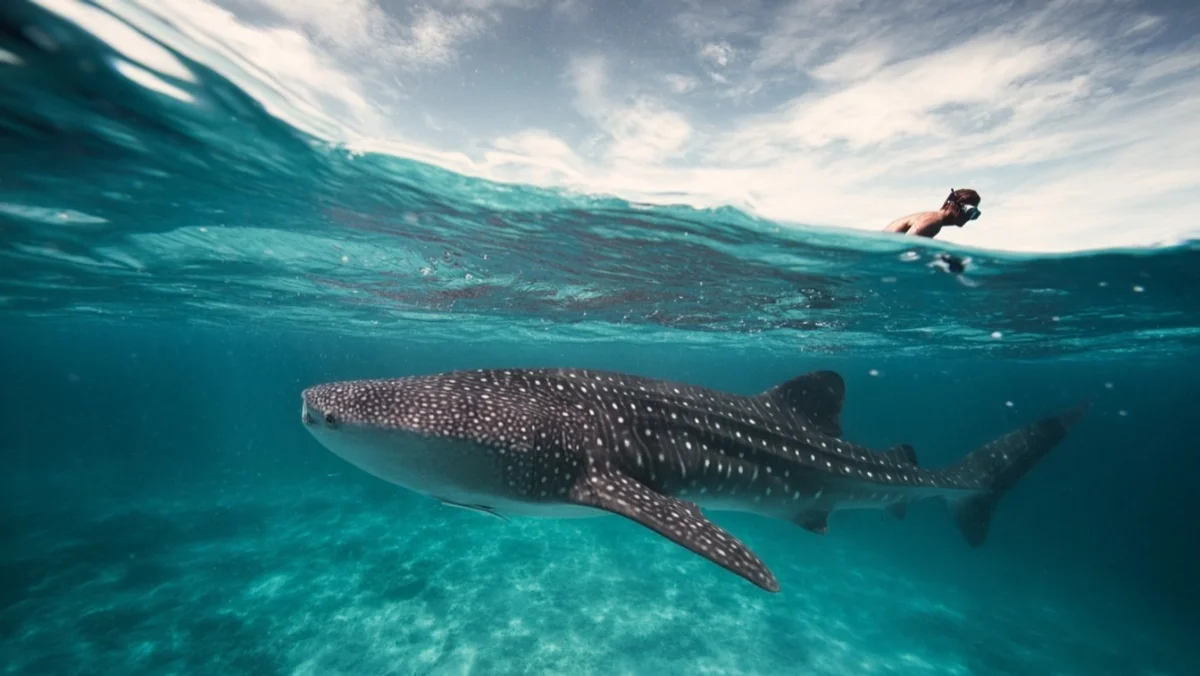
Plankton. The same upwelling that feeds the corals seeds the water column with zooplankton, and by late February the concentration near Hin Muang spikes. Whale sharks — the ocean's largest filter feeders — follow that signal like a scent trail written in microscopic crustaceans.
Sightings are recorded year-round, but the window from early February through late April is when repeat encounters shift from lucky to likely. Marine biology expedition operators schedule annual whale shark research trips to this exact patch of sea. The 2026 season has held to form: a dedicated research expedition departed on March 20, confirming once again that late-season plankton density draws the big animals on schedule.
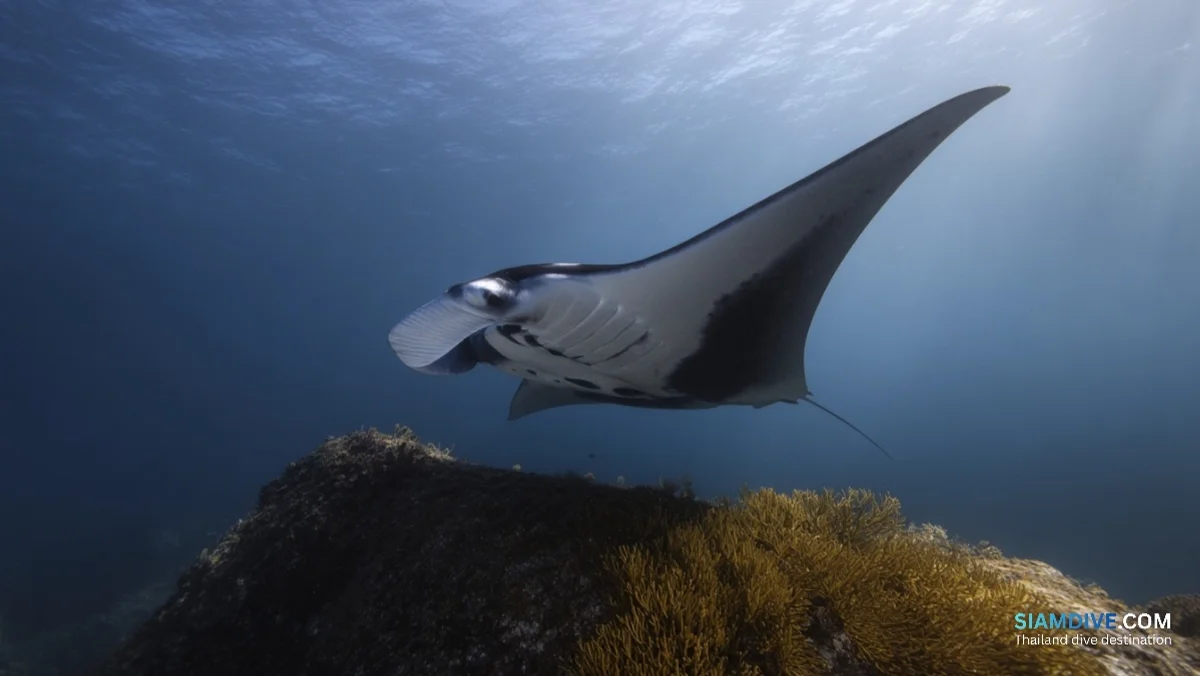
Mantas overlap but peak earlier. December through February is the strongest window, when reef mantas work the cleaning station at the ridge crest and oceanic mantas pass through in open blue water. A single dive at Hin Muang during peak season can produce both species above the same rock — a double encounter that costs a fraction of what a Maldives liveaboard charges for similar odds.
What Else Patrols the Ridge?
Two hundred metres of rock in open ocean acts like a magnet with a very wide radius. The pelagic traffic here extends well beyond whale sharks and mantas:
- Leopard sharks — often resting on sand patches at the ridge's eastern base, 20–25 metres deep
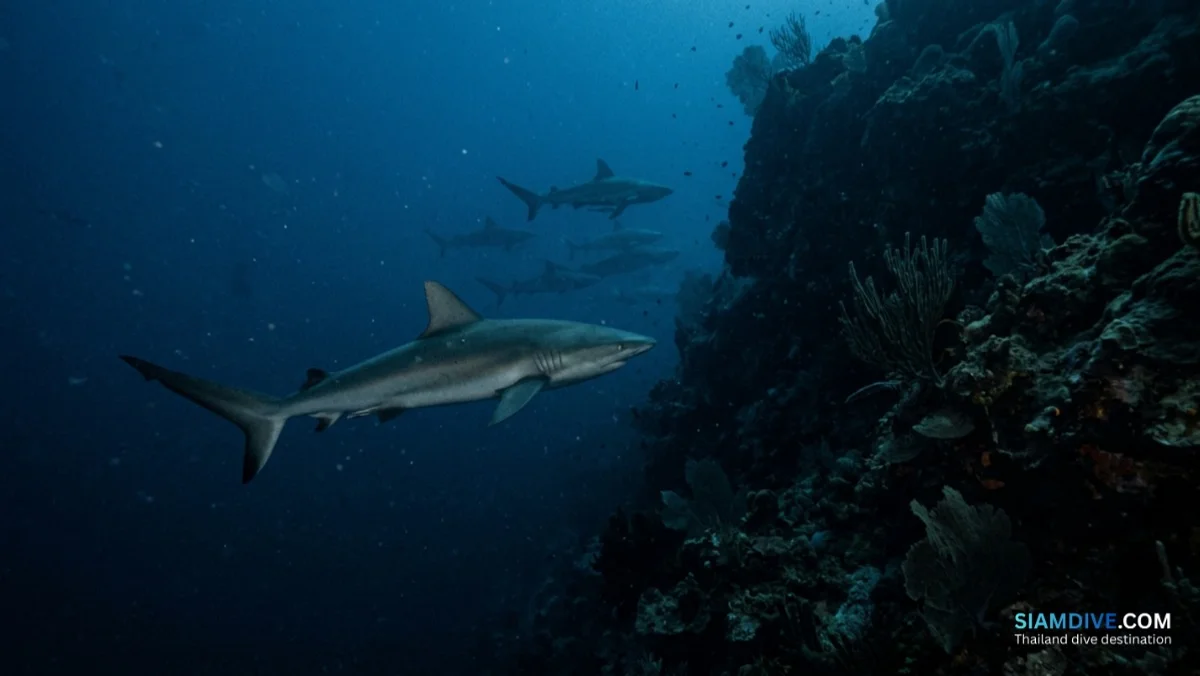
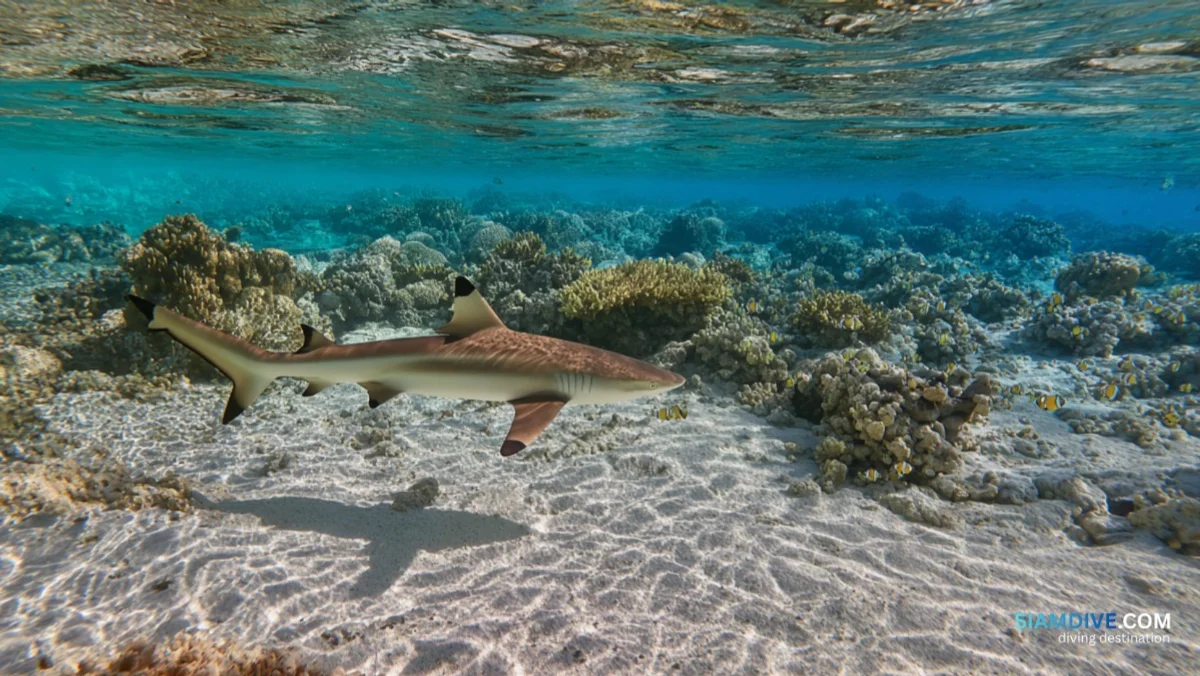
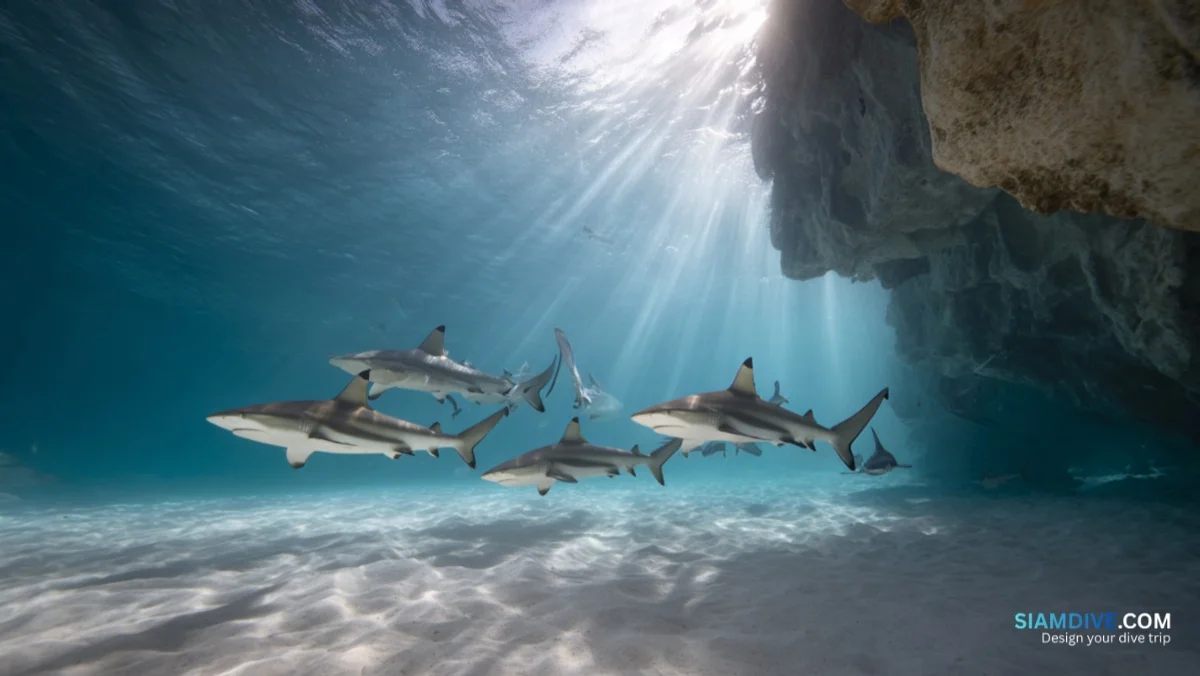
- Grey reef sharks and white-tip reef sharks — cruising the wall's edge, most frequent along the deeper southern face where current brings cooler water
- Eagle rays — solitary or in small groups, mid-water along the ridge crest, sometimes circling the cleaning station
- Giant trevally and yellowfin tuna — schooling in the current shadows behind the ridge, ambush-hunting smaller fish pushed upward by the flow
- Giant morays — tucked into crevices across the wall, some exceeding two metres in length and bold enough to ignore passing divers entirely
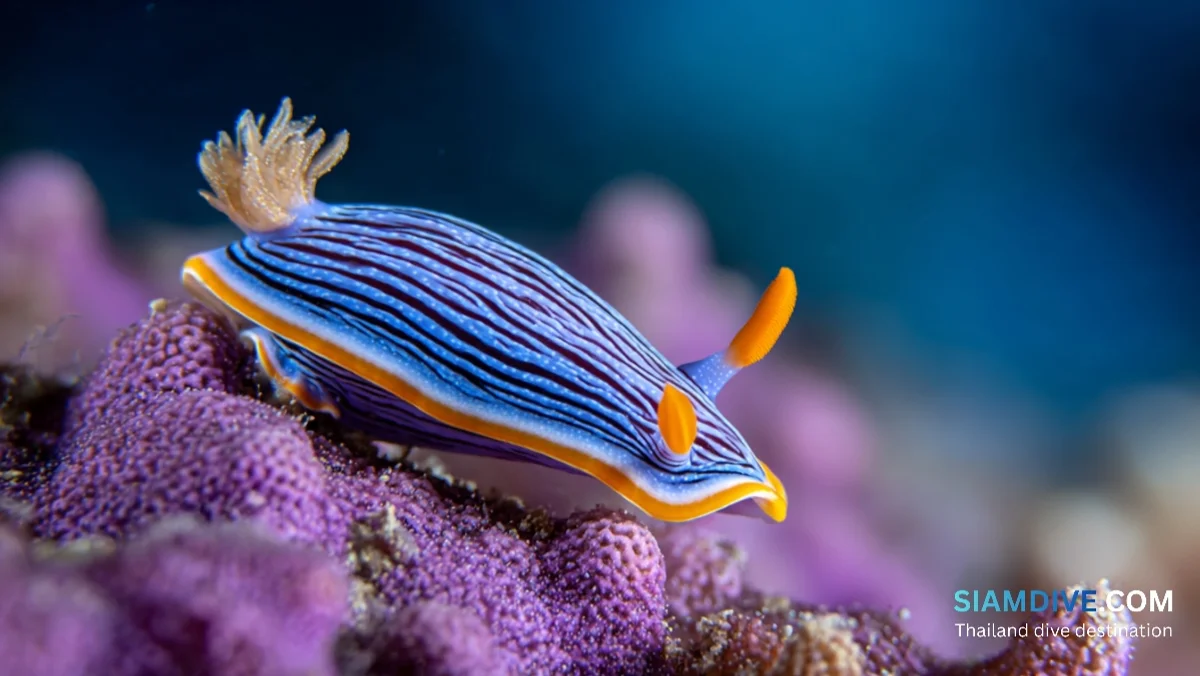
Smaller reef residents — porcupine fish, triggerfish, angelfish, butterflyfish, boxfish, surgeonfish — fill the shallower sections above 15 metres. The density of life packed onto a structure this small is unusual even by Andaman standards. Hin Muang is an oasis: the nearest significant reef, Hin Daeng, sits roughly 500 metres to the northwest, and beyond both rocks there is nothing but open sea for kilometres in every direction. That isolation is precisely what concentrates the traffic. For a sense of how species density works on Thai reefs, the dynamics at Hin Muang are an extreme version of the same principle — except here the entire ecosystem fits on a single ridge.
The Twin Rock Next Door
Almost every trip to Hin Muang includes its neighbour. Hin Daeng — Red Rock — breaks the surface with a small rocky outcrop visible from the boat, which makes it both a landmark and a reassurance when currents push you off the submerged ridge next door. Its walls are carpeted in red soft corals rather than purple, and its topography is broader, with a comfortable plateau at 10–14 metres that serves as an ideal second dive after Hin Muang's deeper profiles.
Day-trip boats typically run Hin Muang first, when air reserves, focus, and energy are at their peak for the deep wall. After a surface interval and lunch on the boat, the group motors five minutes to Hin Daeng for dive two — shallower, warmer, and with the kind of gentle current that lets you drift the wall at reef-fish pace. Together, the twin rocks deliver a depth range from 5 to 60+ metres in a single morning, one of the widest recreational spreads of any day-trip destination in Thailand.
Getting There from Koh Lanta
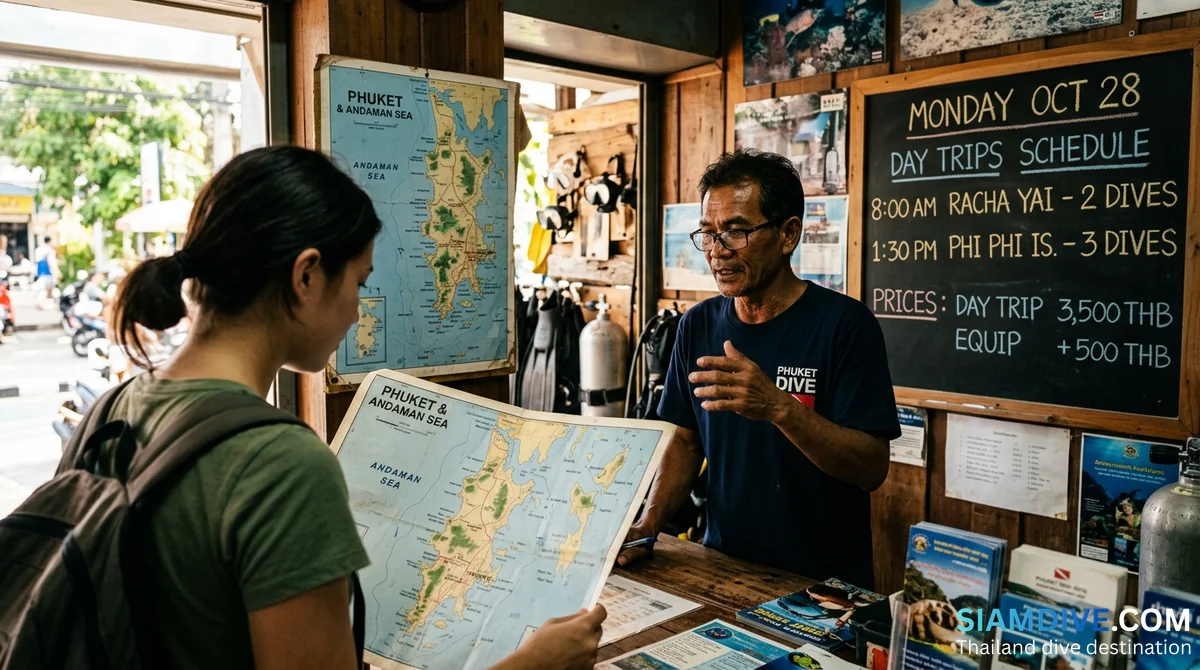
Koh Lanta is the gateway. Speedboats from dive centres on the island's west coast cover the roughly 60-kilometre open-water crossing in 60 to 80 minutes, depending on sea state and boat size. Hotel pickup is standard — expect a knock at the door around 07:00 and a return by mid-afternoon.
- Day-trip price (2 dives) — 3,950–4,500 THB per person, typically including equipment rental, guide, breakfast, lunch, and drinks
- Optional third dive at Koh Haa — around 600 THB extra on some operators' schedules, added as a stop on the return trip
- National park fee — 600 THB per day for foreign nationals, collected separately by park rangers or through the operator
- Deep Adventure add-on — Open Water divers with fewer than 50 logged dives can join a supervised deep dive for roughly 1,000 THB extra
Liveaboards running the southern Andaman route — typically Koh Haa, Hin Daeng, Hin Muang, and occasionally Koh Rok — also stop here, usually with two to three dives over a full day that allows longer bottom times and more relaxed surface intervals. The broader southern Andaman corridor stretches north to the Surin Islands, giving multi-day trips a remarkable range of topographies from shallow snorkel reefs to deep walls.
What Should You Prepare For?
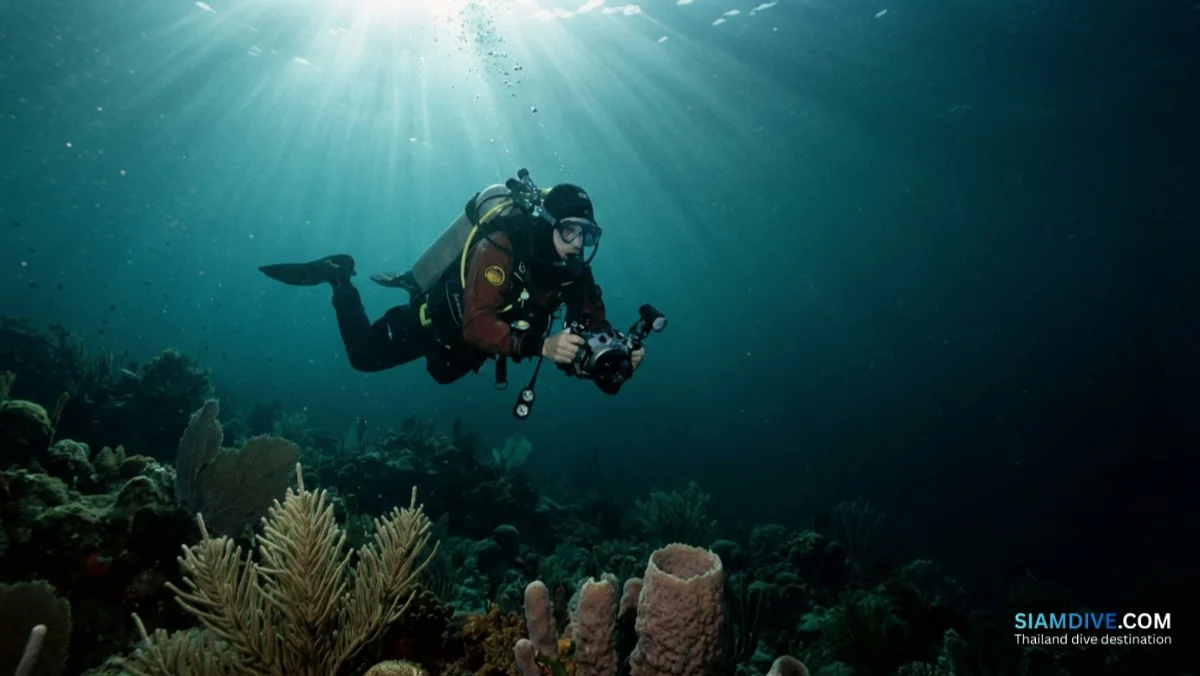
This is not a beginner wall. Currents shift direction without warning, and on some days the flow at the ridge crest accelerates fast enough to pin an unwary diver against the rock or sweep them into open blue. Solid buoyancy control and drift-diving experience are essential; most operators require Advanced Open Water certification or equivalent logged experience.
- Visibility
- 20–30 metres during peak season, occasionally exceeding 30 m on the best days. Plankton blooms in March–April can drop clarity to 15 m, though marine activity often increases in exchange — a trade-off most divers accept gladly.
- Water temperature
- 27–30 °C throughout the open season. Most divers are comfortable in a 3 mm shorty or full suit; a hood is unnecessary.
- Season
- Mu Koh Lanta National Marine Park opens the site from mid-November through mid-May. Hin Muang, Hin Daeng, and Koh Rok close annually from May 16 through November 15 due to monsoon conditions.
- Depth discipline
- The southern wall invites going deep. Without a firm plan, it is easy to drift past 30 metres while staring at the coral and not notice until your computer screams. Set your maximum depth before the dive, not during it.
When to Time Your Visit
The decision comes down to a trade-off between water clarity and megafauna density.
- November–January — Calmest seas, best visibility (often 25–30 m+), mantas at the cleaning station, whale shark encounters possible but sporadic
- February–April — Whale shark peak, plankton blooms thicken the water but draw the heaviest pelagic traffic of the year, manta sightings remain strong through February before tapering
For divers chasing both the wall's visual drama and the best odds of a whale shark flyby, late February through mid-March threads the needle: visibility has not yet dropped to its plankton-season lows, but the sharks are already arriving. The 2026 season has tracked this pattern, with Koh Lanta operators reporting consistent whale shark and manta encounters through March and at least one research expedition running into April.
Hin Muang is not the most accessible dive in Thailand, not the shallowest, and not the gentlest. It is the one that reminds experienced divers why they keep logging hours — because when a 200-metre ridge in the middle of nowhere hosts whale sharks, mantas, and a wall of purple coral deeper than most recreational divers will ever descend, the ocean is clearly still holding cards it has not played yet. And that kind of reef is worth protecting.