Why a Maldives Week Costs More Than Two Similan Safaris
2 พฤษภาคม 2569
A budget Maldives liveaboard starts at $1,200 for seven nights — roughly what two Similan safaris cost combined. The mantas are the same genus. The invoice is not.
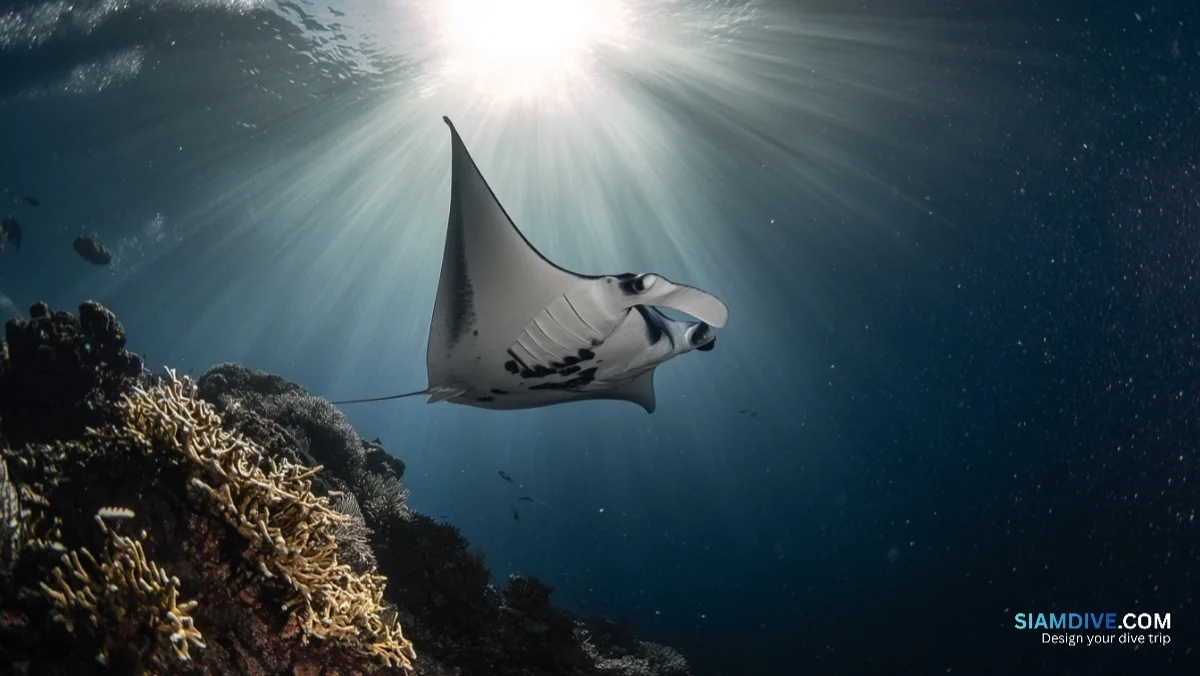
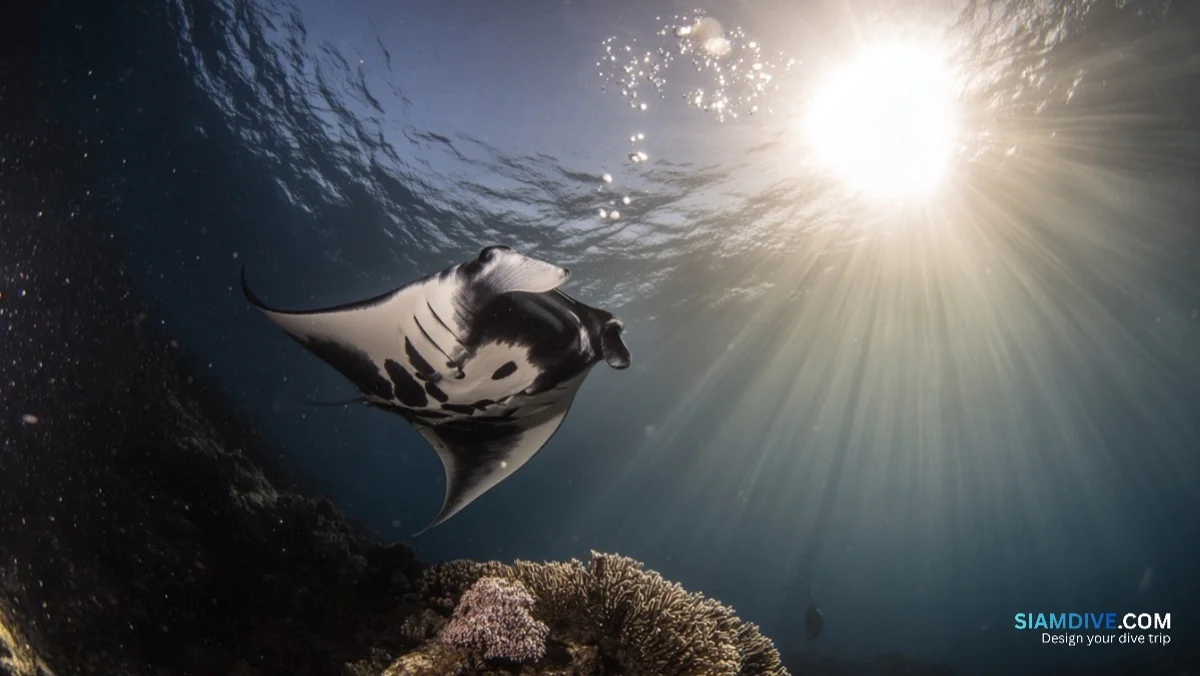
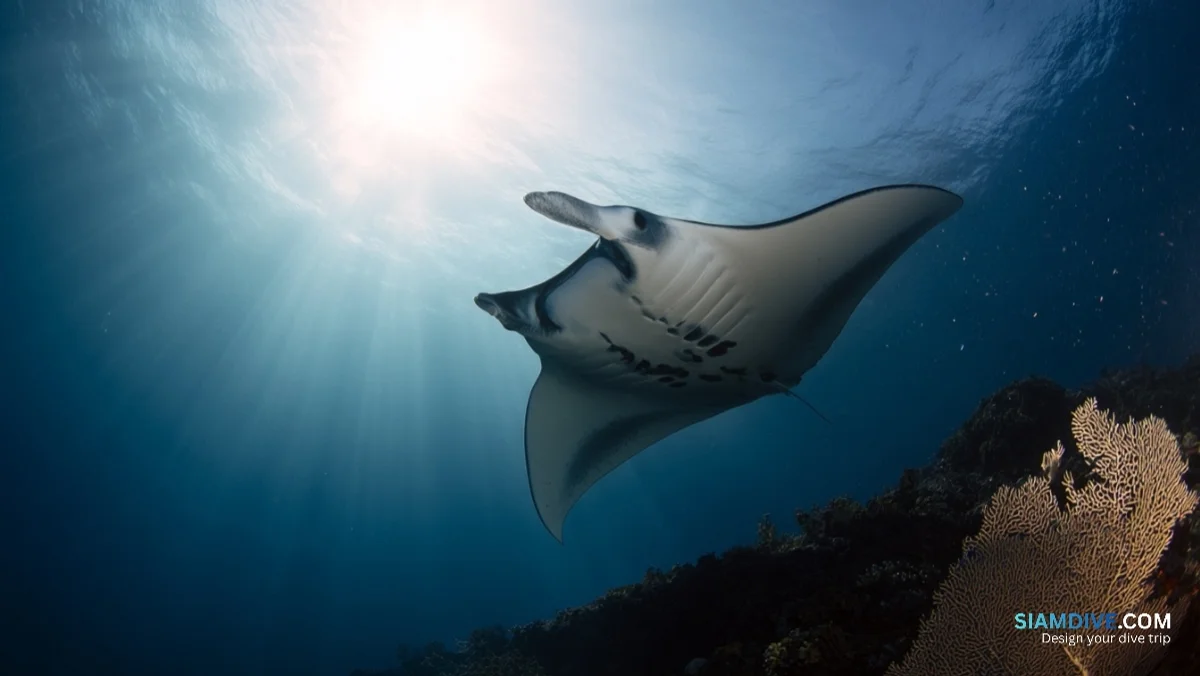
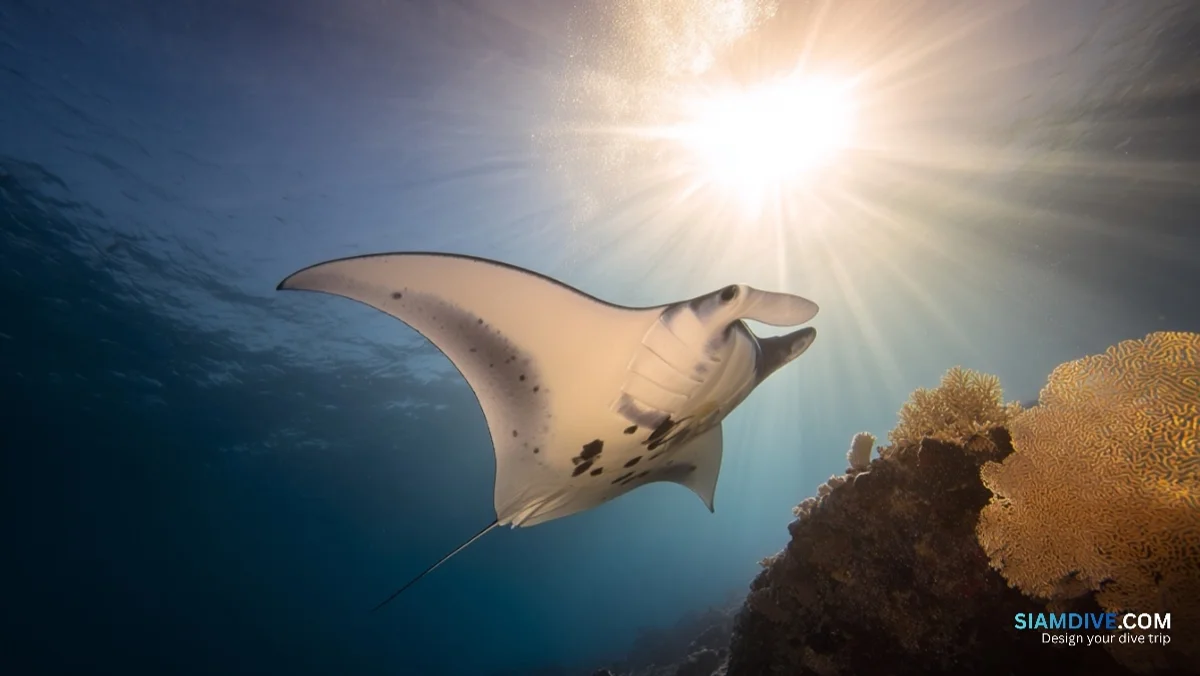
The manta turns in a slow barrel roll three metres overhead, blocking the sun for a full two seconds. This is Koh Bon, forty nautical miles off Khao Lak, and the scene plays out between November and April for anyone willing to spend a few hundred dollars on a liveaboard berth. The same genus — Mobula, the oceanic manta — performs the same unhurried choreography across the Maldives, above cleaning stations on half a dozen atolls and inside the plankton funnels of Hanifaru Bay. The spectacle is near-identical. The price tag is not.
A budget Maldives liveaboard starts around $1,200 for seven nights. A three- to four-night Similan safari with eleven to fifteen dives runs $500–650. That ratio — roughly a third — holds at mid-range tiers too, and it widens once flights, taxes, and add-on fees enter the equation. Neither destination is objectively better. Both deliver mantas, blue water, and genuine big-fish encounters. The real question is what the Maldives premium actually buys — and whether a given diver needs it.
How the Liveaboard Rates Stack Up
Brochure language hides the gap. Published 2025–2026 departure rates, pulled from operator booking pages and aggregator reviews, tell a cleaner story.
- Thailand, budget tier (Manta Queen fleet) — 3–4 nights, 11–15 dives, from THB 18,400–20,000 (~$525–570). Per night: ~$130–145.
- Thailand, mid-range (MV Blue Dolphin, Deep Andaman Queen) — 4 nights, 14 dives, from THB 22,600–28,000 (~$645–800). Per night: ~$160–200.
- Maldives, budget tier (MV Eagle Ray, MV Stingray) — 7 nights, 16–18 dives, from $1,281–1,379. Per night: ~$183–197.
- Maldives, mid-range (MY Duke of York, Spirit fleet) — 7 nights, ~18 dives, from $3,400–3,865. Per night: ~$486–552.
At budget level the per-night difference is $130 versus $183 — noticeable but not seismic. At mid-range it blows open: $160 versus $486 per night, a factor of three. And because Thailand's standard liveaboard itinerary runs three or four nights rather than seven, the total outlay stays dramatically lower. A diver can complete two full Similan liveaboards — eight nights, twenty-eight dives — for roughly the same cash as one Maldives budget week.
The Fees Nobody Puts in the Headline
Both destinations layer charges on top of the brochure number. In Thailand they arrive upfront and round. In the Maldives they accumulate line by line across the invoice, each one modest, until the total is not.
- Thailand — Similan marine park entry: 2,300 THB (~$65) per person per trip, covering the full duration. Equipment rental on most liveaboards: included, or $15–25 per day for a full kit hire.
- Maldives — Green Tax: $6 per person per night. Fuel surcharge: $10–15 per night. Equipment rental: roughly $40 per night. Tips are customary. For a seven-night trip, add-ons alone total $390–430 before gratuities.
A Maldives week advertised at $1,281 invoices closer to $1,700 once the extras land. A Similan four-night at $570 becomes about $635 all-in. The advertised ratio of 2.2:1 stretches to nearly 2.7:1 in practice — and that is the gap most first-time bookers discover only after the deposit clears.
Same Genus, Different Postcode
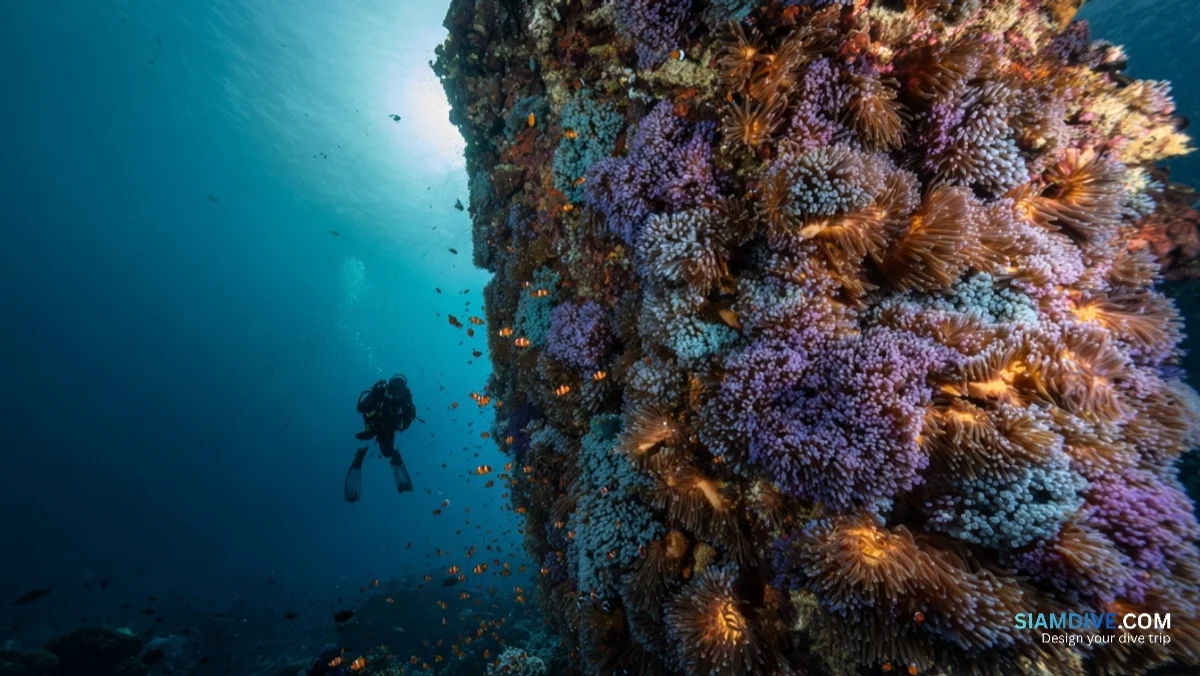
Koh Bon's cleaning station sits at twenty-four metres on a limestone ridge that drops into open blue on three sides. Divers settle into neutral buoyancy below the ridgeline and wait. The resident population — around twenty individually identified oceanic mantas — cycles through between November and April, with peak density in February and March. Across Thai waters, more than 152 individual mantas have been photo-catalogued to date.
February 2025 delivered one of the strongest manta months the Similans had seen in years. Sightings jumped not only at Koh Bon but at Richelieu Rock — a site historically defined by whale sharks rather than mantas — and at Koh Tachai Pinnacle. Khao Lak operators linked the resurgence to higher-than-average plankton concentrations driven by favourable Indian Ocean current patterns, and the trend has generated optimism heading into the 2025–2026 season.
The Maldives runs a larger and more distributed manta programme. Both reef mantas (Mobula alfredi) and oceanic mantas (Mobula birostris) appear across multiple atolls year-round. Hanifaru Bay in Baa Atoll hosts one of the world's largest documented feeding aggregations, peaking between August and October when up to a hundred individuals funnel into a narrow bay to filter dense plankton. On a typical Maldives liveaboard route, manta encounters are near-guaranteed.
The species overlap is real but not complete. Thailand's encounters are almost exclusively oceanic mantas on seasonal cleaning stations. The Maldives adds resident reef mantas across shallow lagoons, year-round availability, and the rare melanistic (black) oceanic mantas documented around Fuvahmulah — an estimated 80% of all Maldives black manta sightings originate from that single remote atoll.
Seven Months vs Twelve
Similan National Park opens October 15 and closes May 15. That seven-month window is legally enforced — no boats operate inside park boundaries during the monsoon closure. Visibility peaks from February to April at 25–35 metres; the bookend months bring shorter weather windows and rougher Andaman crossings that can scrub surface intervals or cancel departures.
The Maldives dives twelve months a year across two monsoon seasons. The northeast monsoon (December–April) delivers calm seas and visibility beyond 30 metres on eastern atolls. The southwest monsoon (May–November) shifts the action west, drives plankton blooms, and with them the manta and whale shark aggregations that define the off-season calendar. There is no closed park and no curfew.
For a diver with dates between November and April, this distinction barely registers. For anyone locked to a June, July, or August window, Thailand's Andaman coast is closed entirely. The Gulf side — Koh Tao, Chumphon Pinnacle, Sail Rock — runs a complementary calendar with decent summer conditions, but its manta encounters are rare and its liveaboard infrastructure limited.
What the Maldives Delivers That Thailand Cannot
Budget comparisons lose credibility the moment they pretend the cheaper option matches the expensive one everywhere. It does not. The Maldives holds specific cards that no amount of Thai arithmetic can offset.
- Hammerhead schools — Hammerhead Point near Rasdhoo and the deep channels of Fuvahmulah regularly produce formations of thirty to fifty scalloped hammerheads on morning dives. Thailand sees occasional lone hammerheads at Richelieu Rock and Hin Daeng, but reliable schooling encounters do not exist in Thai waters.
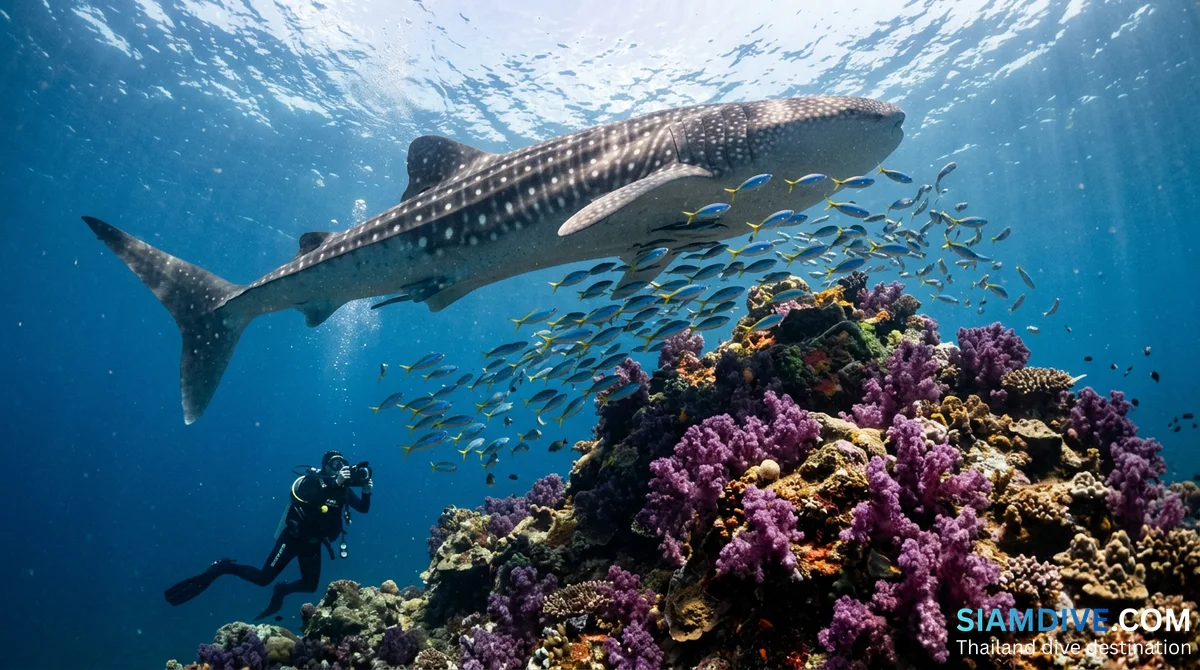
- Year-round whale sharks — South Ari Atoll's Maamigili Marine Protected Area logs whale shark sightings almost daily, every month of the year. Thailand's whale shark encounters — Richelieu Rock, Sail Rock, Chumphon Pinnacle — are seasonal, brief, and impossible to schedule around.
- Tiger sharks on demand — Fuvahmulah's Tiger Zoo delivers daily open-water tiger shark encounters, drawing dedicated shark photographers from around the world. No site in Thailand offers anything comparable.
- Species volume — Over 1,100 recorded fish species across more than 2,000 reefs, many accessible as walk-in house reefs directly off resort jetties. Thailand's Andaman biodiversity is strong, but the catalogued count is smaller and the best sites require boat access.
If hammerhead schools, predictable whale sharks, or daily tiger shark encounters are the trip's reason to exist, the Maldives is the only answer. No budget argument overrides a species that does not reliably show up.
Where the Thai Budget Compounds
Strip the comparison to what a recreational diver on a moderate budget actually does — fifteen to twenty dives across a week to ten days, some time on land, a mix of liveaboard and day boat — and Thailand's cost advantages start stacking faster than the rate sheet alone suggests.
- Flight access — Bangkok is a regional hub with budget carriers running direct routes from Singapore, Kuala Lumpur, Hong Kong, Tokyo, and most Australian east coast cities. A domestic return to Phuket adds $60–100. Malé, the Maldives gateway, has fewer budget-airline links and longer layovers from East and Southeast Asia.
- Day-trip flexibility — Khao Lak and Phuket run day boats to the Similans, Racha Yai, and Shark Point at 3,500–4,500 THB per trip (two dives each). A diver can stitch three day trips and one liveaboard into a ten-day window for roughly $900 total — with afternoons free for Khao Sok or Phang Nga Bay.
- Training cost — PADI Open Water certification in Thailand averages 9,500–12,000 THB (~$270–340). The equivalent in the Maldives runs $500–800. Advanced Open Water, Rescue, and specialty courses follow a similar ratio, making Thailand one of the cheapest places on the planet to stack certifications.
- Shore leave at local prices — Between dives, Khao Lak's night market sells a full pad thai for 60–80 THB. Phang Nga Bay, Khao Sok's lake-and-limestone national park, and the old tin-mining town of Takua Pa are all within an hour. The Maldives resort model isolates divers on atolls where a restaurant plate starts at $30.
The Full Tab for a Ten-Day Manta Trip
A side-by-side estimate for one diver, ten days, manta-focused, booked at budget-to-mid-range tier on 2026 rates. International flights to the region excluded — they swing too wildly by origin city to compare fairly.
- Thailand (Similan focus, ex-Bangkok)
- Domestic flights BKK–Phuket return — ~$80
- Transfer Phuket–Khao Lak return — ~$25
- 4N liveaboard (mid-range tier, 14 dives) — ~$650
- Marine park fee — ~$65
- 3 × day trips Similan / Racha (6 dives) — ~$300
- 6N accommodation (Khao Lak guesthouse) — ~$180
- Food and local transport (10 days) — ~$200
- Total: ~$1,500 for 20 dives
- Maldives (Central Atolls, ex-Malé)
- 7N liveaboard (mid-range, ~18 dives) — ~$3,400
- Green Tax + fuel surcharge (7N) — ~$150
- Equipment rental (7N) — ~$280
- 3N Malé guesthouse (pre/post boat) — ~$150
- Food on land days — ~$90
- Total: ~$4,070 for 18 dives
Thailand delivers twenty dives across ten days for roughly $1,500. The Maldives equivalent produces eighteen dives for $4,070 — 2.7 times the cost, with fewer dives and fewer days on land. Even if the Thai diver upgrades to a premium liveaboard at $800 and adds a fourth day trip, the total stays comfortably under $2,000.
Which Trip Matches Which Diver
Book Thailand if oceanic mantas are the headline encounter, the budget matters, and the trip window falls between November and April. Two Similan liveaboards in a single season — entirely possible for the price of one Maldives week — would log twenty-eight dives across the Andaman's strongest sites, with realistic manta odds on most February and March departures.
Book the Maldives if hammerheads, daily tiger sharks, or year-round whale sharks are non-negotiable. If the dates must fall between June and September. Or if the budget can absorb a $4,000 week without reshuffling the next trip.
For most recreational divers planning a manta-focused 2026 trip on a working budget, the Similan arithmetic is hard to argue against. Same genus overhead. A third of the total cost. And enough money left in the account to start planning the return.