524 Km of Cave Behind a Pool Named Two Eyes
25 เมษายน 2569
Two collapsed limestone pools north of Tulum open into one of the longest underwater cave systems ever mapped. Cavern diving here needs only an Open Water card.
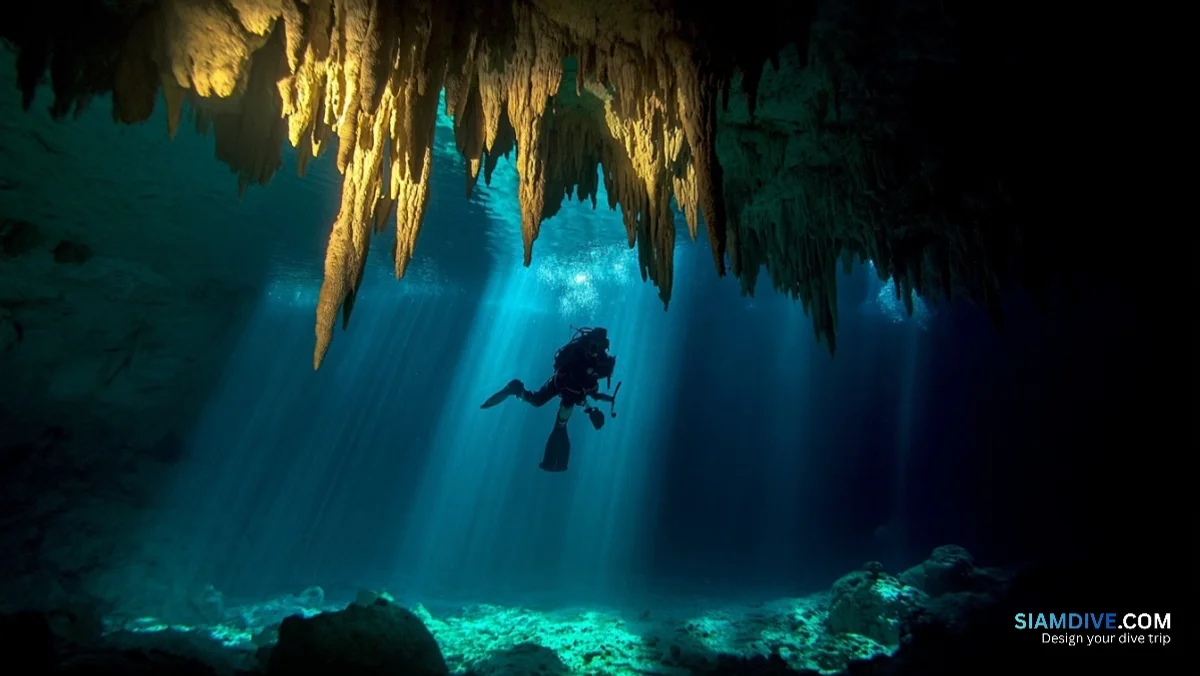
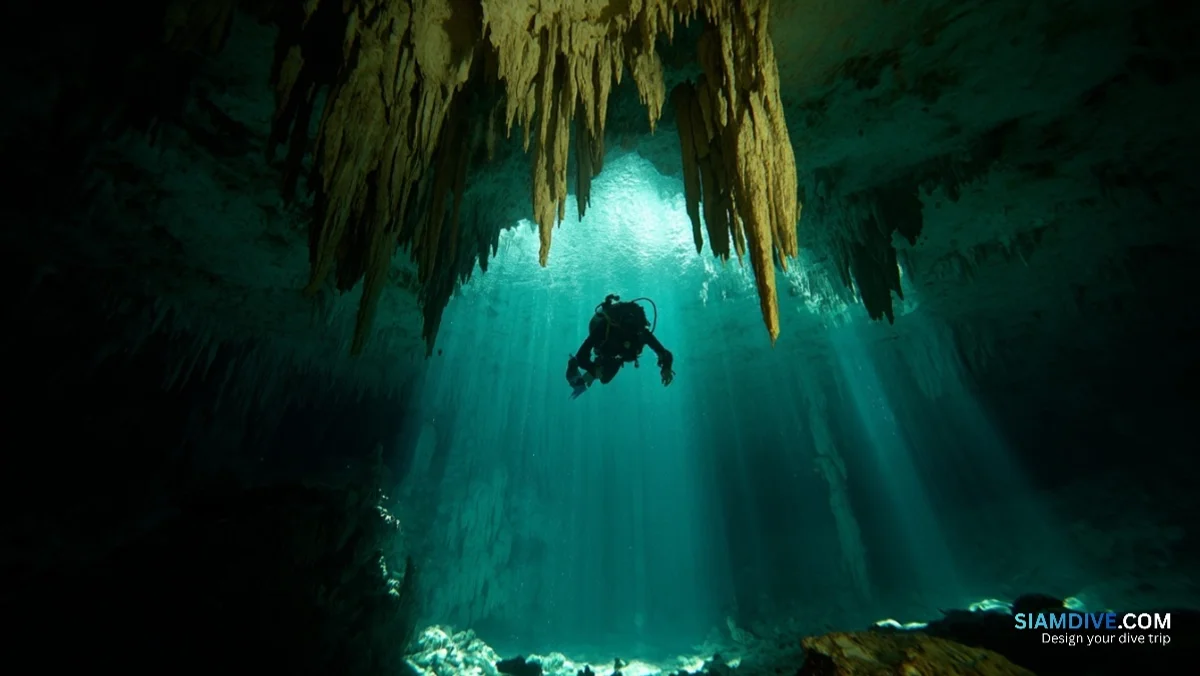
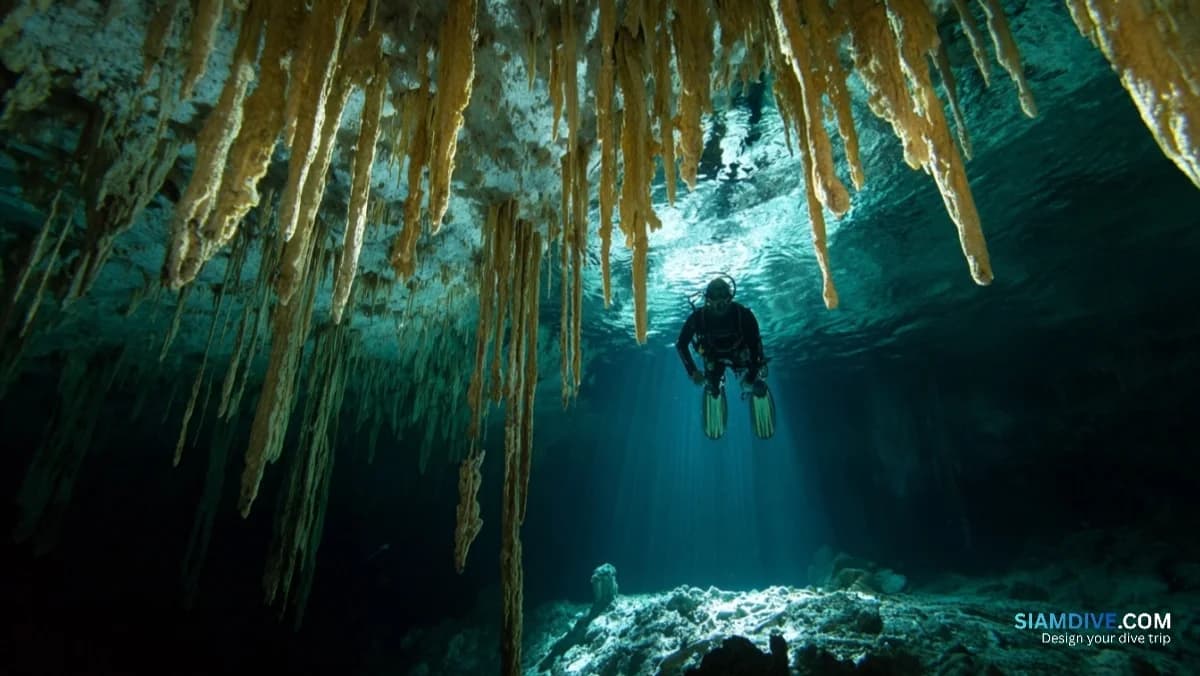
Sunlight drops through two collapsed limestone holes, hits the water, and keeps going — straight down through ten metres of liquid glass to the white sand floor. That is how Cenote Dos Ojos earned its name: two eyes staring up at the Yucatán sky, each one a portal into a cave system that now stretches more than 524 kilometres under the jungle. The depth rarely exceeds ten metres. The visibility can reach a hundred. And every year, thousands of Open Water divers make the trip to Tulum for what might be the most visually striking shallow dive on the planet.
Two Pools, One Parking Lot
The cenote sits about 22 kilometres north of Tulum along Highway 307, down a bumpy access road that ends at a ticket booth and a patch of gravel. The entrance fee is 370 MXN — roughly 20 USD — and includes a life jacket and access to both pools. "Dos Ojos" means "two eyes" in Spanish, and the name describes exactly what you see from above: a pair of sinkholes in the limestone ceiling, each ringed by jungle and dangling tree roots.
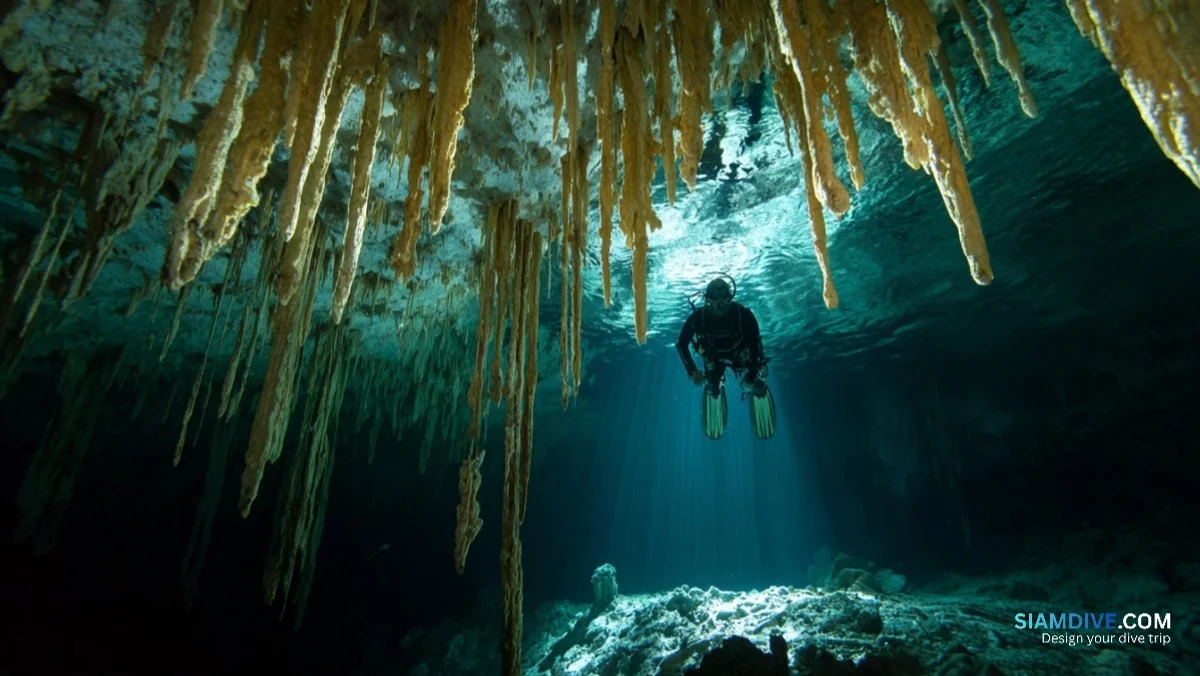
The western eye is wider, fringed by roots that trail into emerald water and lit by a broad cone of sunlight from late morning through early afternoon. The eastern eye opens into a darker, narrower passage that leads toward the Bat Cave circuit. Both pools connect underground through a labyrinth of tunnels and chambers lined with stalactites that formed during the last Ice Age — when the passages stood dry and the sea level sat dozens of metres lower than today.
On the surface, nothing suggests what lies beneath. A rope line. A briefing board. A plastic bin of rental snorkels. Step off the platform and the scene changes entirely: limestone columns stand in rows that would fill a cathedral nave, and the water is so clear it barely registers as a medium at all.
The Barbie Line — Where Visibility Ends at the Wall
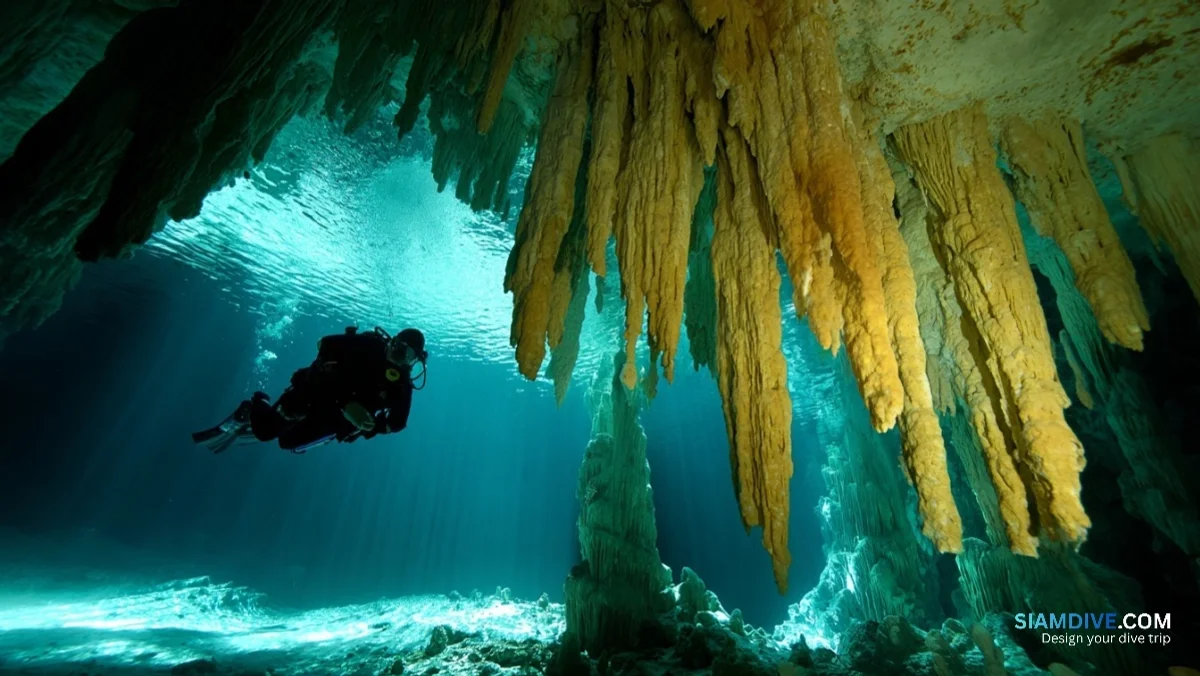
The first of two standard dive circuits follows what locals call the Barbie Line — a guideline threaded through the main cavern passage at a maximum depth of seven metres. Natural light still reaches from the cenote openings at that depth, and certified cavern guides lead groups of two to four divers along a roughly 40-minute route between limestone columns and flowstone formations that have been building for tens of thousands of years.
Visibility here routinely reaches 100 metres. That number sounds absurd until the light angle cooperates and the far wall snaps into focus like a photograph taken from across a room. The water is fresh, filtered through the Yucatán's porous limestone over millennia, and holds a constant 24–25 °C regardless of season. No thermocline. No surge. No current worth mentioning. For divers accustomed to five-metre vis in a tropical thermocline, the effect is disorienting in the best possible way.
Air consumption tends to be low because there is almost nothing to fight against. Buoyancy control matters more than kick power — the ceiling is close, the silt on the floor is finer than talcum powder, and a misplaced fin stroke turns that hundred-metre sightline into a two-metre cloud. Cavern guides in the Tulum corridor enforce a strict no-touch protocol. A single column may have taken 50,000 years to form, and a careless grip can snap a soda-straw stalactite that will never grow back. If you are working on trimming your breathing for better air management, a cenote is both the easiest and the least forgiving place to practise.
Lights Out in the Bat Cave
The second circuit swings east through a low restriction and into the Bat Cave, where the ceiling drops and daylight fades from blue glow to total black. Maximum depth reaches about ten metres. Dive torches replace sunlight, and the geology shifts: thin soda-straw stalactites hang in clusters like frozen rain, curtains of dripstone fold into translucent sheets, and — when the guide kills every light for a three-second count — the darkness is absolute.
The name is literal. Mexican fruit bats roost in the dry upper chambers above the waterline, and their presence in a cenote is one of the biological markers researchers use to assess cave-system health. For divers, the lights-out moment is the signature beat of the Dos Ojos experience — the scene that fills TripAdvisor threads and memory cards. Torches click back on and columns light up one by one, each a slightly different shade of amber depending on the mineral content of the limestone that built it.
Thailand's granite swim-throughs at Elephant Head Rock offer a similar sense of overhead enclosure, but the comparison ends at the geology. Granite is massive and rough-edged. Cenote limestone is smooth, sculpted, and covered in formations delicate enough to shatter under a fin tip. The protocol is the same — streamlined position, zero contact — but the consequences of breaking it are measured in millennia rather than seasons.
Where Freshwater Shimmers Above Salt
Drop below roughly eight to ten metres in the right passage and the halocline appears: a shimmering, blurry band where cold freshwater sits on top of denser saltwater that has seeped inland from the Caribbean coast, about 15 kilometres to the east. The mixing zone looks like heat shimmer on asphalt — images distort, colours smear, and a hand passed through it seems to bend at the wrist.
The phenomenon exists across most coastal cenotes on the Yucatán Peninsula, typically forming between 10 and 30 metres below the water table. At Dos Ojos, it is shallow enough to encounter on a standard cavern dive without straying from the guided route. The cause is geological: the Yucatán is a flat slab of porous limestone barely above sea level. Rainwater percolates down, Caribbean seawater pushes in from the coast, and the two layers refuse to mix cleanly. The boundary between them acts as a liquid lens that bends light in ways no camera filter can replicate.
Wide-angle shots taken through the halocline acquire a dreamy softness that reads like a processing artefact on screen, and autofocus systems struggle to lock on anything inside the band. Manual focus, a slow approach, and patience with the shutter tend to produce the cleanest results — though plenty of divers put the camera away entirely and just watch the shimmer move.
The 524-Km Labyrinth Below
In January 2018, a team led by underwater archaeologist Robert Schmittner confirmed what cave-diving teams had suspected for years: the Dos Ojos system connects to Sistema Sac Actun, forming the longest underwater cave network ever surveyed. At the time of connection, Sac Actun measured 263 kilometres and Dos Ojos contributed another 84. By April 2026, continued survey work has pushed the combined system past 524 kilometres — and exploration teams are still adding passage every month.
The caves hold more than geology. Archaeological surveys in deeper sections have recovered Pleistocene megafauna bones — giant ground sloths, sabretooth relatives — and ancient Maya artefacts including pottery and human remains associated with ritual offerings. The speleothems themselves serve as climate-history archives: growth layers in the stalactites record rainfall and temperature shifts reaching back over 100,000 years, and researchers at institutions including Northwestern University have been extracting that data for more than a decade.
Recreational cavern divers at Dos Ojos see only the outermost fraction of this network. The cavern zone, by definition, stays within the natural-light zone and within about 60 metres of the nearest air surface. Everything beyond that boundary — the other 523-plus kilometres of dark, branching passage — belongs to full cave divers carrying redundant equipment, sidemount rigs, and months of specialist training. The threshold is physical and unambiguous: a sign at the cavern limit reads "STOP — prevent your death."
Open Water Card, Cavern Dive — How That Works
Open Water certification and a checkout dive — that is the entire entry requirement for the standard two-dive circuit at Dos Ojos. No cave card needed. Cavern diving, as the training agencies define it, stays within the light zone, uses a single tank, follows a continuous guideline, and is always guide-led.
That simplicity does not make it identical to an open-water reef dive. The overhead environment changes the risk calculus: a silt-out can drop visibility to zero in seconds, there is no direct ascent to the surface, and disorientation in low light can turn a shallow dive into a serious problem. Dive centres in Tulum and Akumal run a poolside or shore orientation before the first dive, covering guideline protocol, the rule of thirds for air management, and fin-kick techniques that minimise silt disturbance.
- Open Water diver
- Guided cavern dives at Dos Ojos (Barbie Line + Bat Cave), max ~10 m, always with certified cavern guide
- Advanced Open Water
- Opens deeper cenotes — The Pit (40 m+), Angelita — plus multi-cenote day itineraries
- IANTD Cavern Diver (3-day course, 25+ logged dives)
- Greater freedom on cavern routes, more sites, deeper penetration within the light zone
- Full Cave Diver (extensive training, redundant gear)
- Unrestricted access beyond the light zone — twin tanks, sidemount or backmount rig required
For divers building fitness before any overhead-environment dive, solid endurance in open water makes a measurable difference. A structured swim training plan helps arrive ready rather than anxious.
Getting In and What It Costs
Dos Ojos is open year-round. Underground water temperatures hold at 24–25 °C in every month, so seasonal timing matters more for surface comfort and crowd levels than for dive conditions. High season runs November through April, when Tulum fills with visitors and morning dive slots book out days ahead. May through October is quieter, warmer on the surface, and wetter — but the cenote notices none of it.
- Entrance fee: 370 MXN (~20 USD) — life jacket included, access to both pools
- Guided two-dive cavern package: 85–130 USD per person (most operators include tanks, weights, guide, and entrance)
- Full equipment rental: add ~500 MXN (~27 USD) if needed
- Guided snorkel + Bat Cave tour: 700 MXN (~38 USD) — guide, locker, parking included
The access road branches off Highway 307 at kilometre marker 124, roughly 22 km north of Tulum town. A rental car is the simplest option. Colectivos — the shared minivans that shuttle passengers along the Riviera Maya — run the highway but do not turn off into the cenote road, leaving a four-kilometre walk that is not practical with dive gear. Most dive centres in the Tulum–Akumal corridor include door-to-door transport in their package price.
A 3 mm full wetsuit is standard equipment. The water is 24–25 °C, which feels comfortable for the first 20 minutes and noticeably cool by the end of the second dive. Divers accustomed to warmer tropical seas may want to consider when thin neoprene stops being enough. And for a different kind of overhead swim — granite instead of limestone, warm instead of cool — Thailand's cave passages at Koh Thalu in Chumphon make an interesting comparison.