The Lake Where 5 Million Jellyfish Forgot How to Sting
22 เมษายน 2569
Palau's Jellyfish Lake holds millions of golden jellyfish that evolved to be harmless. Here is what 12,000 years of isolation created and how to visit.
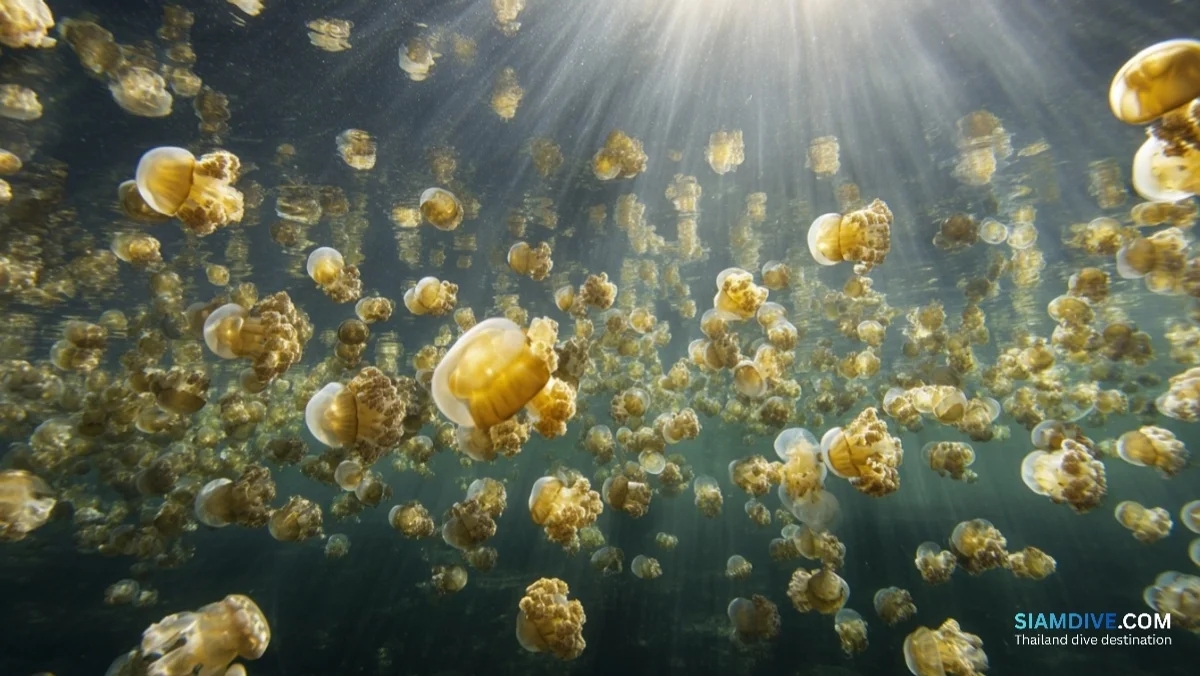
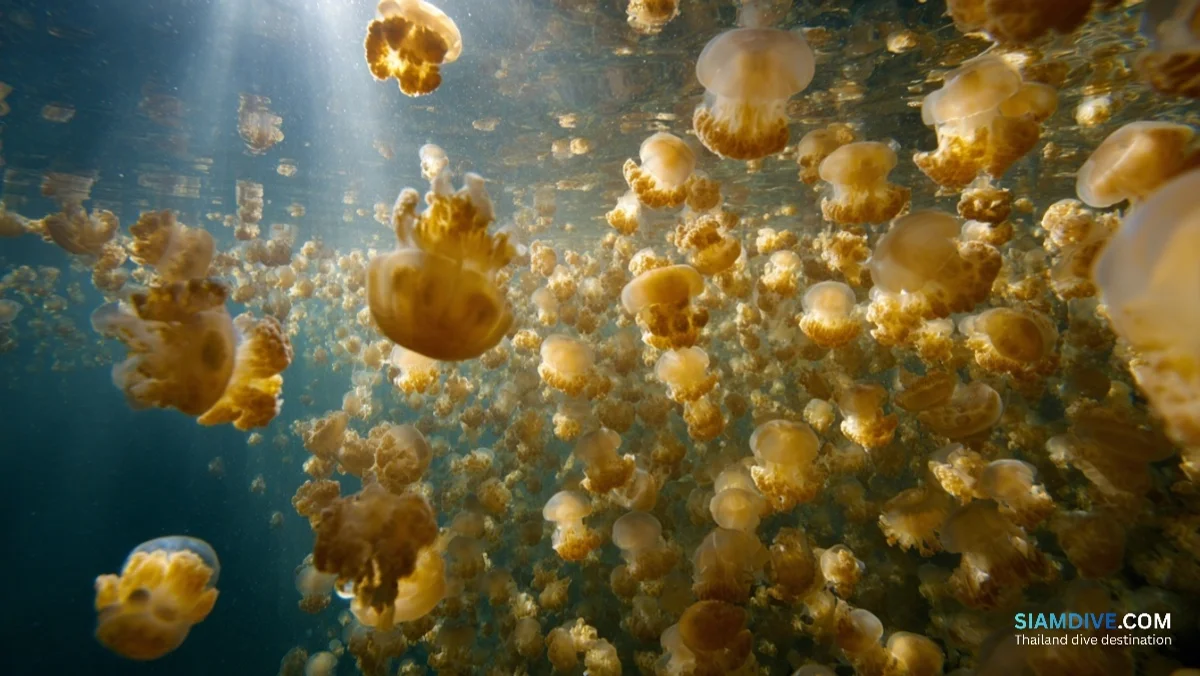
Warm, brackish water rises to chest height as you step off the wooden dock. Within seconds, the first golden bell drifts into view — translucent, the size of a grapefruit, pulsing in a rhythm that looks almost mechanical. Then another. Then dozens. Then the water ahead turns amber with them, a living curtain that parts and re-forms around every stroke. This is Ongeim'l Tketau — Jellyfish Lake — a marine lake on Eil Malk island in Palau's Rock Islands, and the only place on Earth where millions of jellyfish evolved to be functionally harmless to human skin.
How a Glacier Made a Jellyfish Lab
Around 12,000 years ago, at the tail end of the last Ice Age, rising sea levels flooded a limestone basin on Eil Malk island. Saltwater seeped through fissures in the ancient Miocene reef, filled the depression, and then — as the reef walls grew and sealed — the basin became a lake. Connected to the ocean only through microscopic cracks in porous rock, Jellyfish Lake developed its own chemistry, its own food web, and its own rules.
Palau has roughly 70 such marine lakes scattered through the Rock Islands, but Ongeim'l Tketau is the largest and the most studied. The Coral Reef Research Foundation in Koror has monitored its population cycles since the 1990s, making it one of the longest-running marine lake datasets in the Pacific.
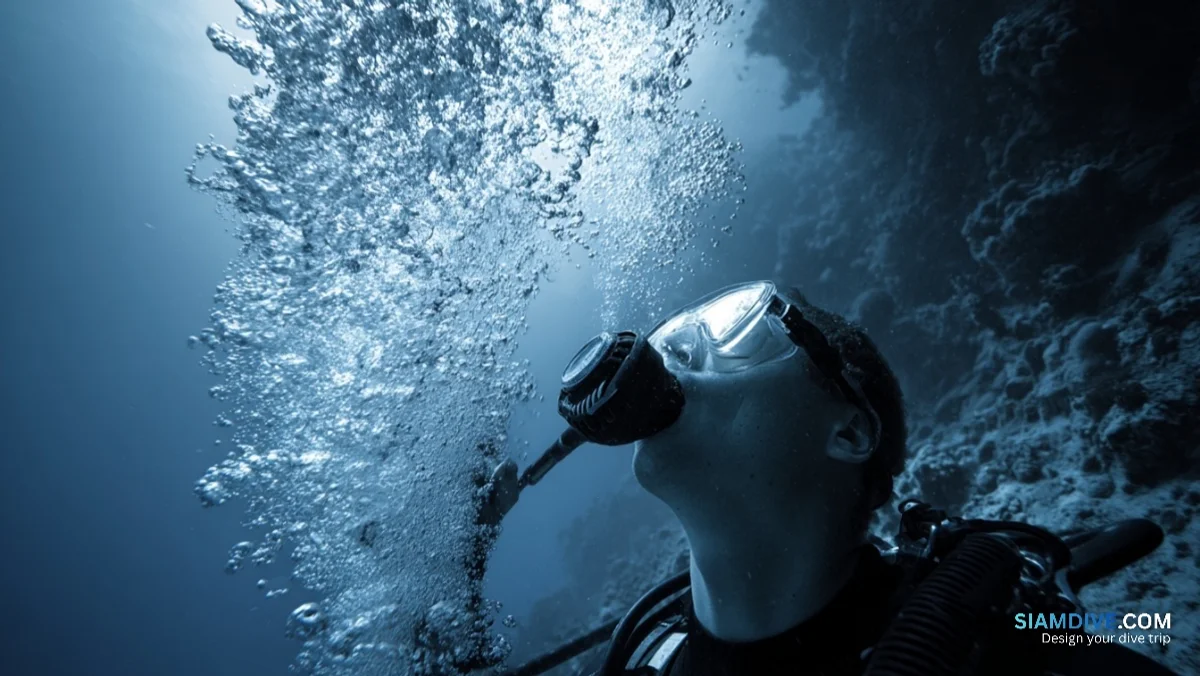
What makes the lake unusual is not just its isolation but its vertical architecture. The top 15 metres hold oxygenated, slightly brackish water — warm, sunlit, thick with life. Below that, a chemocline marks a sharp transition into an anoxic layer saturated with hydrogen sulfide at concentrations exceeding 80 mg per litre. Nothing with gills survives down there. The layering is what banned scuba diving decades ago: descending through the chemocline would expose a diver's skin to H₂S concentrations far above safety thresholds, and the bubbles from a regulator would damage the delicate jellyfish above.
The Subspecies That Dropped Its Weapons
The golden jellyfish in the lake carries the formal name Mastigias cf. papua etpisoni, a subspecies described in 2011 alongside four other newly recognized variants from neighboring marine lakes. Its ancestor, the spotted jellyfish Mastigias papua, still lives in Palau's open lagoons and carries a sting sharp enough to irritate human skin.
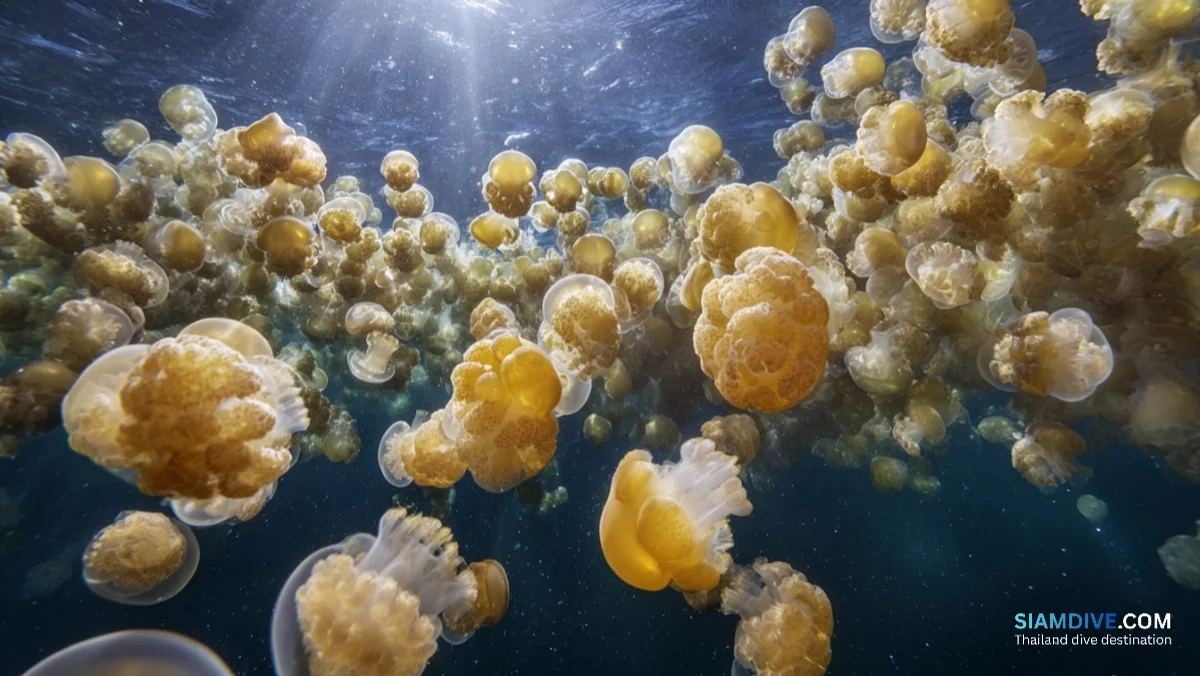
Twelve millennia of isolation changed the equation. Without large predators and with a closed food web dominated by zooplankton and symbiotic algae, the golden jellyfish lost most of the anatomical equipment its lagoon cousins rely on. The spots that pattern the exumbrella of M. papua are almost entirely gone. The clubs — fleshy appendages attached to the oral arms that aid in prey capture — have nearly vanished.
The stinging cells remain, technically. Each jellyfish still fires nematocysts capable of subduing microscopic zooplankton. But the discharge is so weak that a human swimming through a swarm of thousands feels nothing more than a faint tingle, if anything at all. The evolutionary trade-off is straightforward: in a closed system with no fish, no turtles, and no competition for the zooplankton supply, investing energy in venom production became a cost with no return.
One predator did stay behind. The jellyfish-eating anemone Entacmaea medusivora lines the eastern and shadowed margins of the lake, waiting for any golden bell that drifts too close to the rocks. This single threat shaped the jellyfish's most famous behavior.
Solar-Powered Commuters
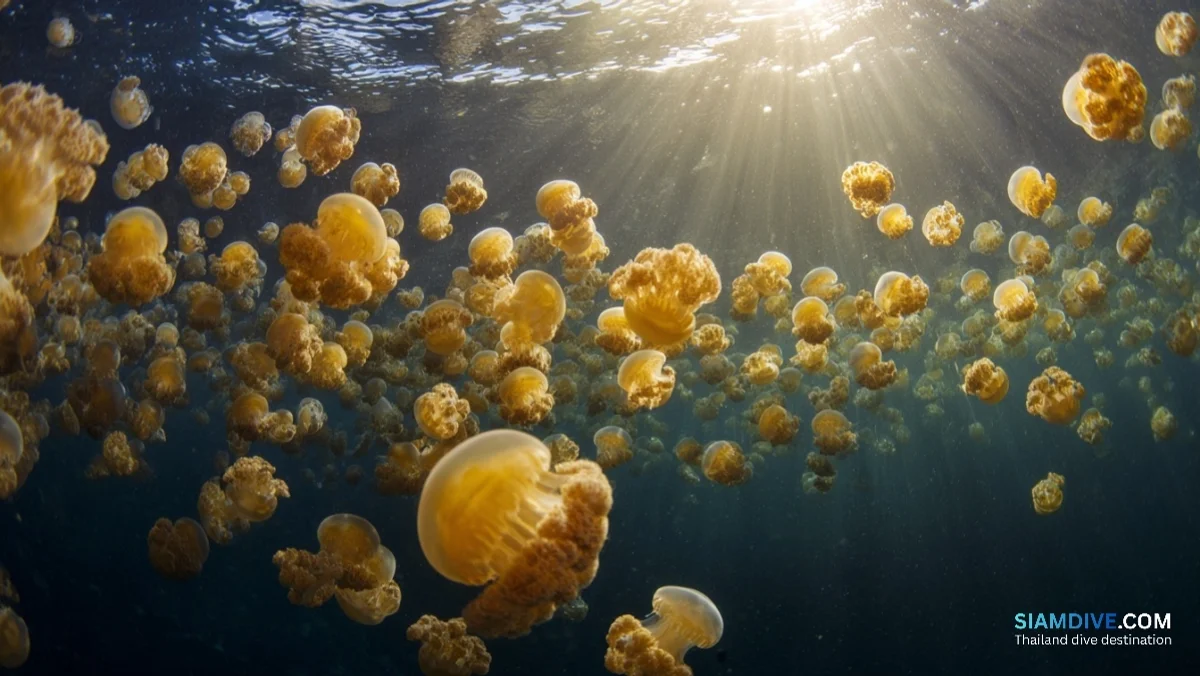
Every sunrise triggers a migration that has been running for millennia. As light hits the eastern tree line, the golden jellyfish swim toward it — not randomly, but in a coordinated mass movement that carries millions of animals from the center of the lake toward the eastern basin. They stop just short of the shadow line cast by the limestone ridge, where the anemones cluster.
By mid-morning, the swarm reverses. As the sun crosses overhead and shifts west, the jellyfish follow, tracking the light across the lake until they reach the western shadow line in the late afternoon. The pattern repeats daily, rain or shine, with remarkable consistency.
The reason is photosynthesis — just not the jellyfish's own. Each golden bell hosts colonies of zooxanthellae, symbiotic algae embedded in its tissue. The algae convert sunlight into sugars, which feed the jellyfish in return for a safe, sun-drenched platform. By chasing light, the jellyfish effectively farm their own fuel. They even rotate counter-clockwise as they swim at the surface, tilting their bells to expose every square millimetre of tissue to the sun.
Between surface runs, the jellyfish make repeated vertical dives to the edge of the chemocline — about 15 metres down — and back. Researchers believe these excursions allow the animals to absorb nitrogen and other nutrients concentrated near the anoxic boundary, supplementing what the zooxanthellae provide.
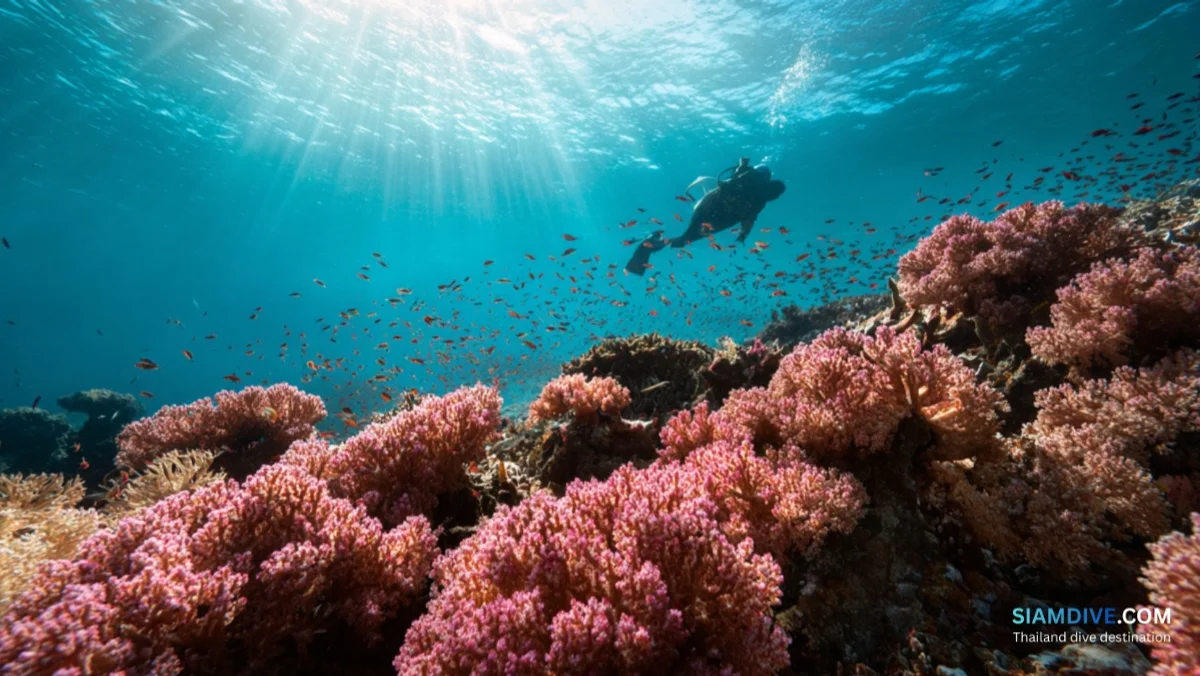
The result is a solar-powered, vertically migrating, self-fertilizing organism that has no real parallel anywhere else on Earth. Corals rely on zooxanthellae too, but corals are fixed to the reef. Coral restoration projects around the world work to rebuild those fixed colonies. The golden jellyfish, by contrast, carries its algal farm wherever it swims.
From Five Million to Five Thousand — and Back
The population has never been stable. Coral Reef Research Foundation surveys show cycles of boom and crash driven by sea surface temperature, rainfall, and the El Nino-Southern Oscillation.
The most dramatic collapse came in 2016. A severe El Nino pushed water temperatures high enough to bleach zooxanthellae out of the jellyfish tissue — the same mechanism that bleaches corals on tropical reefs worldwide. Without their algal partners, the jellyfish starved. The population dropped from millions to near zero, and Koror State closed the lake to tourism entirely.
Recovery took two years. By 2018, surveys confirmed enough golden jellyfish had returned to justify reopening, and visitor numbers climbed back quickly.
Then it happened again. By mid-2025, counts had fallen to fewer than 5,600 individuals — a fraction of the estimated five-million peak. Visitor reviews from that period describe swimming for 40 minutes and spotting fewer than a dozen golden bells, with moon jellyfish making up most of the visible population.
That pattern appears to be reversing. In March 2026, the Palau Aggressor II liveaboard fleet announced the reintroduction of Jellyfish Lake to its itinerary, citing thriving jellyfish numbers. Early visitor reports from Q1 2026 describe swarms thick enough to turn the water golden again — not at peak five-million density, but well beyond the 2025 low.
What the $100 Permit Covers
The boat ride alone makes the trip worth booking — 45 minutes threading between mushroom-shaped limestone islets draped in jungle. But the permit structure is what most visitors want to understand upfront.
- Palau Green Fee — $50 USD per person, valid for 10 days, covering access to all Rock Islands sites
- Jellyfish Lake Permit — $100 USD per person (ages 6 and up), valid for 5 days, specific to the lake
Most visitors book a guided day tour from Koror, which runs between $100 and $200 USD per person on top of the permits. The tour typically includes the boat ride through the Rock Islands, a short jungle hike over the limestone ridge to the lake's edge, and 30 to 60 minutes of snorkeling time.
No dive shops are involved — the lake is snorkel-only. Fins, mask, and a life vest (provided and mandatory) are the only equipment needed. The $100 permit fee funds Koror State's monitoring and conservation program, including the Coral Reef Research Foundation's population surveys.
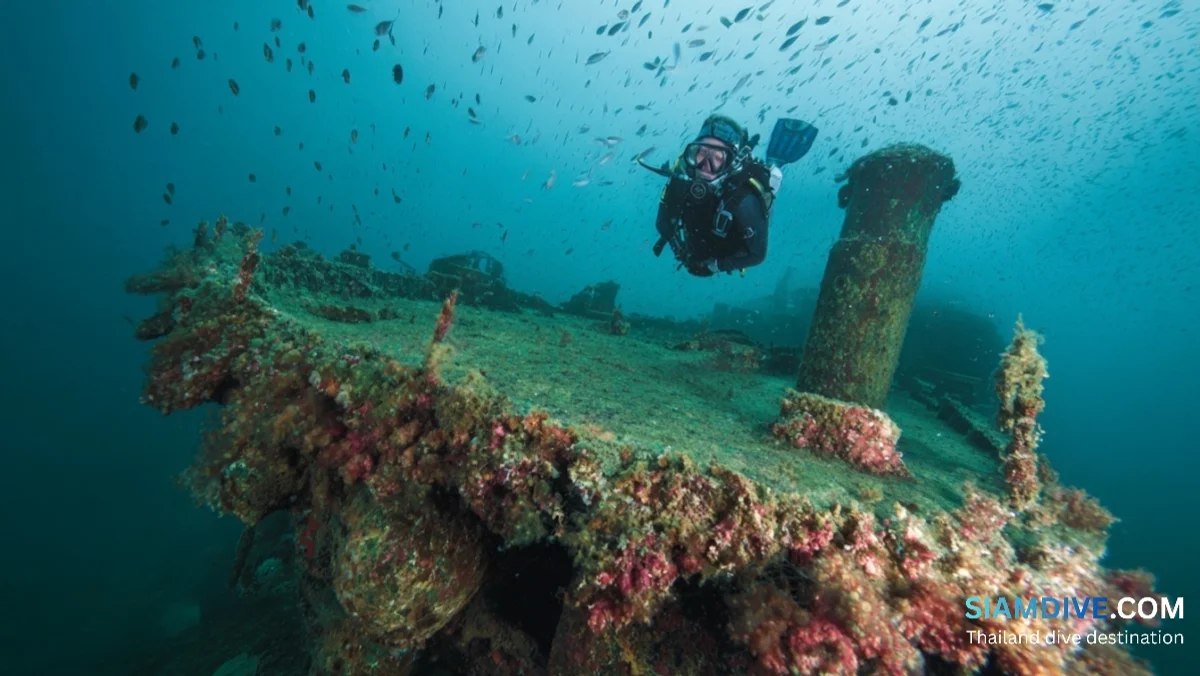
For context, a two-dive day trip on a Thai reef like Boonsung Wreck off Khao Lak runs around 3,500–4,500 THB ($100–130 USD). Jellyfish Lake costs roughly the same once permits are factored in — but delivers an experience with no equivalent anywhere else in the snorkeling world.
Five Rules the Lake Enforces
Every rule at Jellyfish Lake exists because the ecosystem nearly collapsed when it was ignored.
- No scuba diving. Regulator bubbles damage jellyfish tissue, and the hydrogen sulfide layer below 15 metres can absorb through exposed skin at concentrations that exceed safety thresholds eightfold.
- No conventional sunscreen. Chemical UV filters — oxybenzone, octinoxate — are toxic to the zooxanthellae that the jellyfish depend on. Guards at the trailhead will confiscate non-reef-safe products. Mineral-based, reef-safe sunscreen is permitted.
- No touching. The jellyfish body is over 95% water. Even gentle contact can tear tissue, damage the bell, or strip zooxanthellae from the surface. Hands stay at your sides.
- Life vests mandatory. Partly for safety, partly for buoyancy control. A snorkeler floating high disturbs less water than one kicking hard at depth, and the vest keeps inexperienced swimmers from accidentally sinking toward the chemocline.
- No fin kicks near jellyfish. The turbulence from a flutter kick can tumble a jellyfish end over end, disrupting its counter-clockwise rotation and its zooxanthellae exposure cycle.
The strictness works. Despite hosting tens of thousands of visitors per year before the 2025 downturn, the lake's repeated population recoveries suggest that the ecosystem — when protected — is resilient enough to absorb tourism pressure.
Timing the Swarm
Jellyfish Lake is open year-round, though Palau's dry season — November through April — offers calmer seas for the boat ride and clearer skies that drive stronger jellyfish migration. The most reliable snorkeling window is between 09:30 and 11:00, when the swarm is concentrated in the eastern basin near the dock and the sun angle maximizes zooxanthellae activity.
Afternoon visits catch the westward return, but cloud cover can scatter the formation. Overcast days produce a looser, more dispersed swarm — still present, but without the dense golden wall that makes the lake famous.
Getting to Palau typically means flying through Guam, Manila, Taipei, or Seoul. Budget around $800–1,200 USD for roundtrip flights from major Asian hubs, plus $100–250 per night for accommodation in Koror.
For divers planning a full Palau trip, the Rock Islands offer world-class wall and drift diving at sites like Blue Corner, German Channel, and Ulong Channel — some of the most sought-after bucket-list dive experiences on the planet. Jellyfish Lake is typically a half-day side trip woven into a week of diving.
Sources
- Coral Reef Research Foundation — Jellyfish Lake research and monitoring
- Wikipedia — Jellyfish Lake (stratification, migration, population data)
- National Geographic — Golden Jellyfish species profile
- Palau Aggressor II — Jellyfish Lake returns to itinerary (March 2026)
- Oceanic Society — Palau's Jellyfish Lake visitor guide