1,500 Newtons in 80 Microseconds: Thailand's Mantis Shrimp
20 เมษายน 2569
A 10 cm crustacean delivers the ocean's fastest punch — and thrives in Andaman rubble zones most divers swim right past.
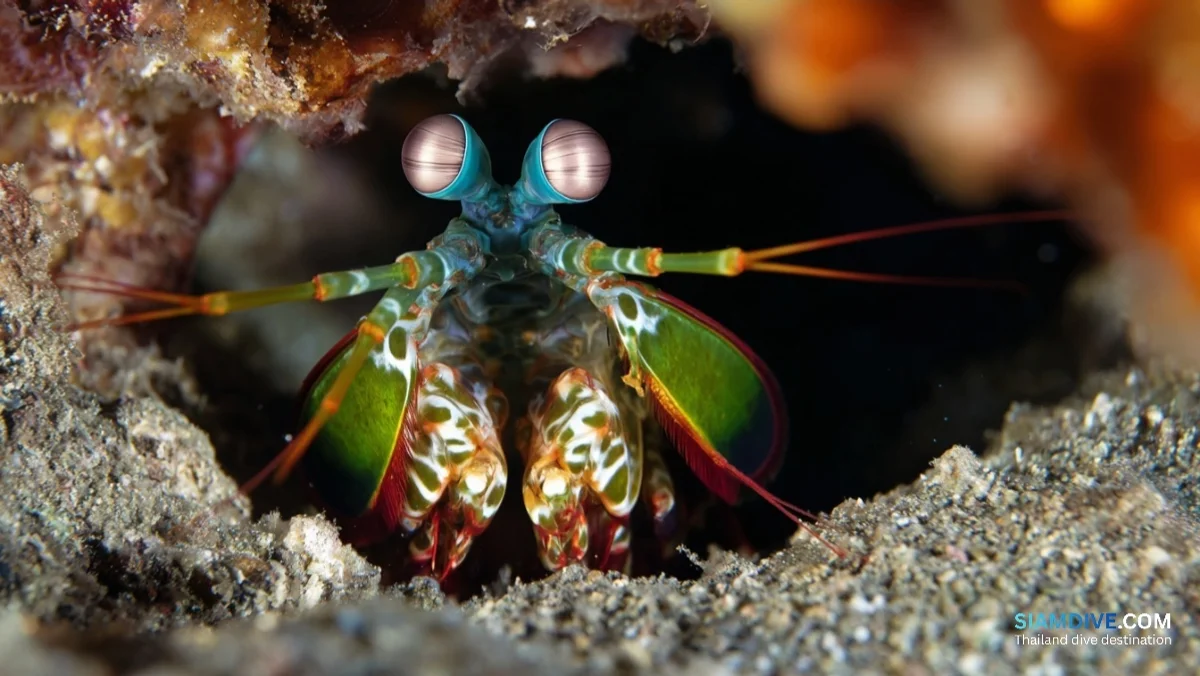
Eighty microseconds. That is how long a peacock mantis shrimp needs to accelerate its club from zero to 23 metres per second — faster than a .22 calibre bullet leaves the muzzle of a pistol. The strike lands with 1,500 newtons of force, roughly 2,500 times the animal's own body weight. And the creature delivering it is smaller than a human hand, often no longer than 10 to 18 centimetres, tucked inside a sandy burrow at the base of an Andaman reef. Divers who have never looked twice at the rubble zone are walking past one of the most extraordinary predators in the ocean.
The Fastest Limb in the Ocean
Muscle alone cannot produce the mantis shrimp's strike. The mechanism works more like a crossbow than an arm. Inside the merus segment of the raptorial appendage sits a saddle-shaped piece of exoskeleton — a spring made of chitin and calcium — compressed by powerful extensor muscles. A pair of tiny sclerites embedded in the tendon act as a latch, holding the system cocked. When the latch releases, stored elastic energy unloads through a four-bar linkage that converts linear deformation into rotational velocity. The dactyl club swings outward and downward. Impact follows in under 800 microseconds from release to full contact.
Research from the Patek Lab at Duke University has measured smashing strikes at 12 to 23 m/s depending on species and specimen size. Peak accelerations exceed 10,000 g — a figure that makes a fighter jet's 9 g seem almost gentle. The force output is disproportionate to the animal's size because the system bypasses the speed limits of direct muscle contraction entirely.
Two Hits From a Single Swing
The club connects once, and then the water itself strikes a second time. At the velocities involved, the rapid displacement of water between the club and the target creates a low-pressure void — a cavitation bubble. When that bubble collapses milliseconds later, it generates a secondary shockwave and a brief flash of light called sonoluminescence. The temperature inside the collapsing bubble may exceed 4,700°C for an instant, hotter than the surface of many stars.
For the mantis shrimp's prey — snails, hermit crabs, bivalves — there is no defence. The shell absorbs the mechanical impact of the club, and before it can redistribute the stress, the cavitation collapse arrives. Two forces, separated by less than a millisecond, from a single movement. Aquarists who keep smashers in glass tanks learn this the hard way: a frustrated mantis shrimp can and does crack aquarium glass.
A Phononic Shield Made of Chitin
If the club hits hard enough to shatter mollusc shells and crack glass, why does the club itself survive? A study published in Science in February 2025 answered a question that had puzzled materials scientists for over a decade. The dactyl club is not just tough — it is engineered to filter its own shock waves.
The outer impact surface is coated in layers of heavily mineralised hydroxyapatite fibres arranged in a V-shaped herringbone pattern, providing hardness at the point of contact. Beneath that, corkscrew bundles of chitin fibres form a Bouligand structure — layers rotated slightly from one to the next, like a spiral staircase made of armour. The February 2025 research, led by a team at Northwestern University, showed that this layered architecture functions as a phononic filter. High-frequency stress waves generated by cavitation bubble collapse are scattered and attenuated as they pass through the periodic microstructure. The club essentially blocks the most damaging frequencies from reaching its interior, the way noise-cancelling headphones neutralise specific sound bands.
The discovery has implications well beyond marine biology. Engineers studying impact-resistant materials — body armour, spacecraft shielding, protective helmets — are now investigating how to replicate the mantis shrimp's graded microstructure in synthetic composites.
Sixteen Colour Channels and Counting
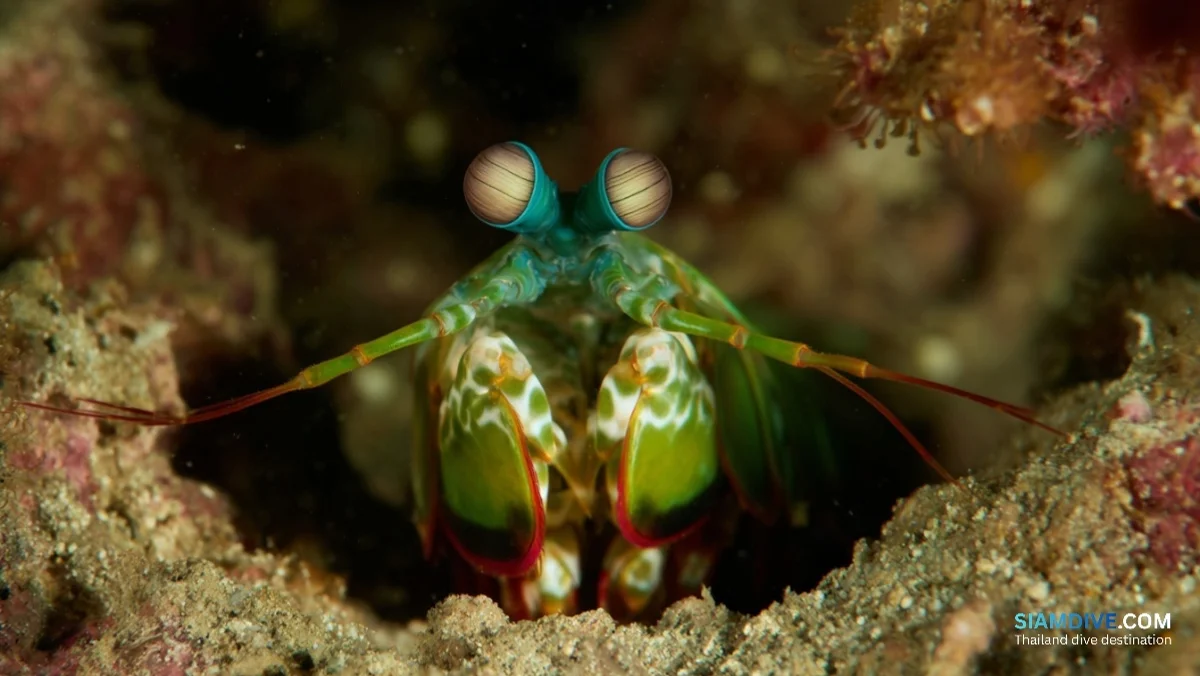
Below the club, behind those armoured appendages, sit the most complex eyes in the animal kingdom. Each eye contains 16 types of photoreceptor cells — compared with three in humans — arranged in a midband that divides the eye into three functional regions. The system can detect wavelengths from deep ultraviolet (300 nm) through to far red (720 nm), and it perceives six channels of polarised light, including circular polarisation, a feat no other animal is confirmed to share.
A 2014 study published in Science found that mantis shrimp do not process colour the way vertebrates do. Rather than comparing signals across receptor types to discriminate fine gradations — the way human vision works — stomatopods appear to use a simpler, faster recognition system. Each receptor type fires a binary signal: present or absent. The result is a scanning system optimised for speed over nuance, which makes sense for a predator that strikes in microseconds. Colour identification needs to be fast, not subtle.
The eyes move independently, each scanning a different arc of the reef. Together they provide trinocular vision from a single eye — depth perception without needing both eyes to converge on the same point. The compound structure also means the shrimp can track a moving target while simultaneously monitoring the periphery for threats, a trick that fighter pilots would envy.
For divers, the practical consequence is simple: the mantis shrimp sees you long before you see it. Approach a burrow entrance too quickly, and the shrimp retreats. Slow, lateral movement gives a better chance of observation.
Smashers and Spearers — 520 Species, Two Strategies
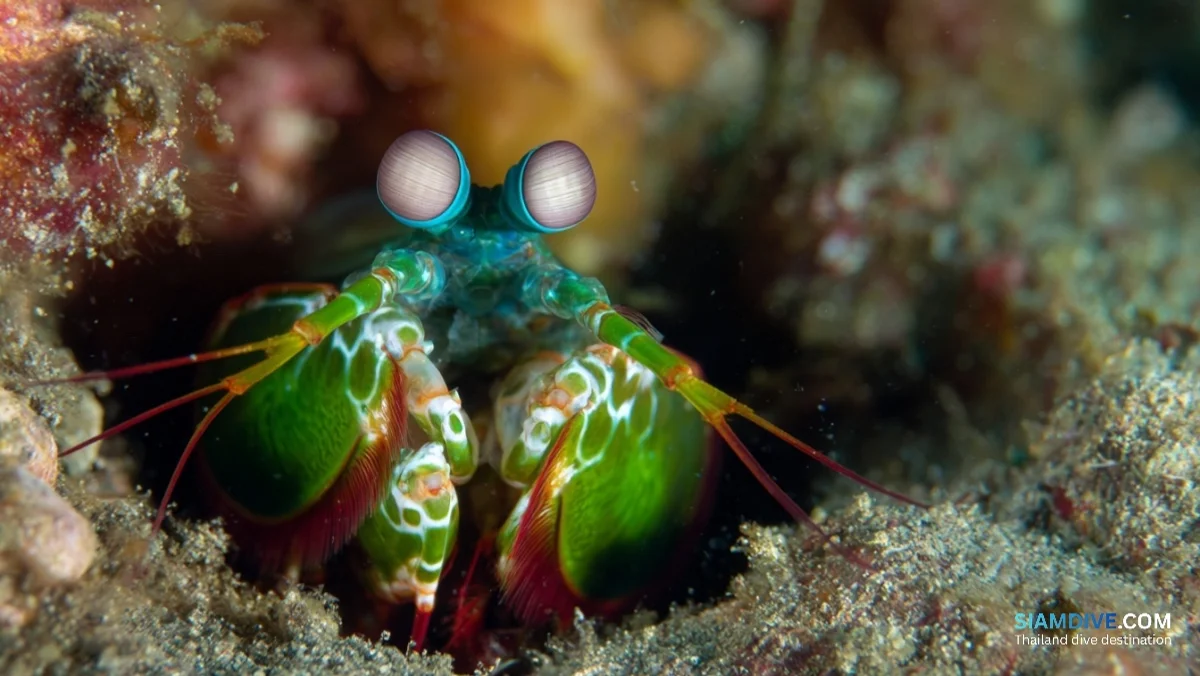
The order Stomatopoda contains more than 520 described species, split into two broad hunting strategies. Smashers — including the peacock mantis shrimp (Odontodactylus scyllarus) and the giant mantis shrimp (Hemisquilla ensigera) — carry heavily calcified clubs and target hard-shelled prey: snails, crabs, oysters. They excavate burrows in coral rubble and hard substrates.
Spearers, by contrast, wield barbed, blade-like raptorial appendages and ambush soft-bodied prey — fish and shrimp — from tunnels dug in sand or mud. They tend to be less colourful, more cryptic, and harder to spot. A few basal species sit between the two groups, carrying appendages that can both smash and spear, though less effectively at either task.
The distinction matters underwater. A smasher sits at its burrow entrance like a boxer in a doorway, clubs folded beneath its head, eyes tracking anything that moves within a body-length. Spearers are ambush predators — they lurk deeper inside their tunnels, often with only antennae and eye-stalks visible, and lunge when a small fish drifts past the opening. Knowing which type inhabits a site changes the search pattern: scan rubble and coral heads for smashers, scan sandy flats and silty slopes for spearers.
- Strike speed (smashers)
- 12–23 m/s, peak acceleration >10,000 g
- Strike force
- Up to 1,500 N (~2,500× body weight)
- Species described
- 520+ across ~17 families
- Size range
- 2–38 cm (most Thai species 8–18 cm)
- Photoreceptor types
- 16 (vs. 3 in humans)
- Lifespan
- 3–6 years in the wild; up to 20+ in captivity
Where They Lurk in the Andaman
Thailand's Andaman coast — from the Similan archipelago south to Koh Lanta — offers some of the best mantis shrimp encounters in Southeast Asia, though they rarely headline a dive briefing. These animals live at the margins: rubble slopes at the base of a reef wall, sandy patches between coral bommies, and the silty fringes of artificial reef structures like the Boonsung wreck.
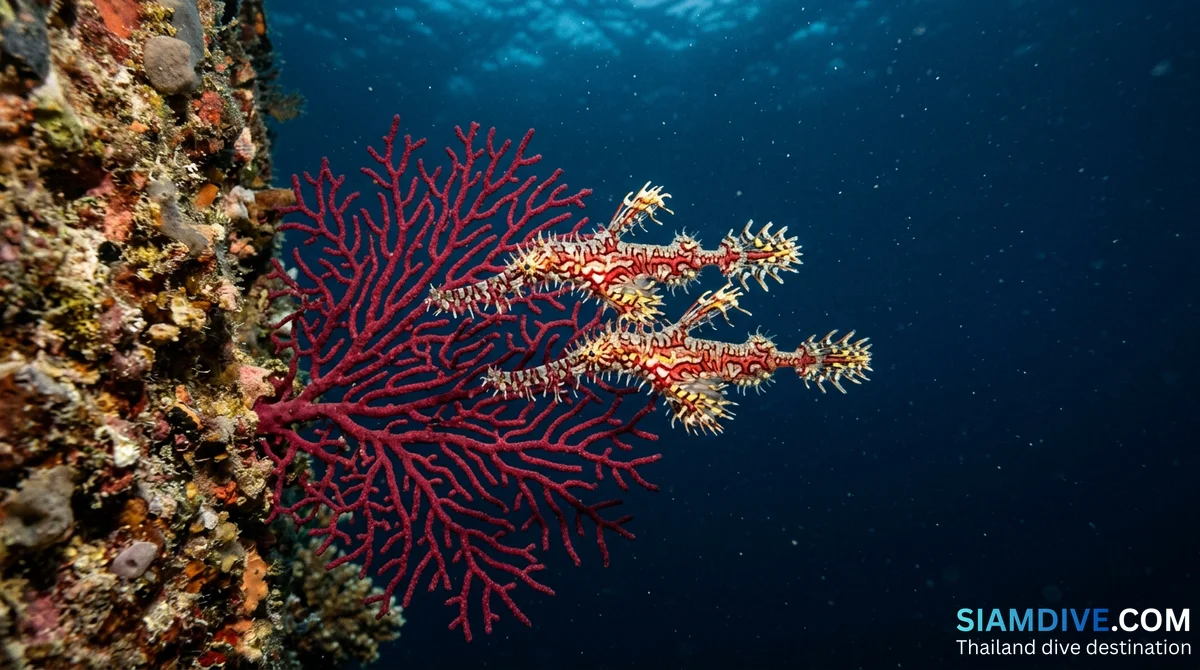
- Koh Doc Mai (Phuket) — The limestone wall drops to 25 metres, and the rubble apron at its base is prime mantis shrimp habitat. Macro photographers already know this site for ghost pipefish, but the same patient scan of the rubble often reveals a peacock mantis shrimp peering from its burrow. Best visibility: November to April.
- Richelieu Rock (Surin) — The horseshoe-shaped pinnacle 40 km offshore from Khao Lak is famous for whale sharks, but the rubble pockets at 18–22 metres shelter both smashing and spearing species. The Andaman's peak season runs October through May, and Richelieu is accessible by day trip or liveaboard.
- Koh Lanta (Krabi) — Hin Daeng and Hin Muang get the headlines, but the shallower reef sites south of Koh Lanta — Koh Haa Yai in particular — have sandy channels at 12–16 metres where spearing mantis shrimp hunt at dusk.
- Kata Reef (Phuket) — A shore-accessible site where night divers regularly encounter spearing mantis shrimp on the sand flat at 8–12 metres. No boat required, entry fee zero.
Mantis shrimp are active year-round, but sightings increase during night dives when spearers emerge to hunt. Smashers tend to remain visible during the day, perched at burrow entrances in the rubble zone. A guide who knows the local burrow map can take a diver straight to a resident individual — these animals are territorial and often return to the same hole for months.
Getting the Shot at 100mm
Macro photography is the only way to do a mantis shrimp justice. The peacock mantis shrimp's body — electric green, ringed with red and blue, eyes on articulated stalks — is one of the most saturated colour palettes on any reef animal. But the animal is fast, reactive, and sits in a hole. Shooting one well demands patience and technique.
A 100mm macro lens (or 60mm on a crop sensor) at f/11 to f/16 gives enough depth of field to hold both eyes in focus without collapsing the background into a flat wall. Dual mini strobes positioned at 10 and 2 o'clock, angled slightly inward, light the face without casting a hard shadow into the burrow. The key is distance: mantis shrimp tolerate a lens at 30–40 cm far better than a hand. Let the housing rest on the sand if possible, exhale slowly, and wait. Many of the best shots come when the shrimp extends its body to survey the reef — a behaviour that lasts two to three seconds before it retreats.
Shoot in burst mode. The animal's movements are sharp and unpredictable, and the difference between a portfolio image and a blur is often a single frame. For video, 120 fps slow-motion footage can sometimes capture the loading phase of a strike, though the actual strike itself requires lab-grade high-speed cameras to freeze.
One more consideration: mantis shrimp can and do strike camera ports. The dactyl club hits with enough force to scratch polished glass and dent aluminium lens covers. Keep the port at a respectful distance, and never prod a burrow entrance with a pointer stick to coax the animal out. Aside from being poor dive etiquette, a provoked smasher can deliver a wound that splits a finger to the bone — an injury well documented in fishing communities across Southeast Asia, where the animal is known by names that translate roughly to "thumb splitter."
Sources
- Nature — How mantis shrimp limbs survive the world's fastest punch (Feb 2025)
- Science — Phononic shield structure in the mantis shrimp dactyl club
- Duke University Patek Lab — Mechanics of mantis shrimp movement
- NIH/PMC — Electrophysiological investigation of power-amplification in mantis shrimp
- Science — A different form of color vision in mantis shrimp (2014)