5 Advanced Diver Habits That Backfire in Rescue Training
1 พฤษภาคม 2569
The jump from Advanced to Rescue is not about depth — it is about performance under stress. Five habits from AOW that will trip you up, and how to fix them.
The first rescue drill does not go the way anyone expects. A diver with 40 logged dives — confident, neutral-buoyant, comfortable at 30 metres — suddenly cannot pull a limp body to the surface without sinking both of them. The fins that felt so natural on a reef wall now churn uselessly against the drag of dead weight. Something has shifted, and the old skills are not enough.
This is the gap between Advanced Open Water and Rescue Diver — not a matter of depth or dive count, but a fundamental change in what the water asks of you. Advanced training teaches you to manage yourself in new environments. Rescue demands you manage someone else while the environment fights back. The habits that made you a good Advanced diver can become the mistakes that stall your Rescue certification.
Where the Gap Opens
Advanced Open Water is, at its core, an exposure course. Five adventure dives — deep, navigation, night, wreck, drift — picked from a menu, guided by the instructor, absorbed through experience. The learning model is guided discovery: see new things, try new skills, build comfort. Nobody asks you to perform under stress because the course is designed to keep stress from happening.
Rescue Diver inverts that model. The PADI Rescue curriculum is built around things going wrong — a panicked diver grabbing you, an unresponsive buddy on the bottom, a missing person with a shrinking air supply. The core competencies cover self-rescue, recognising diver stress, emergency management and equipment, and responding to both responsive and unresponsive divers at every stage from depth to shore.
- Self-rescue review — cramp removal, free-flow management, emergency weight drop, SMB deployment under task-load
- Distressed diver (surface) — tired-diver tow, panicked-diver approach, establishing buoyancy for two
- Distressed diver (underwater) — air-sharing ascent, controlled contact, redirecting a bolting diver
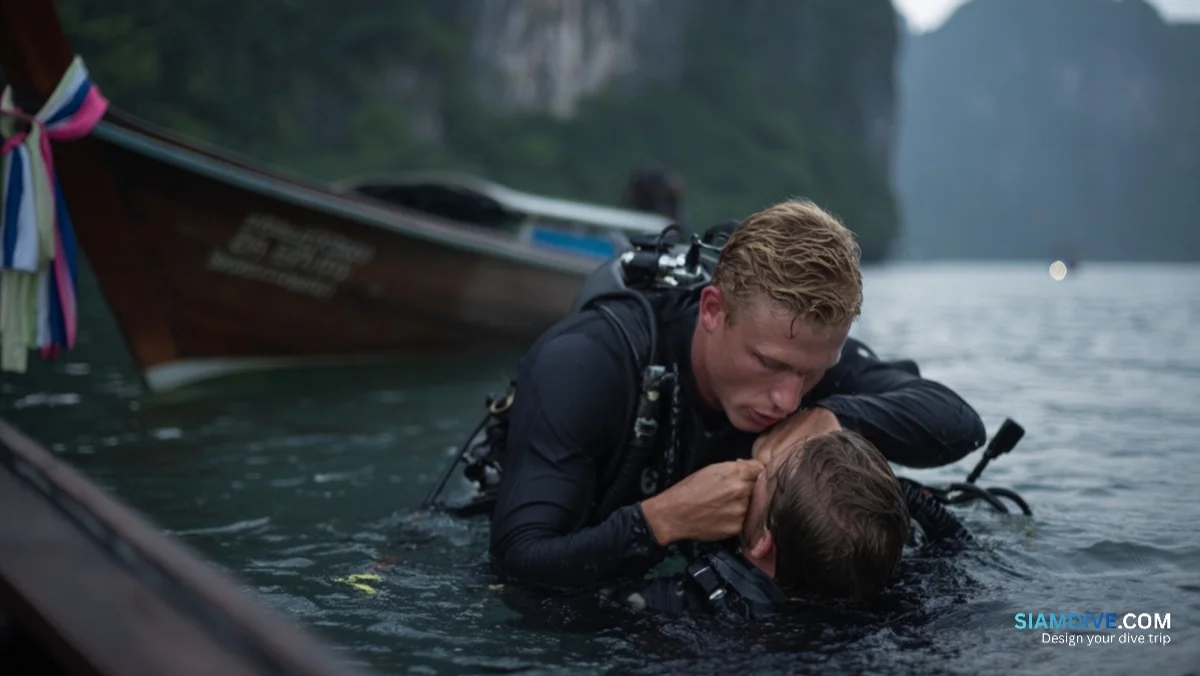
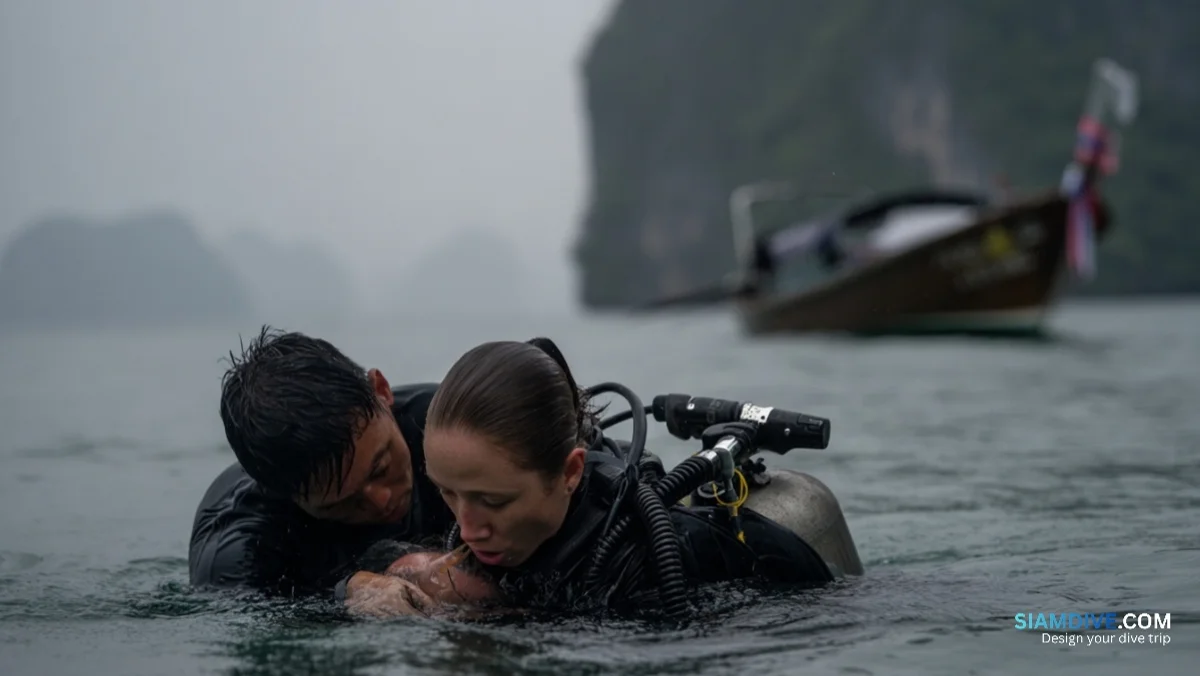
- Unresponsive diver — locate, surface, tow, exit, administer rescue breaths in open water
- Missing diver search — U-patterns, expanding squares, compass navigation under time pressure
- Emergency management — oxygen administration, EAP activation, role assignment, EMS handoff
The shift is not gradual. It lands on day one. DAN's fatality research reinforces why this matters: approximately 90% of diving fatalities trace back to diver error, not equipment failure or environmental conditions. The Rescue course exists to narrow the gap between what divers know in theory and what they do under pressure.
Think of it this way: Advanced is a course where the instructor prevents problems. Rescue is a course where the instructor creates them. Every scenario is designed to push students past the comfort zone that Advanced worked so hard to build — not to break confidence, but to rebuild it on a different foundation. The diver who comes out of Rescue is not braver. They are more prepared for the moment when bravery is irrelevant and only training matters.
Watching When You Should Be Moving
The most common habit carried from Advanced training is observation. In AOW, you learn to look — at the compass, at the reef, at your depth gauge, at whatever the instructor points toward. Passive attention is rewarded. On a deep dive, staying calm and aware is the entire skill.
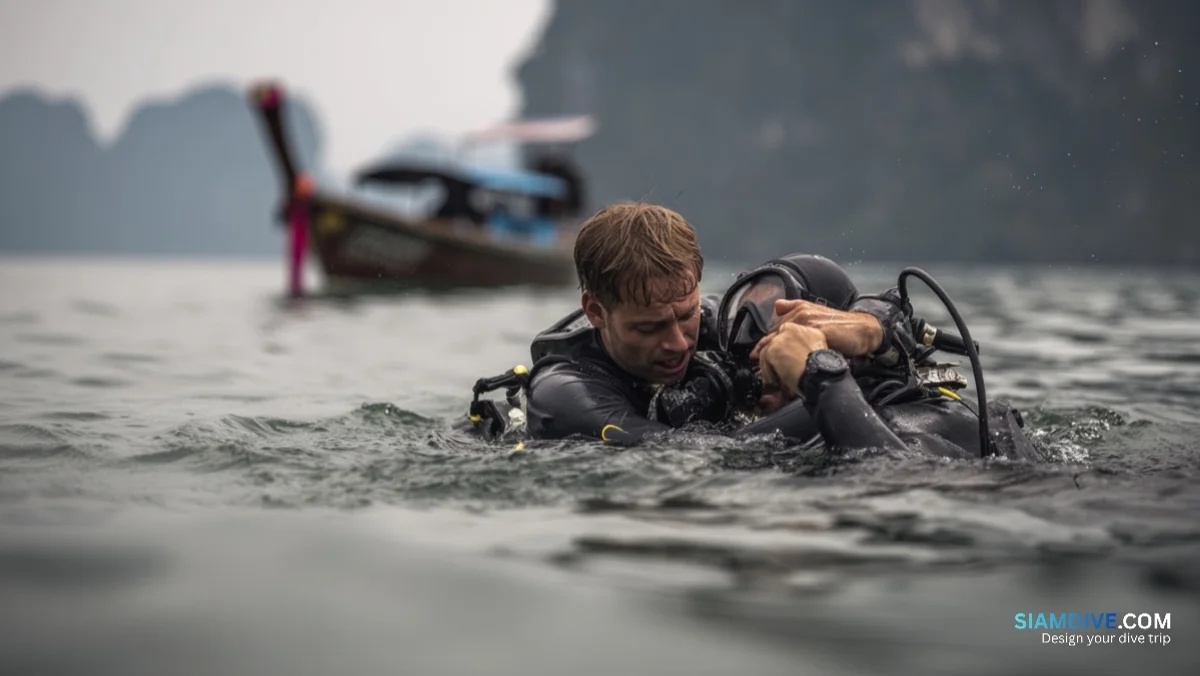
Rescue flips that switch. When a buddy simulates distress — air-sharing signal, erratic ascent, surface thrashing — the instinct trained into most Advanced divers is to watch and assess. Half right. Assessment matters. But Rescue demands action within seconds, not minutes. Approach the distressed diver, establish contact, manage buoyancy for two people, begin a tow. The exercise does not pause while you think it through.
The fix is not to stop assessing — it is to assess while moving. Instructors across Thailand's training centres describe this as the single biggest adjustment: students who can read the situation from three metres away but freeze at the point of contact. The hands that clip a torch or signal "OK" now need to grab a tank valve from behind a panicked diver or support an unconscious chin above the waterline.
The Panic You Did Not Train For
Advanced courses rarely expose students to genuine stress responses — and for good reason. AOW builds confidence through success. But Rescue introduces a concept most divers have never experienced from the responder side: perceptual narrowing.
Perceptual narrowing is the decrease in broad awareness caused by fixation on a perceived threat or a single solution. If a diver locks onto the wrong problem — fumbling with an inflator hose while a buddy drifts away — the narrowing blocks them from seeing the actual priority. This is not a character flaw. It is a physiological response that stress triggers in nearly everyone, and the relationship between panic and breathing makes it worse underwater.
Wrong approach: trying to stay calm by suppressing the stress response. That works in a classroom but collapses in open water with a thrashing diver clawing at your mask.
Right approach: drilling the motor patterns until the hands move before the brain catches up. Rescue exercises are repetitive by design. The tired-diver tow, the do-si-do, the panicked-diver approach from underwater — none of these need to be perfect the first time. They need to become automatic by the third. Repetition overrides narrowing because the body already knows the next step even when thinking slows down.
70% of Rescue Happens at the Surface
Here is the mistake that surprises the most people: Advanced divers default to thinking underwater. The problems they trained for happen at depth — narcosis, air consumption, buoyancy. So when Rescue scenarios shift to the surface, the same divers lose their edge.
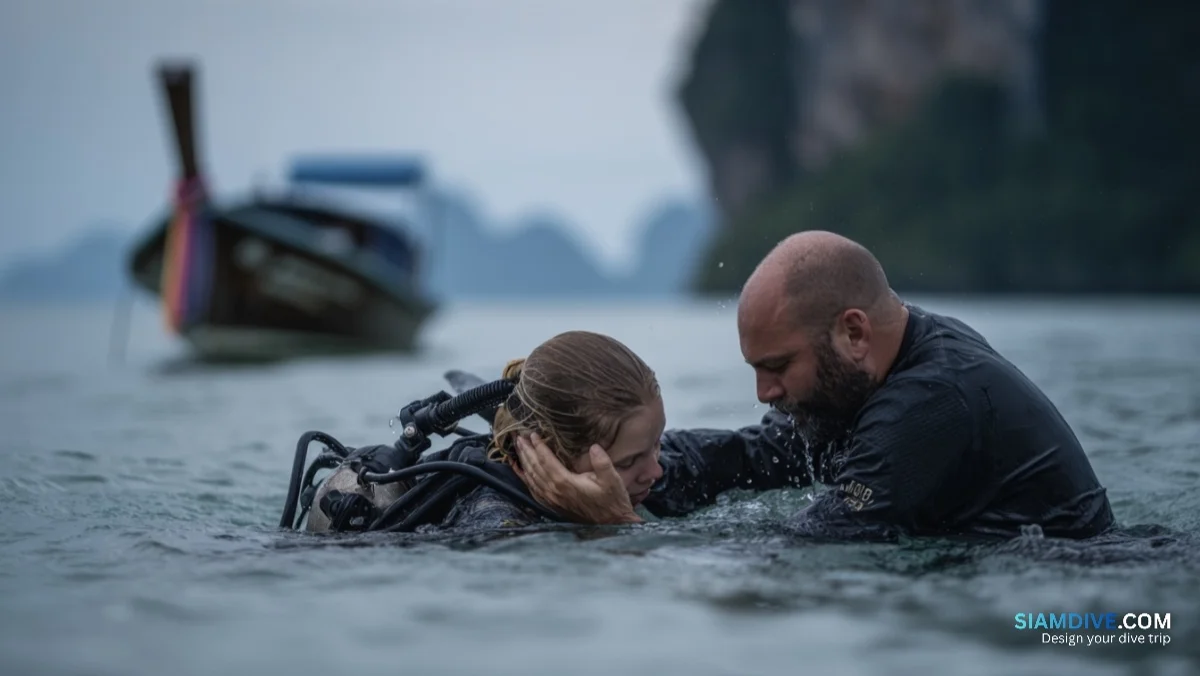
Surface skills dominate the Rescue curriculum. Towing techniques — underarm push, modified tired-swimmer carry, tank-valve tow — consume entire pool sessions. Exiting an unresponsive diver from the water onto a boat or a rocky shore is arguably the hardest physical skill in recreational diving. None of it looks like what most divers picture when they sign up.
The numbers reinforce this. Mean emergency response time after a distress call is roughly seven minutes. Those seven minutes are surface minutes — maintaining an airway, managing a tow, delivering rescue breaths in moving water. Emergency response at depth makes for dramatic stories, but surface work is where outcomes are decided.
- Course duration — 2–3 days (Thailand standard)
- Price range (Koh Tao) — 10,000–14,000 THB including EFR, equipment, and certification
- Prerequisites — Advanced Open Water certification, 20 logged dives minimum, valid EFR or equivalent first-aid certificate
- Surface drill ratio — roughly half of course time spent at the surface or in confined water, not on reefs
A significant share of course time is spent in shallow water or at the surface, not on the reef. That ratio surprises students, but it reflects how emergencies actually unfold.
Save Yourself Before Saving Anyone
Self-rescue sits at the front of the curriculum, and most students breeze through it. After Advanced, self-rescue feels elementary — deploy an SMB, manage a free-flowing regulator, handle a cramp. Done.
Until it is not. Rescue scenarios layer tasks. Manage your own buoyancy while supporting a victim. Breathe steadily while a panicked diver grabs your equipment. Ascend at a controlled rate while pulling someone who cannot control theirs. The self-rescue skills from earlier courses are not wrong — they are incomplete. They assume you have both hands, a clear head, and nobody else's survival depending on your next fin-kick.
The mistake: skipping the refresher because it feels like review. The fix: approach self-rescue as the foundation of everything that follows. Divers who track meaningful skills instead of chasing depth numbers tend to enter Rescue with a stronger base. Practise your weight check with only one hand free. Run your air-sharing drill while finning against a current. Build the multitasking before the course forces it on you.
A practical drill that works: on your next dive trip, run a full buddy check with one hand holding an SMB line. Time how long the check takes with the added distraction. If it takes more than twice as long, you have found the gap — the space between single-task competence and multi-task readiness that Rescue will test on day one.
The Plan Nobody Writes Until It Matters
Somewhere between the tenth tow and the final scenario, the instructor hands out a blank form. Emergency Assistance Plan — fill it in for a local dive site. Most students treat it as paperwork.
DAN's guidance on effective EAPs is specific: they should be simple enough for a non-diver bystander to follow, include emergency contacts, oxygen location, nearest recompression chamber, and role assignments for the dive team.
The mistake: filling it out, handing it in, and forgetting it exists.
The reality: the EAP is the only part of Rescue training that protects people who are not in the water with you. When a diver surfaces with symptoms of decompression illness, the plan — not the rescuer's improvisation — decides whether oxygen reaches them in three minutes or thirteen. It dictates who calls emergency services, who manages the scene, who records the dive profile for the chamber doctor.
Role assignment is the piece most students underestimate. A plan that says "call for help" without specifying who, on which phone, with what information, collapses the moment two people reach for the same device. Writing the EAP with the same precision as a dive plan — depths, times, contingencies — separates paper Rescue Divers from functional ones. For marine injury scenarios in Thai waters, a well-prepared EAP also notes species-specific first-aid protocols and the nearest clinic with relevant treatment stocks.
After the Card
The Rescue certification changes something the card itself does not capture: the way a diver enters the water. Buddy checks become genuine assessments, not gestures. Pre-dive briefings gain a second layer — not just where to go, but what happens when things go wrong. The full PADI progression from Open Water to Divemaster puts Rescue at the inflection point — the course where recreational diving starts to feel like a responsibility, not just a pastime.
For 2026, PADI's Rescue Diver Challenge runs through May and June, with the Master Scuba Diver Challenge waiving the MSD application fee globally for all certifications completed during the calendar year. Completing the Rescue course earns five entries into the MSD prize draw.
But the real return is simpler than challenges and card upgrades. It arrives somewhere around exercise seven or eight — when the hands move before the brain finishes worrying, when the tow feels natural, and when the emergency plan in your pocket carries actual names and phone numbers. That is the gap closing. Not with theory, but with muscle memory that works when thinking slows down.