One Kick Snaps 19 Corals an Hour, the Other Glides Past
3 พฤษภาคม 2569
Research counted 19 coral breaks per hour from careless fins. The frog kick changes that equation — here is how it evolves from OW to cave level.
A column of silt rises behind the diver like smoke from a chimney. It drifts over the staghorn coral table, settles on the polyps, and for the next six hours those polyps cannot feed. The cause is not a surge, not a boat wake, not a dropped weight belt. It is a flutter kick — the same kick nearly every Open Water course teaches as the only way to move underwater.
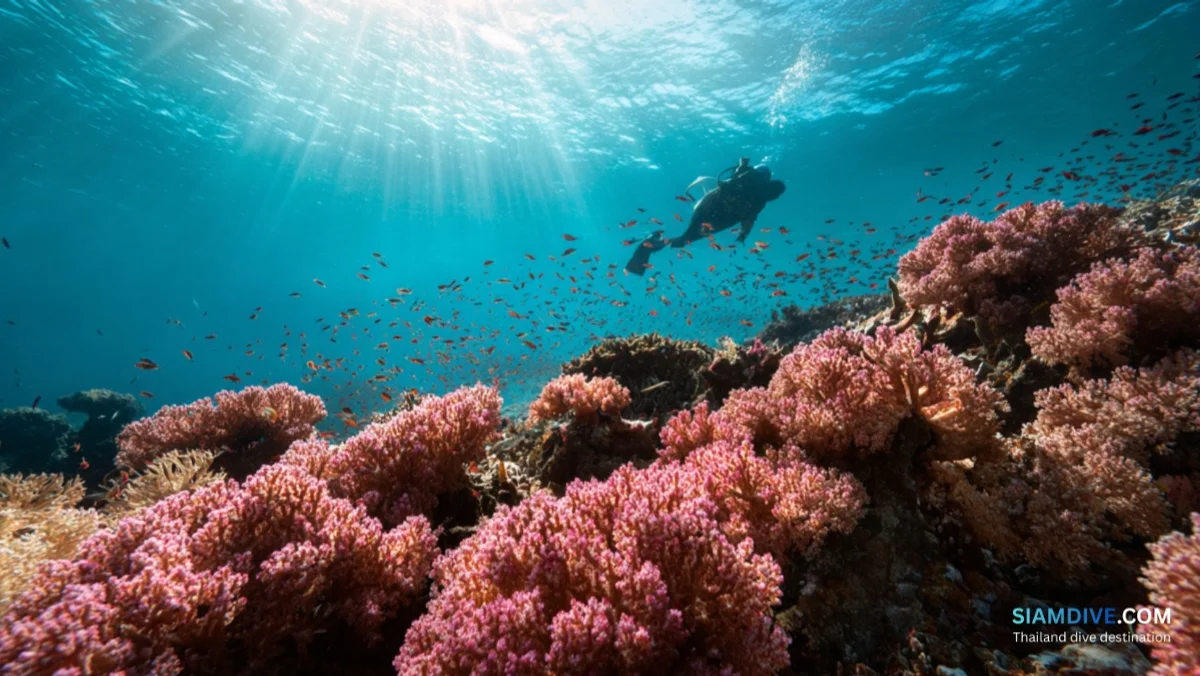
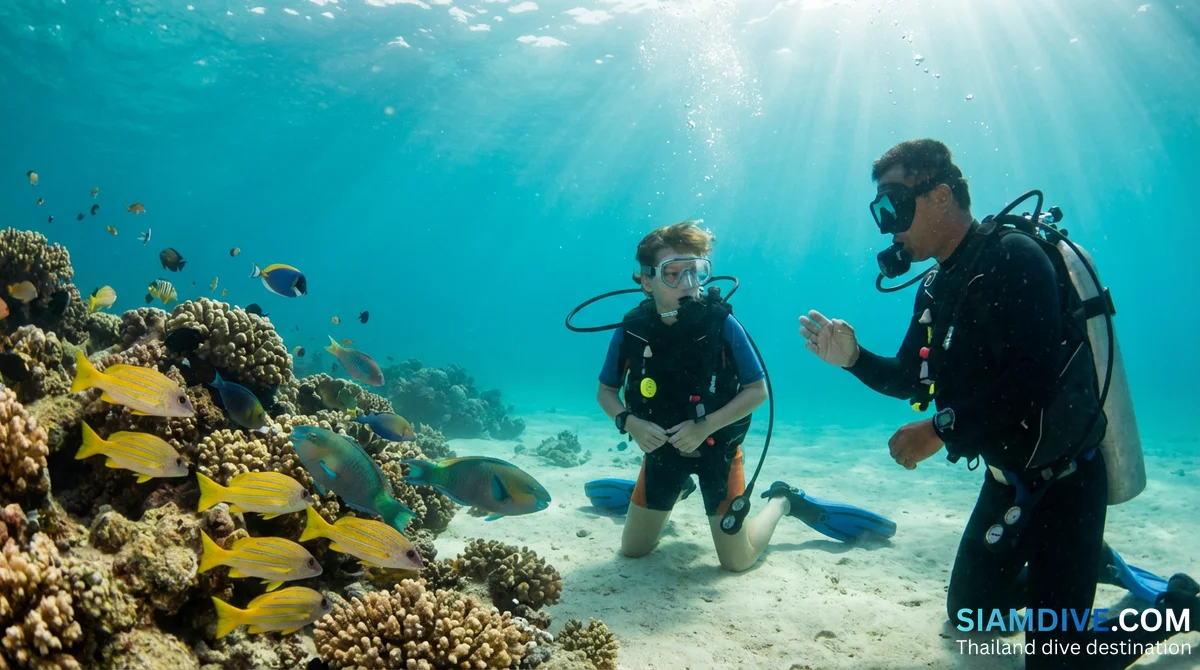
Somewhere on the same reef, another diver crosses the same coral garden and leaves nothing behind. No cloud. No contact. Same fins, same exposure suit, same certification card. The only difference is the shape the legs make: one diver pumps a piston, the other fires a slingshot.
Where the Water Goes
Think of each kick as a pump. The flutter kick runs like a piston — one blade pushes water down while the other lifts, alternating in a vertical plane. That downstroke is the problem. Every time the lower fin sweeps past horizontal, it sends a pulse of water directly into whatever sits below: sand, silt, or the tips of branching coral. Over a 45-minute dive on a shallow reef, that piston fires hundreds of times.
The frog kick works on a completely different axis. Both fins spread outward, load against the water, and snap together behind the diver — the same motion as a breaststroke swimmer's legs. The thrust goes backward, not downward. Neither fin blade drops below the diver's horizontal plane during the power phase. The result is propulsion without a downward pressure wave.
The trade-off is real: flutter generates less frontal drag and covers distance faster. Against a current at Chumphon Pinnacle, it remains the better tool. But on a staghorn garden at 12 metres, speed is not the objective. Precision is.
- Flutter kick — alternating up/down thrust; high silt risk; faster through current; best for open-water transit
- Frog kick — backward-only thrust; minimal silt; moderate speed; best for reef, wreck, and silty bottoms
- Modified flutter — small knee-driven amplitude; low silt; slow speed; best for tight spaces and close reef work
Open Water — the Flutter Default
Most Open Water courses dedicate fewer than thirty minutes to finning technique. The flutter kick gets taught because it is intuitive — anyone who has ever swum freestyle already knows the motion — and because it works immediately. Students have enough to process with mask clearing, regulator recovery, and buoyancy control without adding a second propulsion pattern to the list.
The result is predictable. Certified divers leave the course able to move, able to clear a mask, able to ascend safely — but unable to hover near a reef without leaving a silt trail behind them. It is not a failure of teaching. It is a sequence problem: flutter comes first because it is the easiest to learn, and for many divers, nothing ever comes second.
That gap between what OW teaches and what reefs actually need from a diver's fins is where most coral contact occurs. A peer-reviewed study on Thai dive sites found that two-thirds of observed divers caused some coral damage, with an average of 19 breakages per hour — and fin strikes were the leading cause, ahead of hand touches, dangling gauges, and knee contact combined.
Advanced Open Water Changes the Pattern
Advanced Open Water introduces situations where flutter stops working well. Deep dives demand slower, more efficient movement to conserve gas. Navigation exercises reward straight, stable trim that flutter's body-rocking tends to disrupt. Night dives over sand flats turn silt clouds into a zero-visibility problem that no torch can solve.
This is usually where the frog kick appears — often during a Peak Performance Buoyancy elective or a fish identification dive where the instructor wants students close to the reef without wrecking it. The shift feels dramatic. Divers who spent twenty dives flutter-kicking suddenly discover they can move forward without their fins ever dropping below their hips.
The learning curve is steeper than flutter. A proper frog kick demands ankle flexibility that recreational divers rarely develop, and the timing — bend, spread, snap, glide — feels unnatural for the first dozen attempts. Most divers revert to flutter the moment they need speed or feel current pushing against them. The skill sticks only with deliberate, repeated practice, and the willingness to feel slow for a while. But the payoff is immediate: a diver who can frog-kick at fifteen metres leaves zero silt trace on a coral garden that a flutter-kicker would blanket in seconds.
Peak Performance Buoyancy — Where Kicks Multiply
PADI's Peak Performance Buoyancy specialty, available from Open Water certification onward, is where finning technique finally gets dedicated pool time. The course builds what instructors call a kick vocabulary — multiple propulsion options, each matched to a situation, replacing the single-kick habit that OW creates.
The modified flutter deserves its own mention. It uses the same alternating pattern as the standard flutter but restricts movement to the knee joint, keeping amplitude small and the fin tips above the diver's centre line. Less thrust than a full flutter, but far less downdraft. For slow, careful movement along a wall or over a fragile reef section, it sits between flutter and frog on the disruption scale.
Two more kicks round out the vocabulary at this level:
- Helicopter turn — one fin sweeps forward while the other sweeps back, rotating the diver in place; useful for repositioning over a subject without forward thrust toward the reef
- Back kick — fin blades flip and push water forward, producing reverse motion; essential for backing away from a wall or marine life without turning around and sending a fin wake into the coral behind you
Together, these four kicks give a diver full directional control — forward, backward, rotation, and slow creep — without ever needing to touch the bottom or send a pressure wave toward it.
Cave Line and Zero Silt
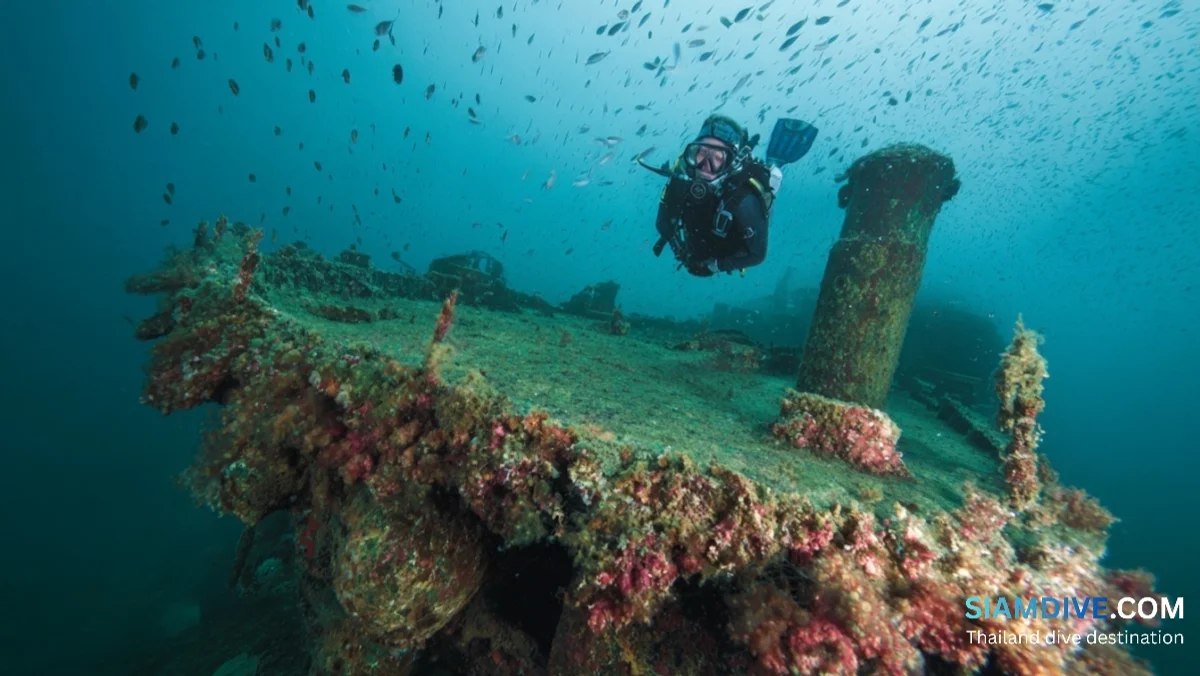
Step inside an overhead environment and the tolerance for sloppy finning drops to zero. SDI/TDI instructor standards list the frog kick as the primary propulsion technique for cave and wreck penetration, where a single silt-out can reduce visibility from twenty metres to nothing in under three seconds.
Cave divers train to a discipline called zero silt — the goal of completing an entire penetration and exit without disturbing the bottom sediment. The frog kick makes this possible because its thrust vector never points down. Combined with rigid horizontal trim — body flat, knees bent at ninety degrees, fins angled above the hip line — a diver can thread through a silty restriction and leave the water behind as clear as they found it.
The back kick becomes equally critical here. When a passage narrows or a line tangle requires a retreat, the ability to reverse without turning around keeps fin wash away from the floor and the ceiling. Flutter-kicking in a cave is treated the way running in a hospital corridor is treated: physically possible, universally understood to be the wrong choice. The habits that work at Open Water level — big kicks, fast movement, reactive corrections — become the habits that end technical dives early.
Why Thai Reefs Need Better Fins Right Now
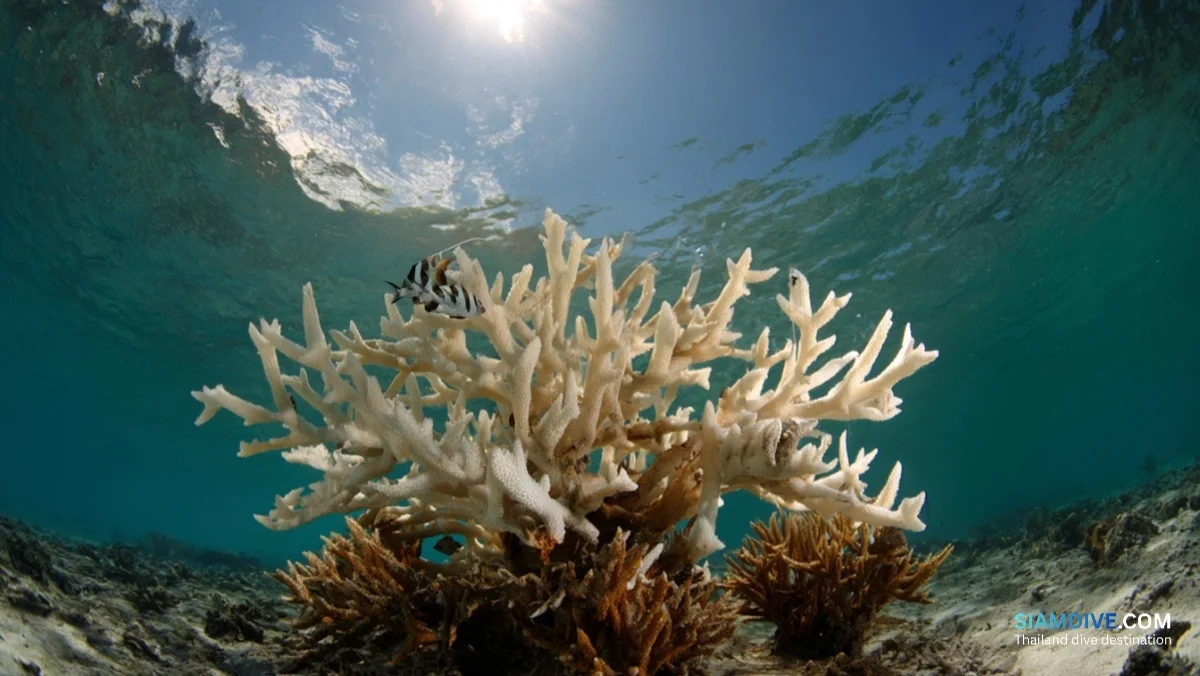
Nineteen breakages per hour is a research average, not a worst case. At high-traffic Thai sites — Koh Tao's Japanese Garden, Racha Yai's Bay 1, Similan's East of Eden — the cumulative damage from thousands of daily fin contacts compounds across seasons. Thailand's reefs are already fighting on multiple fronts. The 2024 mass bleaching event struck 60 to 80 percent of corals nationwide, with Gulf of Thailand sites reaching 90 percent bleached. A coast-to-coast assessment published in January 2026 confirmed what divers had been seeing underwater: surviving reefs are losing structural complexity — the three-dimensional branching architecture that fish and invertebrates depend on — faster than new growth can replace it. A coral cryobank launched in early 2026 is now freezing genetic material from Thai reef species as a hedge against future loss — a measure that underlines how urgent the threat has become.
Thailand's government responded with force in April 2025. New national regulations under the Marine and Coastal Resources Management Act now require dive supervisors to test every participant's fin control before allowing approach to coral areas. Behaviours that stir sediment — including poor finning technique — are explicitly listed as a fineable offence. The rules are enforceable for five years and apply to every marine park in the country.
For the recreational diver arriving in Thailand in 2026, the regulatory landscape has shifted. Fin control is no longer optional polish on an advanced skill set. It is a legal baseline. The frog kick — once a niche technique taught in specialty courses and tech programs — is now the minimum expectation at any reef site under Thai jurisdiction.
Three Drills You Can Run This Week
Switching from flutter to frog does not require a new course, new fins, or a trip to a dive site. Three focused sessions in a pool or confined water will build the muscle memory.
Drill 1 — Stationary hover with frog kick (pool, 2-metre depth): Descend to a flat section of the pool floor. Achieve neutral buoyancy at one metre above the bottom. Execute ten slow frog-kick cycles without gaining or losing depth. If your fins touch the bottom or you rise above two metres, reset. Film from the side so you can verify that your fin tips never drop below hip level during the power phase.
Drill 2 — Kick transition circuit (pool or confined water): Swim four lengths: flutter, frog, modified flutter, frog again. The goal is not speed — it is clean transitions. Each time you switch kicks, hold a two-second glide to reset body position. A buddy watching from above can spot whether your legs revert to flutter mid-frog.
Drill 3 — Sand-patch silt test (open water, 3–5 metre depth): Find a sand patch at a real dive site. Hover one metre above it. Execute ten frog kicks and look behind you. If you see a visible silt cloud, your fin tips are dropping below horizontal during the power phase. Adjust your ankle angle and try again. This drill gives you immediate visual feedback on exactly how clean — or dirty — your kick really is.
Most divers who run all three drills report noticeably cleaner trim within ten to fifteen dives. The frog kick stops feeling awkward somewhere around dive eight. By dive twenty, the flutter kick starts feeling wasteful.
Sources
- TAT Newsroom — Stricter Regulations for Diving Activities in Thailand (2025)
- SDI/TDI — Choosing the Right Fin Kick for Scuba Diving
- Managing the Impacts of SCUBA Divers on Thailand's Coral Reefs (peer-reviewed)
- Mongabay — Thailand's Reefs Losing Complexity (January 2026)
- PADI — Peak Performance Buoyancy Specialty Course