What Happens When You Move Both Tanks Off Your Spine
28 เมษายน 2569
Sidemount configuration shifts 16 kg off your lumbar spine and onto your hips — here's how the mechanics work and five drills to build the muscle memory.
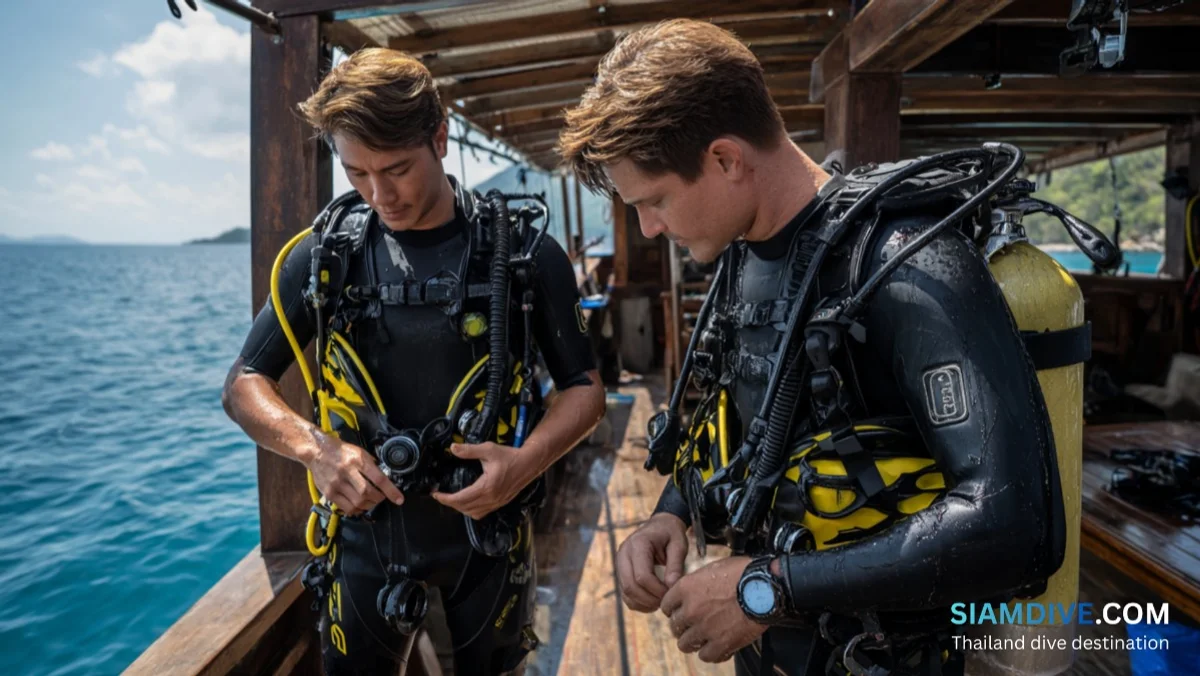
Two aluminium 80s hang at your hips instead of pressing into your lower back. The boat hasn't even left the pier and something already feels different — the weight that normally compresses your lumbar vertebrae simply isn't there. This is what sidemount configuration does before you even hit the water, and it explains why an increasing number of recreational divers on Koh Tao now learn the technique before they even book an Advanced Open Water course.
How Weight Shifts When Tanks Leave Your Back
Think of backmount the way you'd think of a loaded rucksack. The entire mass — cylinder, valve, BCD, weights — stacks along your spine. At the surface, gravity pulls that column straight down. Underwater, the physics change: the tanks become near-neutral, but your centre of mass still sits behind you, forcing constant micro-corrections to avoid tilting nose-up or fin-down.
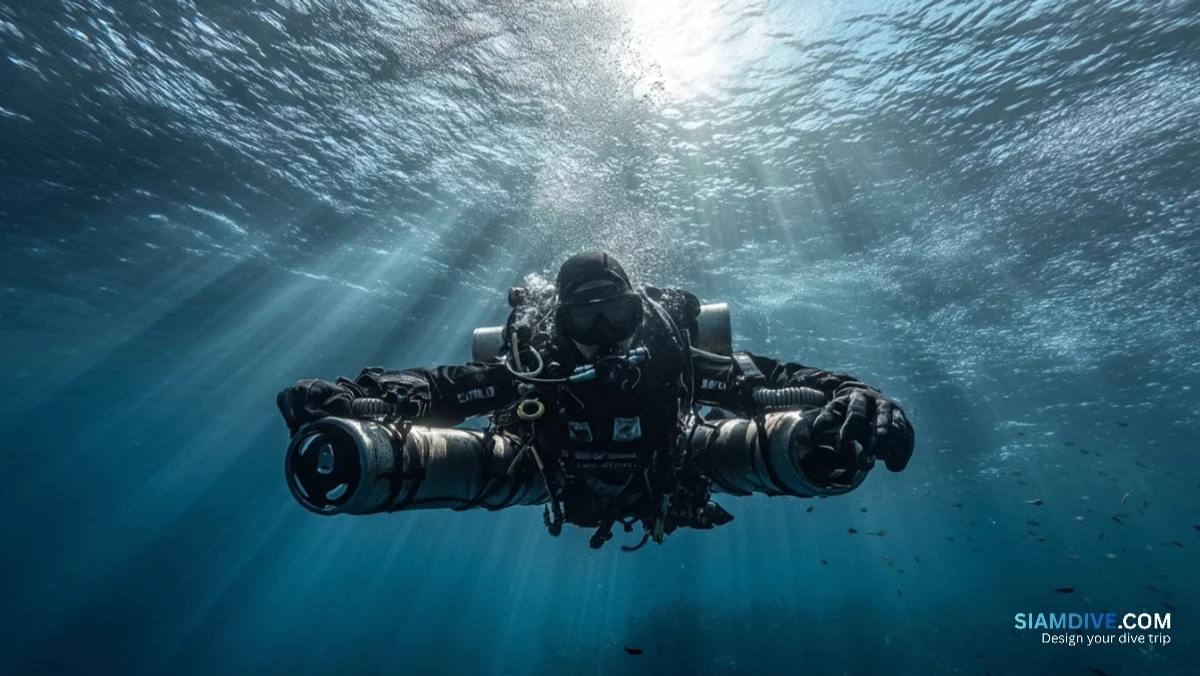
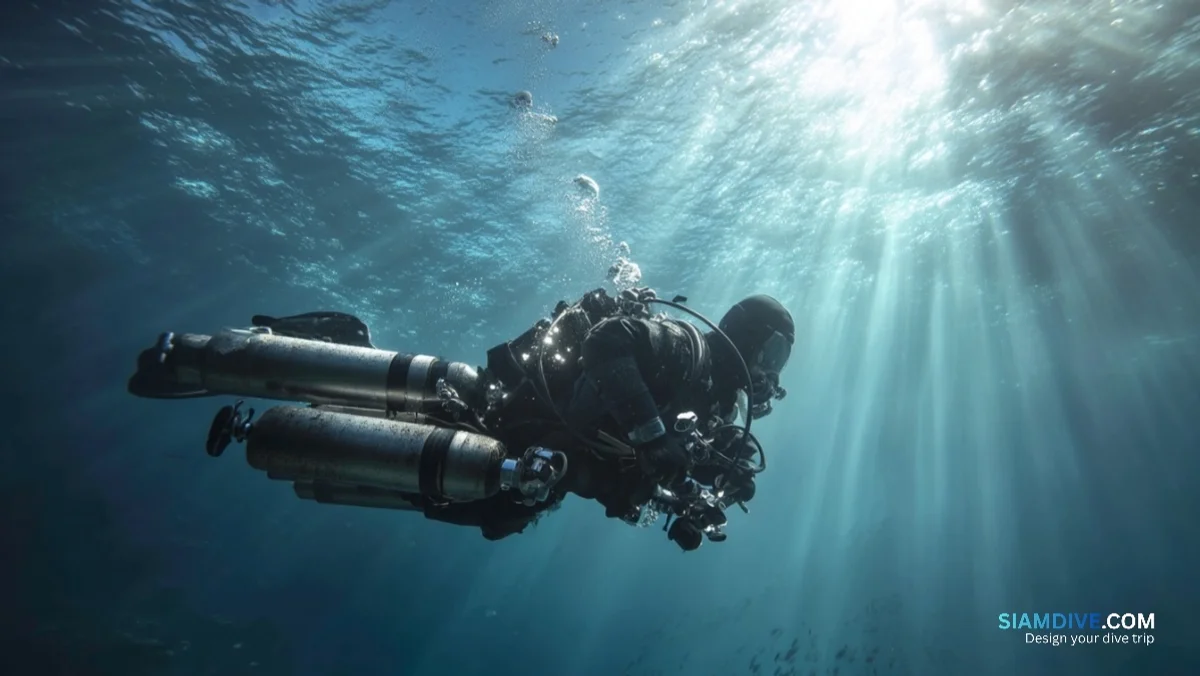
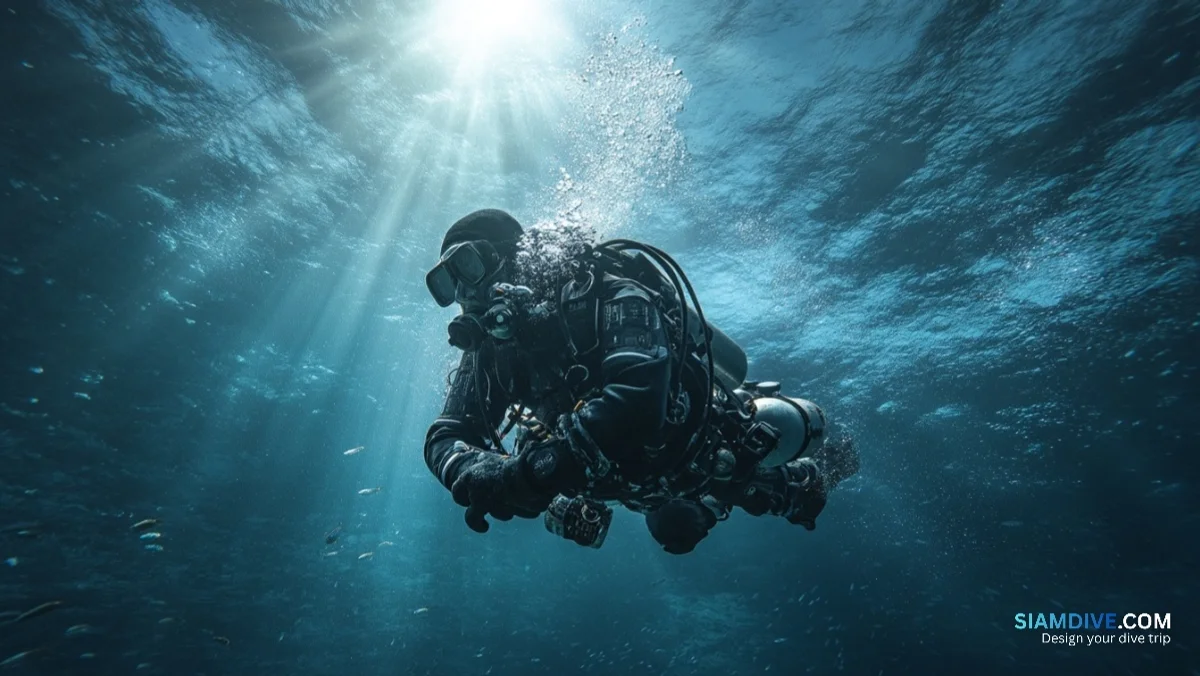
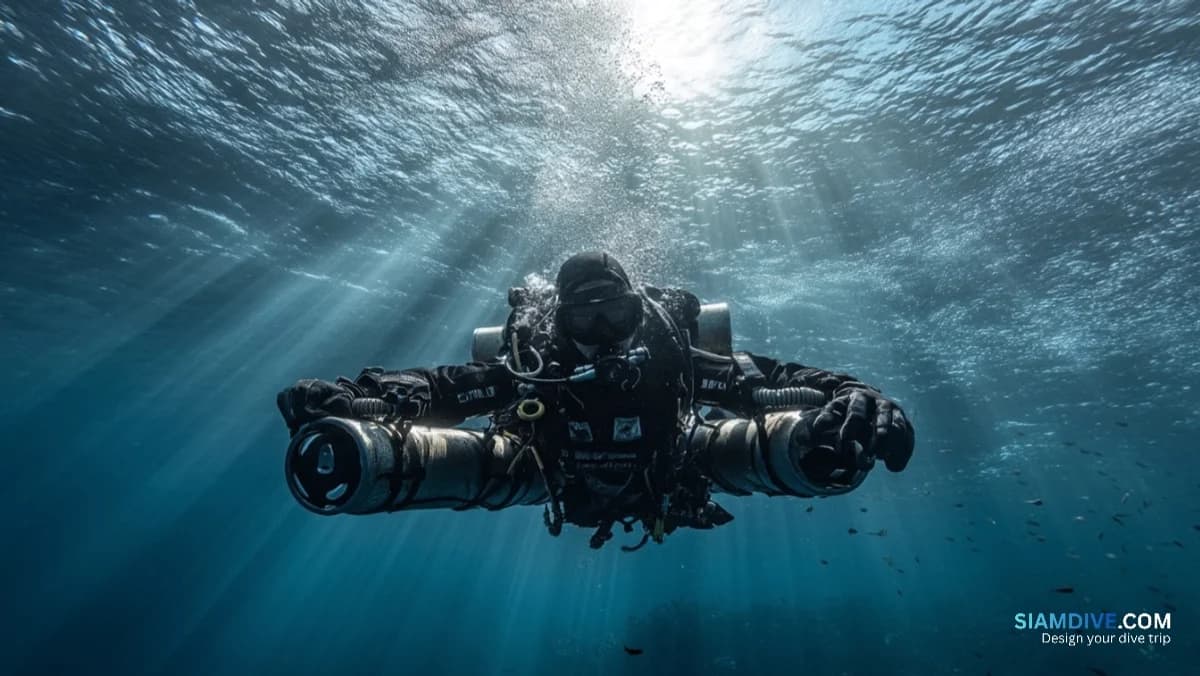
Sidemount re-routes that load. Each cylinder clips to a D-ring at the shoulder and another at the hip, lying parallel to your torso along both flanks. The result is a lower centre of gravity and a wider base of stability — the same principle that makes a catamaran harder to flip than a monohull. The tanks don't dangle or swing; bungee cords pull the cylinder heads snug against your shoulders while bolt snaps anchor the bases at your hips, locking them into a streamlined profile that moves with you rather than against you.
- Spinal load: Backmount concentrates 14–16 kg on the lumbar region; sidemount distributes approximately 7–8 kg per side across shoulder and hip attachment points
- Centre of mass: Moves from behind and above (backmount) to alongside and below (sidemount), improving horizontal trim without effort
- Surface carry: Each tank can be carried separately — one trip per hand — or clipped on at the waterline where buoyancy neutralises the weight entirely
What Changes in the Water
Neutral buoyancy with a single back-mounted cylinder means adjusting one variable. Sidemount introduces two independent volumes of air — and that's where the technique starts earning its keep.
Because the tanks ride at your sides, your cross-section narrows. Shoulders tuck in. Swim-throughs that previously required turning sideways now allow a straight-ahead pass. The reduced drag translates directly into lower air consumption — less effort per kick means less gas burned per minute. On a typical 50-minute reef dive at 18 metres, the difference can amount to 15–20 bar saved per tank, extending bottom time or adding a more comfortable safety stop margin.
A Business of Diving Institute survey of 908 divers found that 57.8% of sidemount users cited better trim as a primary motivation, followed by flexibility at 56.4%. These aren't abstract benefits. Better trim means less silting in restricted environments, less fin-strike on coral, and more time at depth because your gas lasts longer.
For divers who have already struggled with buoyancy after certification, the sidemount position offers a mechanical advantage: the wider distribution of mass makes it physically harder to drift out of horizontal trim, the way training wheels make it harder to fall sideways.
Gas Redundancy Without Going Technical
Two independent cylinders, two independent first stages, two independent second stages. If one regulator free-flows — a scenario any diver should know how to handle at depth — the other system remains completely unaffected. No shared manifold, no isolation valve to fumble with.
Gas management in sidemount follows a simple rule-of-thirds protocol, alternating between tanks at set intervals (usually every 30–50 bar) to keep volumes balanced. The visual and tactile feedback is immediate: reach down, check the SPG on either side, switch if needed. No twisting to check a valve behind your head. The same survey found that 69.4% of sidemount divers rank valve access as their top practical advantage.
Both valves sit within arm's reach at hip level. Shutting down a tank in an emergency becomes a two-second task rather than a shoulder-dislocating stretch behind your neck. For solo divers — or anyone who prefers not to rely entirely on a buddy for air — this built-in redundancy offers genuine peace of mind without the complexity of twinsets or stages.
Who Gains the Most
Sidemount wasn't designed for recreational divers. It started in UK cave exploration during the 1960s, when sump passages were too narrow for back-mounted doubles. The technique migrated to Florida's cave systems, then to Mexican cenotes, and finally — in the last decade — onto open-water reefs.
Today the profile of adopters is broadening fast. The Business of Diving data shows 65.6% of backmount-only divers are considering the switch. Three groups benefit most immediately:
- Divers with back or shoulder issues: No heavy rig to hoist onto the back. Tanks clip on at water level or just below. Walking the pier with an empty harness weighing 3–4 kg instead of a loaded BCD at 20+ kg changes the pre-dive experience entirely. Divers who had resigned themselves to shorter seasons or fewer dives per day often find the discomfort simply disappears
- Smaller-framed divers: A single AL80 on the back can lever a 55 kg diver backward. Two smaller tanks at the hips keep the centre of gravity inside the body's natural envelope, and the option to use AL63s instead of 80s makes the whole rig lighter without sacrificing redundancy
- Divers heading toward technical training: Every tec pathway — whether TDI, ANDI, or PADI TecRec — either requires or strongly recommends sidemount proficiency. Learning it at the recreational stage builds muscle memory years earlier. The 69.3% of current sidemount divers who obtained their skills through a certification course suggest this investment in proper training pays forward
What the Course Looks Like
The PADI Sidemount Diver specialty requires Open Water certification and a minimum age of 15. The course runs one confined-water session plus a minimum of three open-water dives — typically completed in two days on Koh Tao.
Pricing across Koh Tao shops ranges from 8,800 to 14,000 THB depending on inclusions and equipment rental. Most courses do not include sidemount-specific gear (harness, wing, bungees, bolt snaps), so factor in rental costs when comparing quotes.
The progression follows a logical ramp:
- Dive 1 — Confined water: Harness fitting, tank clipping and unclipping, basic buoyancy check in a pool or shallow bay. The instructor adjusts bungee length and D-ring placement to your body until the tanks hang without wobble
- Dive 2 — Open water basics: Descent, neutral buoyancy at 12 m, gas-switch drill (swap regulators between left and right), finning techniques in horizontal trim. Most divers report immediate improvement in equipment awareness
- Dive 3 — Skills integration: Controlled ascent, safety stop at 5 m with both tanks, simulated valve shutdown on one side, buddy gas-share from sidemount donation
- Dive 4 — Full profile: A complete recreational dive to 18–24 m using proper gas management, trim, and propulsion technique — the kind of dive where configuration fades into the background and the reef takes over
Five Drills That Build the Muscle Memory
Certification is the start, not the finish. These five practice drills — recommended by sidemount instructors across Southeast Asia — build the coordination that separates a card-holder from a proficient sidemount diver:
- Blind gas-switch: Close your eyes, reach for the opposing regulator, switch breathing sources. Repeat until you can do it without looking or finning. Goal: under 3 seconds
- One-tank trim hold: Unclip one cylinder and hold it extended in one hand while maintaining neutral buoyancy and horizontal position for 60 seconds. This isolates core stability and reveals whether your weighting depends on both tanks being clipped
- Horizontal hover with no fin movement: Hang at 5 metres, both tanks clipped, zero kick. If you drift up or down, your weighting or clip position needs adjustment — not your fin output. Hold for two full minutes. This drill exposes trim problems that finning masks
- S-drill (gas-share simulation): Donate your long hose to a buddy while switching to your other first stage. Maintain depth control throughout. Practice in both directions — left tank donate, right tank donate — until the sequence is symmetrical
- Valve shutdown at depth: Reach forward, locate the valve on one side by touch alone, close it, confirm no gas flow on that SPG, continue breathing from the other side for 2 minutes, then reopen. This builds the reflex you need when a post fails or a hose leaks
Each drill targets a specific failure mode. The blind gas-switch prepares for free-flow emergencies. The one-tank hold trains for the moment a clip fails and a tank swings free. The hover test reveals whether your static trim is solved by configuration or compensated by finning — only the former counts.
Gear: What You Actually Need
The sidemount-specific kit list is shorter than most people expect:
- Sidemount harness and wing: Purpose-built systems range from simple webbing-only rigs to padded BCDs with integrated weight pockets. Recreational-specific models fix the wing to the harness for simplicity — no separate inflation bladder to wrestle with. Budget: 15,000–35,000 THB new
- Two cylinders: Aluminium 80s (11.1 L) are the standard recreational choice — neutral at 50 bar, easy to trim, available at every shop on Koh Tao. Steel options exist but require different weighting and are harder to source as rentals in Thailand
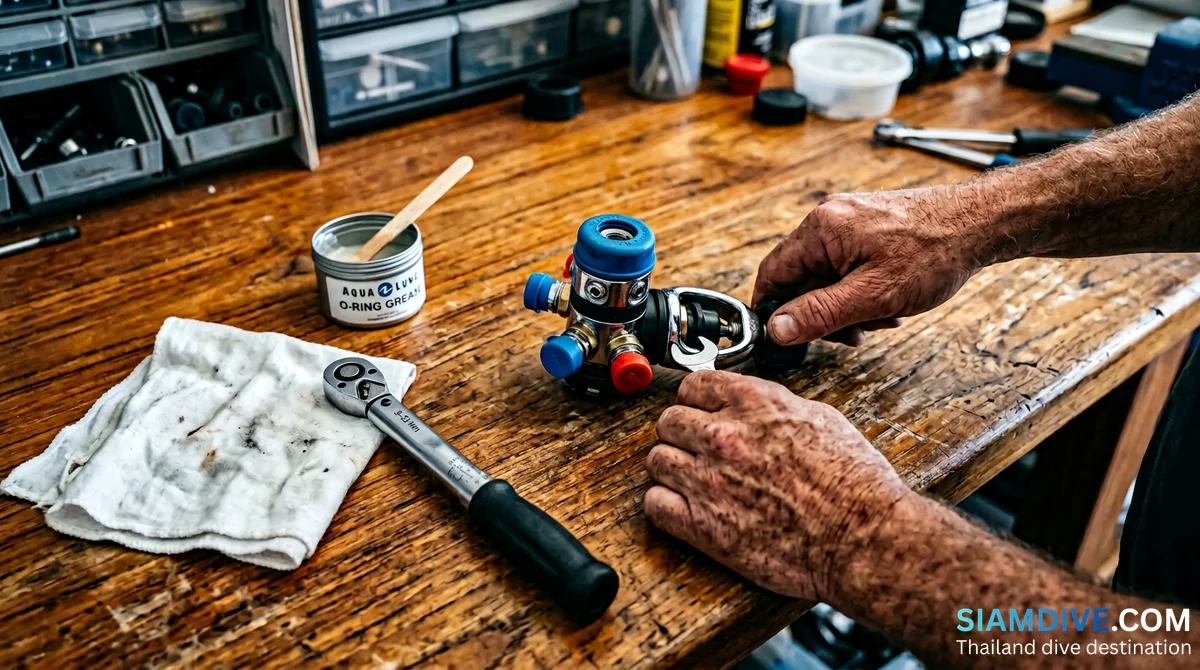
- Two complete regulator sets: Each with first stage, primary second stage, and SPG. No octopus needed — your buddy's backup is the long hose from your other tank. One regulator gets a 150 cm long hose; the other keeps the standard 75 cm
- Bungee loops and bolt snaps: Two neck bungees to hold tank tops against your shoulders, two bolt snaps per tank for lower attachment. Total cost: 200–500 THB
- Stage rigging bands: Cam bands with stainless-steel clips that mount tanks to the harness. Most rental setups include these
One common mistake: buying a technical-grade harness for recreational reef diving. The minimalist cave rigs — designed for narcosis-depth passages and tight restrictions — lack the padding and integrated buoyancy for comfortable 12-metre reef dives. Match the tool to the environment.
Where the Trend Is Heading
At the Elba Sidemount Festival in April 2026, hundreds of divers gathered for three days of trim workshops, equipment demonstrations, and guided sidemount dives at sites off Marciana Marina — an event that five years ago would have drawn only cave specialists. The recreational crossover is no longer a theory; it's a market with dedicated festivals, dedicated gear lines, and dedicated course tracks.
On Koh Tao, several shops now recommend sidemount as a second specialty after Open Water — before Advanced, before Nitrox, before Deep. The logic holds up: if you're going to spend the next 100 dives building habits, build them in the configuration you'll use long-term.
That might not be every diver's path. Backmount remains simpler to set up, easier to rent worldwide, and perfectly adequate for the majority of recreational diving. But for those who feel the heavy pull on their lower back during the surface interval, who want redundancy without jumping to full technical kit, or who simply want their Koh Tao training investment to carry forward into future diving — sidemount offers a middle ground that didn't exist a decade ago.
The tanks move off your spine. Everything else follows.