40 Metres of Visibility Under a Metre of Ice at Lake Baikal
29 เมษายน 2569
Lake Baikal freezes a metre thick by February — and beneath that ice, visibility stretches past 40 metres into a 25-million-year-old ecosystem found nowhere else on Earth.
One metre of ice separates you from water so clear you could read a dive table at 40 metres. Lake Baikal — landlocked in southern Siberia, colder than any ocean dive site on the certification map — freezes hard enough by mid-January to drive trucks across. By February the ice turns transparent, and the world below it opens into something closer to space than sea: a rift lake 1,642 metres deep, older than most mountain ranges, holding one-fifth of all unfrozen fresh water on the planet. For divers willing to cut a triangular hole through the frozen surface and clip onto a safety line, the reward is a 25-million-year-old ecosystem where roughly 80 percent of the species have never been found anywhere else.
What the Ice Looks Like from Below
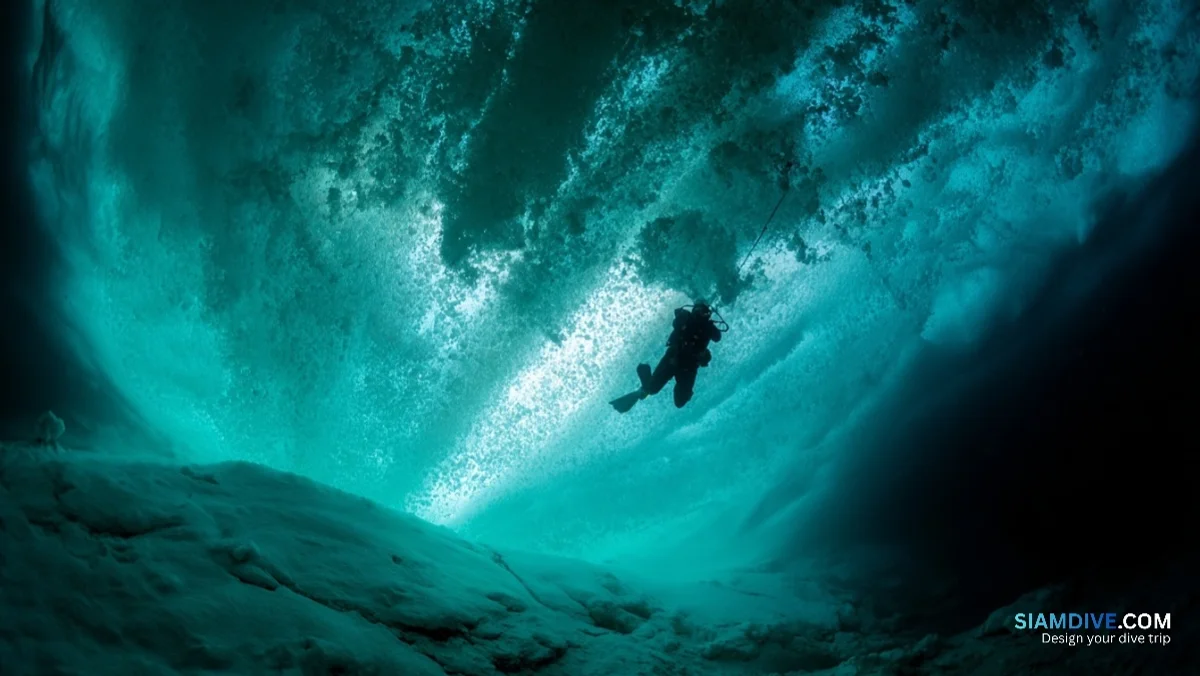
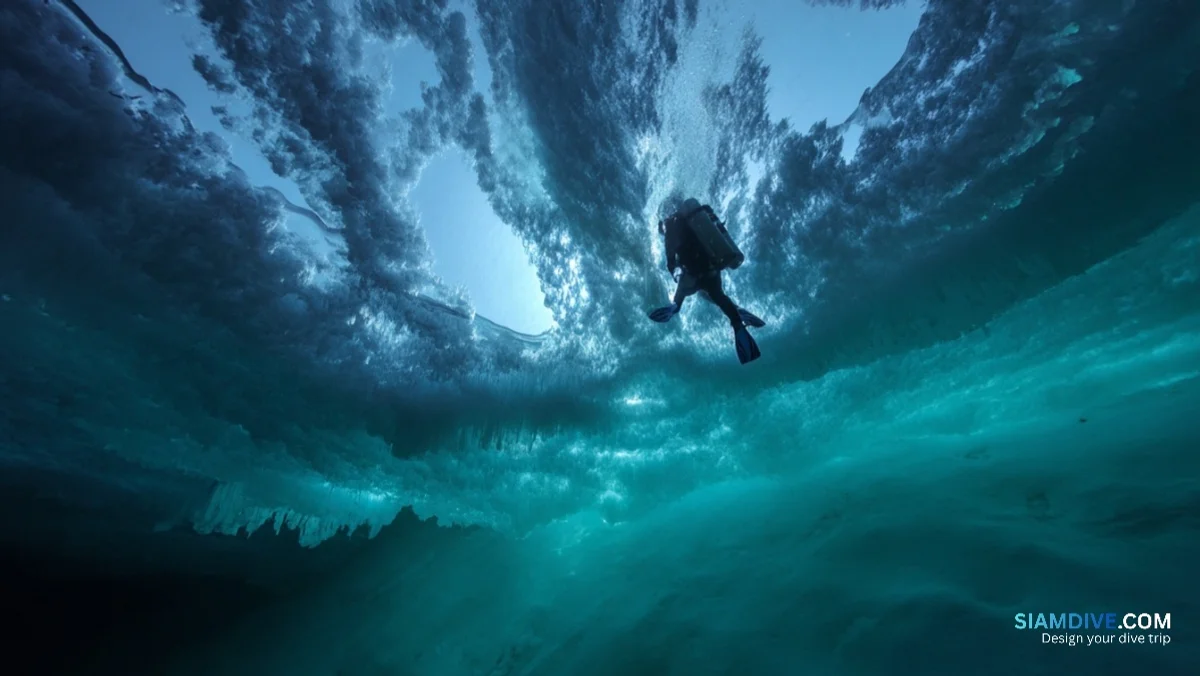
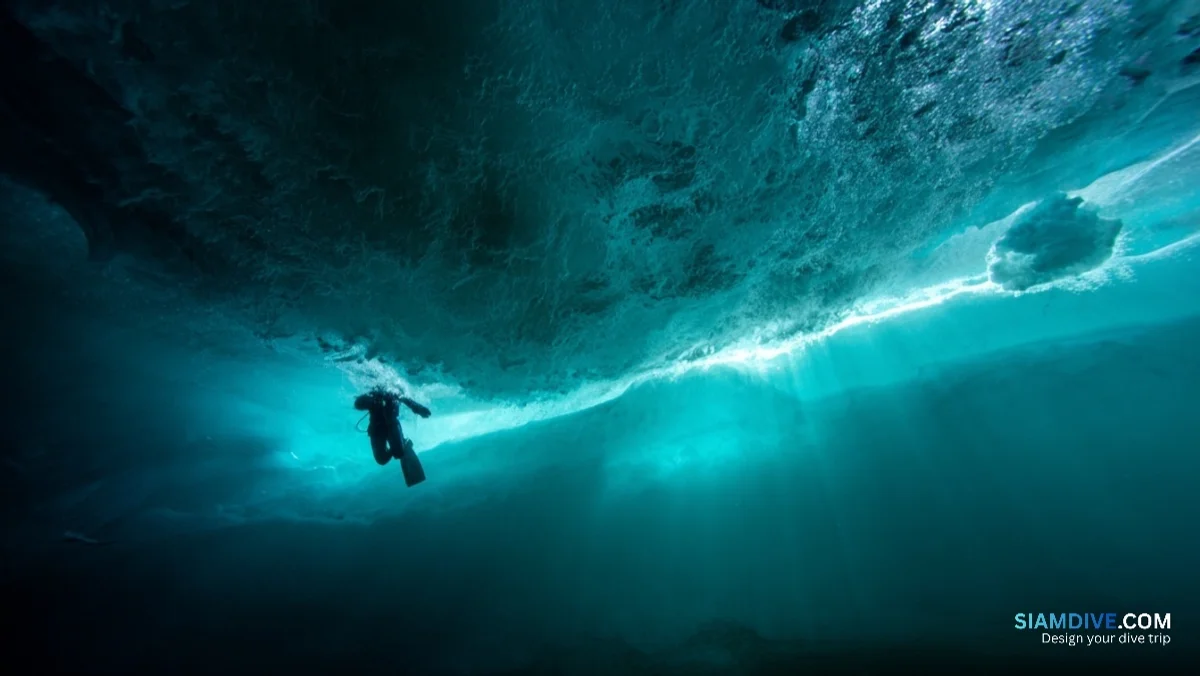
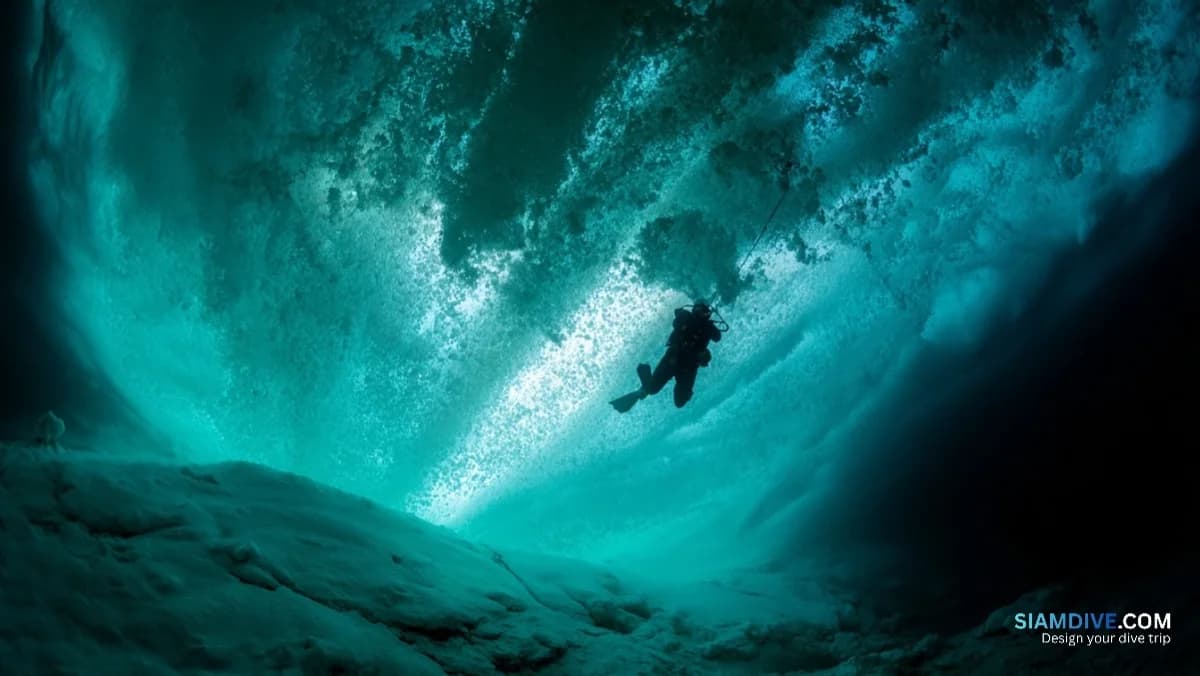
From above, Baikal's winter surface is an unbroken white road — locals drive Lada Nivas across it to reach fishing camps on the far shore. From below, it becomes a cathedral ceiling. Sunlight fractures through pressure cracks and trapped air columns, throwing blue-green shafts that swing with every passing cloud. Where the ice is thickest — up to 140 centimetres by late March — it darkens to a deep teal. Where it is thinner, barely 50 centimetres in early February, it glows bright enough to light the first 15 metres of water without a torch.
The ice itself evolves as the season progresses. Early February produces the clearest sheet: polished, black-looking from above, shot through with fine crack lines. Wind and temperature cycling build hummock ridges that can stack two metres high on the surface, and beneath those ridges the ice develops sculpted channels and overhangs that filter light into patterns no reef could replicate. By March, snow begins to accumulate, dimming the cathedral effect but adding drama — the underside collects ice stalactites and gas-bubble curtains that look like inverted chandeliers.
- Ice thickness — 50–100 cm in early February, up to 140 cm by late March
- Water temperature — approximately 2°C year-round at depth; surface layer 1–4°C under ice
- Air temperature (Feb–Mar) — average −15 to −20°C, can drop to −40°C on clear nights
- Visibility — routinely exceeds 40 metres; at peak clarity, some divers report 50+ metres
- Light zone — usable natural light extends 15–25 metres below clear ice
The visibility is Baikal's defining characteristic underwater. More than 330 rivers feed the lake, but only one — the Angara — drains it, and the sheer volume (23,615 cubic kilometres) dilutes suspended particles to near-zero. During ice season, with no wind mixing and no plankton bloom, the water reaches a clarity that rivals the best cenotes in Mexico. Divers describe looking up through the ice and seeing their tenders' boots as clearly as shadows on frosted glass.
A Lake That Builds Its Own Species
Twenty-five million years of isolation will do things to a gene pool that no aquarium could simulate. Baikal formed when the Eurasian plate cracked along the Baikal Rift Zone — the same tectonic process that split East Africa — and has been filling ever since. The result is the oldest and deepest lake on Earth, with distinct thermal and chemical layers that created separate evolutionary pressure zones from the sunlit shallows to the abyssal floor at 1,642 metres.
More than 2,500 animal species and 1,000 plant species live here. The amphipod crustaceans alone account for over 350 endemic species, filling niches that in other lakes belong to entirely different animal groups. Some are predatory. Some are thumb-sized scavengers. One species, Macrohectopus branickii, is translucent and schools in vast swarms that shimmer under torch light like underwater snowfall. Among fish, 52 species have been recorded, and 27 of them exist nowhere else — mostly sculpin relatives adapted to every depth from shoreline boulders to the pitch-black abyssal plain.
For divers, this means that almost everything visible on a Baikal ice dive is something unavailable on any other dive in the world. The sponges encrusting the rocks below the ice line are endemic. The flatworms gliding across them are endemic. Even the bacteria forming mats on the shallow sediment are genetically distinct from anything found in other freshwater systems. It is the closest a diver can get to exploring another planet's ocean — just dressed in 7 mm neoprene from head to toe.
The Ghost Fish of 1,600 Metres
Golomyanka. The name comes from a Siberian dialect word for "naked," and it fits. Two species — Comephorus baicalensis (big golomyanka) and Comephorus dybowskii (small golomyanka) — are so loaded with oil that their bodies become semi-transparent. Hold a big golomyanka against light and the spine, the circulatory system, and the outlines of internal organs are all visible through the skin. Nearly 39 percent of C. baicalensis's body mass is lipid, a proportion that eliminates the need for a swim bladder and allows the fish to drift through the entire water column — from just below the ice to 1,600 metres — without spending energy on buoyancy.
These fish make up an estimated 70 percent of Baikal's total fish biomass: roughly 150,000 tonnes of translucent, bladderless drifters. They are viviparous — females give birth to 2,000–3,000 live larvae rather than laying eggs, a reproductive strategy almost unheard of in freshwater fish. At night, golomyanka migrate upward from below 100 metres to feed on copepods and amphipods in the 10–25 metre range. In winter, they sometimes swim directly beneath the ice sheet.
Ice divers who time it right — early morning or dusk dives near Listvyanka's shelf edge — can watch palm-sized translucent fish glide past in water cold enough to numb exposed skin in seconds. The golomyanka does not flee from lights. It drifts. The effect, against 40-metre visibility and blue ice overhead, is not easily described without sounding exaggerated — which is exactly why underwater photographers book Baikal trips months in advance.
The Only Freshwater Seal on Earth
Eighty thousand nerpa cannot all hide. Pusa sibirica — Baikal's endemic seal, the only exclusively freshwater pinniped on the planet — numbers between 80,000 and 100,000 individuals, roughly equalling the lake's estimated carrying capacity. How an Arctic-lineage seal ended up in a landlocked Siberian lake is still debated; the leading hypothesis traces a migration south along Siberian river corridors during Pleistocene glaciations.
Adults grow to 1.1–1.4 metres and weigh 63–70 kg, placing them among the smallest true seals. Their diving capability punches above that weight class: nerpa routinely descend to 200 metres and hold their breath for over 20 minutes, hunting golomyanka and sculpin in the cold deep layers. In late winter, females haul out onto the ice to give birth, nursing pups for two to three months until breakup in April. IUCN classifies the species as Least Concern, though PCB contamination and climate-driven ice loss remain long-term threats.
For divers, nerpa encounters are uncommon but not impossible. The largest haul-out colony lives near Ushkany Islands, four rocky islets in the central lake accessible only by multi-day expeditions. Closer to Listvyanka, dive operators report occasional sightings of curious juveniles circling divers in February before disappearing into the blue. These are not guaranteed encounters — nerpa are fast, cautious, and uninterested in posing. But the possibility adds a dimension that no tropical destination can match: a seal that exists only here, in water that exists nowhere else in this form, under ice you had to cut through to enter.
What You Need Before Cutting the Hole
An overhead environment with a single exit point and 2°C water is not the place to learn as you go. Ice diving demands specific certification, specific equipment, and a team structure that leaves no margin for improvisation.
- Certification — PADI Ice Diver Specialty requires minimum age 18, Advanced Open Water certification, and a strong recommendation for prior Dry Suit Diver Specialty. The course covers three ice dives over two days: safety line rigging, tender communication, and emergency protocols.
- Two-up, two-down rule — two divers descend; two tenders remain on the surface, each managing one lifeline. If a diver signals distress or stops signalling, the tender hauls. There is no backup exit.
- Dry suit — non-negotiable. Most Baikal operations use trilaminate or heavy-duty neoprene shells paired with thermal undergarments rated to −20°C or below.
- Gloves and hood — 5–7 mm three-finger mitts, 7 mm hood or semi-dry. Exposed skin at 2°C means incapacitation within minutes.
- Regulator — environmentally sealed first stage is mandatory. At 2°C, an unsealed diaphragm first stage can freeze and free-flow, dumping the air supply fast. Sealed designs prevent ice crystallisation inside the mechanism.
A flooded dry suit at this temperature is not an inconvenience — it is a medical emergency. Cold shock, loss of motor control, and rapid core temperature drop follow within two to four minutes. Many experienced Baikal divers carry a fully independent bailout bottle and regulator, even on shallow ice dives within the light zone. If you have never dived in a dry suit, the time to learn is not under a metre of Siberian ice. Regulator free-flows at depth are dangerous in the tropics — in Baikal, the consequences arrive faster and leave less margin.
February Through March — The Clear-Ice Window
Baikal's ice season runs from mid-January to mid-April, but the prime diving window is narrower. Crystal-clear ice, stable conditions, and reliable logistics converge between early February and mid-March. After that, snowfall blankets the surface and cuts the light transmission that makes under-ice photography extraordinary. Ice structures become more dramatic — stalactites, bubble curtains, pressure ridges — but the translucent ceiling effect fades.
Irkutsk is the staging point: a city of 620,000 people on the Angara River, connected by direct flights from Moscow (approximately 5.5 hours) and seasonal connections from Beijing and Seoul. From Irkutsk, most dive operations base out of Listvyanka, a lakeside settlement about 70 kilometres southeast where the Angara flows out of Baikal.
- 5-day ice diving package — typically includes 1–2 dives per day, tanks, weights, transfers, accommodation, and meals; packages range from approximately €1,500–2,500 per person depending on group size
- Transfers — 300 RUB from Listvyanka hotels, 1,500 RUB from Irkutsk hotels
- Dive community — four dive centres operate in the Irkutsk region, serving roughly 200 active local divers year-round
- Between dives — sauna on the ice (a Baikal tradition), ice fishing, Baikal omul tasting, hovercraft excursions across the frozen surface
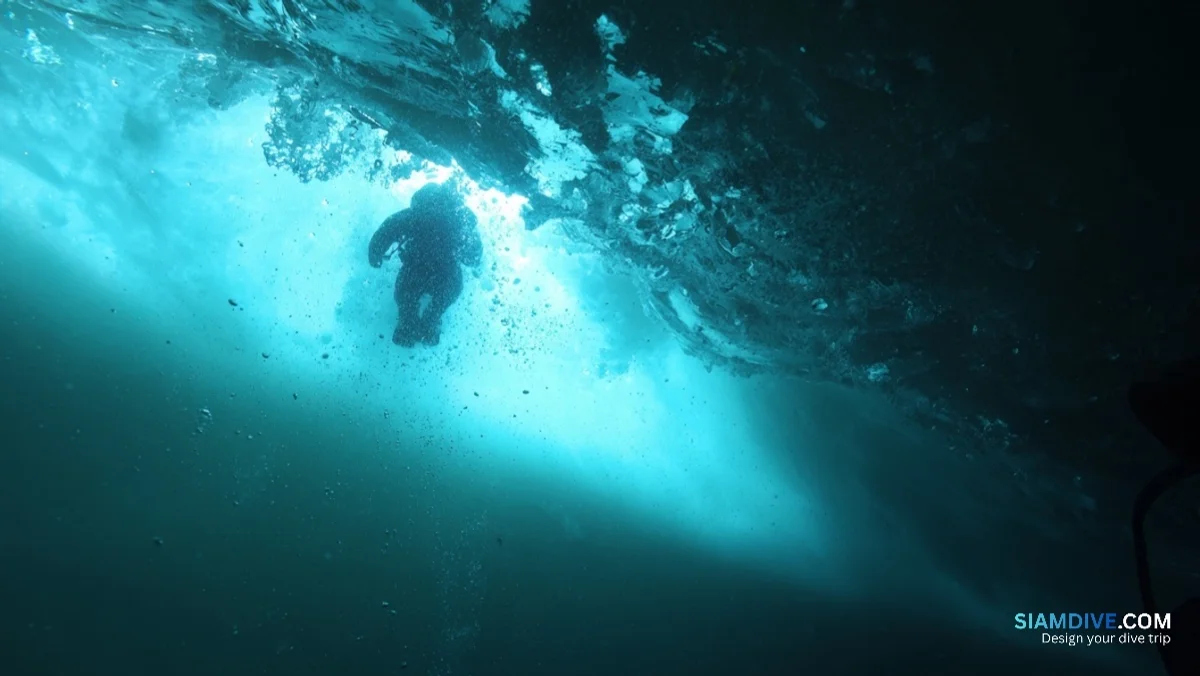
International operators run multi-day expedition packages that handle everything from airport pickup to dive planning. The main challenge is not finding a trip — it is finding the nerve. Dropping through a hole in a metre of ice, into water where your exhaled bubbles flatten and spread across the frozen ceiling above you, requires a specific kind of calm that training can build but cannot entirely manufacture.
91 Metres on a Single Breath — March 2026
On March 3, 2026, at the Third International Ice Freediving Festival in Listvyanka, Alexey Molchanov descended to 91 metres on a single breath beneath Baikal's frozen surface — a new under-ice freediving world record. Surface temperature that morning: −23°C. Water temperature below the ice: 2°C. The dive was Molchanov's 42nd world record overall and his fourth specifically in under-ice depth.
The festival drew freedivers and scuba divers from across Russia and Europe, all operating through a single hole cut in the ice. For the scuba support divers at safety positions 20 metres down, the view was the same one every Baikal ice diver eventually gets: a vanishing point of blue clarity stretching beyond where a torch beam dissolves, broken only by the silhouette of a human body falling into water that has been collecting at the bottom of this rift for 25 million years.
Baikal does not offer warm water, easy logistics, or colourful coral. What it offers is a dive site with no equivalent anywhere on Earth — a freshwater ocean sealed under ice, populated by transparent fish and the world's only landlocked seal, lit from above by fracturing sunlight through a frozen ceiling. For divers who have done the tropics, done the temperate wrecks, and started wondering what else exists out there, the answer is 636 kilometres long and one metre of ice thick.
Looking for the opposite extreme? Read about paying $350 to see almost no fish at Belize's Blue Hole, or find out why solo divers choose Thailand over Bali. For cold-water gear concerns, see how a single O-ring can end a dive day and five narcosis warning signs at 30 metres.
Sources
- SSI — Ice Diving on Lake Baikal: conditions, season, and dive planning
- Wikipedia — Lake Baikal: depth, volume, endemic biodiversity data
- Wikipedia — Baikal Seal: population estimates and IUCN status
- PADI — What Does It Take to Be an Ice Diver: certification requirements
- Molchanovs — Alexey Molchanov under-ice world record, March 2026