45 kg, Wet Deck, One Step: How Giant Strides Go Wrong
5 พฤษภาคม 2569
A torn muscle, a cracked mask, a tank valve to the skull — and the dive hasn't started. Seven platform red flags that cost more than the dive.
One Wrong Step, 45 Kilograms of Consequence
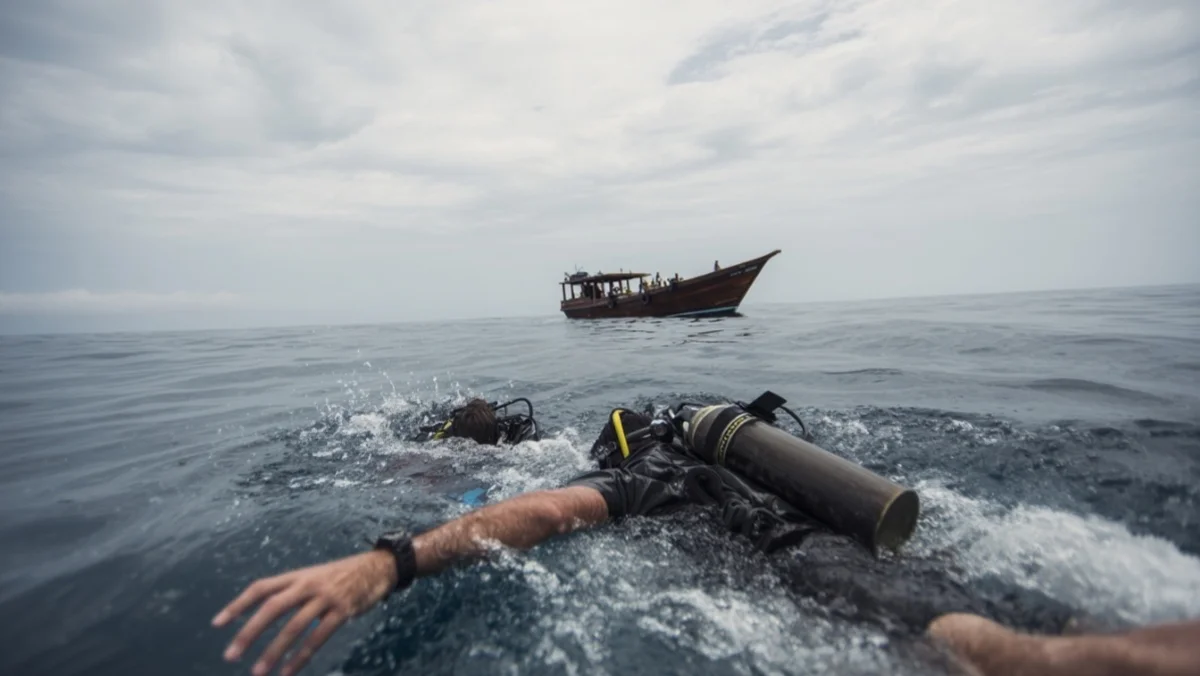
The fin tip catches the lip of the platform. The stride becomes a lurch. Forty-five kilograms of tank, BCD, and lead arrive at the water surface chin-first — not because anything failed at depth, but because a rubber sole met wet fibreglass three seconds before the dive began.
Giant stride entries are taught in every Open Water course, practised on every dive boat from Chalong to Khao Lak, and treated as too simple to revisit after certification. That assumption costs divers torn muscles, cracked mask frames, tank-valve welts on the skull, and the occasional trip to a Phuket hospital that was never part of the dive plan. These injuries rarely make incident reports because they happen at zero metres — above the surface, before the regulator takes its first breath.
What 45 kg Does to a Bad Step
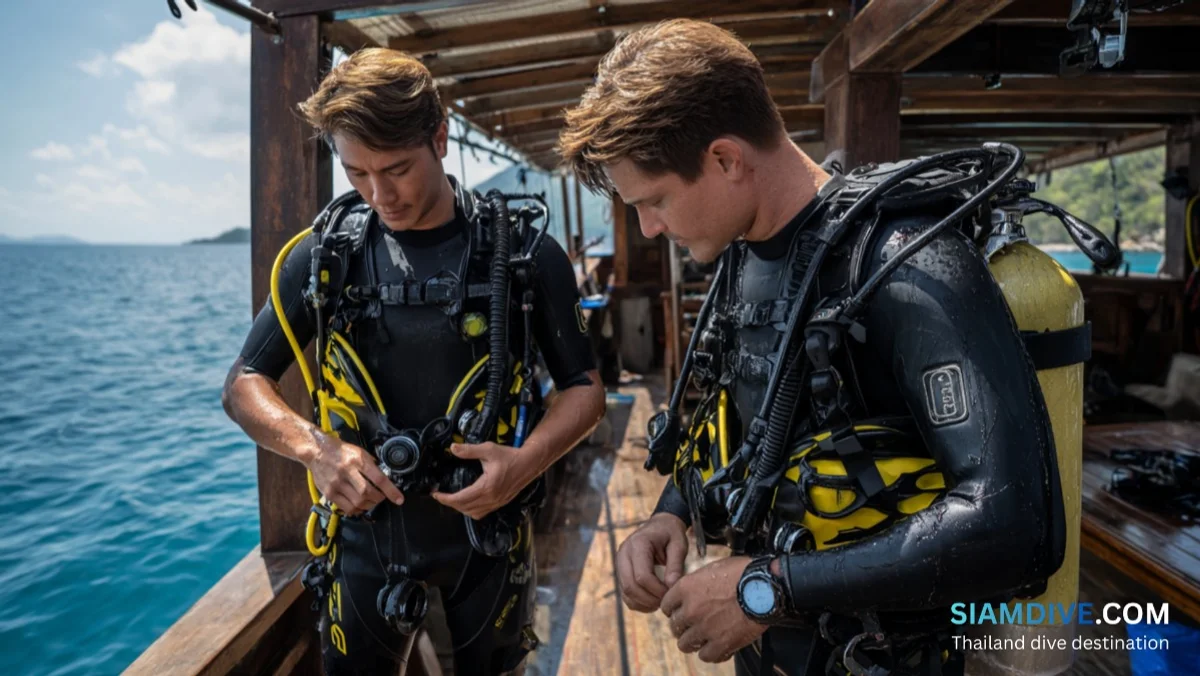
A loaded recreational diver carries roughly 15 kg of tank, 3–5 kg of BCD, 4–8 kg of lead, plus regulator, wetsuit, and accessories. The total sits between 30 and 50 kg depending on configuration, and most of it rides behind the shoulders. That rear-loaded centre of gravity is designed for neutral buoyancy underwater. On a boat platform, it turns every diver into an inverted pendulum waiting for a nudge.
Put your foot on a wet fibreglass platform in full-foot fins. Feel the rubber slide. That sensation is what 45 kg of dive gear is about to accelerate. Open-heel booties on wet fibreglass offer roughly the traction of socks on bathroom tile — full-foot fins are worse. The transition from standing still to swinging one leg forward while carrying that load creates a rotational moment that wants to pitch the body face-first off the edge. Diver forums document cases where the movement is described as a face-first collapse with all the gear's momentum behind it.
DAN's Annual Diving Report tracks musculoskeletal injuries among recreational divers, and the numbers suggest the problem is widespread: lower-back pain prevalence among surveyed divers sits above 50 percent. Not all of that comes from entries — but heavy gear on unstable surfaces under time pressure is a textbook mechanism for exactly this kind of injury.
Three Injuries at Zero Metres
- Mask frame to the face. A diver who does not secure the mask with fingertips against the faceplate will have it ripped upward on water impact. The rigid frame edge can cut the bridge of the nose or the brow ridge. Worse, a dislodged mask underwater means clearing while disoriented and possibly sinking — a reliable setup for panic.
- Tank valve to the back of the skull. The first-stage regulator and valve assembly sit directly behind the head. On an uncontrolled entry — a jump instead of a stride, a back roll without the chin tucked — the head snaps backward into steel or brass. Results range from a painful welt to a brief loss of consciousness. DAN recommends medical evaluation for any head impact associated with altered awareness, regardless of how quickly the diver appears to recover.
- Torn muscle or twisted ankle from a deck slip. Divers on ScubaBoard have documented injuries including a partly torn adductor muscle from a single giant stride where the standing foot slipped on the platform edge. With 45 kg of gear amplifying the force, a minor stumble becomes a load-bearing failure that can sideline a diver for weeks.
Seven Red Flags on the Dive Platform
All of these are visible before you leave the boat. Spotting them takes fewer seconds than a safety stop.
1. The deck is wet and there are no grip pads
Glossy fibreglass, spray from the previous group's exit, morning condensation on every surface — and nothing between your fin sole and a skating rink. Textured EVA mats cost less than a single dive day, and well-run Thai boats have them bolted to the platform. If yours does not, ask the crew for a towel or wet-grip mat. If nothing is available, shuffle to the edge in booties and put your fins on only after your feet are planted on the platform lip.
2. You put your fins on too early
Walking across a rocking boat deck in long-blade fins is an invitation to catch a tip on a tank strap, a bench edge, or another diver's gear. The longer the walk in fins, the higher the odds of going down with 45 kg of momentum behind you. Carry your fins to the platform. Sit if there is a bench. Put them on when you are one step from the edge — not before.
3. Your mask hand is doing something else
The correct hand position is specific: right-hand palm on the regulator second stage, fingers spread across the mask faceplate. Left hand secures the weight-belt buckle or holds the mask strap at the back of the head to block the tank valve. If either hand is carrying a camera, a torch, or gripping the boat rail past the point of no return, the mask and regulator are unprotected on impact. Clip accessories to a D-ring or hand them to a buddy already in the water. Both hands must be free for their assigned jobs.
4. The platform is high and there is no swim step
Thai day boats — particularly converted fishing vessels running out of Chalong, Rassada, and Khao Lak — often have freeboard of 1.2 to 1.8 metres, well above the 0.6-metre platforms on purpose-built dive boats in the Caribbean. Higher platform means longer fall, greater impact, and more time for gear to shift mid-air. Ask the crew about back-roll alternatives from a lower gunwale. If the high platform is the only option, bend your knees slightly deeper at takeoff, tuck your chin, and stride — never jump. At 1.5 metres of freeboard, the difference between a stride and a jump is the difference between a controlled entry and an emergency.
5. You are looking down
Looking down tilts the torso forward, shifts the centre of gravity over the platform edge, and turns the stride into a tumble. The correct reference is the horizon — look straight ahead and step forward. The water will meet you. You do not need to watch it approach.
6. Nobody checked the water below
Bubbles from the diver who entered ten seconds ago. A surface swimmer adjusting a mask strap. A stray mooring line. Entering on top of another diver can injure both — entanglement risks multiply when two sets of gear collide at the surface. Check straight down from the platform edge. If you see bubbles, wait. If the divemaster has not signalled you, ask.
7. Your chin is not tucked
The single most common entry mistake that results in the tank valve hitting the back of the head — and the simplest to fix. Chin down toward the chest before you step. One movement closes the gap between the occiput and the valve assembly. The left hand can also go to the back of the head, over the mask strap, as a physical block. This technique is standard in back-roll entries and works equally well for giant strides.
The Three-Second Protocol
This sequence distils the entry procedures taught by PADI and reinforced by DAN's incident-prevention guidelines into three beats. Nothing else matters until all three are done.
- Second 1 — Plant
- Balls of the feet on the platform lip. Fin blades extending over water. Feel stable before anything else happens.
- Second 2 — Secure
- Right hand: regulator and mask. Left hand: weight buckle or back of head. Chin tucked.
- Second 3 — Scan and stride
- Check the water below. Look at the horizon. Step forward — do not jump.
Three seconds separates a clean entry from a clinic visit. The O₂ kit on the boat is there for underwater emergencies — it should not be needed before anyone gets wet.
Most divers learn these steps in their Open Water course and execute them correctly on training dives. The problem starts after certification, when familiarity replaces procedure. By dive fifty, the entry feels automatic — and automatic means skipping the scan, relaxing the mask hand, or stepping before the feet are set. The three-second protocol exists precisely because the entry is routine. Routine tasks are where complacency lives, and complacency on a wet platform with 45 kg of rear-loaded gear has a predictable outcome.
When the Entry Goes Wrong
If a diver surfaces after a bad entry with a cut, a sore neck, or a twisted ankle, the dive is over. Not shortened — over.
- Abort immediately. An injury sustained on entry will worsen at depth. Pain compounds under increased ambient pressure, and impaired mobility is a documented risk factor for panic and uncontrolled ascent.
- Signal the surface crew. Wave, call, or use a whistle. Do not assume the crew saw the bad entry — they may already be watching the next diver.
- Mask-frame cuts bleed freely but are usually superficial. Control with direct pressure on the surface. Saltwater in a facial laceration is painful but does not require treatment beyond standard wound care.
- Any loss of consciousness — even momentary — rules out diving for the rest of the day. DAN recommends medical evaluation for any head impact with altered awareness, no matter how quickly the diver appears to recover.
- A torn or strained muscle means the diver cannot safely manage buoyancy, handle emergencies, or exit in current. Attempting to dive on an injured leg or back creates a rescue scenario that puts the buddy at risk as well.
Why This Keeps Happening on Thai Day Boats
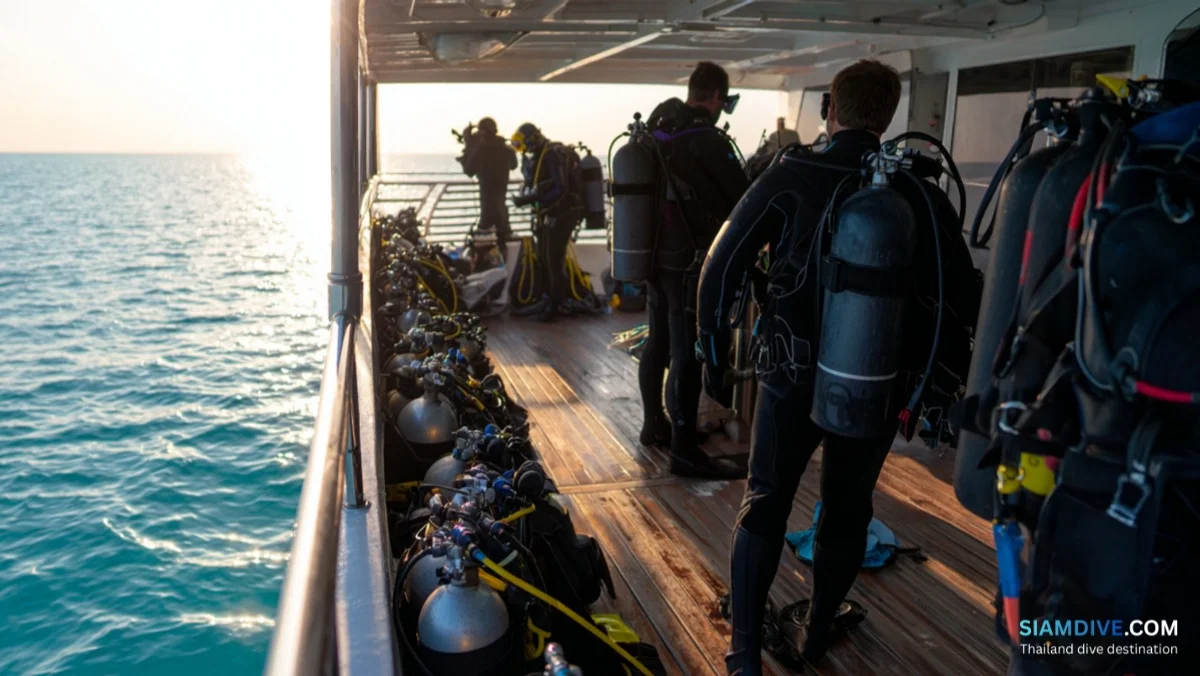
Thailand's day-trip fleet is built for tropical logistics, not for entry ergonomics. Converted fishing vessels running Similan, Racha, and Phi Phi routes were designed to haul nets — launching divers was an afterthought. The step from deck to water can be 1.5 metres. Compare that to a Caribbean dive boat's swim platform sitting at waterline. Add warm-water conditions where thin wetsuits or rash guards replace 5 mm neoprene, and there is less body padding to absorb a bad landing. Morning dew on fibreglass, groups of twenty or more gearing up in limited deck space, and the rush to get everyone in before the current shifts — the entry environment is objectively more hazardous than a purpose-built platform.
None of this is a reason to skip Thai diving. The marine life, the visibility, and the value are difficult to match anywhere in the world. It is a reason to take the three seconds.
Sources
- DAN — Incident Insights: case summaries and diving incident prevention
- NCBI — DAN Annual Diving Report 2020: Diving Injuries chapter
- PADI — How to Giant Stride: official entry technique reference
- ScubaBoard — A Giant Stride Can Hurt You: diver-reported entry incidents
- DAN — Safer Dive Boat Operations: safety guidelines for operators