The O₂ Kit Every Dive Boat Carries but Nobody Practises
3 พฤษภาคม 2569
Only 24% of injured divers receive oxygen first aid. The kit sits on every boat — here's the red-flag checklist and four-step drill that makes it useful.
Strapped to the bench of every licensed dive boat in Thailand sits an orange case — sun-faded sticker, steel latch, maybe a few salt crystals around the seal. It holds a demand valve, a cylinder of medical-grade oxygen, a non-rebreather mask, and a set of hoses most divemasters have never connected outside a classroom. The case gets inspected once a year. It gets opened in an emergency maybe once in a career. That gap — between carrying the kit and knowing how to use it under stress — is where outcomes split between full recovery and permanent neurological damage.
DAN data paints the picture in numbers: only about 24% of injured divers worldwide receive any oxygen first aid at all. Of that quarter, fewer than one in four receive near-100% concentration. The equipment exists on almost every boat. The competence to use it does not. This is the checklist that closes the gap.
Six Signs That Change Everything After a Dive
Decompression sickness does not announce itself with a single dramatic symptom. It creeps. A tingling in the fingertips that could be a wetsuit too tight. A joint ache that could be from hauling tanks. Fatigue that could be the sun. The trick is pattern recognition — when two or more signs stack within hours of surfacing, the odds shift hard toward DCS.
- Joint pain that moves or deepens — shoulders, elbows, knees. Aggravated by movement, not relieved by rest. Accounts for roughly 70% of Type 1 DCS presentations.
- Tingling or numbness (paresthesia) — hands, feet, lips. Often bilateral. If it starts within 30 minutes of surfacing, consider it DCS until proven otherwise.
- Fatigue wildly out of proportion — not "I'm tired after diving" but "I cannot lift my arms to climb the ladder." DAN flags this as the most under-reported symptom because divers rationalize it away. The red flag: fatigue that does not improve after rest. A diver who sleeps the entire boat ride back and still feels crushed at the dock — that is not sunstroke.
- Skin mottling (cutis marmorata) — blotchy, marbled rash across the chest or trunk. Not itching alone — itching is common and mild. Marbling means bubbles are affecting the microvasculature and frequently precedes neurological involvement.
- Dizziness or vertigo — inner-ear DCS can mimic seasickness, which makes it dangerously easy to dismiss on a rocking boat. Key distinction: seasickness improves on land; DCS vertigo does not.
- Difficulty walking, urinating, or seeing clearly — any motor or sensory deficit after a dive is Type 2 DCS until a hyperbaric physician says otherwise. Do not wait for it to "clear up."
The window matters. Symptoms most commonly appear between 15 minutes and 12 hours post-dive, with the majority presenting within the first hour. Waiting to "see if it gets better" burns the golden period when oxygen does its best work.
What's Inside That Orange Case
A properly stocked oxygen kit contains more than a tank and a mask. Each component exists for a specific failure scenario — and knowing which piece to grab first is the difference between fumbling for three minutes and delivering oxygen in thirty seconds.
- Oxygen cylinder + valve — typically an M9 size (255 litres / 8 cubic feet) or larger. A full M9 at 15 litres per minute lasts approximately 17–20 minutes. Larger D-size cylinders (415 litres) extend that to roughly 28 minutes.
- Multifunction regulator with pressure gauge — shows remaining pressure so the provider can estimate time left and plan transitions.
- Demand inhalator valve + intermediate-pressure hose — the gold standard. Delivers oxygen only on inhalation, reaching approximately 95% FiO₂ with a tight mask seal. Conserves gas because nothing flows on exhalation.
- Non-rebreather mask (NRB) + constant-flow outlet — the backup. Delivers roughly 75% FiO₂ at 10–15 lpm. Simpler to use, more comfortable for a distressed patient, but drains the cylinder two to three times faster.
- Oronasal pocket mask with O₂ inlet — for rescue breathing on a non-breathing patient. Connects to the constant-flow port.
- Manually triggered ventilator (MTV) — delivers positive-pressure ventilation to a non-breathing diver. Has an overpressure bypass to prevent lung barotrauma. Press for no more than one second per breath.
Service the demand valve and MTV every two years or per manufacturer recommendation. Check the cylinder hydrostatic test date — expired cylinders cannot be legally refilled in Thailand. A full kit costs between 15,000 and 35,000 THB depending on cylinder size and brand; a regulator service runs approximately 3,000–5,000 THB.
Demand Valve or Non-Rebreather — A Three-Second Decision
The choice is not about which device is "better." Both deliver life-saving oxygen. The choice is about what the patient can physically do right now.
- Patient is conscious, breathing normally, can hold a mask seal
- → Demand valve. Highest FiO₂ (~95%), longest cylinder life. Coach them: "Breathe in slowly and deeply through the mask. Let the valve do the work."
- Patient is conscious but distressed, gasping, or too weak to trigger the valve
- → Non-rebreather mask at 15 lpm. Fill the reservoir bag fully before placing on the face. Aim for a snug fit — every gap drops concentration toward ambient air.
- Patient is unconscious but breathing
- → NRB mask at 15 lpm in the recovery position. Monitor airway constantly. Jaw thrust if needed.
- Patient is not breathing
- → MTV or pocket mask with O₂ inlet. Begin rescue ventilation immediately. One-second press on the MTV per inflation. If no MTV, use the pocket mask connected to constant-flow at 15 lpm while performing mouth-to-mask ventilation.
DAN defines the demand valve as the standard of care for decompression illness first aid. But a non-rebreather mask in use beats a demand valve still in the case. The worst outcome is delivering no oxygen at all — any delivery method, imperfect or not, improves the prognosis.
The Four-Step Drill
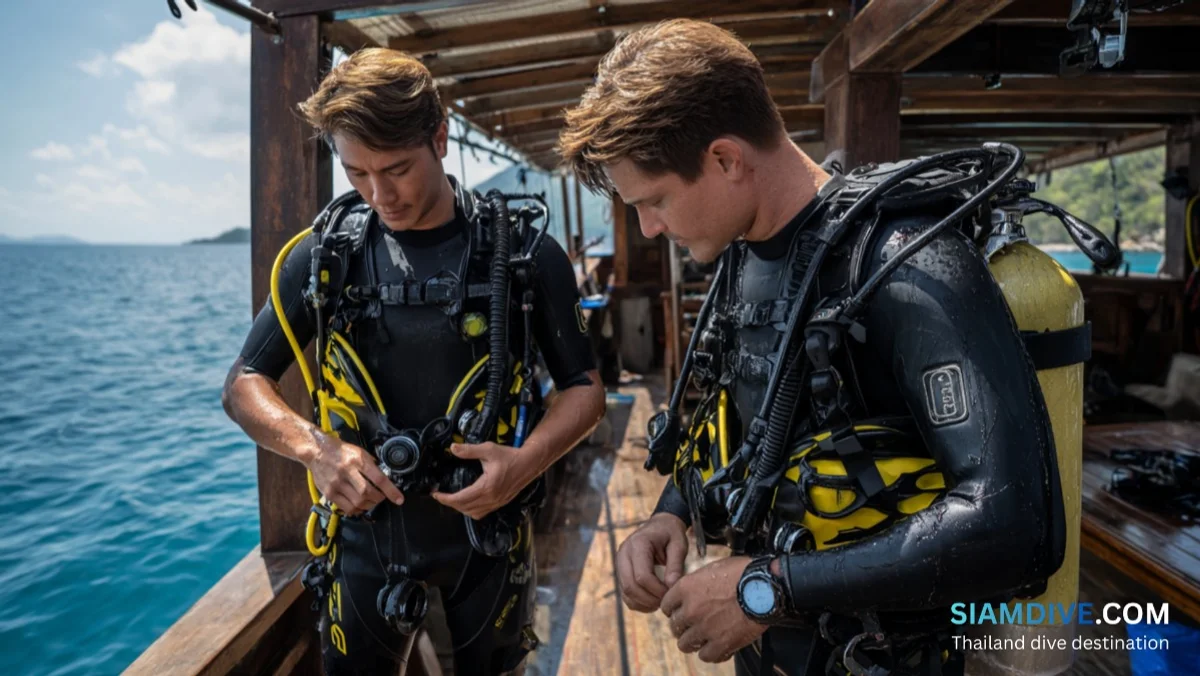
Practise this sequence cold — on the boat, with the engine off, cylinder closed, once per trip season. The four steps take under 90 seconds when rehearsed. Under stress, without rehearsal, the same sequence takes four to six minutes. That difference matters when the patient's nitrogen load is still climbing.
- Recognise and announce. Say it out loud: "Possible DCS." This triggers crew response and starts the clock. Do not wait for consensus from other divers — one person calls it, everyone moves.
- Position the patient flat. Lay them supine on the deck or bench. If vomiting, recovery position. Do not elevate legs (outdated protocol no longer recommended). Keep them out of direct sun, remove exposure suit to monitor skin for mottling.
- Open the case, crack the valve, connect, deliver. Turn the cylinder valve counter-clockwise — full open, then half-turn back as a safety measure. Check gauge: if pressure reads below 50 bar, you have minutes, not twenty. Select demand valve or NRB based on the decision tree above. Place mask, confirm seal, confirm the patient is receiving flow (watch the reservoir bag or listen for the demand valve click).
- Call for help while oxygen flows. Radio the coastguard or dial the nearest chamber hotline. Provide: number of dives today, maximum depth, bottom time, surface interval, time since surfacing, symptoms observed, whether oxygen is being delivered. Do not interrupt oxygen to make the call — assign a second crew member to communication.
Continue delivering oxygen without interruption until the chamber team takes over, medical evacuation arrives, or the cylinder is empty. There is no time limit on normobaric oxygen for DCS — research confirms that early administration within the first four hours of symptom onset reduces the number of hyperbaric treatments needed and increases the probability of complete resolution.
How Long the Cylinder Lasts — and What Happens After
- M9 cylinder (255 L) on demand valve — roughly 25–45 minutes depending on respiratory rate (resting adult: 12–20 breaths/min).
- M9 cylinder on NRB at 15 lpm — approximately 17 minutes flat.
- M9 cylinder on NRB at 10 lpm — approximately 25 minutes.
- D-size cylinder (415 L) on NRB at 15 lpm — approximately 28 minutes.
When the gauge hits zero before help arrives:
- Keep the patient flat and still — movement increases bubble migration through tissues.
- Offer water if conscious — non-carbonated, room temperature, small sips of 100–200 ml every 15 minutes. Dehydration worsens DCS by increasing blood viscosity.
- Monitor and record symptoms every 5 minutes — improvement or deterioration both matter for the chamber physician's treatment table decision.
- Do not let the patient "walk it off," re-enter the water, or attempt improvised in-water recompression unless explicitly directed by a hyperbaric physician on the phone. Uncontrolled in-water recompression has killed divers who might otherwise have survived.
Even after successful treatment in a recompression chamber, symptoms recur in 15–40% of cases. Early and adequate oxygen first aid narrows that window. The kit on the boat is not a cure — it is the bridge between injury and definitive treatment. The shorter and stronger that bridge, the better the outcome on the other side.
Thailand's Chamber Network — Numbers for the Wheelhouse Wall
With the Similan season closing on May 16, 2026, the final liveaboard runs of the year are underway — and Phuket's 24-hour chamber remains the nearest facility for any late-season Andaman incident. On the Gulf side, Koh Tao's year-round operation means the island's peak-visibility months (March through June) are covered without a boat transfer to the mainland.
- Phuket (Andaman Coast) — Hyperbaric Services of Thailand, operational since 1996. Multiplace chamber accommodating up to 4 occupants. 24/7 emergency line: 081 081 9000
- Koh Tao (Upper Gulf) — Mae Haad facility. On-island, no boat transfer required. The shortest transfer window in Thai waters — 10 minutes from any dive operation on the island. 24/7 line: 081 081 9777
- Koh Samui (Gulf) — covers incidents from Samui, Phangan, and Ang Thong Marine Park. 24/7 line: 081 081 9555
- Pattaya (Eastern Seaboard) — Badalveda Diving Medicine Center, Pattaya Hospital, Sukhumvit Road.
- Bangkok — Bangkok Hospital Hyperbaric Oxygen Therapy Center. Non-emergency referral and follow-up; not a primary dive-accident response facility.
Transfer time from the Similan Islands to Phuket's chamber runs 3–5 hours depending on sea state and vessel speed. From the southern Gulf islands (Koh Phangan, Ang Thong), the crossing to Koh Samui takes 45–90 minutes by speedboat. These windows underscore why the oxygen kit matters: every minute of 95% FiO₂ delivered on the boat is a minute of nitrogen washout that the chamber will not have to undo later.
Tape these numbers to the wheelhouse. Programme them into the captain's phone. When the moment arrives, searching the internet on a rocking boat with a panicking crew is not a plan.
Related: Why your CPR certification alone won't cut it on open water · Related: The rapid ascent mistake that starts the bubble cascade · Related: Advanced habits that fail in rescue scenarios