Full-Foot Fins Save 400 g — and Leave Your Feet Bare on Deck
4 พฤษภาคม 2569
Full-foot fins shave 400 g per foot and push power straight to the blade. On a Thai liveaboard, ditching booties has a price — it starts at the sundeck.
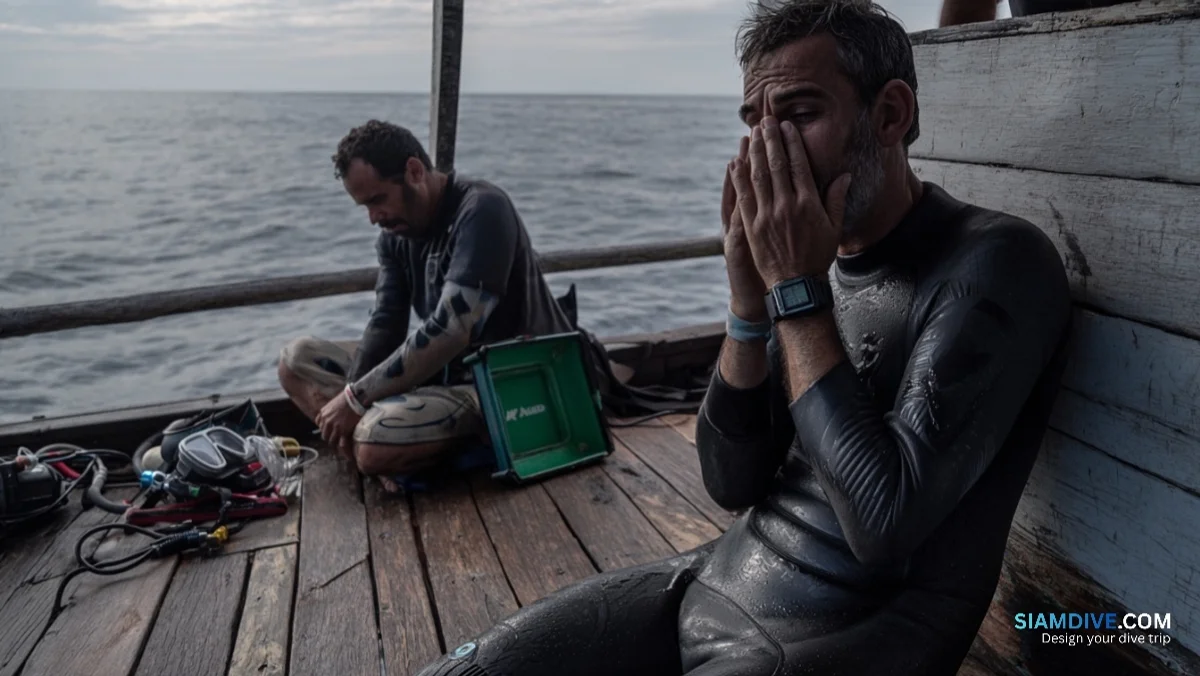
Somewhere between the fin rack and the first giant stride, every liveaboard diver faces the same quiet argument. Full-foot or open-heel? The maths looks obvious in 29°C water — strip the booties, save the weight, feel the blade respond through a thinner foot pocket. But three days into a Similan safari, with a blister forming under the instep and a coral nick on the left heel from a careless sundeck shuffle, the calculation starts to look less settled.
This article maps the real trade-offs — gram by gram, risk by risk — so you can match the fin to the trip, not just the luggage allowance.
What 400 Fewer Grams Buy You
A pair of Cressi Reaction Pro full-foot fins weighs 1,300 g in size 38/39. A comparable open-heel setup — mid-range blade plus 3 mm neoprene booties — lands north of 1,700 g before you tighten the strap. That 400 g gap matters when your checked bag has a 20 kg ceiling and a regulator, BCD, and wetsuit are already in it.
Weight is only part of the advantage. Because a full-foot pocket wraps the foot directly, with no boot sandwiched between skin and rubber, more of each kick transfers into forward motion. Performance comparisons published by scuba.com and discussed at length on ScubaBoard indicate that full-foot fins are slightly more efficient than open-heel models when all other variables are equal. The blade of the Reaction Pro starts from the upper side of the foot pocket, increasing usable surface by roughly 20 per cent over traditional fins of the same length. The Mares Volo Race achieves a similar result through its Channel Thrust system and 680 cm² blade area.
Travel is the other win. Full-foot fins are slimmer, have no dangling straps to snag, and slide into a mesh bag that fits inside a carry-on. For a diver flying Bangkok–Ranong on a domestic carrier with a 15 kg limit, every gram is currency.
- Cressi Reaction Pro (38/39) — 650 g per fin, blade starts from top of foot pocket, polypropylene construction
- Mares Volo Race (M) — approximately 680 g per fin, 680 cm² blade area, OPB system, thermoplastic rubber
- Typical open-heel + 3 mm bootie combo — 850–1,100 g per fin-plus-bootie, depending on brand and blade material
Bare Feet, Wet Teak, One Misstep
Full-foot fins do not accommodate booties. That is the design: the foot pocket is moulded to fit bare skin or, at most, a thin neoprene sock. On a liveaboard, this means every walk between the dive platform, the camera table, and the sundeck happens without sole protection.
Wet wooden decks and fibreglass ladders turn into hazards faster than most divers expect. One documented case on ScubaBoard describes a diver who required rotator cuff surgery after slipping on a bare-foot walk across a wet dive platform. Some operators in Southeast Asia collect all shoes and flip-flops at boarding — a policy born from experience with non-slip deck coatings that perform better against bare skin than rubber soles — but not every vessel enforces this, and not every deck is coated equally. If something does go wrong between dives, the emergency kit on board matters more than most divers realise.
Then there is coral. DAN receives roughly one inquiry per week related to coral contact injuries. The pattern the organisation documents is consistent: coral scrapes fester. Retained calcareous fragments embedded in the wound trigger an inflammatory response that can stretch healing from days to weeks — sometimes months. An NIH case study documented delayed dermatitis following a seemingly minor coral abrasion, complicated by secondary bacterial infection.
On a liveaboard running three to four dives a day, a coral nick acquired during an exit on day one can turn a four-night trip into a wound-management exercise by day three. DAN recommends rinsing daily and applying antibiotic ointment three to four times per day — not the kind of routine most divers pack for.
Branch A: Warm Water, Boat Entry, Light Pack
If your trip checks these three boxes, full-foot fins are the rational choice:
- Water above 26°C — Thailand's Andaman and Gulf coasts sit at 27–29°C year-round. No thermal protection needed for feet.
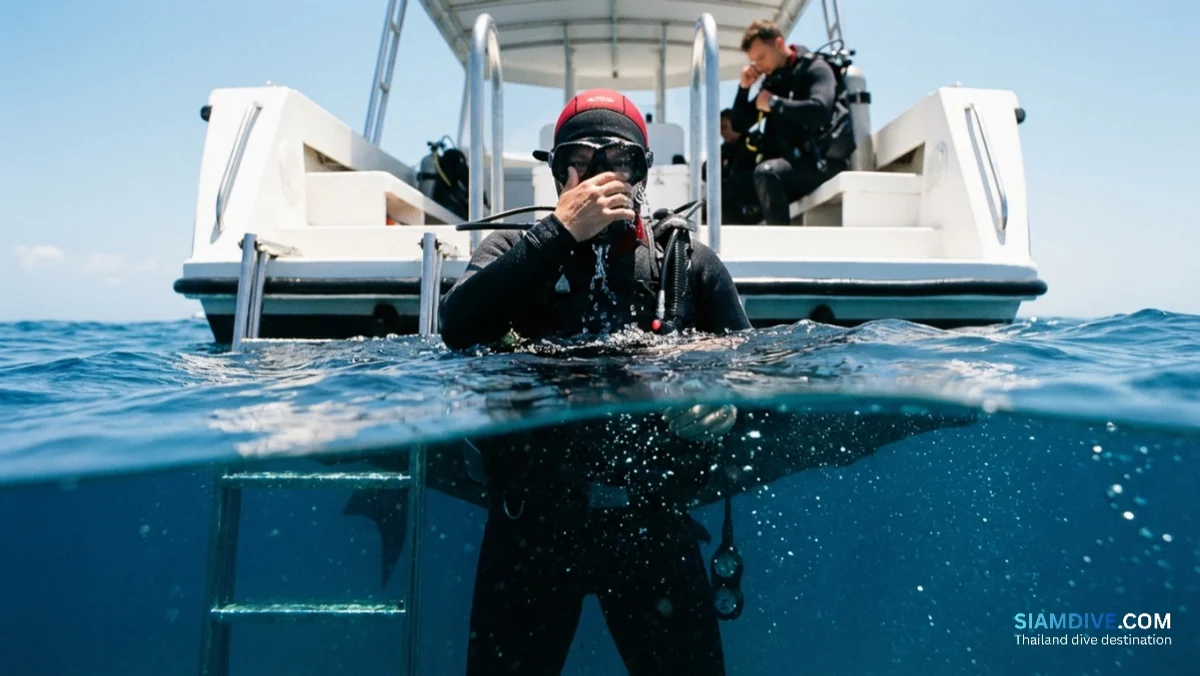
- Boat-only entries — liveaboards and day boats with dive platforms eliminate rocky walks and beach scrambles. Sit, fin up, stride in.
- Airline weight pressure — domestic Thai carriers cap checked bags at 15–20 kg. Full-foot fins reclaim 400–800 g that can go to a strobe, a dry bag, or simply staying under the limit. For a sense of what Thai liveaboard pricing looks like in 2026, the gear-weight equation is part of the total cost calculation.
A pair of neoprene socks — 2 to 3 mm, weighing 60–120 g — addresses the blister risk without adding meaningful bulk. The socks cushion the dorsal foot against the hard upper lip of the pocket, a pressure point that causes discomfort on longer dives if the fit is marginal.
Branch B: Shore Walks, Cold Currents, Rocky Exits
Open-heel fins with booties become non-negotiable when any of these apply:
- Shore diving is on the plan — Koh Tao's Twins, Racha Yai's bay-side entries, any site that starts with a walk across rocks or dead coral. Booties are foot armour. And how you kick once you are in the water matters as much as how you entered it.
- Water drops below 26°C — thermocline hits in the Andaman between January and March can push temperature to 24–25°C at 30 m. Cold feet drain core heat faster than expected; operators running week-long safaris report that core temperature drops progressively over three to four dives a day, even in tropical water.
- Mixed-destination travel — if the same trip includes a Similan liveaboard and a shore-dive day at Koh Lanta or Phi Phi, open-heel gives one-setup versatility without a second pair of fins in the bag.
The weight penalty is real but manageable. A quality 3 mm dive bootie weighs 250–350 g per boot. Budget the weight, and the choice pays for itself in protection. Open-heel fins also tolerate sizing variation better — the adjustable strap accommodates foot swelling, different sock thicknesses, and the gradual loosening that happens over years of salt-water use. For divers who rotate between the Similan Islands in February and a Mediterranean trip in June, a single open-heel setup eliminates the need to own two pairs of fins.
The Neoprene Sock That Changes the Equation
Most of the discomfort and injury risk associated with full-foot fins traces back to one thing: bare skin against hard surfaces. A 2–3 mm neoprene sock — around 500–800 THB at any Thai dive shop — solves most of it.
The sock adds a friction layer inside the foot pocket that prevents blisters. It cushions the dorsal foot against the hard upper lip of the pocket — the spot where most hot-spot complaints originate after long dive days. On deck, it gives enough grip and sole thickness to survive a walk to the rinse station without incident — though it will not protect against a serious slip or a sharp coral fragment underfoot. For night dives, when Andaman water temperature drops a degree or two below daytime readings, the thin neoprene layer also provides just enough thermal buffer to keep toes from going numb at depth.
Sizing shifts when socks enter the equation. A full-foot fin fitted to a bare foot will feel tight with a 3 mm sock. The standard adjustment: size up by half. If you wear a 40/41 barefoot, try a 42/43 with socks. Cressi and Mares both size in two-number increments, which aligns neatly with this rule.
The ScubaPro Go Travel takes a different approach. Technically an open-heel fin with a self-adjustable strap, it is designed to be worn barefoot or with a thin sock, bridging the two categories. Its Piggy Back Stack System allows modular stiffness, and the foot pocket accommodates a neoprene sock without requiring a size change. For divers who want flexibility without committing to a full bootie setup, it is worth a look — though it trades some of the propulsive directness that makes a true full-foot fin efficient.
Three Fins Worth the Bag Space
Not every full-foot fin deserves to survive the packing edit. These three earn their weight — and their spot in a 20 kg bag.
- Cressi Reaction Pro — around $199 / 6,900 THB
650 g per fin (38/39). Polypropylene blade derived from Cressi's freediving line, with blade surface 20 per cent larger than traditional fins of the same length. Elastomer foot pocket with anti-slip sole detailing. The serious option for divers who want full-foot efficiency with near-open-heel power. When gear performs under pressure, the premium pays off. - Mares Volo Race — around $120 / 4,200 THB
Approximately 680 g per fin. OPB (Optimised Pivoting Blade) system and Channel Thrust technology for smooth propulsion with minimal effort. The foot pocket uses thicker-than-average thermoplastic rubber — a genuine comfort advantage over multi-dive days. A strong mid-range pick that balances power and weight. - Cressi Palau — $40–60 / 1,400–2,100 THB
The budget standby. Adequate for recreational depths, comfortable enough for a week of three-dive days, and cheap enough that losing one to airline baggage handling does not ruin the trip. Independent reviews confirm it performs well for its price bracket. If you are testing whether full-foot works for your dive style before spending more, start here.
Get the Size Right Before You Fly
Full-foot fins do not adjust. The foot pocket either fits or it does not, and a poor fit on a liveaboard four hours from shore means seven days of discomfort or a scramble to borrow rental fins that may not match your kicking style.
Three rules:
- Try with the sock you will dive in. If you plan to use 3 mm neoprene socks, bring them to the shop. A bare-foot test for a 3 mm-sock trip guarantees a tight, blister-prone pocket.
- Half-size up for socks. One increment on the Cressi or Mares two-number scale — say 40/41 to 42/43 — typically absorbs a 3 mm sock without creating heel slop.
- Walk, do not just kick. In the shop, walk five steps in the fins. If the heel lifts or the side of the pocket digs into the fifth metatarsal, the fin will cause problems by day two of a liveaboard.
As the 2025–26 Similan season closes in mid-May 2026 — with operators already publishing schedules for the October reopening — the fin decision is the one gear call that affects every dive, every deck walk, and every kilo in the bag. Make it before you pack, not on the boat.
Sources
- DAN — Coral Scrapes and Cuts: prevention, treatment, and infection risk
- NIH/PMC — Delayed Dermatitis Following Injury Caused by Coral
- Scuba.com — Open-Heel or Full-Foot Fins: efficiency and design comparison
- Cressi — Reaction Pro Fins: specifications and blade design
- Thailand National Parks — Mu Ko Similan season and park information