Your CPR Card Means Nothing on a Longtail in Open Swell
2 พฤษภาคม 2569
Classroom CPR assumes solid ground. Thai dive boats offer wet bamboo and open swell. The physics change — here is how to adapt and what kit to demand.
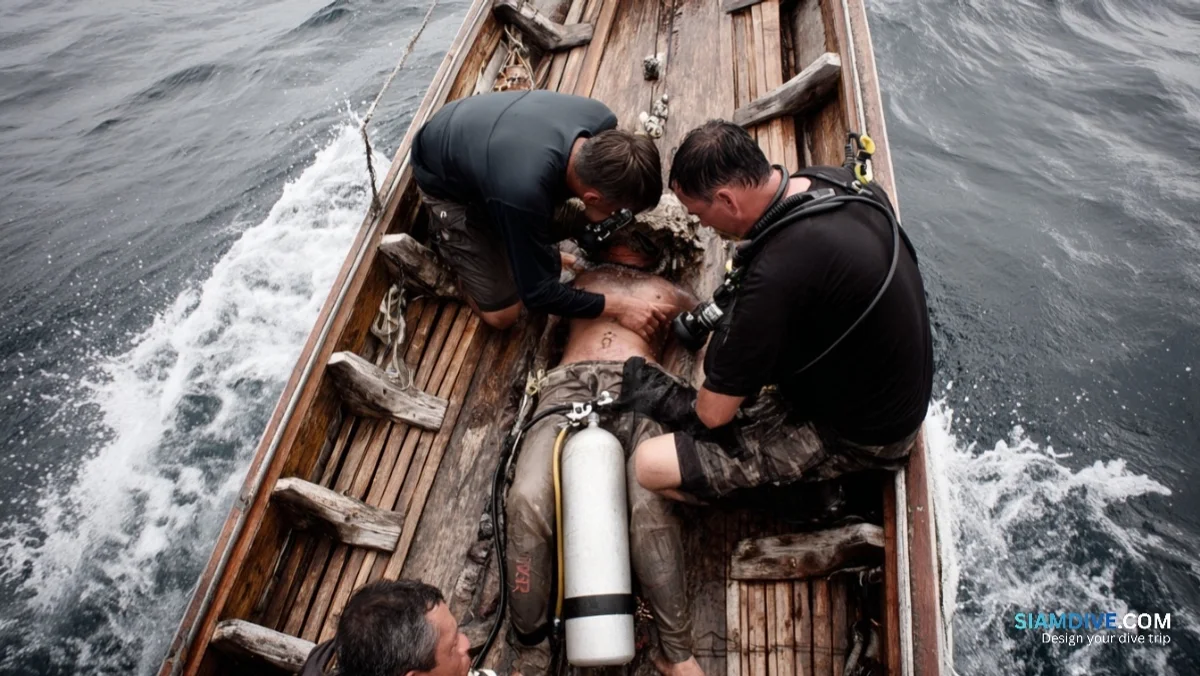
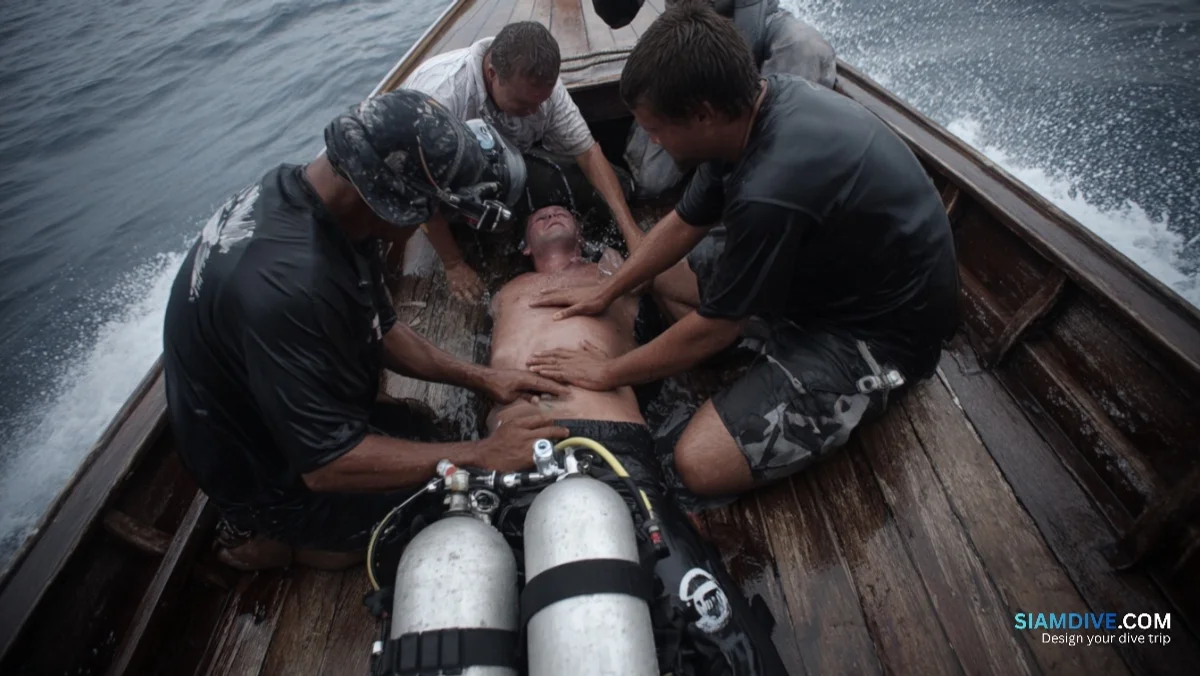
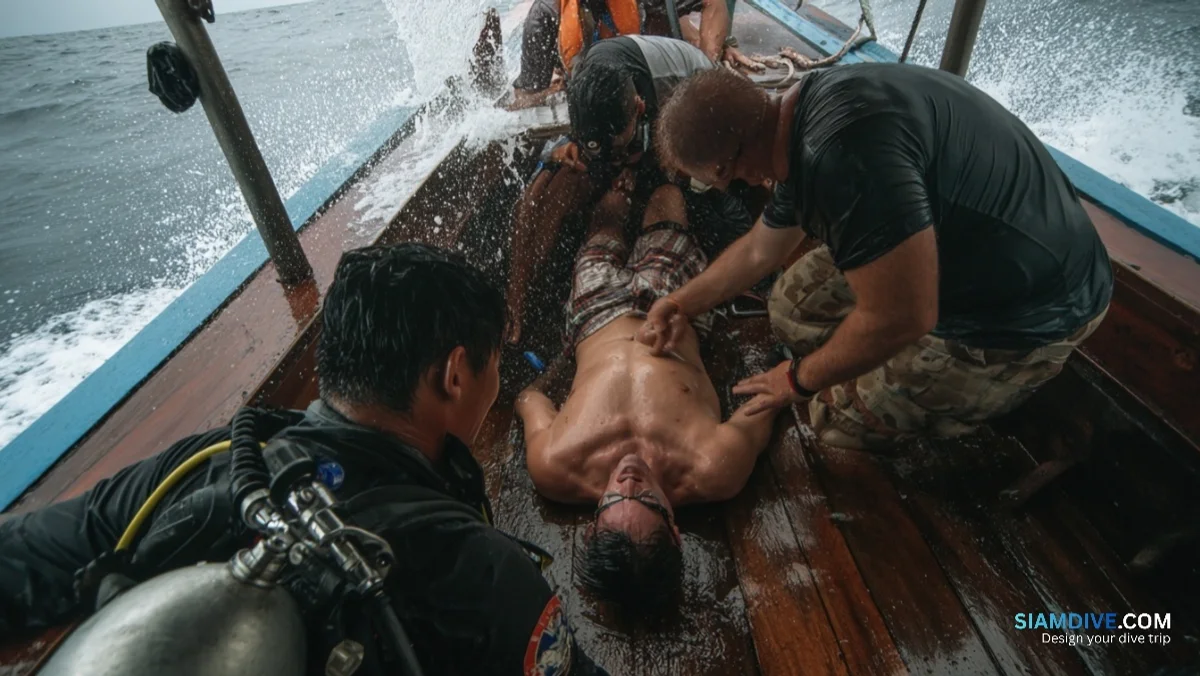
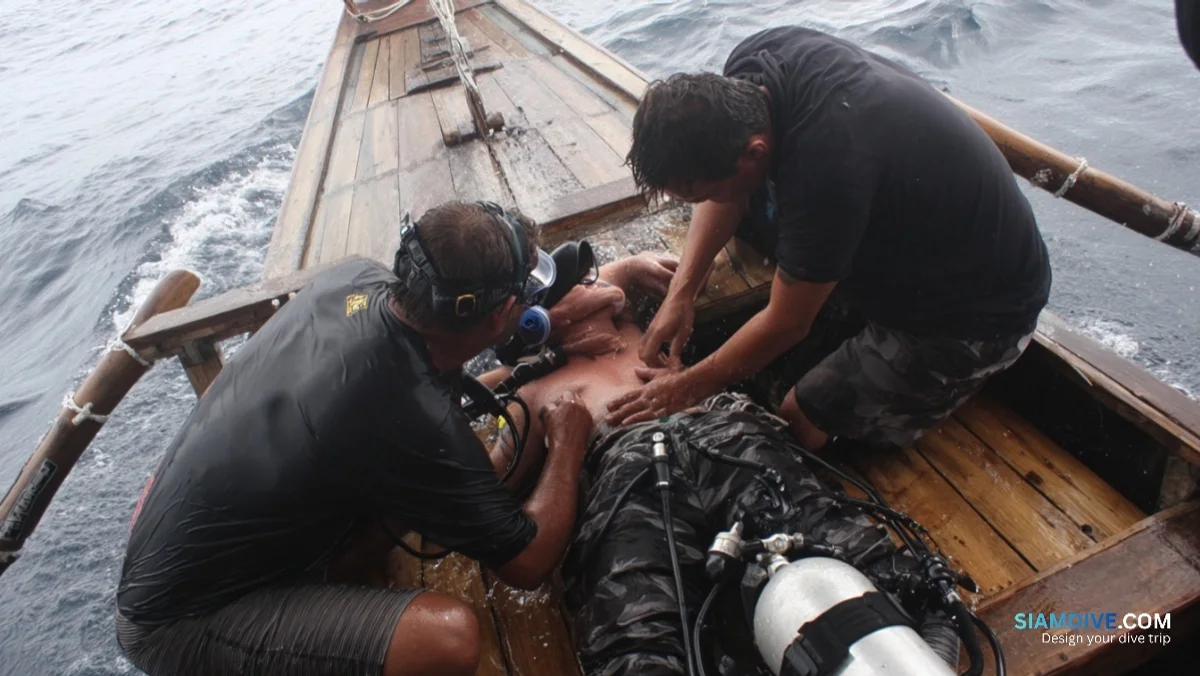
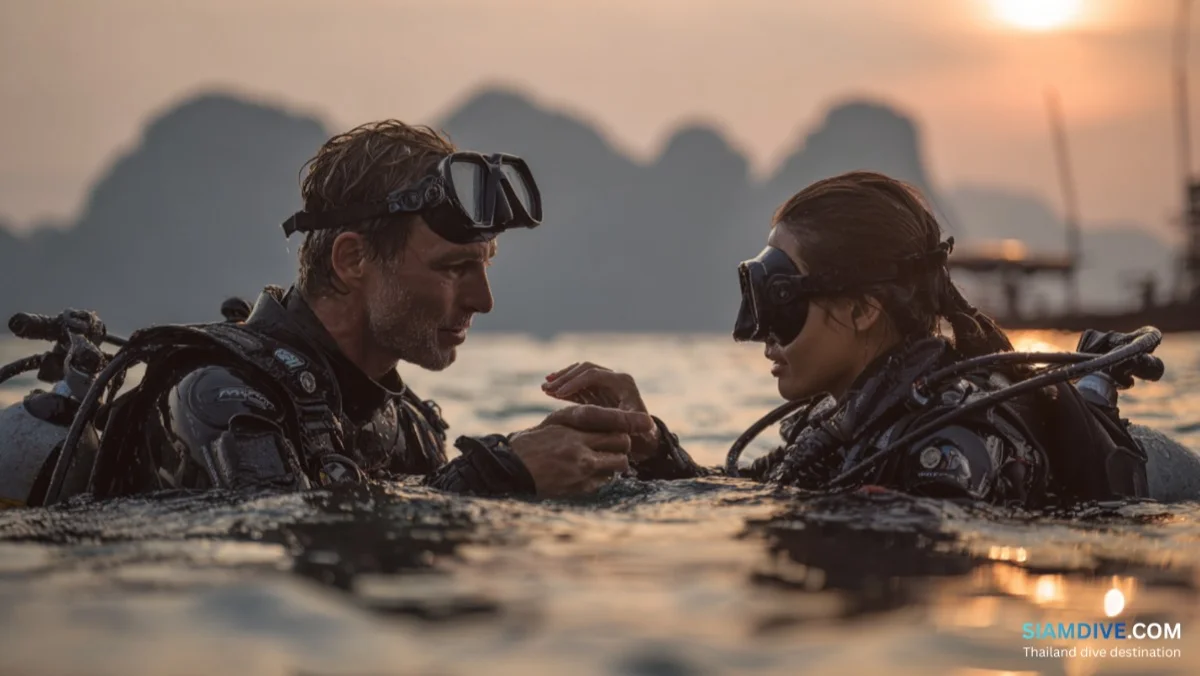
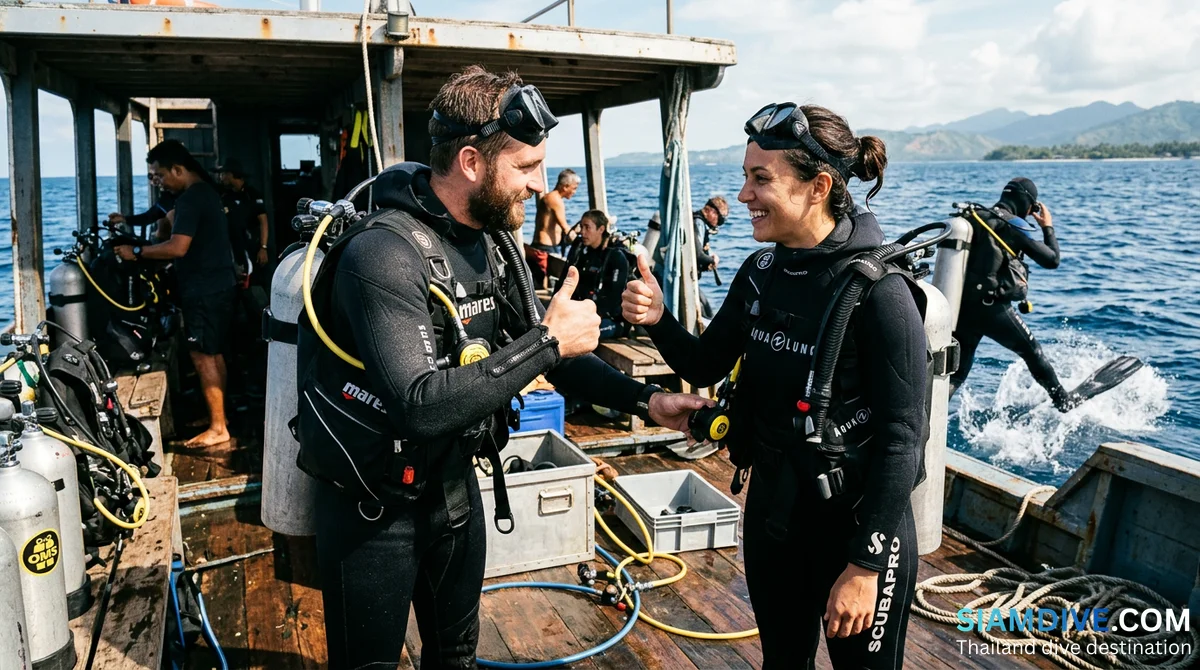
A diver surfaces limp at Sail Rock, sixty nautical miles from the nearest hospital with a pulse oximeter. The divemaster rolls her onto the longtail's bamboo deck, drops to his knees, and places the heel of his hand on her sternum. The boat rolls fifteen degrees to port. His weight shifts. The first compression travels sideways through her ribcage, half its force eaten by the flex of wet planks. Everything he practised on a training-centre floor three months ago is now wrong — not in theory, but in physics.
Thai waters produce some of the best diving in Southeast Asia and some of the most remote emergencies. When something goes wrong between dive sites, the gap between classroom CPR and the reality on a rocking hull can be the gap between a rescue and a recovery.
The Surface That Fights Back
Chest compressions depend on a hard, flat surface beneath the patient. Current AHA standards — mandatory for every training centre since March 1, 2026 — specify a compression depth of 5–6 cm at 100–120 pushes per minute. Those numbers assume tile, concrete, or at worst a carpeted floor. A boat deck offers none of the above.
A systematic review in Resuscitation found that compliant surfaces can absorb up to 57 per cent of compression energy, leaving barely half the intended force reaching the heart. On a hospital mattress, that means poor perfusion. On a longtail's bamboo planking, it means worse — because the surface is not only soft but moving.
Testing CPR quality on hard floors, stationary stretchers, and moving ambulances produces a stark gradient: compression depth drops with each step away from solid ground. On a moving stretcher without a backboard, compressions were effectively futile in a 2018 paramedic transport study. A dive boat in open swell replicates the worst of both problems — a semi-compliant surface on a platform that rolls, pitches, and yaws simultaneously.
How Much Room You Actually Have
Classroom CPR assumes unlimited space around the patient. On a Thai dive boat, space is the first luxury to disappear.
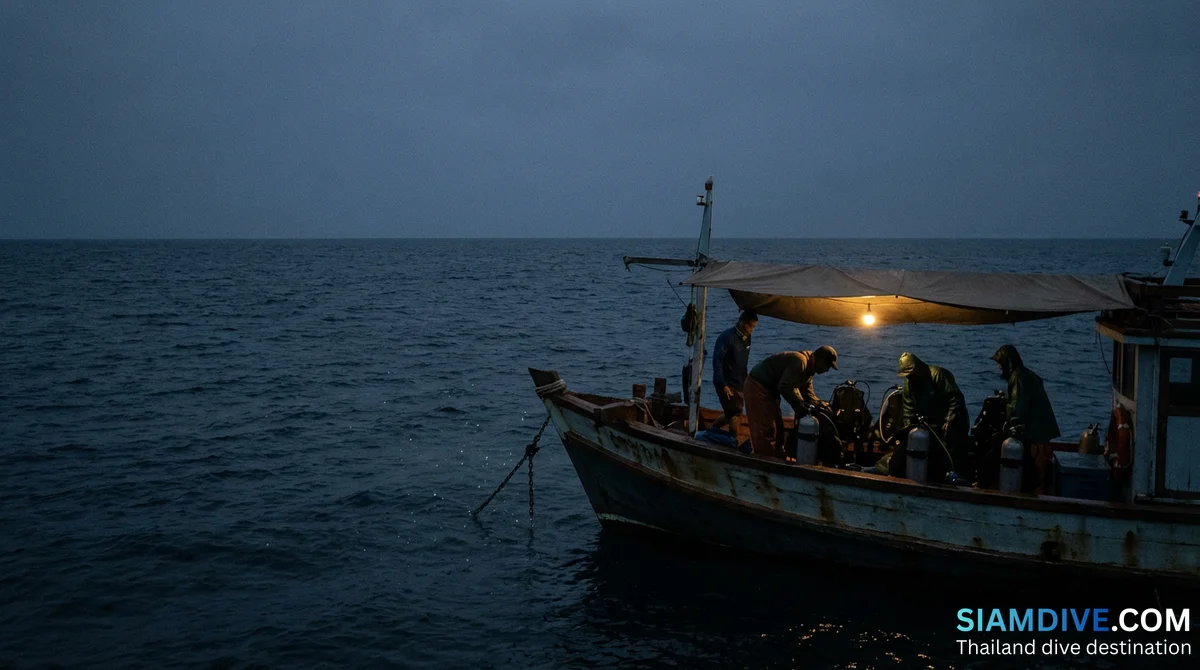
- Longtail (เรือหางยาว) — Beam roughly 1–1.5 metres on coastal dive models. Passengers sit on wooden side benches or cross-legged on bamboo planking. The engine shaft runs the full length of the stern. Lay a person supine in the centre and the rescuer's knees press against the gunwale on one side and touch the engine housing on the other. No room for a second rescuer to rotate in without someone climbing overboard first.
- Speedboat (typical Thai day-trip boat) — Wider beam, typically 3–4 metres. A rear dive platform provides the flattest surface, but it sits at water level and ships waves in any swell above half a metre. Mid-deck engine covers create an obstacle course. Best option: clear the bench seating in the bow section and work there.
- Liveaboard — Salon floor or sun deck. Widest, most stable, and the only Thai dive platform where CPR conditions approach what you trained for. If a casualty can be moved below deck, the lower centre of gravity reduces roll effect on compression quality.
The uncomfortable calculation: most budget dive trips in Thailand — Racha Yai day runs from Phuket, Sail Rock charters from Koh Phangan, Surin snorkel boats — use speedboats or longtails, not liveaboards. The worst platforms for emergency response are the most common ones.
Wet Decks, No Defibrillator
Salt water pools in the bilge. Spray coats every surface. The casualty just came out of the sea. An AED needs a reasonably dry chest and dry electrode pads to read a rhythm and deliver a shock. Marine-rated units carry an IP55 or higher ingress-protection rating — meaning they tolerate water jets and salt air — and cost USD 1,200–2,500.
Most Thai day-trip boats carry none. No current regulation requires one. Thailand's April 2025 diving rules mandate trained supervisors and life vests near coral reefs, but the equipment list stops short of defibrillators or emergency oxygen for multi-dive charters. Operators who carry an O₂ kit and AED are self-regulating, and they tend to be the liveaboard fleet rather than the longtails running budget two-dive packages.
Without an AED, manual CPR and rescue breathing are the only cardiac interventions available until the boat reaches shore-based EMS. That shifts enormous weight onto compression quality — exactly the variable the rocking deck degrades most.
The Distance Nobody Calculates
Thailand's hyperbaric chambers cover the main dive regions, but coverage is measured in boat hours, not ambulance minutes.
- Koh Tao — SSS chamber in Mae Haad, operating 24/7 with emergency line +66 81 081 9777. On the island, transfer is fast. From Sail Rock, however, the return trip runs 60–90 minutes by speedboat in calm conditions — longer during monsoon swell. Chumphon Pinnacle sits a similar distance in the opposite direction.
- Phuket — SSS facility at Bangkok Hospital Siriroj, 24/7, emergency line +66 810 819 000. This single chamber serves the entire Andaman coast from the Myanmar border to Malaysia. From the Similan dive sites, the boat ride back to Tab Lamu pier alone takes three to four hours, followed by a road transfer south.
- Khao Lak and Krabi — Evacuation staging points with 24-hour emergency numbers but no on-site chambers. A casualty from Richelieu Rock or Koh Bon routes through Khao Lak to the Phuket facility.
No dedicated helicopter medevac service exists for dive emergencies in Thailand. Military and Coast Guard helicopters can be requested through the Maritime Rescue Coordination Centre, but response from offshore island locations typically runs one to four hours depending on weather and aircraft availability. In practical terms, whatever happens in the first sixty minutes after a diver surfaces is handled entirely by the people on that boat.
Five Breaths Before You Push
Most CPR courses teach a compression-first sequence: hands on chest, push hard, push fast. For a drowning casualty, that sequence is backwards.
Drowning is a ventilation problem before it becomes a cardiac one. The lungs flood or spasm shut. The heart stops because it runs out of oxygen, not because of an electrical fault. DAN's first-aid protocol for submersion victims calls for five initial breaths — a recruitment manoeuvre that forces open collapsed alveoli and clears fluid from gas-exchange surfaces. Only then does the standard 30:2 compression-to-ventilation cycle begin.
The 2025 AHA guidelines reinforce the same priority, emphasising timely ventilation for drowning and respiratory-origin cardiac arrests. The distinction matters on a boat because most bystanders holding basic CPR cards trained for compression-only or compression-first cardiac scenarios. On a dive vessel, the first skill needed is the one drilled least: mouth-to-pocket-mask breathing on a wet, hypothermic face while the deck tilts underfoot.
Getting water out of the airway before pushing on the chest is not a preference. It is the protocol. Skip it, and compressions push oxygenated blood that does not exist.
Making It Work on a Moving Deck
Adaptation is not improvisation. The techniques below draw from paramedic transport research and DAN's professional-rescue curriculum, scaled to the geometry of a Thai dive boat.
- Brace before you compress. Wedge your knees against the gunwale, a tank rack, or a seated crew member's thighs. On a longtail, press one hip against the side plank. The goal is a stable triangle — two knees and one hip contact point — so the boat can roll without throwing your weight off the casualty's midline.
- Create a hard surface. Slide a scuba cylinder — aluminium 80 or steel 12-litre, valve end forward — under the casualty's shoulder blades. This eliminates deck flex and raises the chest slightly, improving compression geometry. A rigid backboard is better but rarely appears on day boats.
- Lock your elbows completely. On a stable floor, slight elbow flex is tolerable. On a boat, any bend turns into lateral drift the moment the hull rolls. Straight arms transfer force vertically regardless of what the deck does beneath your knees.
- Switch every 60–90 seconds. Fatigue on an unstable surface builds roughly twice as fast as on solid ground. Do not wait for the classroom-standard two-minute rotation. If a second trained person is on board, swap aggressively.
- One person calls, one person compresses. Compressions never stop for a phone call. Assign a crew member or passenger to radio the coastguard on VHF Channel 16 or dial the SSS emergency number. The compressor's job is one job — compress.
- Position head uphill. If the boat pitches bow-up underway, orient the casualty with head toward the bow. Gravity assists venous return to the brain. On a longtail idling with a list, shift the casualty's head to the high side when possible.
These are the same adaptations paramedics apply inside moving ambulances, reduced to a vessel with fewer hands and no dispatcher on the radio.
What Should Be on Board
A dive boat running more than thirty minutes from shore-based EMS should carry, at minimum:
- Emergency oxygen unit — DAN-specification, with a manually triggered ventilator and demand valve. Enough oxygen to maintain continuous flow from the farthest planned dive site back to the dock.
- Pocket mask with one-way valve — silicone, stored dry in a sealed bag. A barrier device that works on a wet face is non-negotiable for drowning response.
- Rigid backboard — doubles as a compression surface and an extrication aid for water-to-deck transfer. On a speedboat, a flat hatch cover can substitute in an emergency.
- Marine AED rated IP55 or above — self-prompting, ideally with bilingual voice guidance. Units from Defibtech or HeartSine tolerate marine conditions without a sealed external case.
- Thermal blanket — hypothermia compounds cardiac arrest. Wrap the casualty between compression cycles if shore is more than thirty minutes away.
After the DiveRACE Class E liveaboard fire off Khao Lak in April 2025 — the third such incident in five years — the Thai Dive Operators Association pushed for stricter vessel inspections. That conversation has yet to reach onboard medical equipment standards. Until it does, carrying an oxygen kit and AED remains voluntary, and the boats most likely to need them are the boats least likely to have them.
Every diver boarding a boat has a stake in asking one question before the first splash: where is the emergency oxygen, and who is trained to use it? If the answer is a shrug, you have learned everything you need to know about the rest of the safety plan. The numbers in your logbook matter less than the kit behind the captain's bench.
Sources
- American Heart Association — 2025 Adult Basic Life Support Guidelines
- DAN — Rescuing Divers and Swimmers: Key First Aid Principles
- PMC — The Optimal Surface for Delivery of CPR: Systematic Review and Meta-Analysis
- SSS Recompression Chamber Network Thailand — Locations and Emergency Contacts
- Thailand.go.th — New Marine and Diving Regulations 2025