Why Lightning Kills at the Surface, Not at 20 Metres
14 พฤษภาคม 2569
Lightning current dissipates within metres of the surface. Your greatest danger is between dives, not during them — and most briefings never mention it.
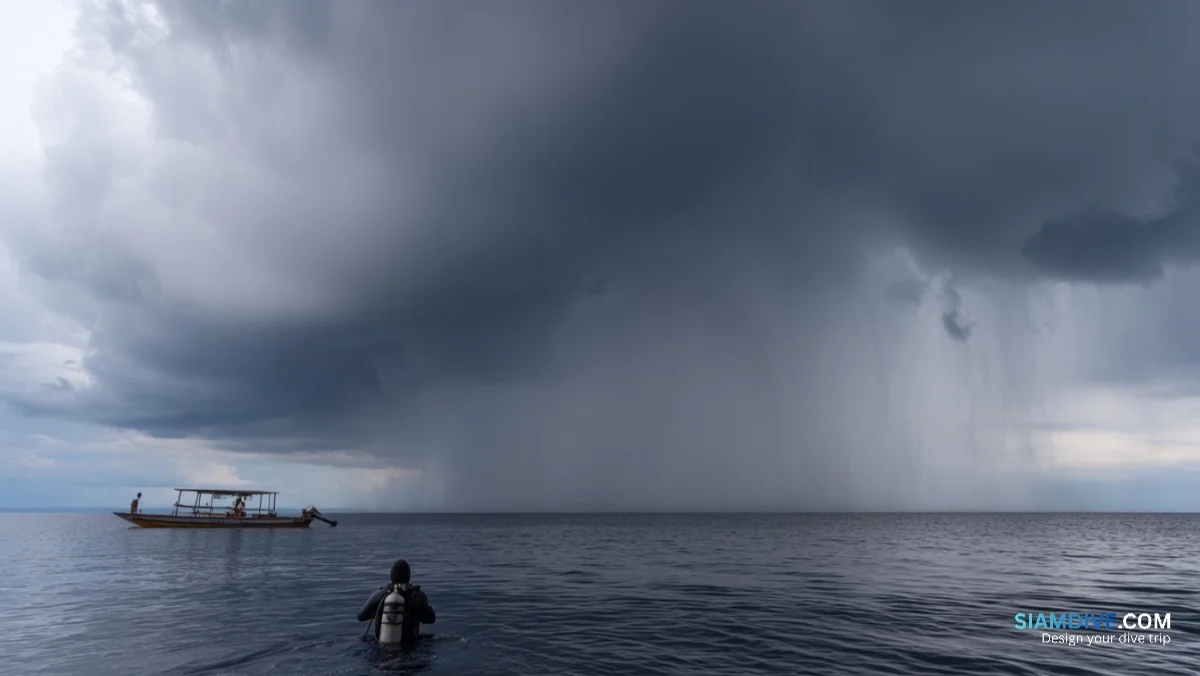
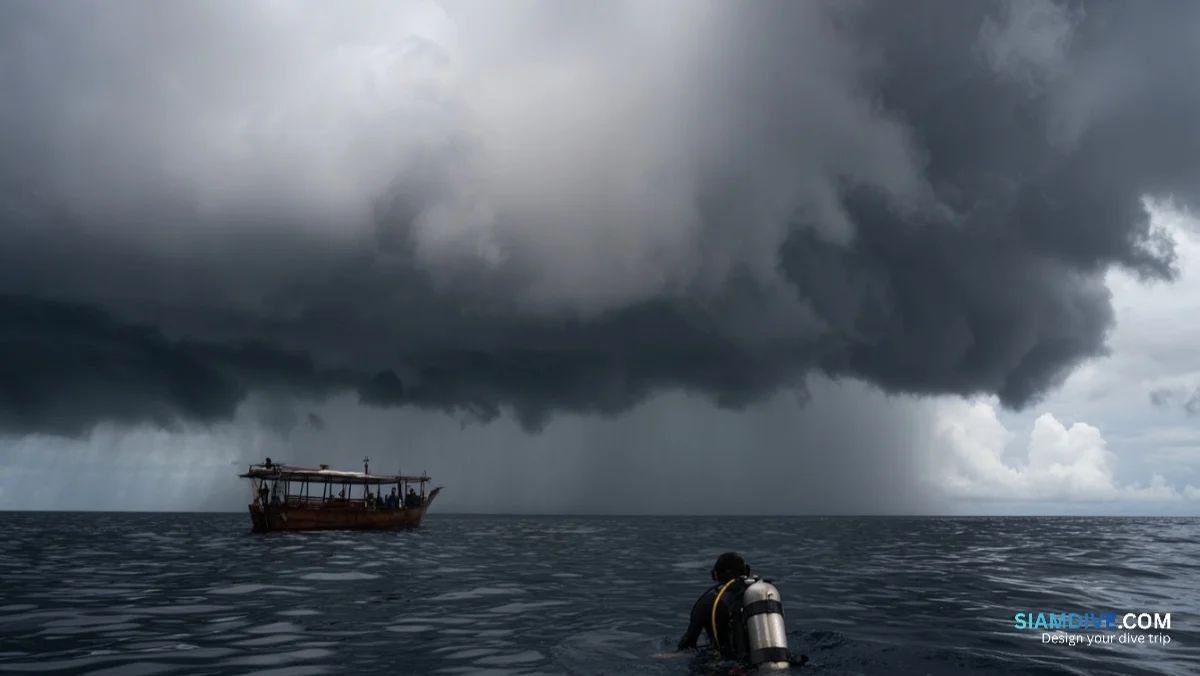
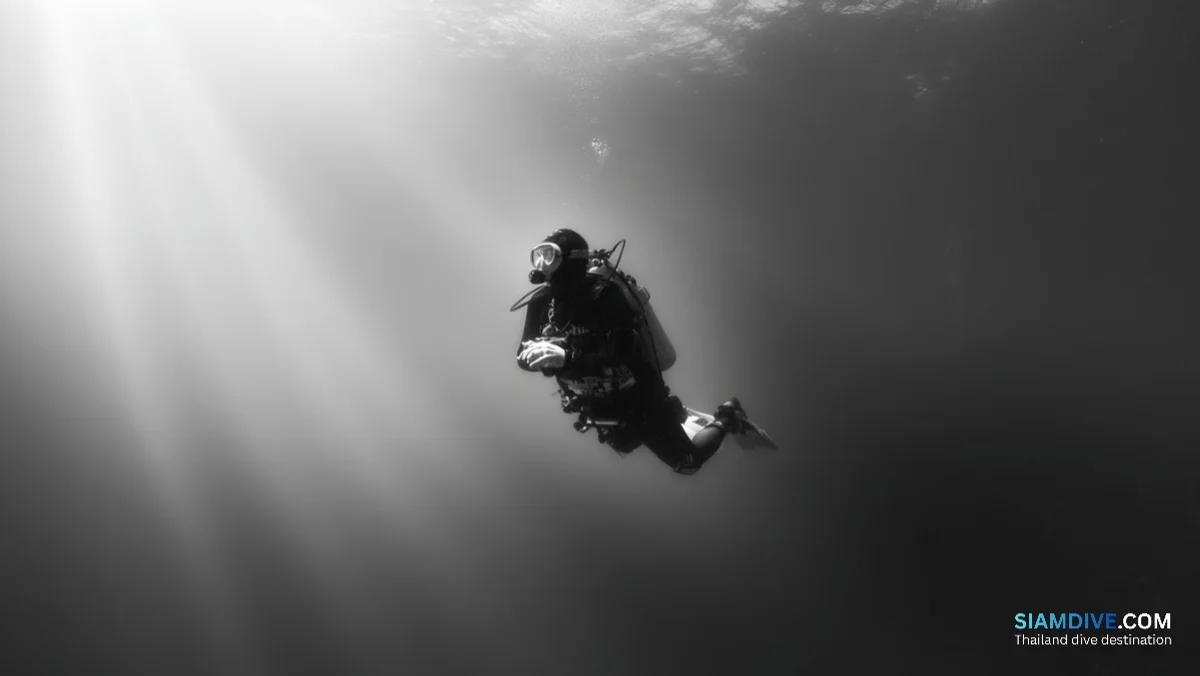
A bolt of lightning carries up to 300 million volts and reaches the water in under a millisecond. At depth — even six or seven metres down — a diver would barely register it. The current fans out across the surface, bleeds energy into the saltwater, and falls to harmless levels within roughly a hundred metres of the strike point. But at the surface, bobbing in your BCD between dives, your aluminium cylinder points straight at the sky. It is the tallest conducting object on the water. Most dive briefings never mention this.
What Happens When Lightning Hits Saltwater
Saltwater conducts electricity roughly 25 times better than freshwater. When a bolt hits the ocean, the current does not drill downward — it radiates outward across the surface like ripples from a dropped stone, losing energy exponentially as it spreads. The Austrian diving safety organisation EOBV — one of the few bodies to study this question in detail — reports that at approximately 100 metres from the strike point, both horizontally and vertically, the current has dissipated to levels harmless to living organisms.
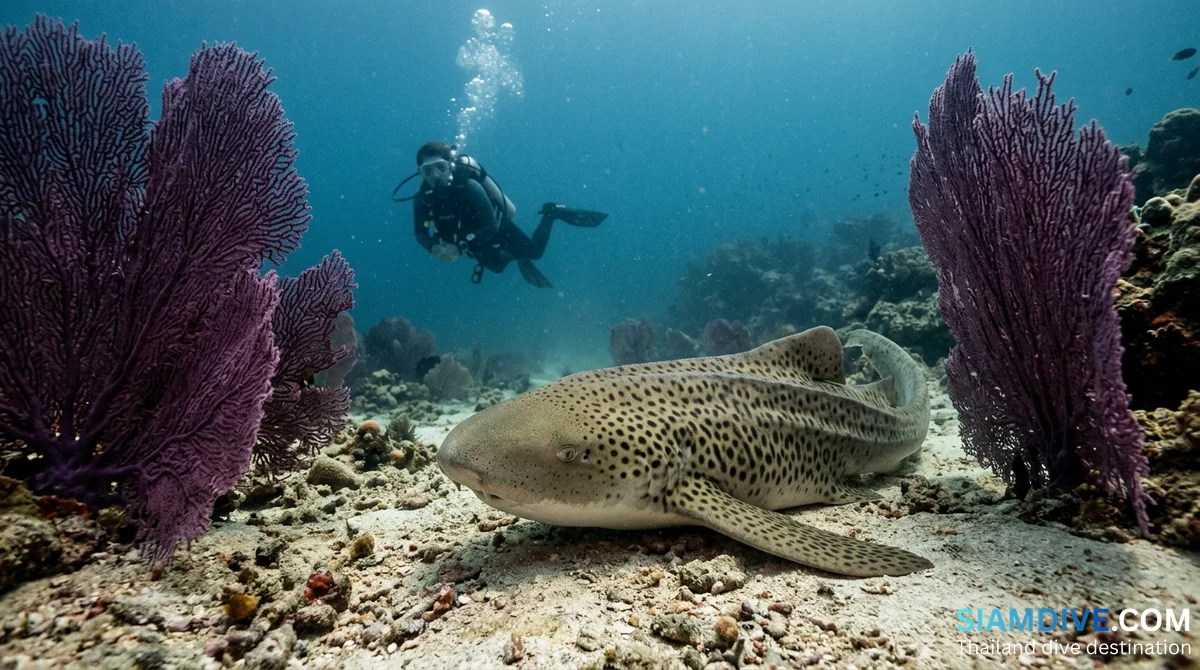
For a diver at 20 metres during a strike 50 metres away, the physics are reassuring. For a snorkeler floating horizontally in the top metre of water, or a diver hanging vertically at the surface with a metal cylinder above the waterline, the physics are lethal. Every confirmed fatality or serious injury from lightning in the diving record occurred at or very near the surface.
- Top 0–1 metre — peak current density, highest lethal risk from surface strikes
- 1–5 metres — significant current, risk remains elevated
- 5–20 metres — current drops rapidly, low risk
- Below 20 metres — negligible risk from surface-conducted electricity
The counterintuitive result: depth is shelter. The surface is exposure.
Why the Surface Interval Is the Danger Window
Between dives, the physics invert. You ascend from relative safety into maximum exposure — and you cannot go back down. Residual nitrogen loading from the first dive means descending again risks decompression sickness. You wait at the surface for an hour or more, either aboard the boat or — on crowded day trips — floating alongside it in your BCD.
Three factors compound the danger during this window.
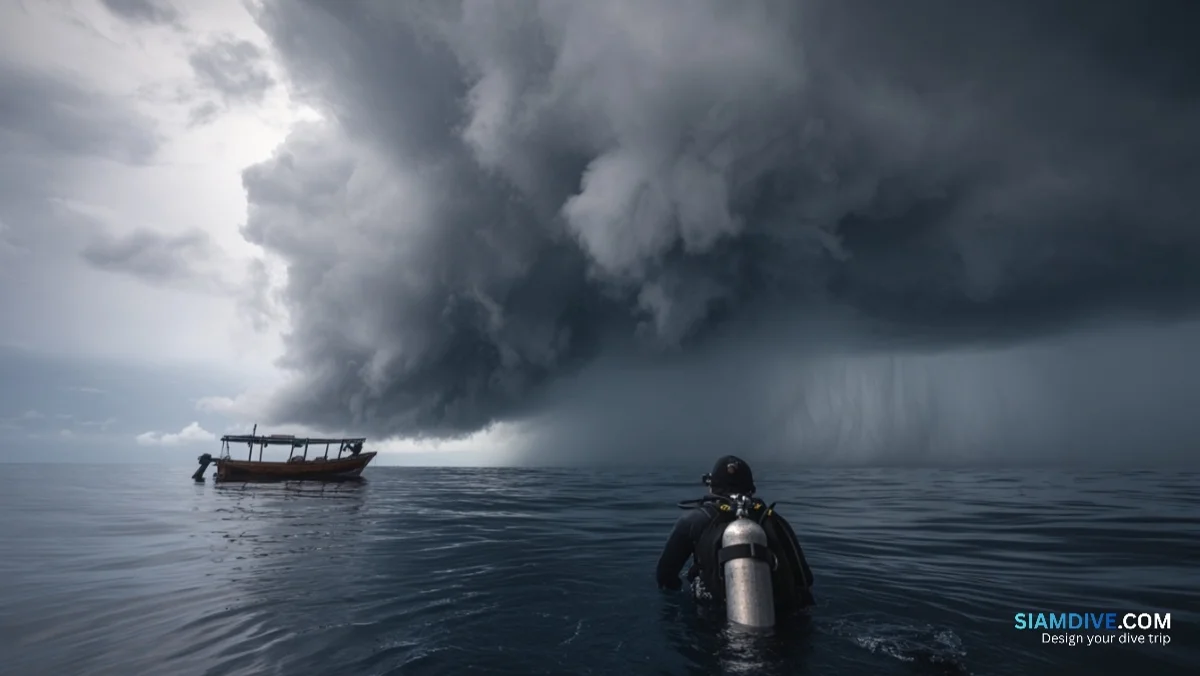
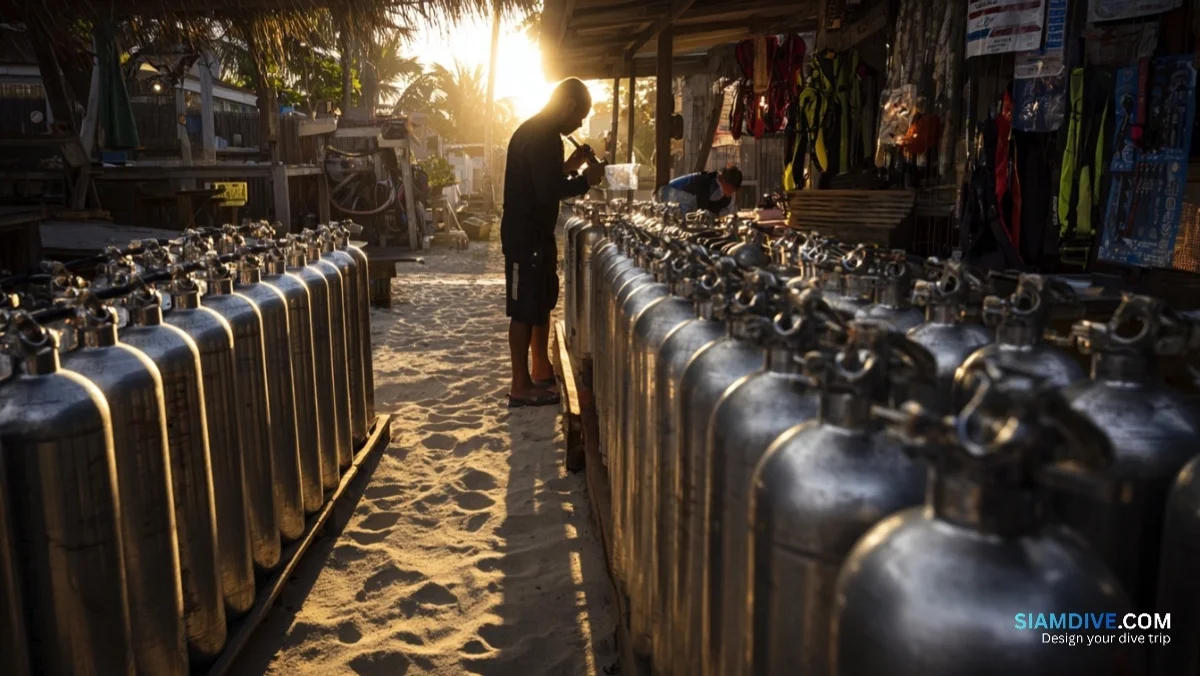
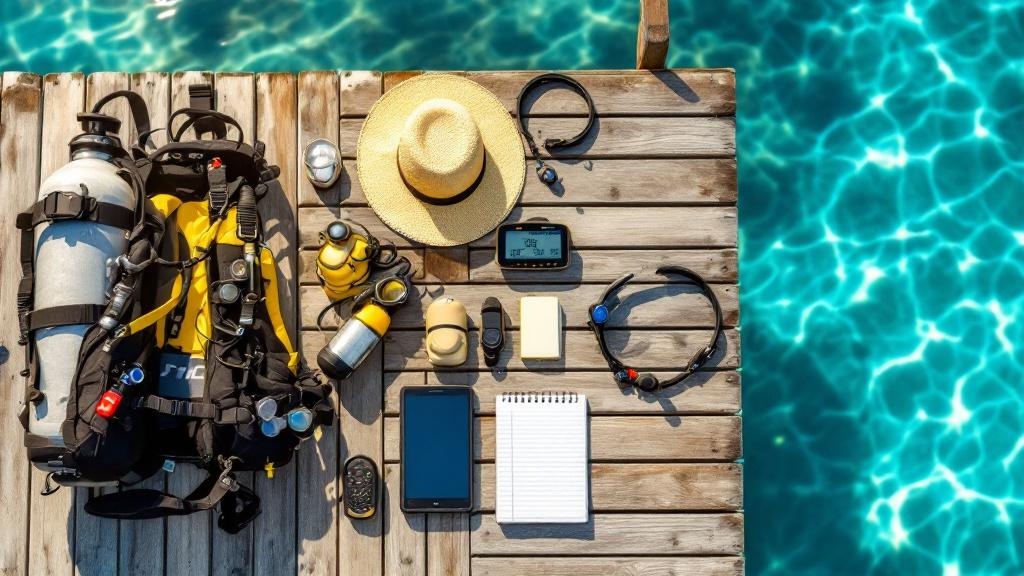
First, your cylinder. An aluminium 80 standing upright in a BCD rises roughly 65 centimetres above a diver's head. On a flat ocean surface, any metal protrusion — an antenna, a mast, a steel valve assembly — becomes a preferential path for electrical discharge. Your tank is often the highest metal point within ten metres of open water.
Second, your position. If conditions force you to wait in the water rather than climb aboard, you hang vertically with your head at the surface and your tank above the waterline. This is the worst possible orientation for a nearby lightning strike — maximum exposure in the highest-current layer.
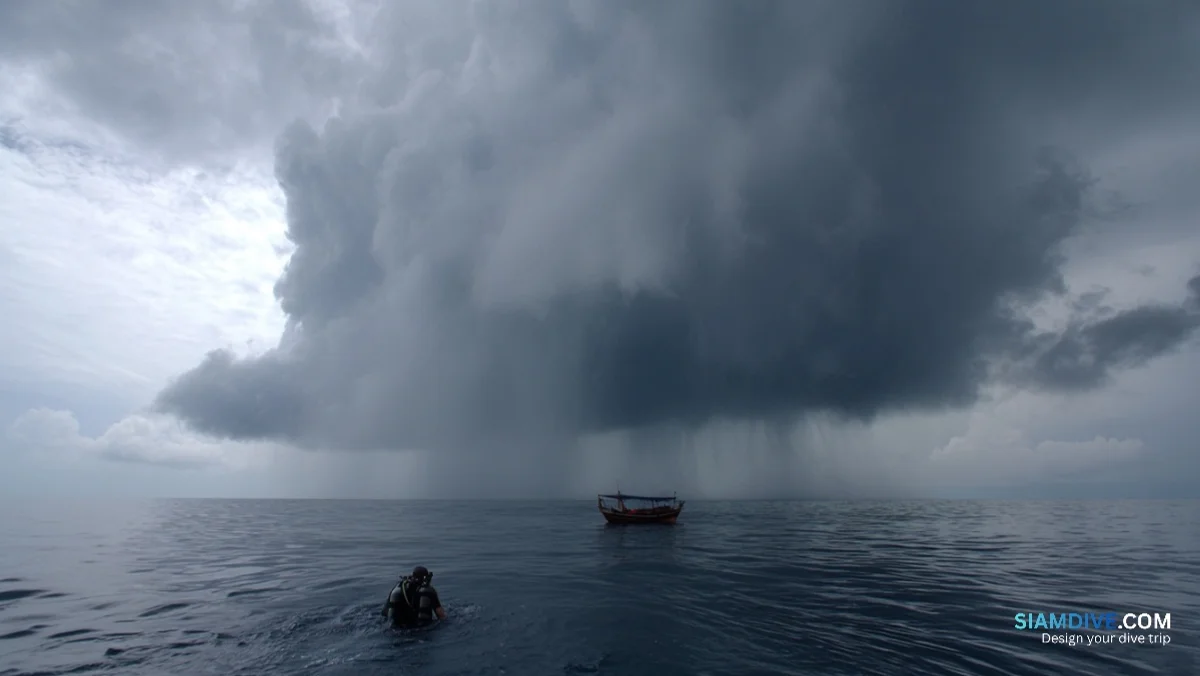
Third, timing. Tropical squalls in the Andaman Sea can form, intensify, and arrive in as little as ten minutes. A cloudless sky at the start of your surface interval can become a full thunderstorm before your nitrogen off-gassing permits a second descent. The storm does not wait for your dive computer to clear.
Eight Red Flags Before the First Rumble
Thunder travels slower than lightning. By the time you hear it, the electrical danger has already been present for minutes. A bolt can strike up to 24 kilometres from the storm cell's visible rain curtain — well beyond earshot. These eight signals appear before the first audible warning.
- Anvil-shaped cloud tops — flat, spreading tops on cumulus towers mean the cloud has hit the tropopause; active thunderstorm conditions are likely within 30–60 minutes
- Darkening horizon in one quadrant — a grey-black wall forming on the windward side signals an approaching squall front; if it grows visibly over 15 minutes, it is heading your way
- Sudden wind shift or dead calm — wind changing direction sharply or dropping to zero often precedes a gust front by 15–20 minutes
- Temperature drop on wet skin — a noticeable cooling on the boat deck means the storm's cold downdraft outflow has reached your position; the cell itself is close behind
- Rising swell from an unexpected direction — wave energy arriving from the storm's bearing can outpace the visible cloud front by several kilometres
- Static on VHF radio — crackling or popping on marine channels indicates electrical discharges in the atmosphere nearby
- Visible flashes without audible thunder — you can see the lightning but cannot hear it; the storm is distant but may be tracking toward you
- Rain smell on a sea breeze — petrichor carried offshore means the squall line is close and currently upwind
Any two of these appearing together warrant cancelling the next dive and running the storm protocol below.
The 30-Second Count
Flash. One, two, three... boom. Count the seconds between lightning and thunder, then divide by five. The result is the storm's distance in miles. Divide by three for kilometres.
| Seconds | Distance |
|---|---|
| 5 | ~1.5 km — immediate danger |
| 10 | ~3 km — get out of the water now |
| 15 | ~5 km — abort dive, begin protocol |
| 30 | ~10 km — prepare and monitor |
NOAA's 30-30 rule adds a second number that matters more than the first: stay sheltered for a full 30 minutes after the last thunder you hear. Storms re-intensify, stall, or reverse direction without warning. Roughly half of all lightning fatalities worldwide occur after the rain stops — people step out assuming the danger has passed when a trailing cell delivers the final bolt.
On a dive boat, the 30-minute wait feels excessive. The sun breaks through, the sea flattens, clients grow restless. But the protocol exists because complacency on boats has a worse track record than patience does.
What to Do on the Boat
A flash on the horizon, a low rumble across the water — whichever comes first triggers the same sequence, whether you are on a Phuket day-trip long-tail or a four-deck Similan liveaboard.
- Get out of the water immediately — surface, climb the ladder, get on deck
- Remove your BCD and cylinder; lay the tank flat on the deck, away from where people are sitting
- Remove metal jewellery, watches with metal bands, and dive knives
- Move to the centre of the boat, as low as possible — sit or crouch on the deck
- If the boat has a cabin, get inside and stay away from windows and metal fixtures
- Lower or disconnect antennas, outriggers, and any protruding metal structures if time allows
- Do not touch VHF radios, phones plugged into external antennas, or metal railings while lightning is active
- Put on life jackets — a nearby strike can cause cardiac arrest or loss of consciousness, and an unconscious person overboard has minutes
On a dive boat without a cabin — the standard for Thai long-tail day trips — crouch low on the centre of the deck and keep your group together. If shore is within ten minutes of motoring, the captain should head for it. If not, anchoring and riding out the storm cell is safer than running blind through its core. A typical thunderstorm cell passes a fixed point in 20–40 minutes.
Thailand's Monsoon Lightning Calendar
Forty-six lightning deaths and an average of 36 serious injuries per year across Thailand — that is the count from Ministry of Health data covering 2008 to 2012. Most struck in open agricultural areas, but maritime incidents involving fishing boats, longtails, and small dive operations go chronically underreported along both coasts.
The Andaman coast from Phuket to Lanta enters its Southwest monsoon between May and October. Thunderstorms build most often between 14:00 and 18:00, generated by inland heating that collides with the sea breeze. A morning two-tank dive typically wraps up before the danger window opens. Afternoon dives and late surface intervals land directly in the peak hours for electrical activity — which is exactly when most monsoon-season incidents occur.
The Thai Meteorological Department warned in mid-May 2026 of waves reaching 2–3 metres in the upper Andaman Sea with thundershowers, recommending small boats remain ashore during May 16–18. The southwesterly wind pattern driving these conditions recurs week by week through October with varying severity.
Gulf coast sites — Koh Tao, Koh Samui, Chumphon — follow a shifted monsoon calendar. Their stormy season peaks October through December, roughly four months behind the Andaman. Lightning risk exists on both coasts year-round, but the probability spikes hard during each coast's monsoon window.
Seven Questions for Every Dive Briefing
Currents, marine life, entry technique — standard briefing material that every operator covers. Lightning almost never comes up. These seven questions take under a minute to ask and reveal how seriously an operator has thought about weather risk.
- Do you monitor weather radar during operations? — Real-time radar apps like Windy or the TMD satellite feed are the only way to spot squalls forming beyond the horizon. A captain relying solely on eyes and sky-reading is not enough during monsoon season.
- What is your flash-to-thunder abort threshold? — Anything at or below 30 seconds (10 km) is a defensible trigger. "We keep an eye on it" is an intention, not a protocol.
- Who makes the abort call? — On well-run boats, the captain alone has authority to cancel a dive for weather. Divemasters should not face pressure from paying customers to push into a building storm.
- Does the boat carry a lightning conductor? — Most fibreglass day boats in Thailand do not. That is not a disqualification, but it changes your protocol: without a grounded conductor, every metal object on deck is a candidate strike point.
- Where do we stage during a storm? — A designated low, central area of the boat. If the crew cannot name one without thinking, they have not rehearsed this scenario.
- What is the nearest shelter from this dive site? — A protected bay, a larger vessel, or land within 10–15 minutes of motoring. If the answer is "nothing close," the afternoon dive during monsoon deserves a second thought.
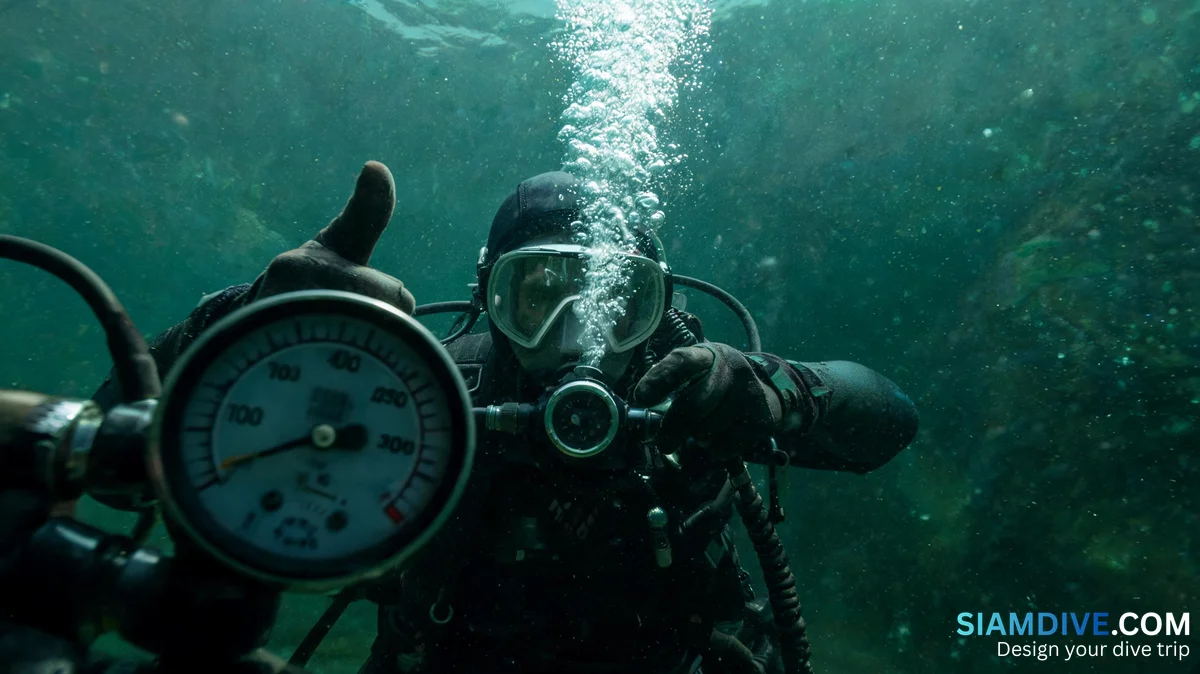
- How do you recall divers still underwater? — Tank banging, a recall horn, or a specific signal pattern. A diver at 18 metres has no idea the sky has turned black and cannot hear the thunder.
An operator who answers all seven without hesitation has planned for this. An operator who pauses on the first question has not. Both responses are useful information — they tell you whether the boat has a weather protocol or whether you need to be your own.