The Propeller Is 3 Metres Behind the Ladder — Still Spinning
13 พฤษภาคม 2569
The propeller is 3 metres behind the ladder and spinning. Most Thai dive briefings never mention it. Eight red flags for your next boat dive.
Three metres. That is the distance between the bottom rung of a standard Thai dive boat ladder and the outboard propeller behind it. On most day-trip boats running out of Khao Lak, Phuket, and Koh Tao, that propeller is spinning while you climb.
The engine stays on. The crew keeps the boat steady against the current. And the briefing — if it mentions propellers at all — gets through it in one sentence: stay away from the back of the boat.
One sentence, carrying the weight of everything that follows.
Why the Engine Stays On
Training agencies teach a clean sequence: engine off, propeller stopped, divers board. DAN's safe boating guidelines state it plainly — the engine should be off and the propeller still before anyone boards or disembarks.
Thai operators know the protocol. Most of them skip it, for a reason that makes operational sense: current.
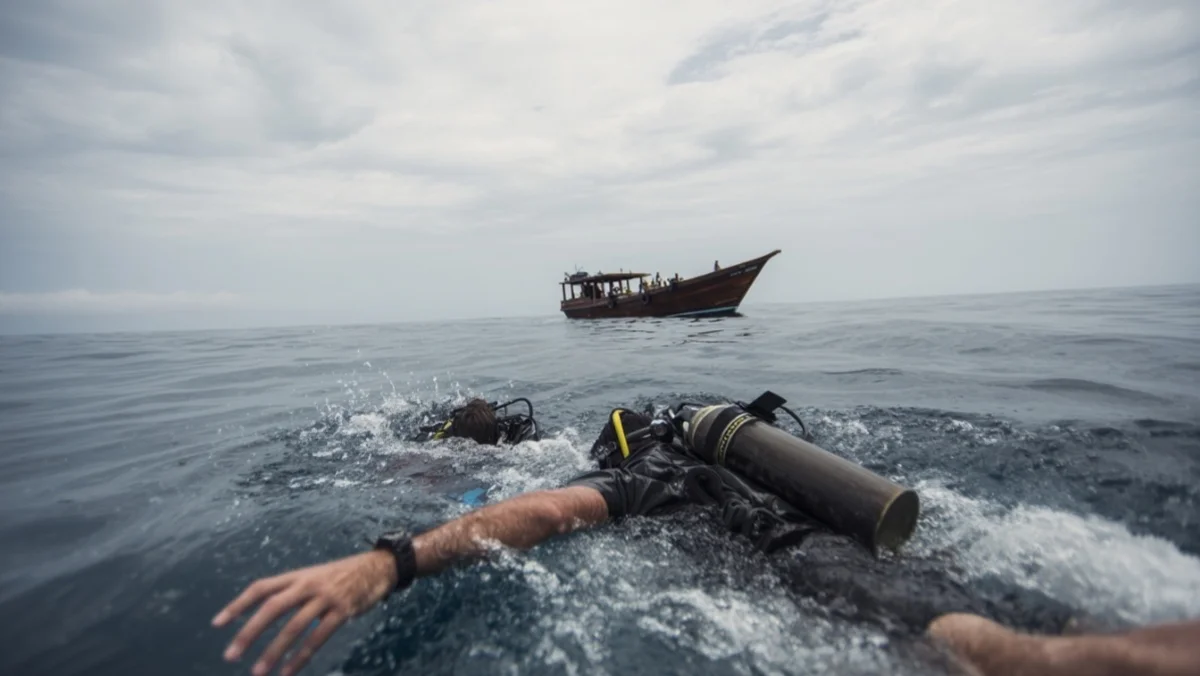
At sites like Richelieu Rock, Koh Bon Pinnacle, and Hin Daeng, currents run one to three knots on an average day. Anchoring is often impossible — the bottom is too deep, the reef too fragile, or the mooring line is already claimed. So the captain holds station with the engines, nudging throttle to keep the stern close to where divers surface. This is a live-boat pickup, and it is standard practice across most of Thailand's Andaman and Gulf dive operations.
The problem is geometry. On a typical Thai day-trip boat — fibreglass hull, twin outboard engines — the propellers sit directly behind and below the swim platform. When the captain idles forward to hold position, those blades spin at several hundred RPM inside a jet of thrust wash that a swimmer at water level cannot see and may not feel until contact.
On smaller longtail boats used for shore trips, the exposure is worse. A longtail mounts its propeller on an exposed driveshaft extended by several metres of bare metal rod — no gearbox, no housing, no shroud. There is nowhere to bolt a guard, and nothing between the swimmer and the blade but water.
169 Strikes, 30 Deaths, and a 93% Reporting Gap
169 propeller strikes in 2024. Thirty dead, 158 injured — up from 145 strikes and 23 deaths in 2023, according to the U.S. Coast Guard's annual report. Those numbers come from a country where reporting is mandatory. Research cited in DAN's literature estimates that up to 93 percent of non-fatal, non-hospitalized propeller injuries are never reported at all.
Thailand does not publish equivalent data. What surfaces instead are individual cases, each one a compressed lesson in physics and inattention.
In January 2025, a 29-year-old Swedish swimmer near Koh Talu was pulled under a boat and caught in the propeller. Emergency surgery closed the wounds with 150 stitches. He lost both sensation and mobility in his arm. In November 2024, a 15-year-old snorkeler from Singapore was killed by a propeller strike in the Maldives. Neither was a diver. Both were in the water near a boat whose engine was running.
On May 7, 2026 — five days before this article was written — a 64-year-old diver died after being struck by a boat propeller off Bimini in the Bahamas. The group had been diving from a sport-fishing vessel. The pattern holds: a running engine, a person in the water, and a distance that felt safe until it wasn't.
Before the Briefing Ends — Three Red Flags
Red flag 1: The briefing skips the propeller. Current direction, maximum depth, hand signals, buddy pairs — and nothing about where the propeller sits or whether the engine stays on during pickup. If the guide skips this, ask directly: will the engine be running when we re-board? Where is the propeller relative to the ladder? A competent guide answers without hesitating.
Red flag 2: No designated pickup point. On a live-boat pickup, the captain should brief where divers will surface, which side of the boat to approach, and where the propeller sits relative to that approach path. If none of this is covered, the plan is improvised — and improvised plans near spinning machinery are how incidents begin.
Red flag 3: No tagline. A tagline — sometimes called a trail line or current line — is a rope trailed from the boat that drifting divers can grab before swimming toward the ladder. In current, it is the single most effective piece of equipment between a diver and the propeller wash. No tagline means no controlled boarding sequence, which means every diver invents their own approach angle. Some of those angles run through the prop wash.
From Safety Stop to Swim Platform — Three More
Red flag 4: You surface without deploying an SMB. A surface marker buoy tells the captain exactly where you are before you break the surface. Without one, the boat may motor toward you for pickup — engine running, propeller spinning — while you are still at the surface trying to orient. Deploy your delayed SMB from the safety stop so the boat can position itself before you arrive.
Red flag 5: You surface and cannot see the hull. Current may have carried you past the pickup zone. If the boat is not within sight, resist the urge to swim toward engine noise. Stay put, keep your SMB inflated, and wait. The most dangerous geometry is a diver swimming toward a boat that is simultaneously motoring toward the diver — two closing vectors, zero visibility on the propeller.
Red flag 6: You surface behind the stern. The prop wash flows behind and beneath the transom. If current or wind has pushed you past the boat's stern, do not swim along the hull toward the ladder. Signal the crew — whistle, SMB, raised arm — and wait for the boat to reposition. Or swim wide and approach from the beam. The extra two minutes are cheap insurance.
The Ladder — Two Final Red Flags
Red flag 7: The crew waves you in without confirming the prop is clear. On well-run Thai boats, a designated crew member stands at the transom and confirms that the propeller is disengaged — hand raised, verbal call of prop clear, or pointing at the kill switch — before beckoning divers toward the ladder. No confirmation, no approach. If the captain runs engines for station-keeping and the crew simply waves, wait until you see that explicit signal.
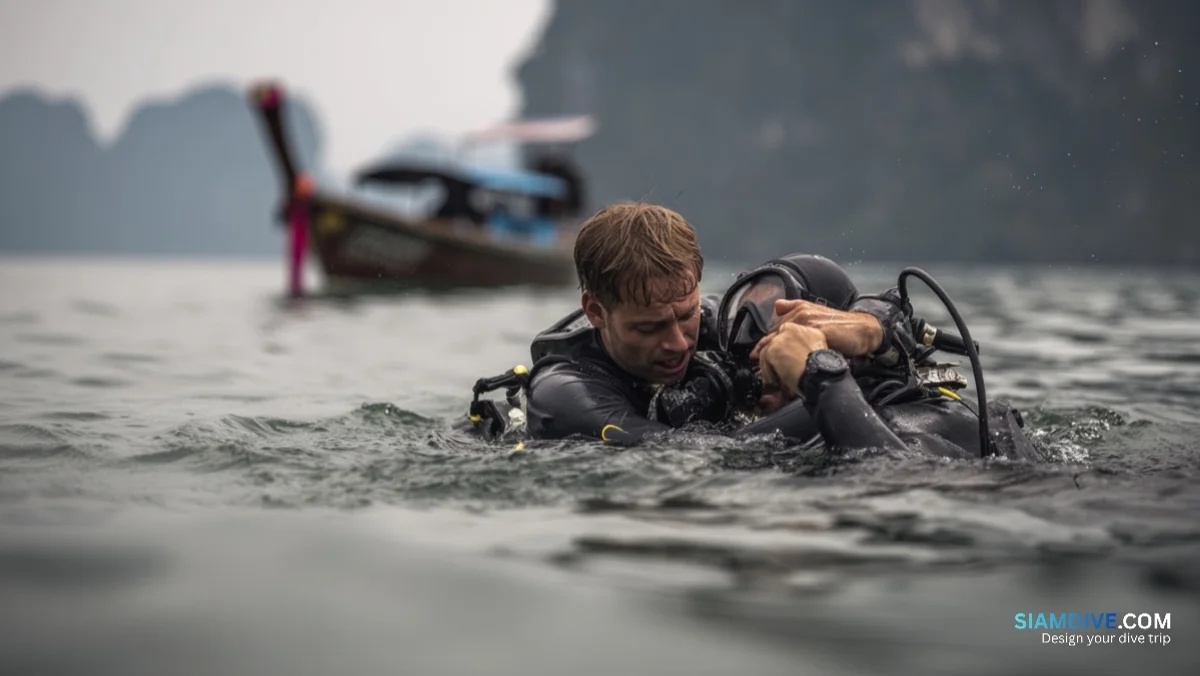
Red flag 8: Multiple divers rush the ladder at once. A crowded ladder means bodies in the water at propeller depth while others climb. The safe sequence is one diver on the ladder at a time, fins removed and handed up, BCD partially inflated for buoyancy while waiting. If there is no visible queue — no numbered turns, no crew member directing traffic — position yourself away from the stern and let the crowd thin. Patience at the ladder is not politeness. It is the same category of risk management as every other safety stop you take seriously.
Prop Guards — Half a Solution
Propeller guards — steel or aluminium cages bolted around the blades — exist, and DAN Europe has run a public campaign encouraging operators to install them. The evidence, however, is split down the middle.
A 2024 Korean study surveyed guard regulations across multiple countries and found adoption uneven, enforcement inconsistent. A guarded propeller tends to push a body rather than slice it, which reduces injury severity. But guards alter thrust efficiency. A 2025 hydrodynamic study focused on Thai long-tail boat propellers found that guards cost enough thrust that captains compensate with higher RPM — partially offsetting the safety gain with more powerful wash.
Long-tail boats face a harder problem. The propeller mounts on a bare shaft extended by several metres of exposed metal rod — no housing, no gearbox, no surface to attach a guard. On a longtail, the only protection is distance and awareness.
Thailand's 2025 diving regulations, which took effect in April of that year, introduced mandatory dive supervisor ratios — one supervisor per four divers on deep dives, one per 20 snorkelers. Those rules address who watches divers underwater. They say nothing about what happens when those divers surface next to a running engine. Propeller protocols remain conspicuously absent from the new framework.
Eight Questions for Tomorrow's Briefing
These take under two minutes. The answers tell you whether the operator has thought about propeller safety or is counting on the same three metres of luck that have worked so far.
- Will the engine run during pickup? — Expected: yes, for current holding. Follow-up: where is the propeller relative to the ladder?
- Which side do I approach? — Expected: upwind or up-current side, away from the stern.
- Is there a tagline? — Expected: yes, deployed before divers surface.
- Should I deploy an SMB? — Expected: yes, from your safety stop.
- What is the boarding sequence? — Expected: one diver at a time, fins off, crew-directed.
- Does someone watch the stern during boarding? — Expected: yes, a designated crew member confirms prop is clear.
- Is there a prop guard? — Ideal answer: yes. If no, the previous five answers matter more.
- What if I surface behind the boat? — Expected: stay put, signal, wait for the boat to reposition.
A guide who answers all eight without blinking runs a tighter operation than most. A guide who looks puzzled by question three is telling you something worth hearing before you roll backward off the gunwale.
That line cutter clipped to your BCD and that tank with the current hydro stamp — they matter. But neither will help if you surface into a prop wash you did not know was there. The most important piece of safety equipment for re-boarding a Thai dive boat is information: knowing the engine is on, knowing where the propeller sits, and knowing the plan for keeping you clear of it.