Incense, Rebels and a Bone Relic: Wat Chalong on a Rest Day
4 พฤษภาคม 2569
Phuket's most sacred temple sits ten minutes from the dive boats at Chalong Pier. Inside a 60-metre pagoda, a bone fragment of the Buddha waits beside the memory of a monk who faced down a rebellion.
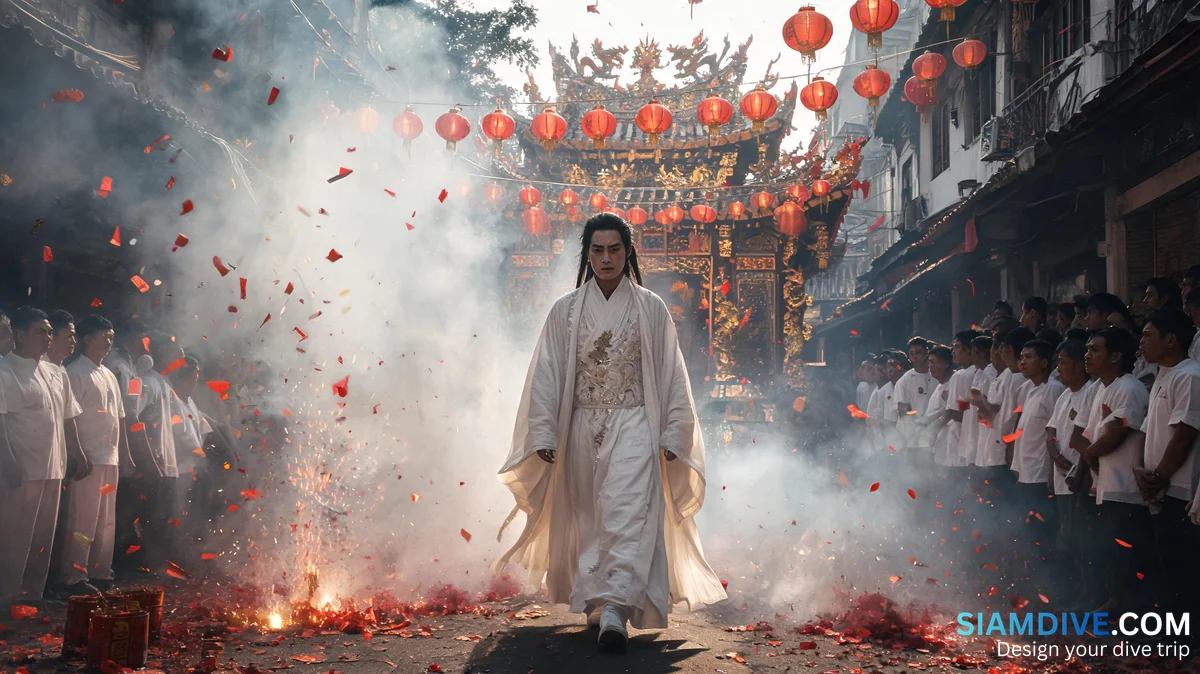
The incense hits before the architecture does. Step through the eastern gate of Wat Chaiyathararam — the temple everyone in Phuket simply calls Wat Chalong — and a curtain of sandalwood smoke folds around you, thick enough to taste. Ahead, a 60-metre pagoda punches through the canopy of rain trees, its gold-leaf surface catching the morning light like a second sun. Somewhere behind the ordination hall, a string of firecrackers detonates: someone's prayer has been answered.
Ten Minutes from the Dive Boats
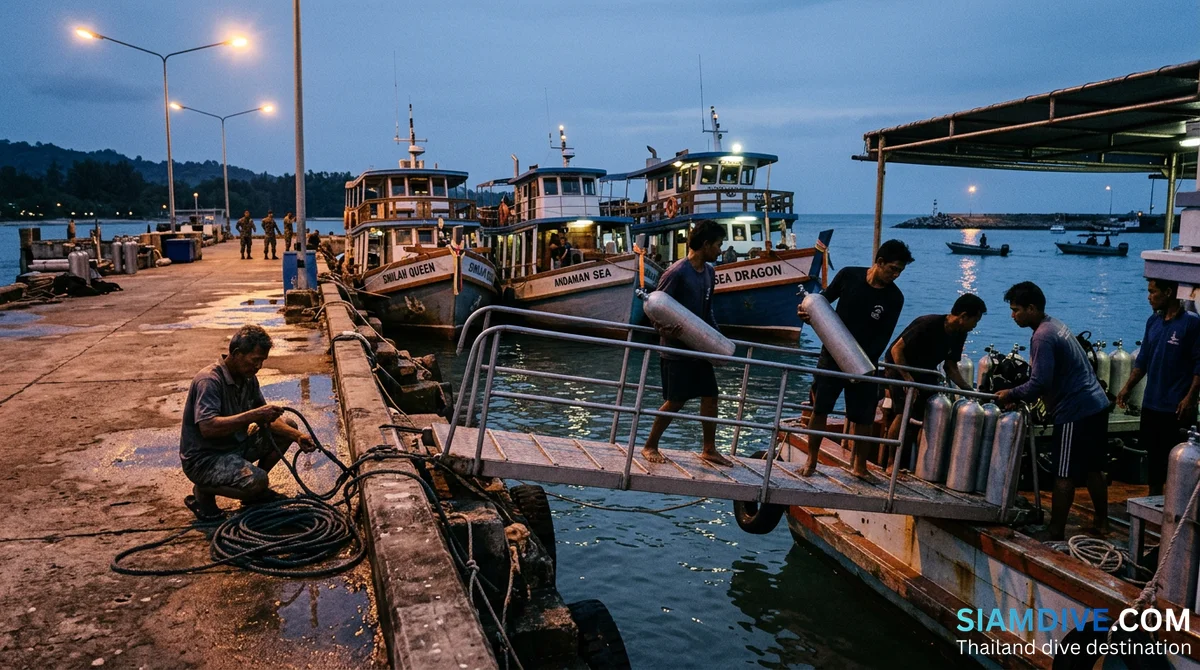
Chalong Pier is where most Phuket dive trips begin. Longtails and speedboats shuttle divers south to Racha Yai, Shark Point and the Phi Phi walls every morning before seven. What few visitors realise is that Phuket's most important Buddhist temple sits barely three kilometres northeast of that same pier — a ten-minute tuk-tuk ride that costs less than a bottle of sunscreen.
That proximity makes Wat Chalong a natural fit for the gaps in a dive itinerary. The temple opens at seven, well before the afternoon heat clamps down. A rest day between multi-dive days, a pre-flight 24-hour surface interval, the morning after a liveaboard return — any of these leave a window wide enough for a visit that takes roughly 90 minutes at a comfortable pace.
A Monk, a Rebellion and Blessed Headbands
The story that made Wat Chalong famous across Thailand begins with tin. By the 1870s, Phuket's economy ran almost entirely on tin mining, and the workforce was overwhelmingly Chinese. When global tin prices collapsed in the mid-1870s, mine owners — many of whom also led local Chinese secret societies called Angyee — could no longer pay their workers. According to an account published by The Phuket News, the resulting unrest exploded in 1876 into a full-scale uprising. Armed groups of miners attacked villages across the island.
Terrified locals fled to Wat Chalong, where the abbot, Luang Pho Chaem, refused to abandon his monastery. According to Wikipedia's account of Luang Pho Chaem, villagers urged him to escape, but he stayed. His disciples gathered around him, and he blessed cotton headbands — pha prachiat — for the fighters, turning the temple into a rallying point. The makeshift militia held off the rebels long enough for reinforcements to arrive from Bangkok.
King Rama V later bestowed on Luang Pho Chaem the royal title Phra Kru Wisit Wongsacharn. Today, life-size statues of both Luang Pho Chaem and his fellow monk Luang Pho Chuang sit in the old sermon hall, draped in gold leaf applied by generations of devotees. Locals still press squares of gold onto the figures, a gesture believed to bring protection and good fortune.
The Grand Pagoda and the Buddha's Bone
The structure that dominates the skyline is the Phra Mahathat Chedi, a three-storey pagoda completed in 2001 after a decade of construction. At 60 metres, it is visible from much of southern Phuket. The architecture blends southern, central and northeastern Thai styles — an unusual fusion that reflects both the island's multicultural history and the ambition of the project.
The first and second floors hold rows of Buddha images arranged in the seven postures corresponding to the seven days of the week. Murals on the interior walls depict scenes from the Jataka tales — stories of the Buddha's previous lives — rendered in rich pigments that glow under the diffused light from high windows.
The top level houses the relic. In 1999, Sri Lanka presented a bone fragment of the Buddha — a Phra Borom Sareerikatat — to King Rama IX on the occasion of his 72nd birthday. The relic was subsequently installed inside a glass reliquary at the summit of the chedi. Visitors can climb to the third floor, where the air is cooler and the views extend across Chalong Bay to the Andaman Sea.
Firecrackers, Fortune Sticks and Everyday Devotion
Wat Chalong is not a museum. It is a working temple, and the rituals happening around visitors are genuine.
The firecracker tradition is the loudest. When Thai Buddhists believe a prayer has been granted, they return to the temple and light firecrackers as an expression of gratitude. As Phuket 101 explains, the louder the bang, the stronger the thanks — big firecrackers for big answered prayers. A vendor near the brick kiln sells strings of them, and a temple attendant helps with lighting.
Quieter but equally absorbing is the fortune-telling ritual known as seam si (เซียมซี). Devotees shake a bamboo cylinder until a single numbered stick falls out. The number corresponds to a paper fortune collected from a nearby rack — a tradition with roots in Chinese divination that has been woven into Thai Buddhist practice for centuries.
What to Know Before You Go
- Opening hours: 7:00 AM – 5:00 PM daily
- Entrance fee: Free (donations appreciated)
- Distance from Chalong Pier: ~3 km / 10 minutes by car or tuk-tuk
- Dress code: Shoulders and knees covered. Sarongs available to borrow at the entrance. Shoes removed before entering buildings.
- Time needed: 60–90 minutes for a thorough visit
- Best time of day: Early morning (7–9 AM) for cooler temperatures and fewer visitors
Fitting It into a Dive Trip
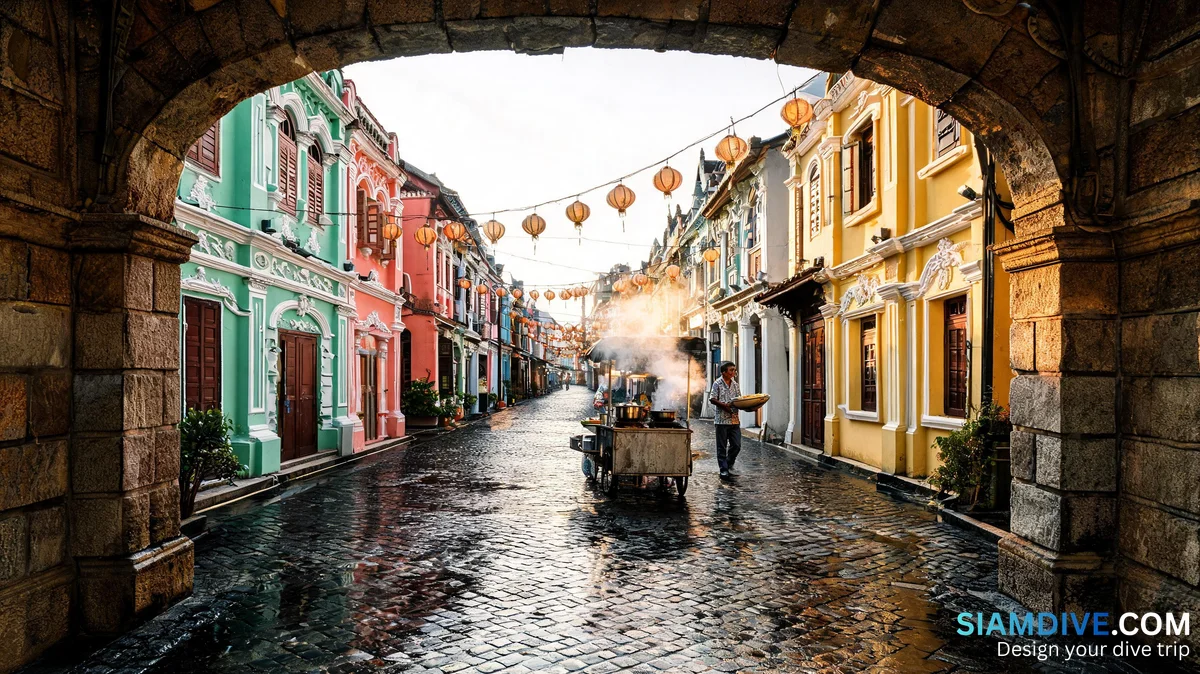
The most practical window is a rest day or the mandatory 18–24 hour pre-flight surface interval. If the last dive ends by noon, a late-afternoon visit catches the pagoda in golden light and avoids the midday heat entirely. Combine it with lunch in Phuket Old Town — the 50-baht Michelin noodles in the Tin Quarter are a 25-minute drive north — and the rest day writes itself.
For divers based at Kata or Karon, Wat Chalong is a 15-minute drive south. For those staying near Patong, it is roughly 30 minutes. Either way, the temple is closer than most visitors assume. Phuket is a compact island, and the southern end — where the dive boats leave and the best reefs like Racha Yai's 94-species reef sit offshore — also happens to be where the island's spiritual heart beats.
Beyond the Temple Walls
The compound extends well beyond the pagoda. Wandering the grounds reveals subsidiary prayer halls, a bell tower, and dense tropical landscaping that muffles the traffic noise from Route 4021. Frangipani and bougainvillea line the walkways. Stray dogs doze under the bodhi trees in a scene that could belong to any Thai temple — except for the scale of the chedi towering above it all.
Wat Chalong does not require a deep knowledge of Buddhism to appreciate. The architecture is extraordinary. The history is vivid. The rituals are alive. And for divers who spend their mornings descending into blue water, there is something grounding about ascending a golden staircase instead — climbing toward a fragment of bone that has been venerated for more than two thousand years, while the Andaman glitters on the horizon behind you.