6 Milliseconds: How Frogfish Catch What They Cannot Chase
29 เมษายน 2569
Frogfish strike faster than any reef predator yet never swim after prey. The biology behind the Gulf of Thailand's best-camouflaged ambush hunter.
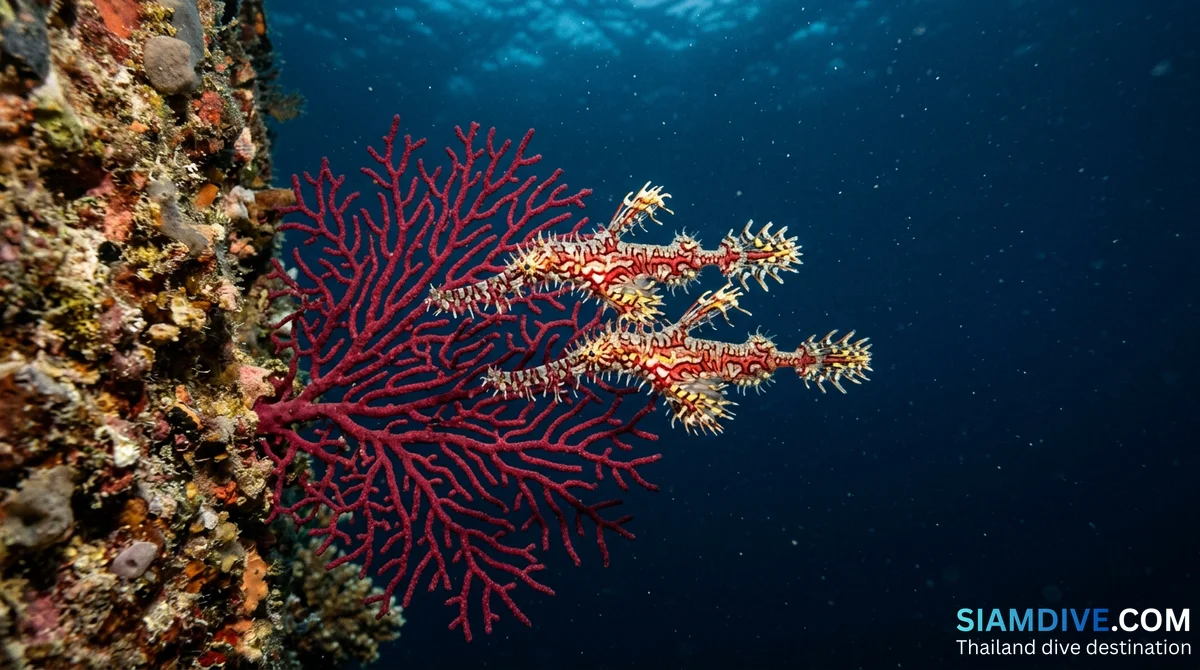
A thumbnail-sized lump on a mustard-yellow sponge blinks — one eye, then the other — and nothing else moves. For divers sweeping a torch beam across White Rock on a Koh Tao night dive, this is the moment that separates a forgettable log entry from a story worth retelling. The lump is a frogfish, a member of the family Antennariidae, and it has been sitting in exactly this position for days, possibly weeks, waiting for something small and curious to drift a fraction too close.
A Mouth Built for Speed, Not for Chasing
Most reef predators rely on some version of pursuit. Barracuda accelerate. Trevally wheel. Moray eels lunge from crevices with a second set of pharyngeal jaws. Frogfish do none of this. Their pectoral fins have evolved into stubby, arm-like limbs better suited for crawling across substrate than for open-water swimming. What they own instead is the fastest known feeding strike of any vertebrate in the ocean.
High-speed camera studies have clocked that strike at roughly 6 milliseconds. In that sliver of time — shorter than the duration of a single camera-flash burst — the frogfish's jaws snap open and its oral cavity expands to as much as 12 times its resting volume. The sudden expansion creates a vacuum powerful enough to pull the prey, and the water surrounding it, straight into the mouth before the victim registers danger. Slow-motion footage is the only way to see what actually happens; at real speed, the prey simply vanishes.
Rather than chasing dinner across the reef, the frogfish brings dinner to itself. And the tool it uses sits right between its eyes.
The Fishing Rod Between Its Eyes
Every frogfish carries a modified first dorsal spine called the illicium — a thin, flexible rod that extends forward from the top of the head. At its tip sits the esca, a fleshy lure whose shape differs from species to species. In some, the esca mimics a tiny worm. In others, it resembles a juvenile fish complete with eyespots and translucent fin-like extensions.
The technique looks remarkably like fly fishing. The frogfish flicks the illicium forward, bouncing and twitching the esca in patterns that mimic the movement of live prey. Damselfish, blennies, and small crustaceans approach to investigate — and the 6-millisecond vacuum does the rest. Some species are so committed to the strategy that if the esca is bitten off by an over-eager target, they regenerate it over several weeks.
Marine biologists use esca morphology as one of the primary identification keys, alongside body size, rod length, and skin texture. In Thai waters, this matters: the difference between a painted frogfish and a giant frogfish often comes down to esca shape rather than colour, since both can shift their pigmentation to look nearly identical sitting on the same sponge.
Camouflage That Rewrites Itself
Colour change in frogfish is not instantaneous — that trick belongs to cuttlefish, which fire chromatophores in fractions of a second. Frogfish take days to weeks. But the result is arguably more thorough. A frogfish settling onto a purple tube sponge will gradually shift its entire body pigmentation to match, often picking up texture cues as well. The skin is covered with bifurcated spinules — tiny, branched projections — that can resemble algae filaments, sponge pores, or coral polyps depending on the species and the surface beneath.
The commitment to stillness is total. A well-camouflaged frogfish does not flinch when a torch beam passes over it, does not shift when surge pushes water across the reef, does not move when a cleaner shrimp walks across its face. This is what makes them so difficult to spot during the day and, paradoxically, why night dives improve the odds. Under torchlight, the colour contrast between frogfish skin and substrate often sharpens — particularly when the beam hits at an oblique angle, throwing shadows that daylight never casts.
Which Frogfish Live in Thai Waters?
The Gulf of Thailand and the Andaman Sea host several Antennariidae species, though sighting records remain patchy. An animal that looks like a sponge does not show up reliably on transect counts, and many frogfish encounters go unreported by recreational divers who never realise what they swam past.
What has been confirmed:
- Painted frogfish (Antennarius pictus) — the most commonly sighted species in the Gulf, found on reef rubble and artificial structures at 5–30 metres
- Giant frogfish (Antennarius commerson) — recorded around Phuket and the Andaman coast, reaching up to 30 cm, often perched on barrel sponges at 10–25 metres
- Clown frogfish (Antennarius maculatus) — documented in Similan waters, typically under 15 cm, recognisable by white-edged dark spots when not fully colour-matched
- Brackish-water frogfish (Antennarius biocellatus) — a rare find photographed at Sail Rock in the Gulf, one of the few species tolerating lower-salinity water near river outflows
- Sargassumfish (Histrio histrio) — a pelagic oddity recorded at Koh Tao, living among floating Sargassum weed rather than on the reef itself
A scientific survey published in the journal Check List confirmed for the first time that genera Antennatus and Histrio occur at Koh Tao, expanding the known distribution of Antennariidae in the Gulf. Since then, dive guides on the island have maintained informal sighting logs — particularly for the painted frogfish, which appears to hold stable populations at several shallow sites year-round.
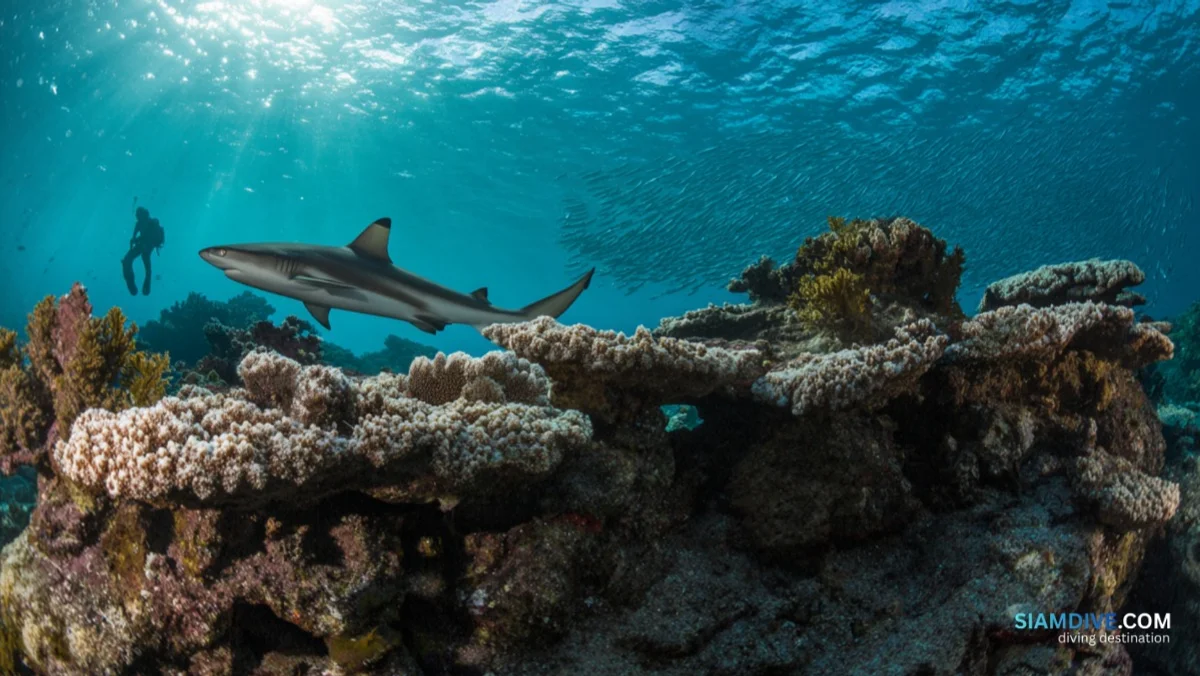
The Gulf supports a broader range of unusual marine life than most visitors expect, from the blacktip reef sharks rebuilding numbers at Phi Phi to the banded sea kraits carrying lethal venom yet posing zero recorded threat to divers.
Night Dives and the Torchlight Advantage
Frogfish are not nocturnal — they ambush prey around the clock. But night dives tilt the odds in the diver's favour for three reasons.
First, the small reef fish that frogfish target become sluggish after dark. Damselfish tuck into crevices, blennies go still. A frogfish is more likely to be actively working its lure at night, and a twitching illicium under torchlight is far easier to spot than a motionless blob on a sponge.
Second, a dive torch creates sharper colour contrast than ambient sunlight. Frogfish camouflage is optimised for the broad, diffused spectrum of daytime reef light. Under the focused, warm beam of a torch — particularly when held at a low angle — subtle mismatches between animal and substrate become visible. Texture differences pop. The glint of an eye catches.
Third, fewer divers on a night dive means less fin-wash, less suspended silt, and a calmer reef. Frogfish that press into crevices during busy day-dive traffic sometimes sit more exposed after the boats have gone quiet.
The Gulf's best-known night dive sites for macro hunters:
- White Rock, Koh Tao — shallow reef at 6–20 m with dense sponge coverage, a textbook frogfish habitat
- Twins, Koh Tao — boulder and rubble zones between 8–18 m where painted frogfish have been repeatedly logged by local guides
- Sail Rock — a deeper site at 10–35 m between Koh Tao and Koh Phangan, where the rare brackish-water frogfish was photographed
The common mistake is swimming too fast. Frogfish reward a pace of roughly two metres per minute — slower than most divers are comfortable with, but enough to cover a meaningful section of reef in a 50-minute dive. After surfacing from a slow frogfish hunt, most Koh Tao night divers agree that an 80-baht pad thai on Sairee Beach is the only fitting way to end the evening.
April on the Gulf — Prime Conditions for the Search
March through May marks the Gulf of Thailand's calmest, clearest window. Koh Tao dive operators are logging visibility between 20 and 30 metres in April 2026, with water temperatures holding steady at 28–30 °C — conditions that make night dives comfortable in a 3 mm wetsuit and macro photography viable without fighting surge or particulate haze.
This is also whale shark season at Chumphon Pinnacle and Southwest Pinnacle, which means most eyes scan the blue water column. Frogfish hunters should look the opposite direction: the shallow, sponge-encrusted margins of White Rock and Twins, where foot traffic drops off and the substrate thickens with potential hiding spots. While everyone else watches for a 6-metre filter feeder, the 6-centimetre ambush predator sits three metres below the surface, twitching its lure in the dark.
Night dive prices on Koh Tao typically run 1,200–1,800 THB for a single guided dive including torch rental, though rates shift with season and group size. Several operators now offer dedicated macro night dives, and a growing number run UV fluoro night dives — a technique borrowed from coral research — that can make certain frogfish species fluoresce faintly under ultraviolet torchlight, revealing outlines invisible under standard white light.
What the Camera Sees
Frogfish rank among the most-photographed macro subjects on any tropical reef, and their cooperation makes them ideal for photographers at every skill level. They sit still. They tolerate strobes. They rarely bolt.
The challenge is focus. A frogfish matched to a sponge fools a camera's autofocus as easily as it fools a damselfish. Manual focus — or a focus light aimed directly at the eye, the one feature that always reflects differently from the substrate — solves the problem quickly.
Practical notes for Gulf night dives with a camera:
- Lens choice — 60 mm or 100/105 mm macro; the shorter focal length gives more working distance in tight quarters around boulders
- Strobe angle — low and angled inward to cut backscatter from suspended particles in the water column
- Torch discipline — a constant beam on the frogfish for more than 30 seconds can trigger retraction into a crevice; pulse the light, or switch to a red filter for sustained observation
- The yawn shot — frogfish periodically gape their mouths wide to flush water across the gills, giving a rare view of the jaw mechanism at rest. Patient photographers who park themselves at a single specimen for 5–10 minutes often capture the shot that defines a trip
One behaviour worth waiting for: frogfish occasionally "walk" across the substrate using their pectoral and pelvic fins in an alternating gait that looks more amphibian than fish. The movement is slow and deliberate, and it offers a sequence of images that no other reef fish can match — a predator that literally strolls to its next ambush point.
Six milliseconds is too fast for any shutter. But the mouth gaping open at rest, the illicium extended mid-twitch, the eye locked on a passing blenny — those are the frames that make a frogfish portfolio. The animal does the hard part. The photographer just has to find it first.
Sources
- Wikipedia — Frogfish (Antennariidae) biology and feeding mechanics
- Check List — First records of Antennariidae genera at Koh Tao, Gulf of Thailand
- Britannica — Frogfish: anglerfish family, lure mechanism, camouflage
- Scientific Data — Chromosome-level genome of striated frogfish (Antennarius striatus)
- PADI — Diving in Koh Tao: conditions and marine life