90 Seconds to Act When Your Regulator Free-Flows at Depth
28 เมษายน 2569
A free-flowing regulator can drain your tank in under two minutes at 30 metres. Three practised steps turn that noise into a controlled ascent.
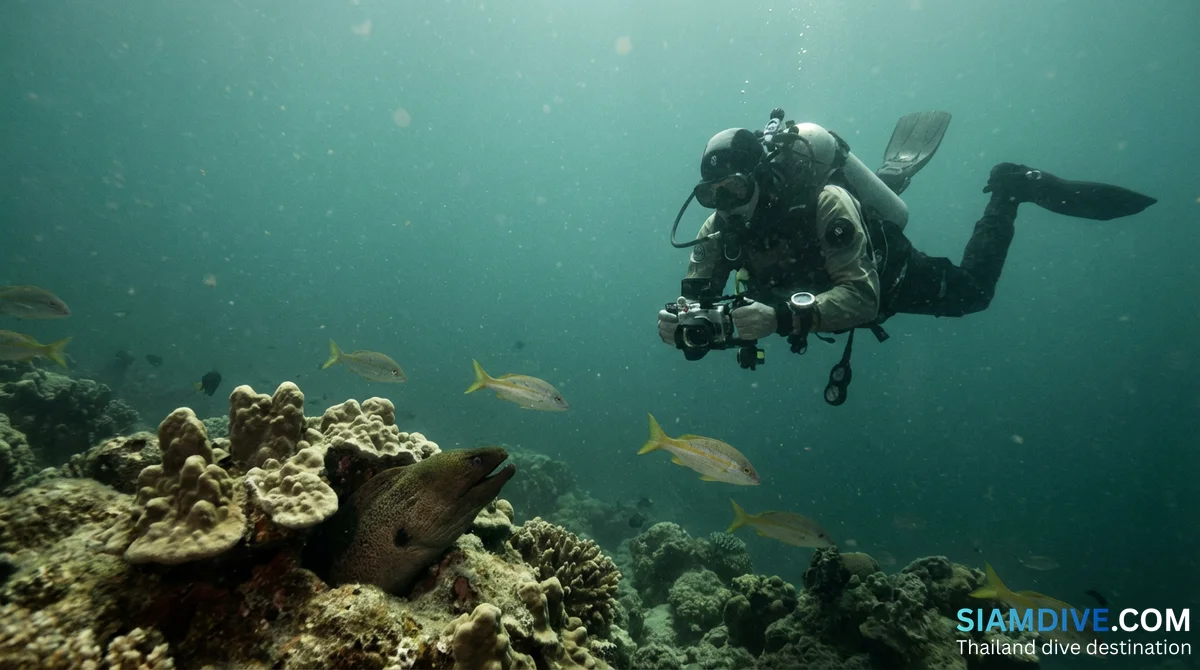
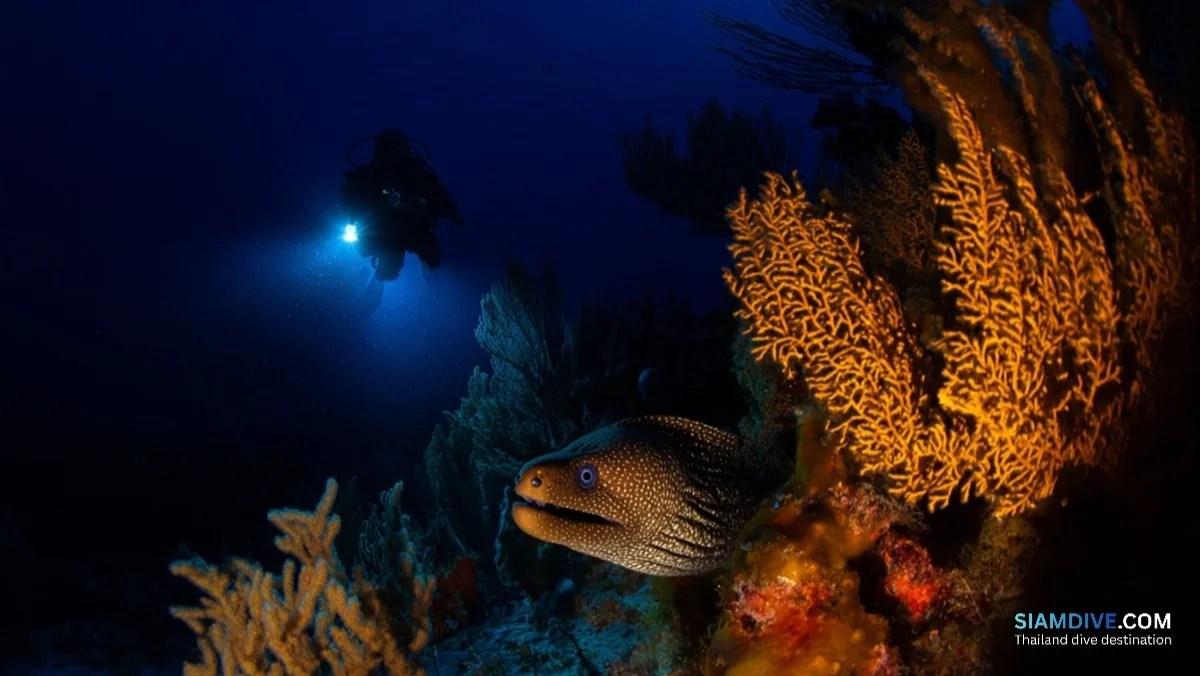
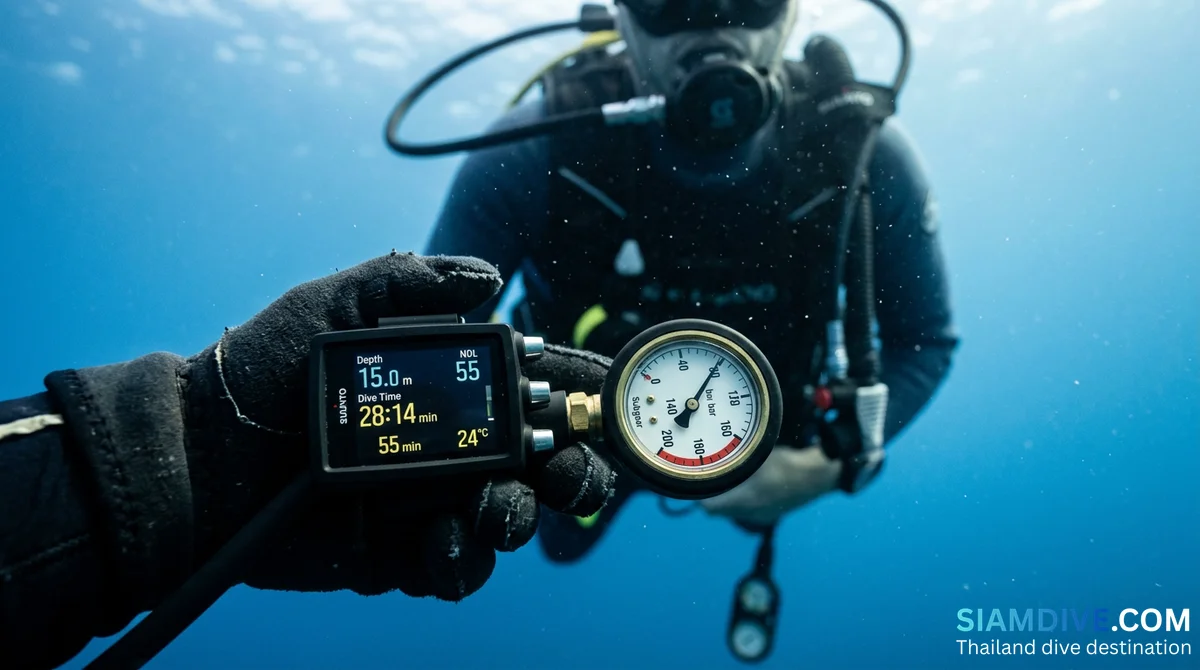
Thirty metres down on a reef wall, mid-breath, the second stage locks open. The sound is unmistakable — a violent, continuous rush of bubbles pouring from the mouthpiece, loud enough to drown out everything else on the dive. The needle on the pressure gauge starts falling in real time.
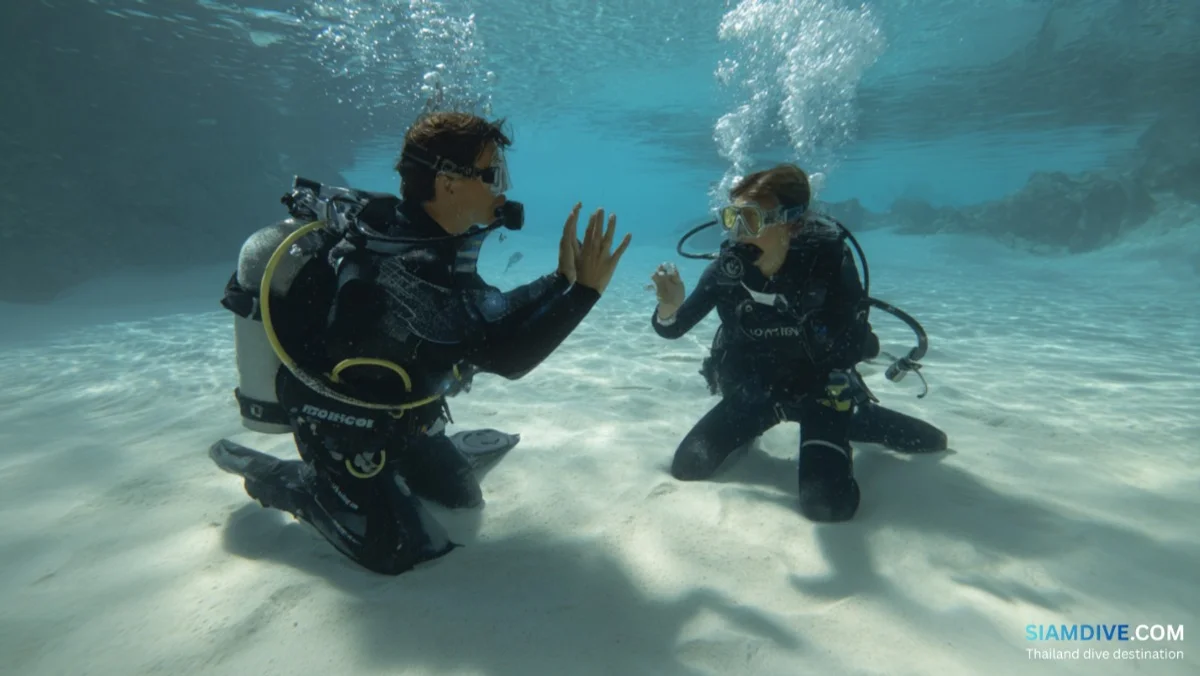
Most divers have practised this skill once, in waist-deep water, during Open Water certification. The drill lasted thirty seconds with an instructor at arm's length. At depth, with a real gauge dropping and current pushing, thirty seconds feels like three.
The good news: a free-flowing regulator is still delivering air. The bad news: it delivers all of it, whether the diver wants it or not. A standard aluminium 80-cubic-foot tank can bleed dry in under two minutes at 30 metres. What happens in the next ninety seconds — three specific actions, in order — determines whether the dive ends with a controlled ascent or an emergency.
The Noise That Means Your Reg Still Works
Every modern scuba regulator is designed to fail in one direction: open. Engineers call this a downstream failure — the second-stage valve gives way toward airflow rather than shutting it off. A regulator that fails upstream, cutting air supply entirely, would be far more dangerous. The hiss of a free-flow is the system working as intended, just not on the diver's schedule.
Several things trigger it. The most common cause is cold water — when ambient temperature drops below 10°C, moisture inside the first stage can freeze around the valve seat, forcing the intermediate-pressure chamber open. The EN 250:2014 standard exists for exactly this scenario: regulators carrying that certification have passed testing in 4°C water at a breathing rate of 62.5 litres per minute for five consecutive minutes without free-flowing.
Cold water is not the only culprit. An overdue service lets O-rings harden and valve seats wear, raising intermediate pressure until the second stage can no longer hold it back. A sharp knock to the purge button — common during entries or when clipping off gear — can unseat the diaphragm. And the venturi effect itself: once air starts flowing fast through the second stage, the low-pressure zone it creates inside the housing pulls the diaphragm inward, sustaining the flow even after the initial trigger disappears. Most second stages carry a venturi lever or switch — flipping it to the pre-dive position reduces the airstream's leverage on the diaphragm.
Thailand's tropical waters sit between 26°C and 30°C for most of the dive season, which makes freeze-induced free-flows rare. The risk here shifts to service neglect and IP creep — particularly in high-volume rental fleets where regulators may see four dives a day, six days a week, across a full October-to-May Similan season.
How Fast a Free-Flow Drains Your Tank
The maths are simple and unforgiving. A relaxed diver at the surface consumes air at roughly 15 to 20 litres per minute — the surface air consumption rate, or SAC. At 30 metres, ambient pressure hits 4 ATA, multiplying that consumption by four: 60 to 80 litres per minute just for normal breathing.
A free-flowing second stage does not breathe like a diver. It dumps gas at a rate governed by intermediate pressure and orifice size — commonly 200 to 400 litres per minute through a wide-open second stage at the surface. At depth, ambient pressure assists the flow rather than restricting it.
Put that against a standard aluminium tank — 80 cubic feet of gas, 11.1-litre water volume, 207-bar fill:
- Surface free-flow drain — roughly 2 to 3 minutes for a full AL80
- 30-metre free-flow drain — roughly 60 to 90 seconds for the same tank
Watch a free-flow from the outside and it looks like someone opened a fire hydrant — a solid column of bubbles roaring from the mouthpiece. Those numbers assume a full tank. Start the dive at 150 bar instead of 200, and the window tightens by a quarter. Begin a free-flow with 80 bar remaining — not unusual on a second dive of the day — and less than a minute of gas may be left at depth.
Two numbers worth carrying on every dive: time to drain, and bar remaining. The gauge tells one; the other comes from understanding the maths before the reg starts screaming.
Step One — Tilt and Sip
The instinct is to seal the mouthpiece tight and try to breathe normally. That instinct is wrong. A sealed mouthpiece on a free-flowing second stage forces a continuous blast of air into the airway — a fast track to lung over-expansion if the diver cannot exhale fast enough.
The correct technique, taught in every PADI and SSI Open Water course, takes about five seconds to execute:
- Break the seal. Keep the right side of the mouthpiece gripped between the teeth as normal. Let the left side pull away from the lips, creating a gap where water and air can escape freely.
- Tilt the head. Roll the head to the right so the open side of the mouthpiece faces slightly downward. Gravity and water pressure help clear water from the gap.
- Sip, do not inhale. Take short, deliberate breaths — sipping air from the stream of bubbles rushing past the mouth. The tongue acts as a dam, blocking water between sips.
The technique is not comfortable. Water enters the mouth. The flow feels wasteful and loud. None of that matters. Each sip delivers enough air to keep the diver conscious and thinking clearly while executing steps two and three.
The Open Water pool drill runs this exercise for thirty seconds. At depth, the goal is not to breathe from the free-flow indefinitely — it is to stay on it just long enough to transition to backup gas. Every second spent sipping is a second not spent panicking, and a second closer to the surface at a safe ascent rate.
Step Two — Get on Backup Gas
Sip breathing buys time. Backup gas buys the ascent. The transition should happen within fifteen to twenty seconds of starting the sip technique — long enough to stabilise breathing, short enough to preserve air.
First option: the diver's own octopus or alternate air source. Most recreational setups carry a second stage on a longer hose, clipped or tucked into the chest area. Reaching it while sip-breathing from a screaming primary takes practice, which is why pre-dive buddy checks matter — knowing where the alternate sits, confirming it delivers air, and rehearsing the grab-and-switch before every dive.
If the free-flow is caused by a first-stage failure — elevated IP pushing too much air to both second stages — the diver's own octopus may also free-flow. This is the scenario that catches people off guard. When the first stage is the problem, both regulators on that tank are compromised.
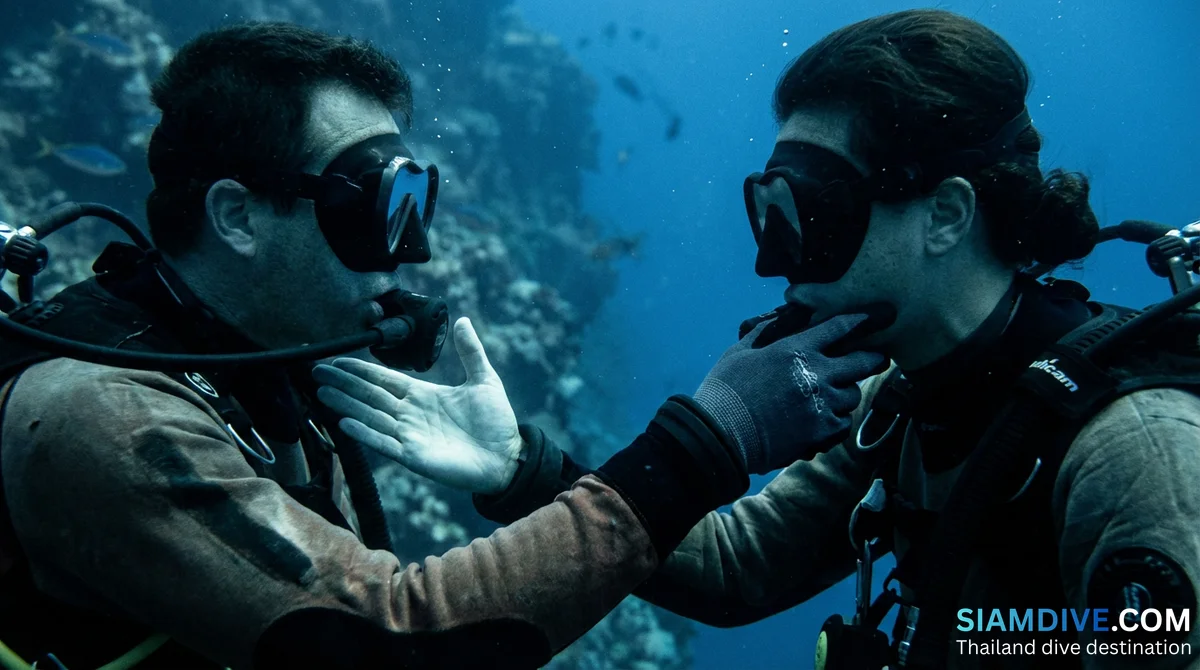
The fallback is buddy air. Signal the buddy with the standard out-of-air hand signal — flat hand slicing across the throat — secure their octopus, and establish a shared breathing position. The receiving diver holds the donated second stage; the donating diver maintains control of buoyancy for both.
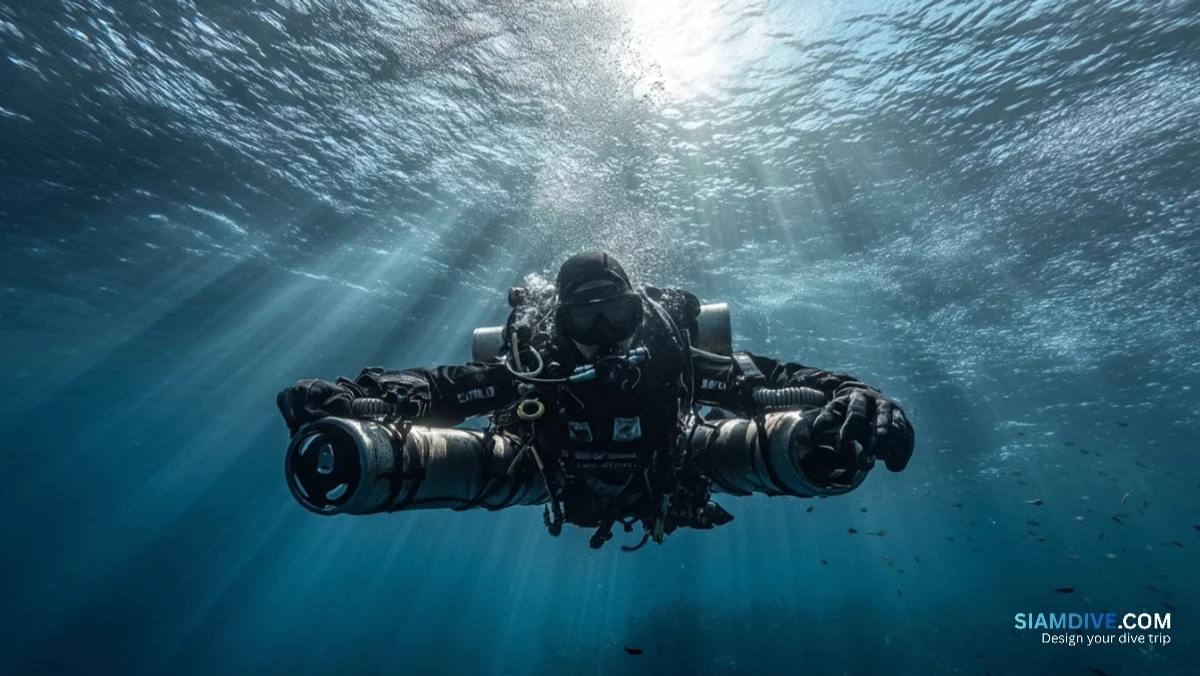
A third option exists for divers carrying a pony bottle or stage cylinder — an independent air supply that sidesteps the failed first stage entirely. For recreational day-boat diving in the Andaman Sea or the Gulf of Thailand, pony bottles are uncommon but appear more often among divers running deeper profiles at sites like Richelieu Rock or Hin Daeng.
Step Three — Climb Without Bolting
Here is where most free-flow incidents go sideways. The sound, the falling gauge, the taste of salt water — everything screams go up now. Going up is correct. Going up fast is not.
DAN's incident data flags uncontrolled ascents as one of the leading injury mechanisms linked to regulator free-flows. The free-flow itself rarely causes direct harm — it is the panicked bolt to the surface, skipping the safety stop, holding breath on the way up, that produces arterial gas embolism or decompression sickness.
The protocol for a controlled ascent after switching to backup gas:
- Establish buoyancy control. Vent the BCD. A diver who has just switched to buddy air tends to be head-up and slightly over-inflated from the stress response. Dump air from the shoulder valve and get horizontal.
- Ascend at 9 metres per minute or slower. Most dive computers alarm at 10 m/min. Follow the computer. If sharing air, the pair ascends together, matching pace, maintaining eye contact.
- Safety stop if gas allows. Three minutes at five metres. If the shared air supply reads above 50 bar, the stop is worth making. Below 50 bar — skip it. Running dry at five metres is worse than the marginal decompression benefit lost.
- Surface, inflate, signal. Orally inflate the BCD, signal the boat, and stay buoyant.
The entire sequence — from the first hiss of the free-flow to breaking the surface — should take four to six minutes from 30 metres. That is a long time when adrenaline is running. Rehearsing the steps before the dive, visualising the sequence, and running buddy-air drills in shallow water all compress that mental timeline.
When Both Regs Start Screaming
Most briefings never mention it, but both regulators on a buddy pair can fail on the same dive. One published DAN case runs exactly this way: one diver's primary began free-flowing during ascent. The buddy offered alternate air, and the pair started a shared ascent. Partway up, the buddy's own primary also began to free-flow — a coincidence of cold water and two regulators with overdue services. Neither diver carried a pony bottle.
They reached the surface with single-digit bar remaining in both tanks. No injuries — but only because both divers had drilled the sequence enough to execute it under compound stress.
Two lessons sit inside that case. First, if the conditions that trigger one free-flow are present — cold thermocline, high breathing rate, overdue service — they are often present for both divers. Rental regulators on the same day boat come from the same service batch. Thermoclines hit both divers at the same moment.
Second, the response changes when backup gas is itself compromised. Priority shifts from a managed ascent to a direct ascent — still controlled, still venting the BCD, still exhaling — but without a safety stop. A direct ascent without a stop is always preferable to running out of gas at depth.
Keeping Your Regulator Quiet
Prevention lives in three places: the service log, the pre-dive check, and the dive plan.
Service intervals vary by manufacturer, but the principle is consistent — replace soft parts before they fail:
- Cressi — every 12 months or 100 dives, whichever comes first
- SCUBAPRO — every 24 months or 100 dives
- Atomic Aquatics — every 24 months or 300 dives (T3 model: 36 months)
For divers renting regulators — the majority of recreational visitors to Thailand — one question matters: ask the dive centre when the regulator was last serviced. A reputable operation answers without hesitation. Evasion is a red flag worth heeding before boarding the boat.
Pre-dive checks take thirty seconds and catch most free-flow triggers before they reach depth:
- Venturi lever to pre-dive position before turning on the tank
- Breathe from both second stages with the tank pressurised — listen for hissing between breaths
- Watch the SPG for a stable reading — a needle that creeps upward with both second stages sealed suggests rising IP
- Inspect hose connections for bubbles or weeping O-rings
Cold-water divers face an extra layer. EN 250:2014 certification marks regulators tested in 4°C water, but even certified models benefit from a few habits: avoid purging at the surface in cold air, keep the cylinder in a warm space until kit-up, and breathe steadily rather than in heavy gasps that accelerate cooling inside the first stage.
For Thailand, where water temperatures hold between 26°C and 30°C even through the deepest thermoclines at 30 metres, the freeze risk is negligible. The far more common culprit is a high-season rental regulator that has been breathed hard across hundreds of dives since its last service — IP creeping quietly upward until the second stage surrenders.