Promthep Cape at Sunset: Where Phuket's Land Runs Out
4 พฤษภาคม 2569
Phuket's southernmost headland draws two million sunset seekers a year, but the rocky point below the terrace still rewards anyone willing to scramble.
The last tour bus has emptied its passengers onto the upper terrace. Selfie sticks rise like periscopes above a sea of heads. A vendor hawks coconut ice cream from a cart wedged between the railing and a concrete bench. The scene could be any over-visited viewpoint in Southeast Asia — and for about ninety seconds, Promthep Cape looks like it has nothing left to offer except a parking lot and a photo op.
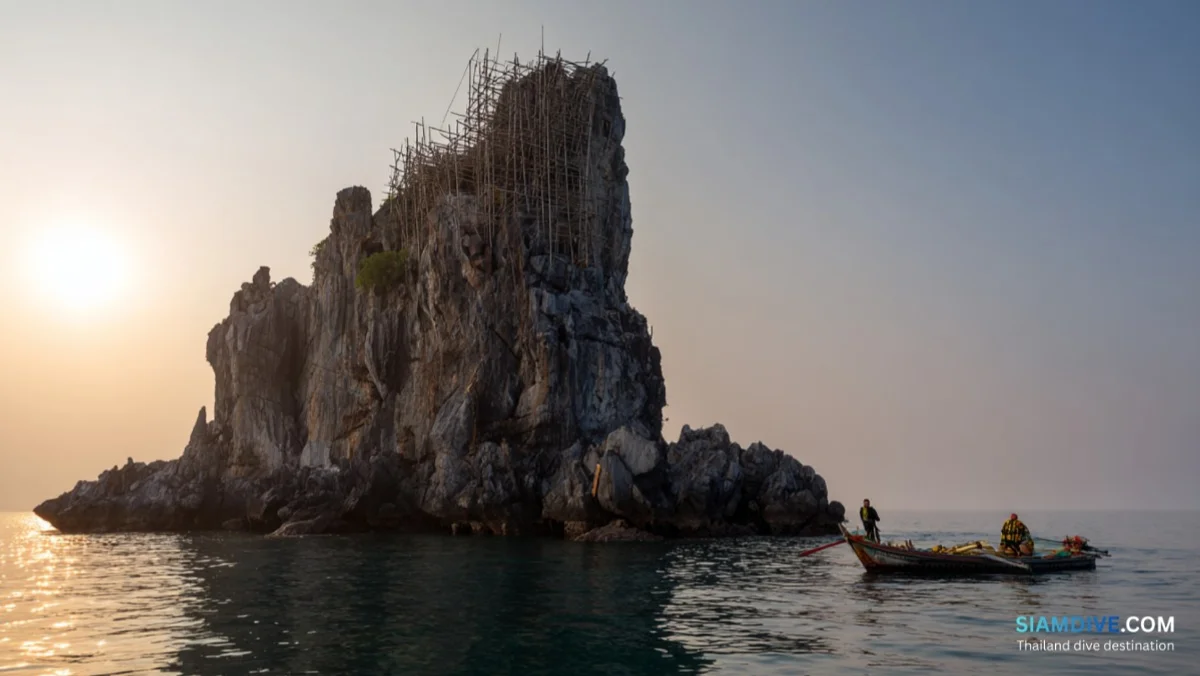
Then you slip past the souvenir stalls and follow the crumbling laterite path that drops toward the rocky point. The crowd noise fades first, replaced by wind. The paving ends. The Andaman Sea opens wide in every direction — not framed by a terrace railing but raw and immense, surging against dark stone fifty meters below your shoes. For a few minutes before the sun touches the horizon, Promthep Cape feels exactly the way it must have felt to the Malay sailors who used this headland as a navigation landmark centuries before anyone thought to pour concrete up here.
That tension — between postcard cliche and genuine awe — is what makes Phuket's southernmost tip worth the detour. Especially for divers, who already know these waters from below and rarely see them gilded from above.
A Cape Named for the Creator God
"Laem Phromthep" translates loosely as "Brahma's Cape" or "God's Cape." The Thai name pairs Phrom (พรหม), the Thai rendering of Brahma, the Hindu god of creation, with thep (เทพ), meaning divine being.
Before Phuket became synonymous with beach clubs and liveaboard departures, the cape served as a celestial reference point for maritime trade. Sailors navigating between the Malay Peninsula and the ports of the Indian Ocean would sight the jagged promontory rising from the Andaman Sea and know they had cleared the southern tip of Junk Ceylon — the old European name for Phuket island. The cape's latitude, roughly 7 degrees 45 minutes north, placed it at a critical juncture where the Andaman's monsoon currents shift direction, making accurate identification essential for ships carrying tin, spices, and textiles.
According to the Tourism Authority of Thailand, the cape also played a strategic role during World War II, when the Thai military used the elevated ground as an observation post to monitor naval movement in the strait between Phuket and the Phi Phi archipelago. Today the only uniformed personnel are parking attendants waving minivans into numbered slots, but the panoramic sight lines that made the headland tactically valuable are the same ones that now draw roughly two million visitors each year.
The Kanchanaphisek Lighthouse: A Jubilee Tower Above the Andaman
The white concrete tower visible from the road is the Kanchanaphisek Lighthouse, constructed in 1996 by the Royal Thai Navy and the people of Phuket to commemorate the Golden Jubilee — the fiftieth anniversary of King Bhumibol Adulyadej's accession to the throne. The Thai word Kanchanaphisek means "Golden Jubilee Celebration."
Its light flashes white once every nine seconds — 0.21 seconds of illumination followed by 8.79 seconds of darkness, a rhythm as steady as a resting heartbeat. The lantern sits 95 meters above mean sea level and is visible from 22 nautical miles, roughly 41 kilometers out at sea.
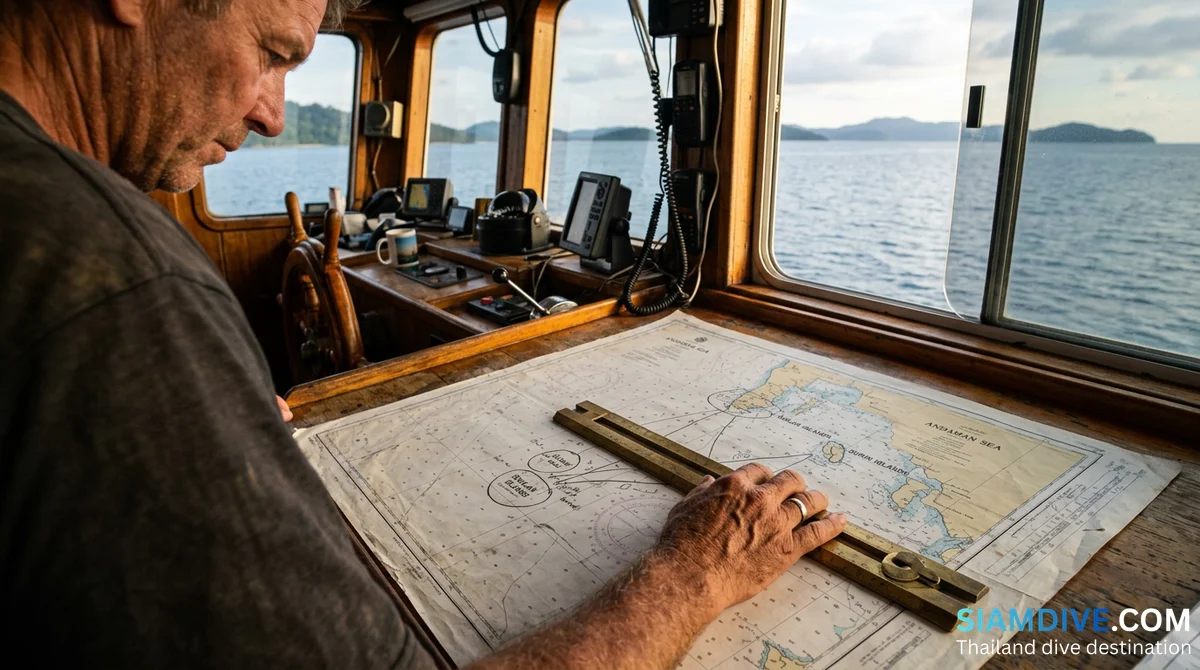
Inside, a small museum displays antique navigation charts, brass sextants, ship models tracing the evolution of vessels from Malay prahu to modern dive boats, and photographs documenting Phuket's maritime heritage. The museum keeps modest hours — 9:00 a.m. to 5:00 p.m. daily — and charges a token 20-baht admission, less than a dollar. It is worth the climb if only for the 360-degree view from the gallery: the emerald shallows over Koh Man island to the southeast, the long curve of Nai Harn Beach sweeping north to the west, and on clear days, the faint grey profile of Koh Phi Phi floating on the horizon like a half-remembered dream.
Elephants, Silk Ribbons, and a Shrine to Brahma
Before you reach the lighthouse steps, a detour to the left leads to the Brahma Elephant Shrine — a tiered platform crowded with hundreds of carved elephants ranging from thumb-sized wooden figurines to waist-high stone sculptures. Devotees leave them as offerings of gratitude and prayers for longevity, strength, and loyalty — qualities Thai tradition associates with the elephant, which also happens to be the traditional mount of Brahma himself.
The shrine is dedicated to Phra Phrom, the Thai representation of Brahma, whose four faces symbolize compassion, kindness, mercy, and impartiality — blessings radiating in every cardinal direction. Local belief holds that if you make a wish here and it comes true, you must return to place a new elephant at the shrine as a gesture of gratitude. The accumulation of figurines over the years, some weathered to grey, some still slick with fresh gold paint, tells a visual story of fulfilled promises stretching back decades.
Look also for the sugar palm trees (ton tan, ต้นตาล) that grow along the windward slope of the headland. Their slender trunks, rising twelve to fifteen meters before erupting into fan-shaped crowns, have become a visual signature of the cape, appearing in nearly every professional photograph of the place. A local superstition says that tying a seven-colored silk ribbon to a sugar palm at Promthep Cape will bring lasting love.
Chasing the Golden Hour: When to Arrive and Where to Stand
Sunset at Promthep Cape occurs between roughly 18:00 and 18:30 depending on the season, with the earliest sunsets around December 21 and the latest near June 21. The swing is modest — Phuket sits only eight degrees north of the equator — but the quality of light changes between the monsoon months (May through October, when afternoon clouds can steal the show) and the dry season (November through April, when clear skies deliver textbook golden hours).
Arriving by 16:30 is the commonly repeated advice, and it is sound. Earlier gives you time to explore the lighthouse museum, walk the shrine, and scout a position on the lower rocks before the upper terrace fills with tour groups that typically arrive between 17:00 and 17:30.
Three viewing positions offer distinctly different experiences:
- Upper Terrace (easiest access) — Paved, railed, and crowded. Good for wide panoramas but hemmed in by other visitors. Tour groups congregate here.
- Lighthouse Gallery — Elevated and less packed. The museum closes at 17:00, but the outdoor gallery and the grassy areas around the tower base stay accessible through sunset. Best for photographers who want the coastline and sky in one frame without heads in the foreground.
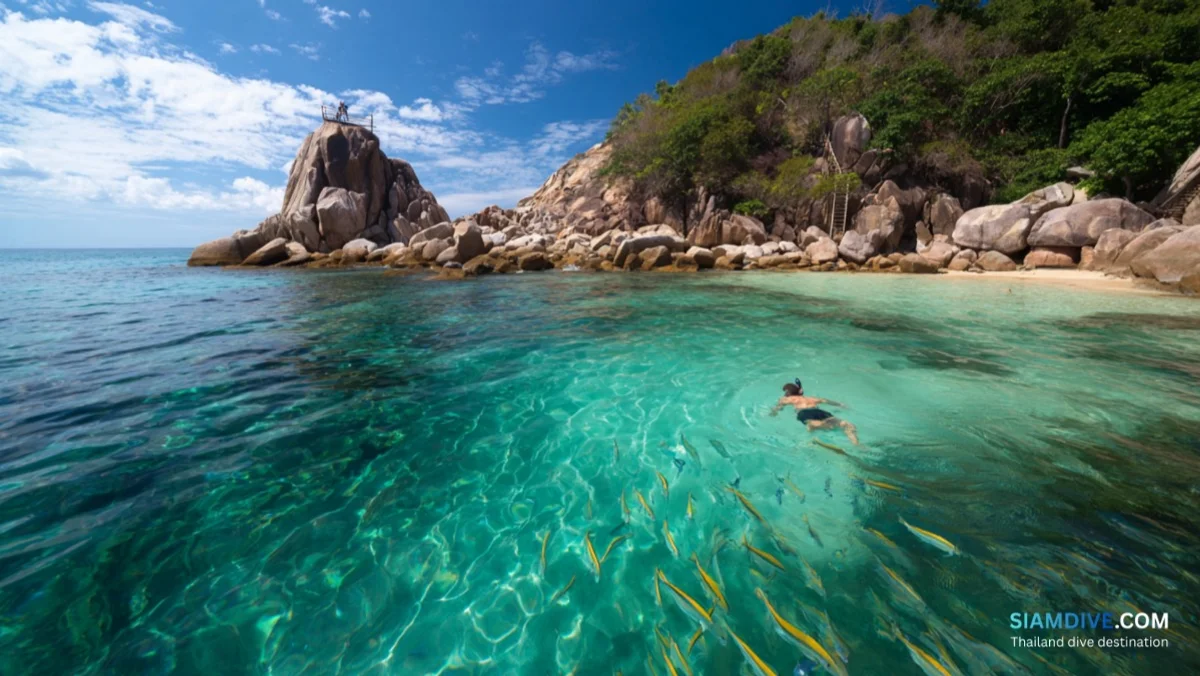
- Rocky Point (lowest level) — Follow the dirt path past the shrine and descend toward the water. The rocks are uneven and can be slippery, but the payoff is visceral: emerald water surging into crevices, white foam exploding against dark stone, and a nearly unobstructed western horizon that wraps around you in a 180-degree arc. This is where the cape stops feeling like a tourist attraction and starts feeling like the edge of a continent.
Photographers should note that the cape faces almost due west, so the sun drops directly in front of you — no neck-craning required. A wide-angle lens captures the full sweep of coastline and sky; a telephoto isolates the sun as it flattens against the water. The minutes immediately after the sun disappears often produce the richest colors — deep magentas, apricots, and purples that reflect off the water and the undersides of clouds. Stay for the afterglow.
Beyond Sunset: The Wider Southern Phuket Loop
Promthep Cape sits at the anchor point of a half-day circuit that covers some of Phuket's best low-key attractions — the kind of itinerary that fills a surface interval day better than a hotel pool.
The cape is only two kilometers from Rawai Beach, a working fishing village where longtail boats line the shore in neat rows and seafood vendors sell grilled prawns, squid, and whole fish straight from the boat at prices that would make a Patong restaurant owner flinch. Rawai is not a swimming beach — the water is shallow and weedy at low tide — but the atmosphere at dusk, with boat engines puttering and charcoal smoke drifting across the road, feels authentically coastal in a way that resort beaches do not.
From Rawai, a ten-minute drive north reaches Nai Harn Beach, consistently rated among Phuket's finest swimming beaches and still comparatively quiet despite its growing reputation.
Continue another five minutes along the coastal road and you pass the Windmill Viewpoint, where three active wind turbines frame the Andaman panorama — a quirky modern counterpoint to the ancient headland you just left.
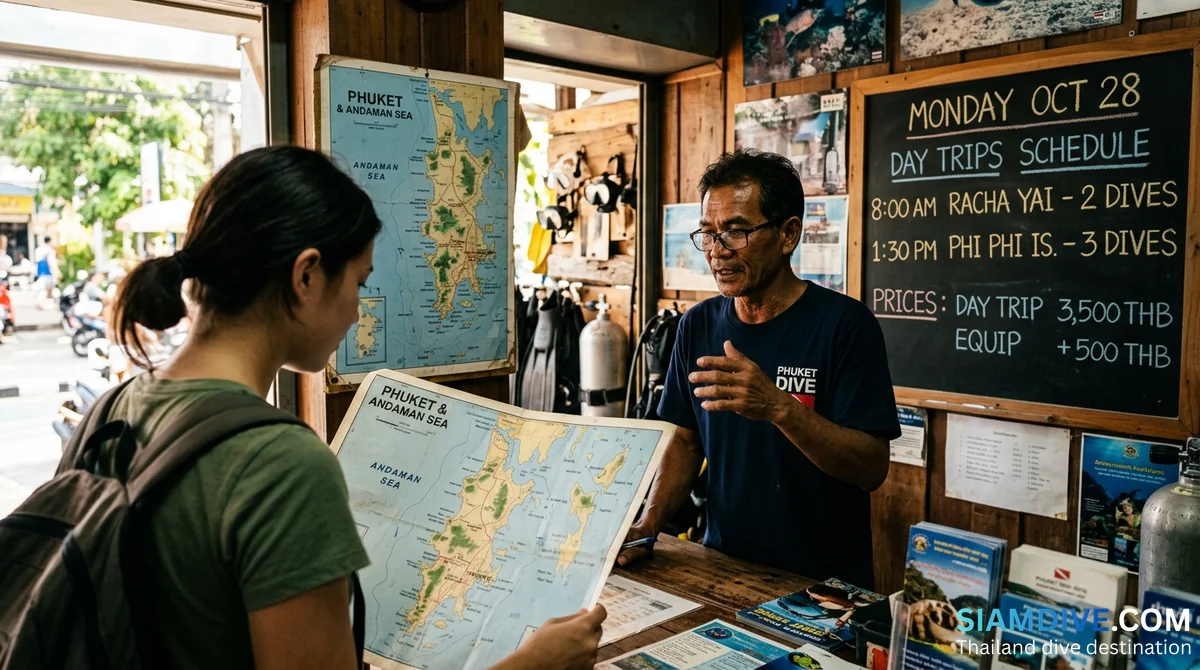
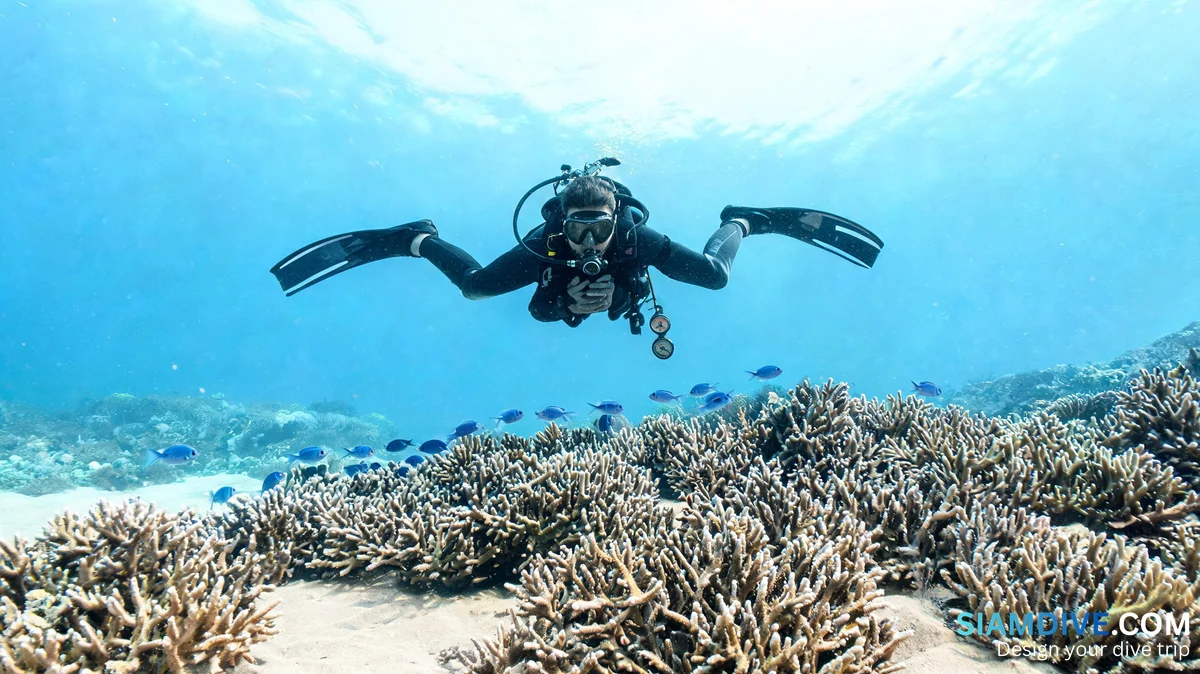
Divers visiting Phuket will recognize this stretch of coast as the departure zone for day trips to Racha Yai and Racha Noi. The same waters that glow emerald from the cape's cliffs hide 94 documented species at Racha Yai, making the sunset view a kind of topside bookend to a morning spent at depth.
If you are spending the evening in Phuket Old Town afterward, the 50-baht Michelin noodles in the Tin Quarter make a fitting post-sunset dinner — simple, local, and a world away from the resort buffet circuit.
Practical Details for Divers on a Day Off
- Admission — Free. Parking is also free.
- Lighthouse Museum — Open 09:00–17:00 daily. 20 THB entry.
- Getting There — 20 km from Phuket Town (30–50 min by car). From Patong Beach, allow 35–45 minutes. No reliable public bus route; rent a scooter or hire a Grab car.
- What to Bring — Water, walking shoes with grip for the rocky path down to the point, sunscreen, and a camera. The wind at the point is strong enough to wobble a tripod.
- Crowd Strategy — Weekday visits are noticeably calmer. Early mornings (before 09:00) offer solitude and soft light, though you lose the sunset draw.
- Combine With — Rawai seafood market, Nai Harn Beach, Windmill Viewpoint, or a dive day at Racha Yai/Noi.
For those planning a longer Phuket diving itinerary, Promthep Cape also serves as a visual reminder of just how close the open Andaman is. The liveaboard fleet departing from Phuket marinas passes within sight of the cape on the way south to the Similan Islands, and beyond.
Why This Viewpoint Still Earns Its Reputation
Travel cynicism is easy to come by in Phuket. The island has been on the global tourism circuit for more than three decades, and any attraction drawing two million annual visitors invites skepticism — how good can it really be with a parking lot and a souvenir cart at the entrance?
Promthep Cape has something most "must-see" viewpoints lack: genuine geological drama. The headland juts into open ocean, not a sheltered bay. The rocks at the point are raw and unrailed. The water below is not the docile turquoise of a resort lagoon — it moves, surges, and occasionally throws spray high enough to catch the light.
For divers, there is an added layer of recognition. That water is not abstract scenery. It is the same Andaman Sea you breathed through a regulator that morning, the same current that pushed you along a reef wall at 18 meters, Seeing it from 95 meters above, gold-lit and enormous, reframes the scale of the underwater world in a way that a logbook entry never quite captures.
The sun will set whether you are there or not. Promthep Cape simply gives you a front-row seat at the edge of the island, where land runs out and the sea takes over.