What Sits at 91 Metres in the Baltic — and Why No One Agrees
17 พฤษภาคม 2569
A 60-metre disc on the Baltic seafloor has stumped geologists and thrilled UFO hunters for 15 years. The evidence points in two directions at once.
The Ping
June 2011. Peter Lindberg and Dennis Åsberg are dragging side-scan sonar across the Gulf of Bothnia, hunting for shipwrecks and their cargo. The screen paints something neither man has seen in twenty years of professional salvage: a near-perfect circle, 60 metres across, sitting on the seabed at 91 metres depth. Behind it, a 300-metre drag mark scores the mud — as if something heavy slid to a stop.
Lindberg's first public comment was measured: "I have been doing this for about 20 years and I have never seen anything like this." Within weeks the sonar image leaked. Within months, tabloids worldwide had christened it the "Baltic Sea UFO." The resemblance to the Millennium Falcon in the blurrier frames did not help the scientific community take it seriously — but it did guarantee that funding would follow.
Sixty Metres Wide, Ninety-One Deep
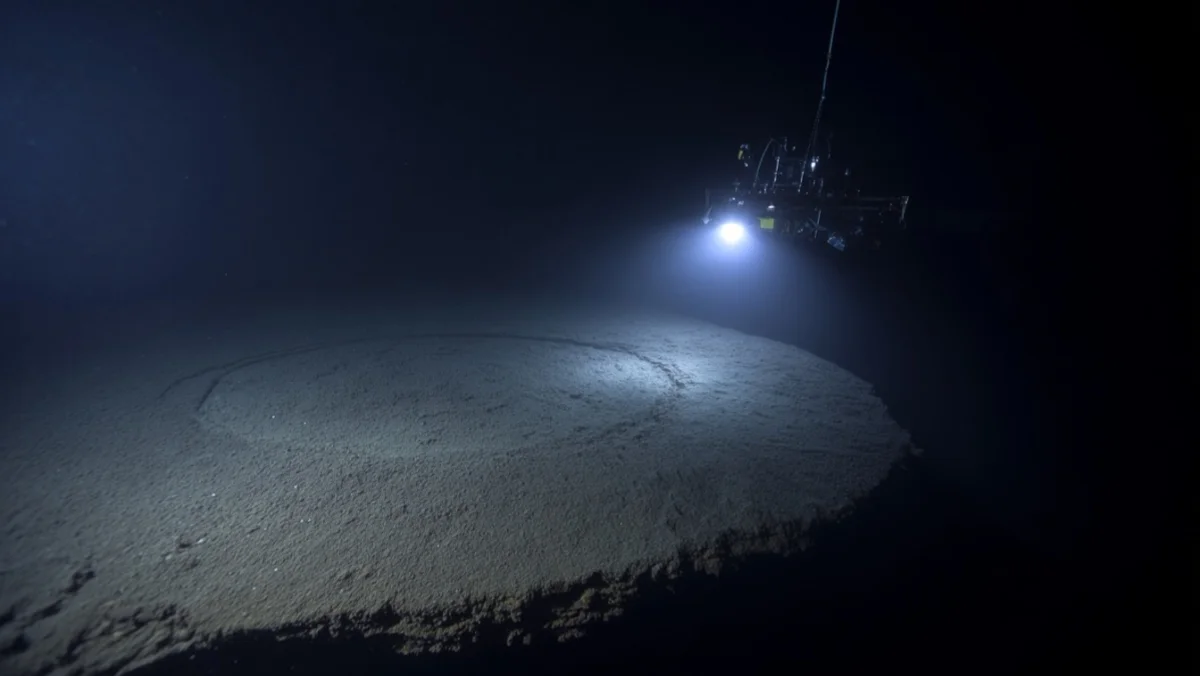
The formation rests on the seafloor of the northern Baltic Sea, roughly between Sweden and Finland, in one of the most glacially reworked seabeds on Earth. Multiple sonar passes and dive surveys have established its dimensions:
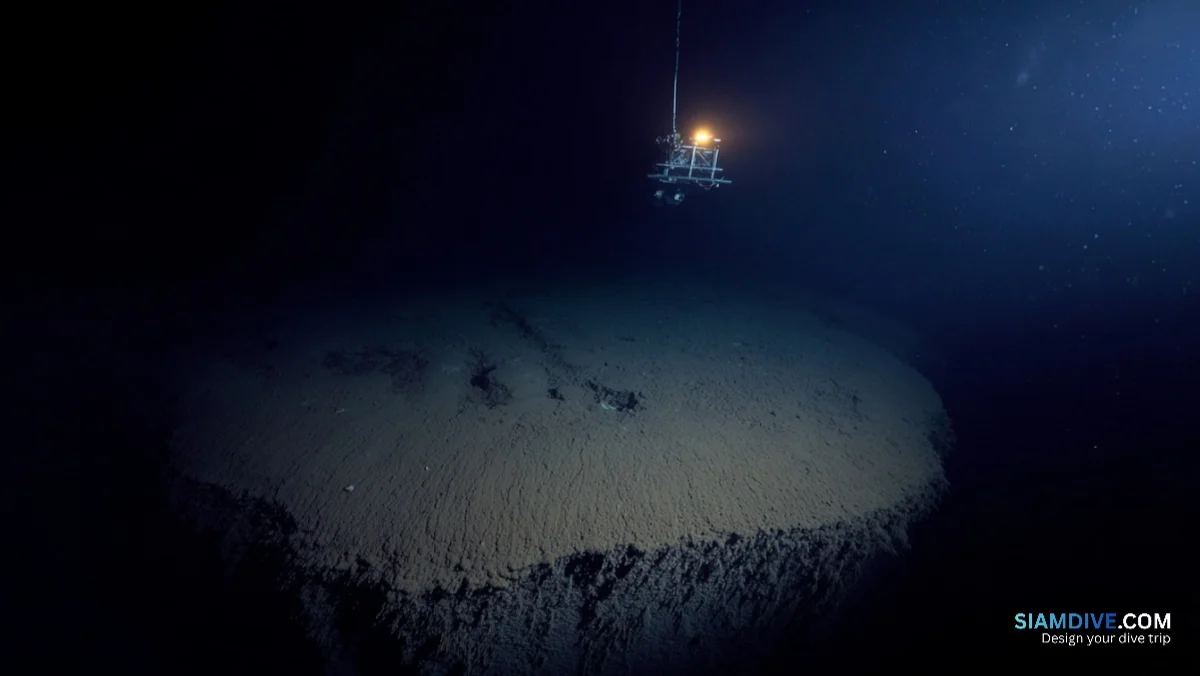
- Diameter: approximately 60 metres — wider than a Boeing 747 is long
- Depth: 91 metres below the surface
- Drag mark: a 300-metre track trailing behind the disc, consistent with lateral movement across the seabed
- Profile: disc with a raised centre, an egg-shaped opening leading inside, and what sonar interprets as right-angle edges on portions of the perimeter
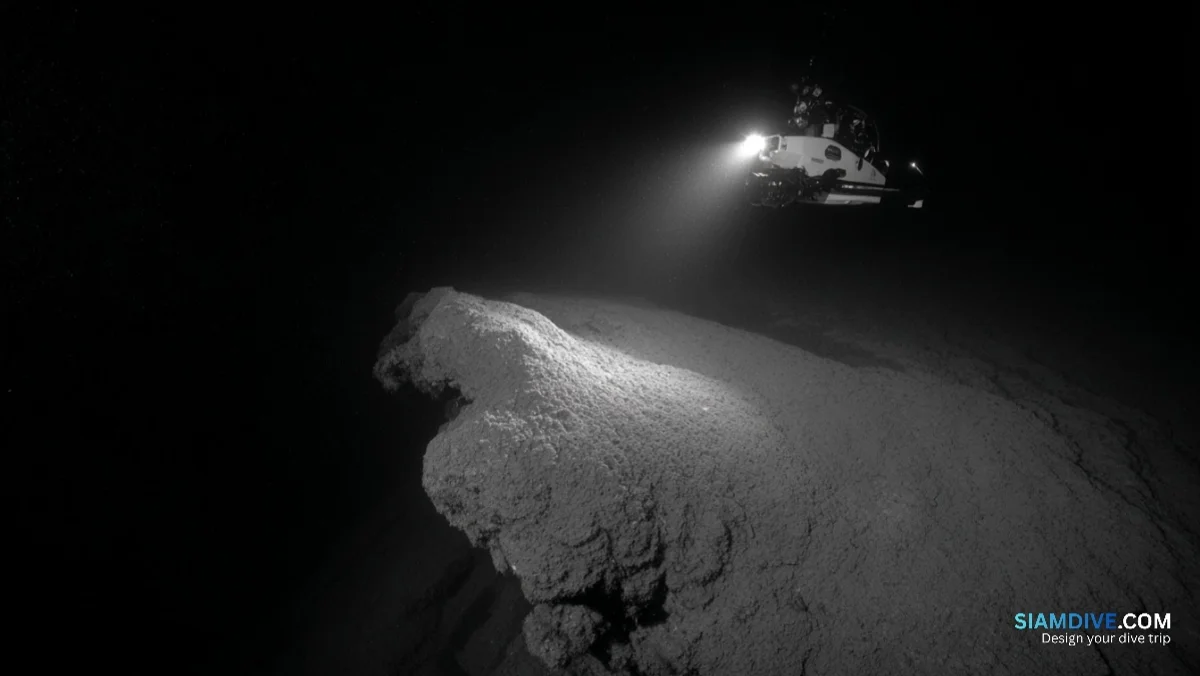
- Surface features: corridors or channels carved into the top, plus a formation the team described as a "staircase"
In higher-resolution scans the geometry becomes less cinematic and more ambiguous — irregular enough to be natural, regular enough to unsettle anyone who studies the images for more than a few minutes.
When the Instruments Went Quiet
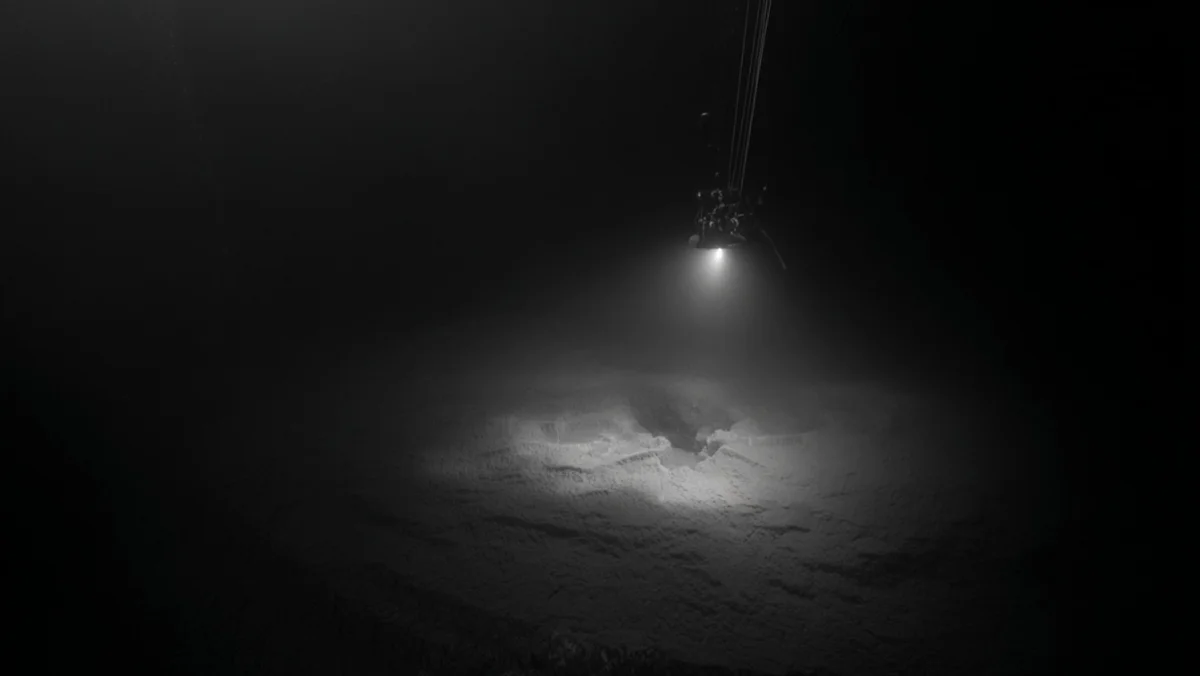
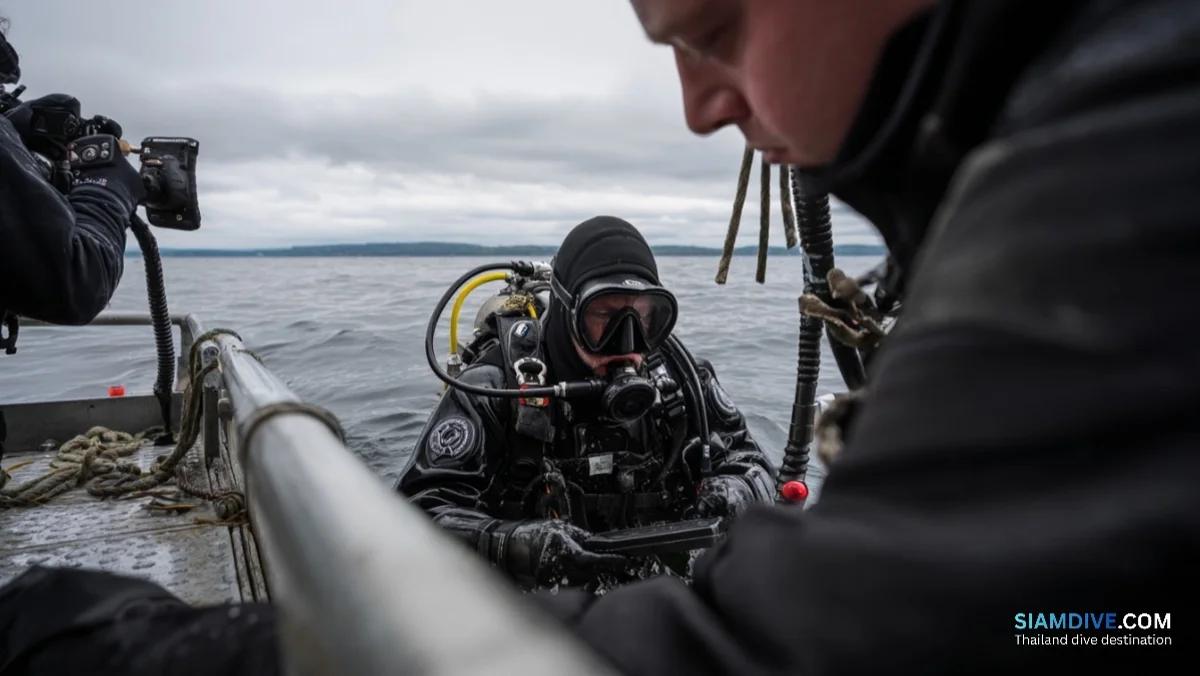
Ocean X returned in 2012 with divers and cameras. The footage they hoped to capture never fully materialised — not because of depth or visibility, but because of electronics.
As the vessel positioned directly above the disc, multiple systems failed simultaneously. Satellite phones cut out. Cameras glitched. Navigation returned corrupted data. The team moved 200 metres away: everything worked. They returned overhead: failure again. The pattern repeated.
Diver Stefan Hogeborn, one of the first humans to touch the structure, added another detail: "Usually rocks don't burn. This stone was like it had been exposed to extreme heat." The surfaces showed discolouration consistent with high-temperature contact — not what glacial deposits typically display.
Lindberg himself refused the paranormal explanation. A Swedish Coast Guard vessel — larger and more sophisticated than a standard patrol craft — remained within 400 metres throughout the expedition. Lindberg suspected interference from that ship's systems. But no formal investigation confirmed or ruled out either source. The electronics mystery remains exactly that.
The Glacial Hypothesis
The Baltic seafloor spent tens of thousands of years being scraped, compressed, and rebuilt by ice. The Weichselian glaciation ended roughly 11,700 years ago after pushing enormous volumes of material across Scandinavia — leaving drumlins, moraines, and erratics in its wake.
Geologists from Stockholm University analysed rock samples retrieved from the disc's surface. Their findings:
- Composition: granites, gneisses, and sandstones — the most common Baltic glacial erratics
- One outlier: a loose basalt fragment (hardened lava), present but not dominant
- No exotic materials: zero unusual metals, alloys, or synthetic compounds
- Drag mark interpretation: consistent with glacial transport — ice sheets routinely push formations hundreds of metres before melting releases them
Associate professor Volker Brüchert of Stockholm University assessed the samples as "the most common rocks that you would encounter in any place in a moraine landscape." Multiple peer reviews have since classified the anomaly as a glacial deposit — a drumlin or large erratic shaped by ice-age mechanics. The scientific consensus holds.
What the Rocks Don't Fully Explain
Consensus, though, is not closure. Several observations resist clean geological accounting:
- The symmetry. Drumlins elongate along ice-flow direction. This formation is near-circular — unusual, though not impossible, for glacial deposition
- The heat signatures. Surface discolouration suggesting extreme temperatures. Glacial processes generate pressure, not surface-level burns. Volcanic erratics can mimic this appearance, but basalt was only a minor component of the samples
- Right-angle edges. Portions of the perimeter show what sonar reads as 90-degree geometry. Natural fracturing produces straight lines, but multiple perpendicular edges on one formation stretch probability
- The electronics correlation. No known glacial deposit disrupts satellite communications. If the effect was real and caused by the object rather than the Coast Guard vessel, it implies electromagnetic properties the rock analysis did not detect
- The internal structure. The egg-shaped opening and reported "staircase" are difficult to reconcile with ice deposition alone — though erosion and fracturing can produce surprisingly architectural shapes
None of these points constitutes proof of artificial origin. Each has a possible mundane explanation. Together, they form the reason the file stays open and new expeditions keep finding funding.
USOs — A Broader Pattern?
The Baltic disc exists within a wider, quieter conversation about Unidentified Submerged Objects. Where UAPs dominate headlines in the sky, USOs represent the underwater fraction of the same unresolved dataset — and the dataset is growing.
Since August 2025, the Enigma Labs platform has logged over 9,000 witness reports of unidentified objects within 10 miles of United States shorelines. California leads with 389 documented cases, Florida with 306. In 2022, the Pentagon widened its official terminology from "Unidentified Aerial Phenomena" to "Unidentified Anomalous Phenomena" — specifically to encompass objects transitioning between air and water without visible propulsion change.
Two historical cases anchor the USO record:
- Shag Harbour, Nova Scotia, 1967. At least eleven witnesses watched a lit object descend into harbour waters. RCMP, Canadian Coast Guard, and Navy investigated. Divers searched the seafloor for three days. Nothing was recovered. The Canadian government classified it officially as a UFO — the only crash case supported by freely available government documentation
- USS Nimitz, Pacific Ocean, 2004. Commander David Fravor observed a 40-foot Tic Tac-shaped object hovering above churning water that suggested something massive just beneath the surface. Radar tracked objects descending from 80,000 feet to sea level in seconds. The Pentagon released the FLIR footage in 2020 and has never provided a conventional explanation
Whether the Baltic disc connects to transmedium phenomena or occupies an entirely separate geological category is speculation. But the institutional vocabulary now exists — "USO" has a Pentagon definition, a research budget, and a growing evidence base that did not exist when Ocean X first published their sonar image.
2025: The Investigation Reopens
Fifteen years after discovery, the Baltic anomaly entered its most rigorous investigative phase yet. In mid-2025, Ocean X partnered with external scientific teams for a new survey using technology unavailable during earlier expeditions:
- CQR Robotics: underwater drones for sustained deep-water mapping beyond diver endurance limits
- Sigma 2 (France): a formal scientific group studying anomalous phenomena with peer-review methodology
- Stockholm University: continued geological input, now including Dr. Beatrice Villarroel from the VASCO project — a programme searching for anomalous signatures in astronomical data
- New instruments: multibeam sonar, sub-bottom profiling, environmental sampling, magnetic field measurement, and photogrammetry
The Society for UAP Studies (SUAPS) announced formal backing — the first time an academic body has supported a Baltic anomaly mission. In July 2025, Dennis Åsberg stated publicly that new findings were "so profound" they might be "too disruptive to release," and confirmed a scientific paper in development with Dr. Villarroel.
No paper has appeared as of early 2026. That either means peer review is doing its slow, careful work — or the claim will quietly join the long list of announcements that never materialised into data. The Baltic anomaly has seen both outcomes before.
Two Readings of the Same Seabed
The formation at 91 metres remains genuinely unresolved — not because science has failed, but because the object occupies an uncomfortable position between categories. Rock composition says glacial deposit. Shape, heat evidence, and electronics say something additional happened at this location, even if that something proves geological rather than extraterrestrial.
The disc sits where it has sat since at least the last ice age — measured, photographed, sampled, debated, and still waiting for either a definitive paper or a definitive dive that closes the question for good. After fifteen years, neither has arrived. The seafloor keeps its own schedule.
Related reading on SiamDive:
- Five Bombs, 15 Survivors, 80 Years of Coral on the Hardeep
- 0.4°C Warmer — How a Decade Changed Thailand's Thermocline
- Why a Thousand Garden Eels Disappear the Moment You Exhale
Sources
- Wikipedia — Baltic Sea Anomaly (compiled references and geological analysis)
- IFLScience — What Was The Mysterious Object Seen 90 Metres Underwater?
- ExplorersWeb — Is the Baltic Sea Anomaly Natural, Man-Made, or a Hoax?
- Above The Norm — A Decade of Unanswered Questions on the Seafloor (2025)
- Enigma Labs — Unidentified Submerged Objects data collection