34 Starfish per Hectare Is All It Takes to Kill a Thai Reef
4 พฤษภาคม 2569
Crown-of-thorns starfish at Koh Tao now exceed outbreak thresholds at 34.4 per hectare. The science behind the surge and what Thailand's reefs stand to lose.
At low tide on a Koh Tao reef flat, the evidence looks surgical. A circular white patch, thirty centimetres across, marks where a crown-of-thorns starfish pressed its stomach against the coral overnight. The tissue is gone. The skeleton is clean. By morning the starfish has moved on, dragging twenty-one thorn-covered arms across the rubble at a pace that seems almost lazy — thirty-five centimetres a minute — until it finds the next colony and begins again.
At outbreak densities, a single hectare of reef can hold dozens of these animals, each one grinding through six to ten square metres of living coral every year. Multiply that by thirty-four starfish on a single hectare — the density now documented at Koh Tao — and an entire reef section can lose its living tissue in under two years. The arithmetic should unsettle anyone who has ever finned over a Thai reef and assumed it would look the same next season.
The Stomach That Comes Outside
The crown-of-thorns starfish (Acanthaster sp.) is not a subtle animal. Adults can stretch fifty centimetres across, armed with up to twenty-one arms. Their upper surface bristles with venomous spines coated in saponin — toxic enough to cause searing pain, nausea, and swelling lasting days. But the real weapon works underneath.
To feed, the starfish everts its cardiac stomach directly onto the coral surface, secreting digestive enzymes that dissolve live polyps in place. What remains is a stark white scar — bare calcium carbonate, stripped of every cell. A large adult can eliminate roughly sixty square centimetres of coral per day in cooler months, and considerably more in warm water when metabolism accelerates.
- Adult diameter: up to 50 cm, with 14–21 arms
- Annual coral consumption: 6–10 m² per individual
- Locomotion speed: 35 cm/min across reef substrate
- Venom delivery: saponin-coated spines; first aid requires hot-water immersion at 45 °C
- Feeding method: eversible cardiac stomach applied directly to coral surface
On the Great Barrier Reef, crown-of-thorns predation accounts for forty-two per cent of hard coral cover loss — more than bleaching, more than cyclones. Thai reefs carry the same species. The same arithmetic applies.
34.4 per Hectare — Where Koh Tao Crossed the Line
A healthy reef might hold one or two crown-of-thorns per hectare. At those densities, the starfish actually serve a purpose: cropping fast-growing corals and leaving room for slower species to compete. The trouble starts when the count climbs past the outbreak threshold — and at Koh Tao, it has.
A two-year underwater visual census published in Environmental Monitoring and Assessment in 2024 recorded 34.4 Acanthaster individuals per hectare around Koh Tao — consistently exceeding the regional outbreak definition. Size distribution was unimodal, a signature of a primary outbreak, meaning the population boom originated locally rather than drifting in on ocean currents.
Longer-term monitoring from the reef research community fills in the timeline. Across 375 surveys spanning nine years at Koh Tao, crown-of-thorns starfish appeared in 16.3 per cent of transects. Monthly removal efforts collected eighty-nine individuals in a typical year, ranging from juveniles as small as three centimetres to adults at forty-three centimetres.
- Outbreak threshold: ~15 individuals per hectare (regional definition)
- Koh Tao density (2024 study): 34.4 per hectare — more than double the threshold
- Monitoring record: 375 surveys over 9 years; COTS present in 16.3 % of transects
- Annual removals: 89 individuals collected, sizes 3–43 cm
- Trend: numbers declined 2019–2022, then spiked sharply in 2023
That 2023 spike has not reversed. The reef is living with an active outbreak, and every month of elevated density translates directly into lost coral cover. For context, at thirty-four starfish per hectare, each consuming six to ten square metres per year, a single hectare of reef can lose over two hundred square metres of live coral tissue annually — enough to visibly change the landscape between dive seasons.
What Flips the Switch
Two forces push a crown-of-thorns population from background noise to full-blown outbreak, and both are amplified by human activity.
Nutrient runoff. Crown-of-thorns larvae feed on phytoplankton. In the nutrient-poor waters around a healthy reef, most larvae starve before they ever settle. Fertiliser and sewage runoff from coastal agriculture and island development change that equation — phytoplankton blooms, larval survival jumps, and more juveniles reach the reef. Islands with growing tourism infrastructure and limited wastewater treatment, like Koh Tao, sit squarely in the risk zone.
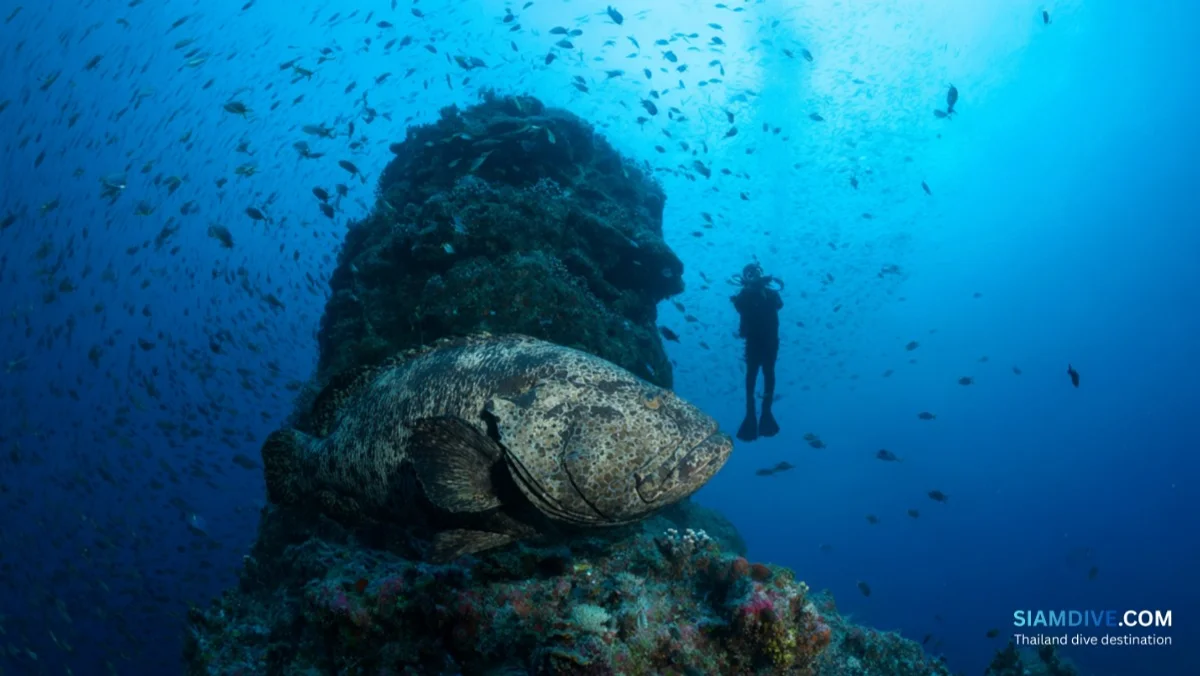
Predator collapse. Giant triton snails, humphead wrasse, titan triggerfish, and certain pufferfish prey on crown-of-thorns at various life stages. The giant triton — a marine snail that can reach half a metre in length — is one of the few animals capable of attacking a full-grown adult, prying open the starfish's central disc and consuming it whole. But tritons are slow-breeding, heavily collected for their shells, and functionally absent from most Thai reefs. Humphead wrasse face similar pressure from the live-reef-fish trade. Overfishing removes these predators faster than they can reproduce, and the brake on starfish populations disappears with them.
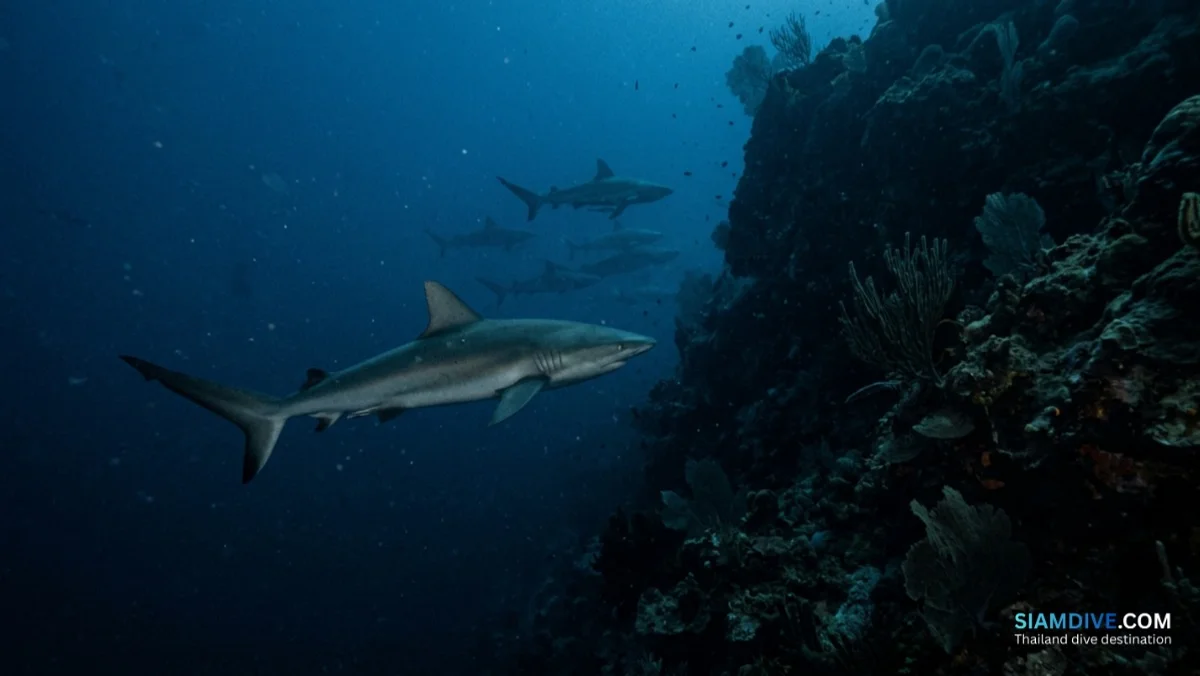
A February 2025 paper in Communications Biology revealed a subtler mechanism. Removing apex predators like sharks doesn't just eliminate direct predation — it reshapes how mesopredatory fish behave. Without sharks patrolling, mid-level predators alter their foraging patterns, spending less time in exposed areas where crown-of-thorns are vulnerable. They become bolder in some ways but paradoxically less effective as starfish predators. The result is a trophic cascade with an extra step that earlier models missed: fewer sharks → changed fish behaviour → reduced starfish predation → outbreaks. The finding matters because it means even reefs with healthy mid-level fish populations can still experience COTS outbreaks if the apex predators above them are gone.
For reefs near developed Thai islands — where both nutrient loads and human pressure on coral run high — the conditions for outbreaks overlap almost perfectly.
Branching Coral Falls First
Crown-of-thorns do not eat indiscriminately. The Koh Tao study documented a marked feeding preference for tabular and arborescent (branching) coral morphologies. Massive, laminar, and submassive forms were consistently avoided.
That selectivity carries consequences far beyond the individual colony. Branching corals are the architectural scaffolding of a reef — the three-dimensional lattice that shelters juvenile fish, invertebrates, and the small creatures that sustain the food web. A single table coral can harbour dozens of species in its shade. Strip that canopy away and what remains is a flatter, simpler landscape — fewer hiding places, less shade, less surface area for algae grazers to work. The reef still exists, but it functions like a parking lot instead of a city.
A coast-to-coast assessment published by Mongabay in January 2026 documented exactly this trajectory across Thailand. Researchers surveyed ninety-nine nearshore reefs and sixteen offshore pinnacles between 2022 and 2024, covering seventeen kilometres of reef at depths from four to twenty metres. The verdict: Thai reefs are undergoing "widespread homogenisation," shifting toward dominance by bouldering Porites — the species tough enough to survive what branching corals cannot.
Crown-of-thorns and rising sea temperatures are hitting the same targets from different angles. The branching corals that bleach most easily are also the ones the starfish eat first. After the 2024 marine heatwave bleached fifty per cent of Gulf of Thailand coral and forced the closure of twelve national marine parks, a simultaneous COTS outbreak compounds the damage faster than any recovery programme can match.
The Removal Equation
Controlling crown-of-thorns is labour-intensive and never permanent. But targeted removal buys time — and on reefs already weakened by bleaching, time is the scarcest resource.
In Thailand, removal within a National Marine Park requires a permit from the Department of National Parks, Wildlife and Plant Conservation. Outside park boundaries, the Department of Marine and Coastal Resources (DMCR) has standardised predator management guidelines and trained dive professionals in removal techniques.
Three approaches dominate:
- Manual collection — divers wearing heavy gloves gather starfish and bring them ashore to desiccate. At Koh Tao, the New Heaven Reef Conservation Program has run monthly collections since 2010 as part of its long-term monitoring effort.
- Injection — a vinegar or bile-salt solution injected directly into the starfish kills it within 24–48 hours without damaging surrounding coral. Standard on the Great Barrier Reef, increasingly adopted across Southeast Asia.
- Survey-first protocol — Green Fins Thailand emphasises that removal without baseline data is guesswork. Their approach: survey the reef, establish density per hectare, and intervene only when populations cross outbreak thresholds.
On the Great Barrier Reef, a systematic control programme deploying trained divers with injection equipment has culled over 1.3 million starfish since 2012, and managed reefs retained coral cover significantly higher than unmanaged reefs nearby. Thailand's programmes are smaller in scale but follow the same logic: early detection and rapid response matter more than total eradication, which is not achievable for a species that can release millions of eggs in a single spawning event. A female crown-of-thorns produces roughly sixty-five million eggs per season. No removal team can outbreed that output — they can only stay ahead of it reef by reef, season by season.
After You Spot One
Any diver working Thai reefs will eventually see a crown-of-thorns. The encounter calls for awareness, not panic.
Do not touch. The spines punch through thin neoprene easily. Envenomation produces immediate burning pain and localised swelling. Hot-water immersion at 45 °C is the recommended first aid; spine fragments may need medical removal. Good buoyancy and careful fin placement keep divers safe and keep the reef intact.
Report what you see. Dive centres participating in reef monitoring programmes — Reef Check, Green Fins, and local conservation groups — track sighting data across Thai waters. A single starfish on a dive is unremarkable; one or two per hectare is the natural baseline. Clusters of five or more on a single reef section signal a potential outbreak, and early reporting is the cheapest intervention that exists. Note the location, depth, approximate size of each animal, and whether fresh white feeding scars are visible on nearby coral. That information is what triggers a response.
Support no-take zones. The 2025 trophic cascade research reinforces what divers have long heard: marine reserves that protect fish populations also protect reefs from crown-of-thorns outbreaks. Every hectare where predators thrive is a hectare less likely to tip past that thirty-four-per-hectare line.
The crown-of-thorns is not an invader. It belongs on Thai reefs, has always been here, and in small numbers performs a useful ecological role. The crisis is entirely human-made — nutrient pollution, overfishing, and warming seas have shifted the balance. Understanding the mechanism is the first step toward pushing it back.
Sources
- Australian Institute of Marine Science — Crown-of-Thorns Starfish research
- Environmental Monitoring and Assessment (2024) — Morphological dietary preferences of outbreaking COTS in the Gulf of Thailand
- Communications Biology (Feb 2025) — Predator removals, trophic cascades and crown-of-thorns outbreaks
- Mongabay (Jan 2026) — Coast-to-coast assessment reveals Thailand's reefs losing complexity
- New Heaven Reef Conservation Program — Crown of thorns starfish population studies
- Green Fins Thailand — Crown of Thorns Starfish Outbreak management