29-Cent Shark Satay From a Village That Still Hunts Sharks
← Blog

29-Cent Shark Satay From a Village That Still Hunts Sharks

15 พฤษภาคม 2569

In Tanjung Luar, wooden boats return from 20-day voyages with holds full of sharks. Twenty kilometres inland, their meat becomes satay sold for pocket change.

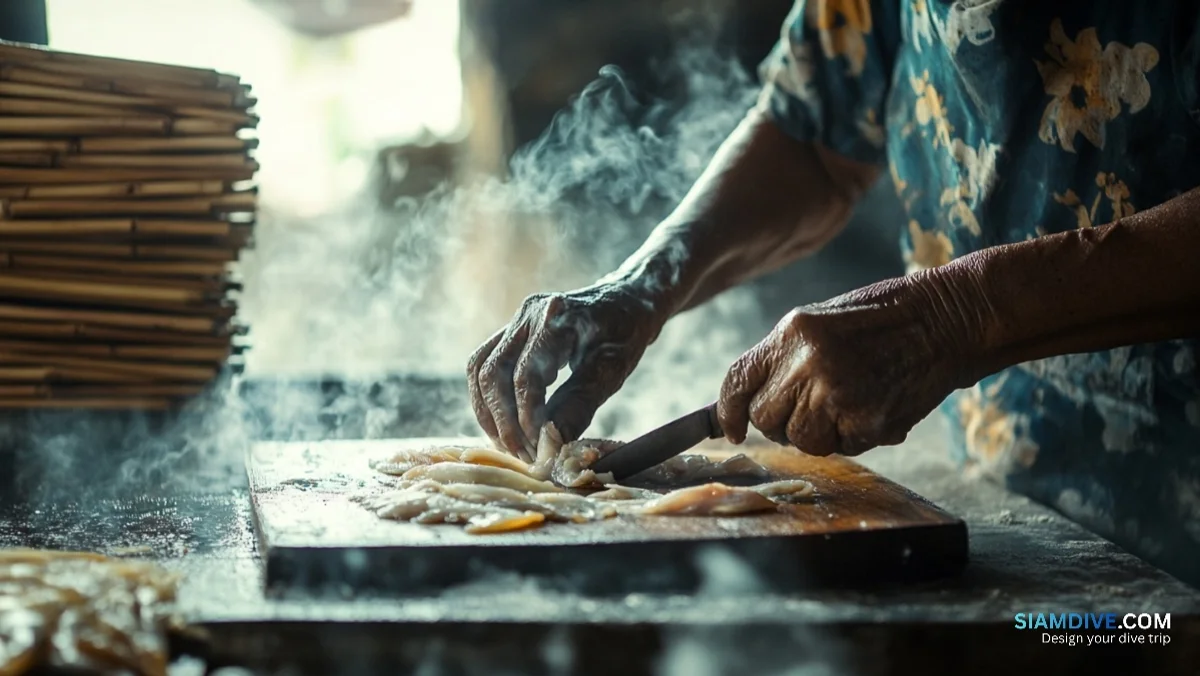
The blade meets cartilage at the joint with a sound like tearing cardboard. In a concrete shed twenty kilometres inland from Tanjung Luar's fish landing site, a woman in a faded headscarf separates a blacktip reef shark into seven commercial cuts — fins, belly flaps, backbone strips, jaw, head, skin, and the remaining trunk that will become satay by sundown. She has done this since she was fourteen. Her mother did it before her.

This is Rumbuk, the processing heart of eastern Lombok's shark trade, where the catch from Indonesia's largest elasmobranch market arrives by truck and leaves as crackers, meatballs, smoked strips, and skewers selling for 5,000 rupiah — about 29 US cents.

Twenty Days at Sea for a Hold of Sharks

The boats that supply Tanjung Luar are wooden vessels of 15–30 gross tonnes, crewed by four to five fishermen who spend 15 to 20 days at sea per voyage. They work longline gear across waters stretching from Sumbawa Strait to the deep channels around Sumba, targeting pelagic and demersal sharks alike.

A single trip costs roughly IDR 15 million (approximately USD 940) in fuel, ice, bait, and provisions. A productive day yields 10–30 sharks averaging 20–30 kilograms each. At landing prices of IDR 600,000–1,000,000 per animal, a good voyage returns three to five times the operational cost — margins that have sustained this fleet since the early 1990s.

"This has been a hereditary job from the previous generation to our generation," fisherman Safruddin told Mongabay Indonesia in April 2026, standing beside a row of thresher carcasses. Knowledge — tide patterns, longline spacing, shark behaviour around seamounts — passes father to son with the boat itself.

From Dock to Rumbuk: The Processing Chain

Tanjung Luar's landing site operates like a wholesale clearinghouse. Sharks arrive whole, are auctioned at dawn, and within hours are loaded onto trucks bound for Rumbuk and smaller processing hamlets. The market handles an estimated 13,000 individual sharks per year across 57 documented species — from silky sharks and blue sharks to CITES-listed hammerheads.

At Rumbuk, the division of labour is total. Men split carcasses with cleavers. Women prepare secondary cuts. Children stack drying racks in the afternoon heat. The products serve different price tiers and markets:

  • Sate ikan (shark satay) — marinated trunk meat on bamboo skewers, grilled roadside, IDR 5,000 per skewer (~USD 0.29)
  • Abon (shredded dried shark) — sold in bags as a rice topping, IDR 25,000–40,000 per kilogram
  • Kerupuk (shark crackers) — mixed with tapioca starch, a common snack across Lombok
  • Bakso and otak-otak — meatballs and fish cakes for market stalls and street vendors
  • Sirip kering (dried fins) — exported to middlemen, the high-value cut that draws international scrutiny

Why 29-Cent Protein Matters on Lombok

Eastern Lombok ranks among Indonesia's less-developed regions. Shark meat fills a protein gap that chicken and beef cannot always close at the same price point.

  • Shark trunk meat — IDR 25,000–40,000/kg at local markets
  • Chicken breast (comparison) — IDR 45,000–55,000/kg in the same markets
  • Family meal cost — five people can eat protein-rich shark satay for under IDR 25,000 (~USD 1.50)

For communities within a fifty-kilometre radius of Tanjung Luar, this price point is not a novelty — it is a nutritional baseline. A Mongabay Indonesia photojournalism report published in April 2026 captured the economic scale: entire villages whose daily income flows directly from the catch, the cut, and the grill.

This does not make the trade environmentally sustainable. It does explain why it persists despite mounting regulatory pressure, and why conservation programmes that ignore the affordability equation face resistance at the village level.

The Conservation Bind

Indonesia ratified CITES Appendix II protections for several shark species traded through Tanjung Luar, including scalloped hammerheads and silky sharks. Enforcement, however, meets a community where the entire economic chain — boat crews, processors, vendors — depends on the catch.

The tension is not abstract. Banning the trade overnight would collapse a local economy without a ready alternative. Conservation programmes that have gained traction — such as the Alor regency's 91% shark-fishing reduction through marine-tourism conversion — took years of community negotiation and required viable substitute income. Eastern Lombok's tourism infrastructure is not yet at that stage.

For divers who encounter shark conservation as a marine issue, Tanjung Luar is a reminder that it is equally a food-security issue, a labour issue, and a generational-identity issue. The path from 57 species on the dock to a 29-cent skewer on a roadside grill runs through every one of those dimensions.

What Divers Can Do With This Knowledge

Understanding the supply chain does not require endorsing it. But it changes the quality of conversation divers bring to shark conservation.

  • Ask about alternatives, not just bans — effective programmes replace income, not just prohibit extraction
  • Support marine-tourism ventures in eastern Indonesia — every dive dollar that reaches communities like Tanjung Luar strengthens the economic case for live sharks
  • Recognise the CITES gap — listing a species protects it on paper; enforcement in remote fishing villages depends on funding, education, and economic substitution
  • Read the sourcing — shark meat appears in Southeast Asian markets under local names; knowing the chain helps divers make informed food choices when travelling

The sharks circling Aliwal Shoal's caves and the reef systems near resort coastlines exist in a connected ocean. What happens at Tanjung Luar's dock at dawn reaches the water column everywhere.

Sources

← กลับไปหน้า Blog

Gallery

29-Cent Shark Satay From a Village That Still Hunts Sharks — image 129-Cent Shark Satay From a Village That Still Hunts Sharks — image 229-Cent Shark Satay From a Village That Still Hunts Sharks — image 329-Cent Shark Satay From a Village That Still Hunts Sharks — image 429-Cent Shark Satay From a Village That Still Hunts Sharks — image 5

บทความแนะนำ

Koh Haa Diving Guide: Five Islands of Crystal Clear Water

Koh Haa Diving Guide: Five Islands of Crystal Clear Water

Dive Koh Haa's lagoon, Cathedral cave, and deep pinnacles from Koh Lanta. All-level sites with 20-30m visibility and rich marine life.

Andaman Sea vs Gulf of Thailand: Picking Your Dive Region

Andaman Sea vs Gulf of Thailand: Picking Your Dive Region

Compare Thailand's two dive coasts side by side — marine life, visibility, seasons, costs, and which region fits your experience level.

Thailand vs the World: Where Should You Get Scuba Certified?

Thailand vs the World: Where Should You Get Scuba Certified?

Compare scuba certification costs, conditions, and quality across Thailand, Honduras, Philippines, and more — and discover why Koh Tao certifies more divers than anywhere on Earth.

27 Dolphins, One Cargo Plane, and a Cold War Ghost Story

27 Dolphins, One Cargo Plane, and a Cold War Ghost Story

In 2000, a Soviet trainer flew 27 war-trained dolphins to Iran. Twenty-six years later, they resurfaced — in a Pentagon briefing about kamikaze dolphins.

28°C Above, 22°C Below: When 3mm Fails in Thailand

28°C Above, 22°C Below: When 3mm Fails in Thailand

Andaman thermoclines drop from 29°C to 22°C without warning. At 20 metres, 3mm compresses to barely 1mm — the spec-driven case for when 5mm earns its weight.

The 3-Second Mistake That Drags Divers to the Surface

The 3-Second Mistake That Drags Divers to the Surface

A slack loop catches your valve post. The SMB rockets up. You follow — unless you know the drill that stops it cold.

75 cm of Fury: What Triggers a Titan Triggerfish to Charge

75 cm of Fury: What Triggers a Titan Triggerfish to Charge

Teeth built to crack urchins, an inverted-cone territory that reaches the surface, and a charge with zero warning — why Thailand's biggest triggerfish earns its fearsome reputation.

Ear Equalization for Divers: Techniques That Actually Work

Ear Equalization for Divers: Techniques That Actually Work

Master Valsalva, Frenzel, and Toynbee methods to equalize your ears safely. Stop ear pain on every dive with these proven techniques.

Racha Noi: Phuket's Offshore Island Where Manta Rays Show Up Unannounced

Racha Noi: Phuket's Offshore Island Where Manta Rays Show Up Unannounced

Racha Noi offers Phuket's clearest water, manta ray encounters, and uncrowded dive sites. A 40-minute speedboat ride from Chalong to a different world.

Diving in Currents: How to Stay Safe and Enjoy the Ride

Diving in Currents: How to Stay Safe and Enjoy the Ride

Learn to read, manage, and enjoy underwater currents. From drift diving to handling downcurrents, this guide covers what every diver needs to know.

Koh Lipe Diving Guide: Thailand's Hidden Andaman Gem

Koh Lipe Diving Guide: Thailand's Hidden Andaman Gem

Explore Koh Lipe's top dive sites from Jabang's soft coral gardens to 8 Mile Rock's granite pinnacles. Season, costs, and how to get there.

One Missing Sugar Is Why Anemones Don't Eat Their Clownfish

One Missing Sugar Is Why Anemones Don't Eat Their Clownfish

Clownfish mucus lacks one sugar that triggers anemone stings — a 2025 study cracked the mechanism. Plus sex changes, matchmaking rules, and Thai species.

Air Consumption in Scuba Diving: How to Make Every Tank Last

Air Consumption in Scuba Diving: How to Make Every Tank Last

Learn how to reduce your air consumption and extend dive time. Practical tips on breathing, buoyancy, trim, and gas management for every level.

Storing Your Dive Gear for Months? The Checklist That Prevents Expensive Surprises

Storing Your Dive Gear for Months? The Checklist That Prevents Expensive Surprises

Seasonal diver? Heading home after a trip? Follow this item-by-item storage checklist so your regulator, BCD, wetsuit, and tank survive months of downtime.

Safe Diving Techniques: 8 Skills That Prevent Accidents

Safe Diving Techniques: 8 Skills That Prevent Accidents

Master the 8 essential safe diving techniques every diver must know — from buoyancy control and air management to emergency ascents and SMB deployment.

Hin Phae Diving Guide: Koh Tao's Quiet Granite Pinnacle

Hin Phae Diving Guide: Koh Tao's Quiet Granite Pinnacle

Hin Phae is the small advanced pinnacle 30 m from the Sattakut wreck. Big groupers, healthy coral, and almost no other divers — here's how to dive it.

Why Surin's Snorkel Reefs Make 30-Metre Dives Look Overrated

Why Surin's Snorkel Reefs Make 30-Metre Dives Look Overrated

At Surin, the coral starts at arm's length. Five bays where snorkel-depth reefs rival the density you'd chase on a deep dive — no tank required.

Why Whale Sharks Return to Hin Muang's 60-Metre Purple Wall

Why Whale Sharks Return to Hin Muang's 60-Metre Purple Wall

Thailand's deepest dive wall drops 60 m into the Andaman Sea — draped in purple soft coral and visited by whale sharks every February through April.

The 15-Minute Post-Dive Rinse That Doubles Your Gear's Life

The 15-Minute Post-Dive Rinse That Doubles Your Gear's Life

Master the complete 15-minute post-dive rinse protocol for every piece of scuba equipment. From regulator dust caps to BCD bladder flushes, this step-by-step routine prevents corrosion and extends gear life.

How to Not Throw Up on the Dive Boat: A Practical Seasickness Guide

How to Not Throw Up on the Dive Boat: A Practical Seasickness Guide

Seasickness ruins more dive trips than equipment failures. Learn exactly how to prevent and manage nausea on dive boats — from the right medications and natural remedies to where to sit, what to eat, and what to do if you're already green.

ทริปแนะนำ

Vela Liveaboard
liveaboard

Vela Liveaboard

MV Vela / Vala — massive 43 m steel-hull liveaboard with only 20 guests max for ultimate space and privacy. King and twin AC en-suite cabins, large dive deck, indoor saloon and rooftop sun deck. Highest international safety standards.

Hug Ocean Boat
daytrip

Hug Ocean Boat

Discover Phuket's Andaman Sea aboard Hug Ocean — a luxury 3-deck dive yacht for 80 guests with a thrilling water slide, sun-soaked top deck, and PADI-certified diving at Racha Yai and Racha Noi.

Aquarian Liveaboard
liveaboard

Aquarian Liveaboard

MV Aquarian — striking 2021-built red steel liveaboard, 31.4 m × 7.5 m, max 28 guests in 14 cabins. Free unlimited Nitrox via Coltri Sub membranes, one of Thailand's largest dive platforms, and full premium-hotel comfort.

Issara Liveaboard
liveaboard

Issara Liveaboard

MV Issara — high-end Thai steel-hulled liveaboard built 2016–17, 28.5 m × 6.5 m, 4 decks, max 22 guests in 11 hotel-style cabins. Indoor saloon, jacuzzi sun deck, full-board buffet dining.