Your Second Stage at 30m: Balanced vs Unbalanced, Tested
18 เมษายน 2569
At recreational depths, balanced and unbalanced second stages drift apart on breathing effort. Here's what ANSTI data and gas-density research actually show.
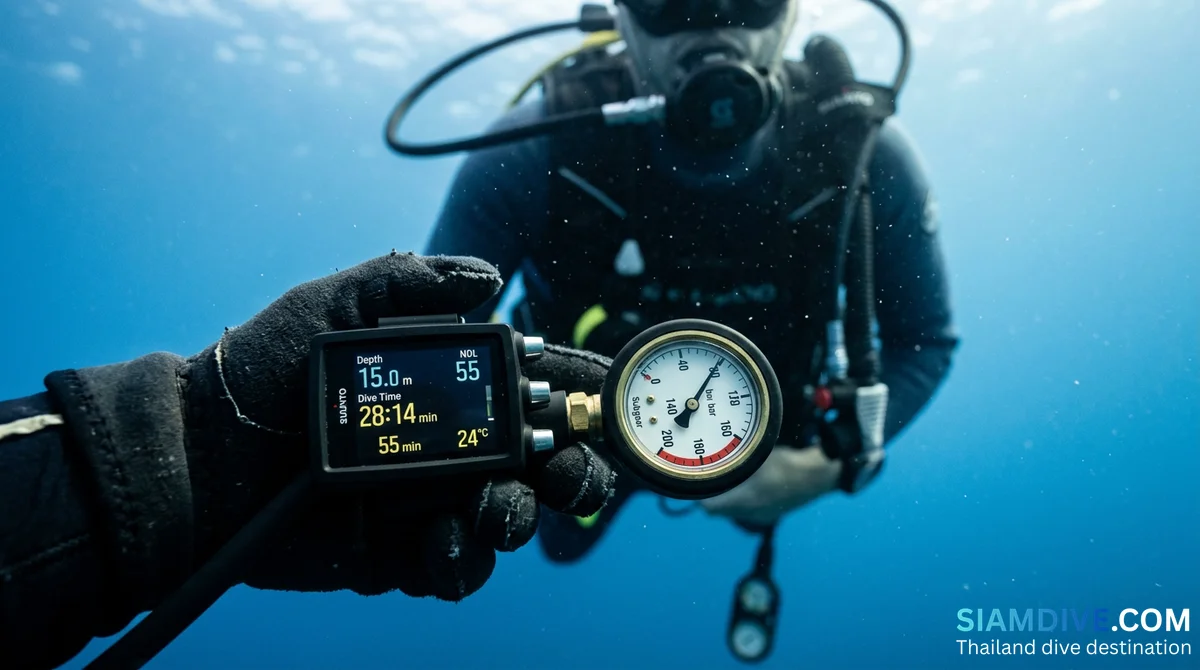
Open two regulators on a workbench — one balanced second stage, one unbalanced — and at 10 meters in a pool you can barely tell them apart. Both breathe fine. Both feed air on demand. The spec sheets diverge quietly, and the average diver shrugs. Put the same pair at 30 meters on a drift along Phuket's Anemone Reef, though, and a small number in the airflow graph starts writing a different story. This piece is about that number, where it comes from, and when a diver should actually care.
The short version of the engineering argument: a balanced second stage is not marketing. It describes a valve that keeps cracking effort independent of intermediate pressure and tank pressure. At shallow recreational depth, that independence is invisible. At depth — on dense gas, on the back half of a long dive — it is the difference between a regulator that disappears and one you are consciously pulling air through.
What "balanced" actually means inside a second stage
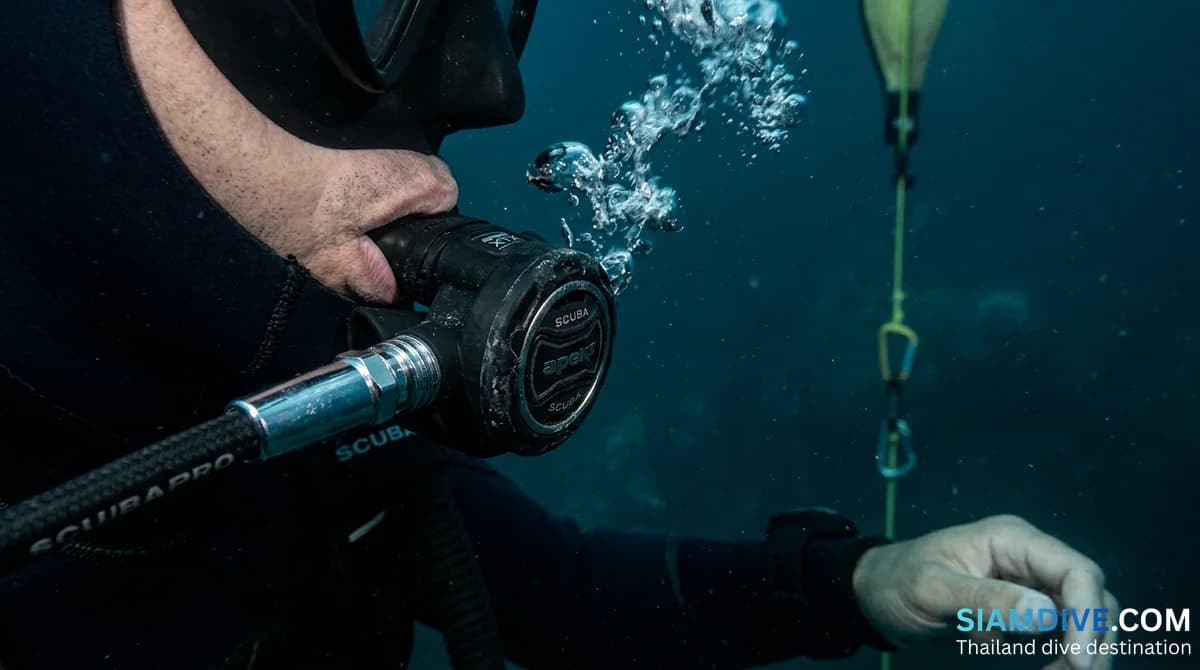
A second stage is a demand valve. You inhale, the diaphragm deflects, a lever rotates, a poppet lifts off its orifice, and intermediate-pressure (IP) gas from the first stage rushes through the oral tube. The spring behind the poppet wants the valve closed. The entire design question is how it decides when to open.
In an unbalanced second stage, the spring is sized against a specific IP — typically 135 psi over ambient. When IP falls (as it does in an unbalanced-piston first stage nearing reserve), the mechanical advantage shifts and the valve takes a little more vacuum to crack. In a balanced second stage, a small duct routes IP gas to the back of the poppet. That pressure cancels most of the force the spring is fighting. Cracking effort stops depending on IP.
That is the whole story on a dry bench. It is not the whole story underwater.
The variable that actually matters: gas density
Every 10 meters you descend, ambient pressure adds one atmosphere. The air you breathe compresses the same way — denser molecules, same breath volume, more mass moving through the hoses and across the venturi on every inhalation. At 30 meters on air, the gas you pull off the regulator weighs about 5.2 grams per liter. At 39 meters, it crosses 6.2 grams per liter.
Those numbers are not arbitrary. Gavin Anthony and Simon Mitchell, in a 2015 paper on respiratory physiology under pressure, identified 5.2 g/L as the ideal ceiling for recreational gas mixtures and 6.2 g/L as the hard limit at which CO₂ retention in both open-circuit and rebreather subjects becomes measurably unsafe. Below that ceiling, a fit diver compensates. Above it, a measurable percentage of divers fail to clear CO₂ fast enough and stack a hypercapnia load that makes narcosis feel worse and makes judgment feel fine when it isn't.
On air, those thresholds translate to roughly 31 m and 39 m. BSAC and DAN now cite them in planning tables. They also sit directly on top of the recreational 30–40 m envelope — meaning every diver who has ever done a deep AOW dive has operated within one or two meters of the ideal density ceiling, and the decision about gear was made without ever hearing those numbers.
How ANSTI actually measures what you are feeling
The benchmark test for regulator breathing effort is the ANSTI wet breathing simulator at Dive Lab in Panama City Beach. The machine pressurizes a chamber to simulate 132, 165, and 198 feet of seawater (40, 50, 60 m), pushes 2.5 liters of gas through the regulator on each breath at 15, 25, and 30 breaths per minute, and reports work of breathing in joules per liter. It is rated to 100 msw — well beyond anything a recreational regulator will ever legally see.
- GOOD: < 3.0 J/L — the EN 250:2014 European certification ceiling
- VERY GOOD: ≤ 1.5 J/L
- EXCELLENT: ≤ 1.0 J/L
The EN 250 standard also caps positive static pressure at 5 mbar so the regulator does not free-flow when you tilt your head, and limits total elastic work to 0.3 J/L so the diaphragm doesn't feel like it's shoving back. Any regulator legally sold in the EU must clear those thresholds at the machine's deepest and busiest setting — which is why, as a floor, EN-250 certification is worth more than most spec-sheet bullet points.
Side-by-side at depth: three representative designs
To make the comparison concrete, look at what three common configurations actually do as depth and breathing rate climb. The numbers below are representative of published ScubaLab and DiveLab results across several years of reg testing, not a single lab run; individual service condition, environmental sealing, and gas composition shift every number slightly.
| Configuration | Cracking effort (in H₂O) | WOB at 40 m, 25 bpm | WOB at 60 m, 30 bpm | Typical use |
|---|---|---|---|---|
| Unbalanced piston + unbalanced 2nd (entry-level rental class) | 1.4–1.8" | ~1.6 J/L | ~2.8 J/L | pool, shop rental, <25 m |
| Balanced diaphragm + balanced 2nd (mid-tier owner) | 0.8–1.2" | ~1.1 J/L | ~1.8 J/L | daily recreational to 40 m |
| High-flow balanced (Scubapro MK11/C370 class) | 0.6–1.0" | ≤ 1.0 J/L | ≤ 1.5 J/L | deep, cold, heavy workload |
What the table hides is the shape of the curve. Unbalanced rigs don't just show a higher number at 60 m; they show a steeper slope. The effort gap between 40 m and 60 m is often roughly double what a balanced rig shows over the same depth range. You feel that slope as "I'm sucking harder than I remember" on the second half of a deeper dive — not as a single bad breath, but as the cumulative sense that each inhalation takes a fraction more diaphragm travel than the last.
The first stage is where the surprise hides
A balanced second stage bolted to an unbalanced first stage is still a compromise, and this is the combination most divers end up diving without realizing it. Three failure modes matter:
- Unbalanced piston first stage — as tank pressure falls toward 50 bar, IP drops. A second stage tuned to 135 psi suddenly sees 120. Cracking effort rises even if the second stage itself is balanced.
- Unbalanced diaphragm first stage — the opposite: IP rises as tank pressure falls. Free-flow risk increases; divers often notice a looser, wetter feel in the last third of a dive, and on cold descents the risk of an ice-triggered free-flow climbs with it.
- Balanced first stage (piston or diaphragm) — IP stays flat from 232 bar down to about 20 bar above ambient. Every breath at every depth and at every tank pressure feels the same.
That last line is what you are actually buying when you upgrade: not easier air at 10 m, but consistency across the full dive. On a Similan Islands liveaboard with four deep dives a day and tanks drained harder on the afternoon dives, the balanced first stage is the piece that keeps dive four feeling like dive one.
Warning signs that actually matter underwater
Engineers like data; divers have to make decisions underwater. Here are the moments when the numbers above stop being academic:
- You find yourself consciously pulling harder past 25 m. A healthy regulator at recreational depth should feel the same as it does at 10 m. If it doesn't, the service is overdue or the first stage isn't actually balanced.
- You skip-breathe to stretch gas and end the dive with a headache. That is CO₂ retention — a textbook consequence of elevated work of breathing plus poor breathing discipline. The fix is both a better regulator and a slower, deeper breathing pattern; neither alone is sufficient.
- Breathing effort rises markedly below 600 psi / 40 bar. On unbalanced gear this is normal. On balanced gear, it is a symptom that the IP is drifting and something in the first stage wants attention.
- Wet breaths or a "ticking" exhaust tee. The exhaust diaphragm isn't seating. Service now, not next month.
- Free-flow on descent. Usually a venturi-assist setting, but also a sign the IP is climbing into territory the second stage wasn't tuned for.
In our experience running deeper profiles at Richelieu Rock and the pinnacles off Koh Bon, the divers who most often hit CO₂ headaches aren't on old rental gear — they're on decent balanced rigs that haven't been serviced in three seasons. The gear was good when they bought it. Saltwater, neglect, and drift are doing the rest.
Venturi, cracking effort, and the knob most divers ignore
Almost every modern second stage has two adjustments the diver can reach: an inhalation-effort knob (which preloads the cracking spring) and a venturi lever (plus/minus or dive/pre-dive). They do different jobs and are worth understanding separately.
- The venturi lever directs incoming airflow across the diaphragm. In "dive" it creates a low-pressure zone that helps the diaphragm continue deflecting once you've started inhaling — assist. In "pre-dive" it breaks that flow path so the regulator doesn't free-flow on the surface or in a current on descent.
- The effort knob preloads the poppet spring. Tuned fully out (minimum effort) when diving; tuned in when the regulator is stowed to reduce free-flow risk and preserve the seat.
At depth, turn both toward "easiest." You are already paying a gas-density tax on every breath; there is no reason to add a mechanical one. The one exception: on descent in a strong current, flip the venturi to pre-dive until you are settled, then switch to dive. More than one diver has lost half a bar per minute riding a free-flow they didn't realize was happening because their venturi was set aggressively on a current-swept entry.
Service intervals: what the warranty actually says in 2026
Manufacturer rules in 2026 are not uniform, and the scuba forums perpetuate several myths worth killing:
- Aqualung, Apeks, Mares, Scubapro: annual service required to maintain the parts warranty. The regulator will still work past a year; the warranty will not.
- Atomic Aquatics: 2 years or 300 dive hours, whichever comes first. Warranty remains valid across the original owner's lifetime regardless of service timing, but free parts coverage is contingent on hitting the service window.
- Halcyon, Hollis: annual or every 100 dives, whichever comes first.
As of April 1, 2026, Aqua Master Thailand became the official Huish Outdoors distributor for Oceanic, Hollis, and BARE in the country. That matters more than it sounds: genuine Hollis service parts are now sourced domestically rather than through Singapore, which on the last round of shop conversations in Phuket was cutting one to two weeks off the typical reg-service turnaround. If you dive Hollis or Oceanic gear here, that is useful news. For every other brand, ask the shop which distributor their service parts come from before you hand over the first stage — the difference between a genuine service kit and a generic-fit kit is not something you want to find out at 30 m.
Honest shortlist for Thailand's recreational depths
For the typical two-tank day off Chalong Pier, 25–30 m max, warm water: a balanced diaphragm first stage paired with a balanced second stage is the sweet spot. You don't need the breathing performance of an Atomic B2 or an Apeks XTX200. You do need a first stage that keeps IP flat when the tank drops to 50 bar, because that is exactly the moment unbalanced gear gets lousy to breathe.
For technical-leaning recreational profiles — Similan deep sites, Richelieu, the wreck of the Boonsung below 25 m — the Scubapro MK11/C370 that won the 2025 ScubaLab Best Buy (sub-1.0 J/L at the mid-depth tests, "soft, smooth and quiet" in the tester notes) is the reference at its price. Above it, the Scubapro MK25/S620Ti, the Atomic B2, and the Apeks XTX200 are effectively indistinguishable on an ANSTI graph at recreational depths. The choice between them comes down to environmental sealing (Apeks has the clearest cold-water pedigree), parts availability in your country, and what your local technician services competently without reaching for a generic kit.
For cold-water sidelines — Similan in January mornings, early-morning Andaman descents — any regulator sold in the EU since 2014 has passed the EN 250 cold-water certification test. That does not mean all of them stay equally dry at 40 m, but it does mean the worst-case work of breathing is capped by law.
The short version worth remembering
Balanced is not a marketing word. It describes a mechanism that keeps cracking effort independent of IP and tank pressure. At 10 m you can't feel the difference. At 30 m, on slightly dense gas, on the back half of a dive, you absolutely can. And once you understand that the real ceiling for comfortable recreational breathing isn't depth itself but gas density — 5.2 g/L as the planning target, 6.2 g/L as the absolute line — the decision to spend another 6,000 THB on a balanced first stage stops looking like a luxury and starts looking like a CO₂ budget.
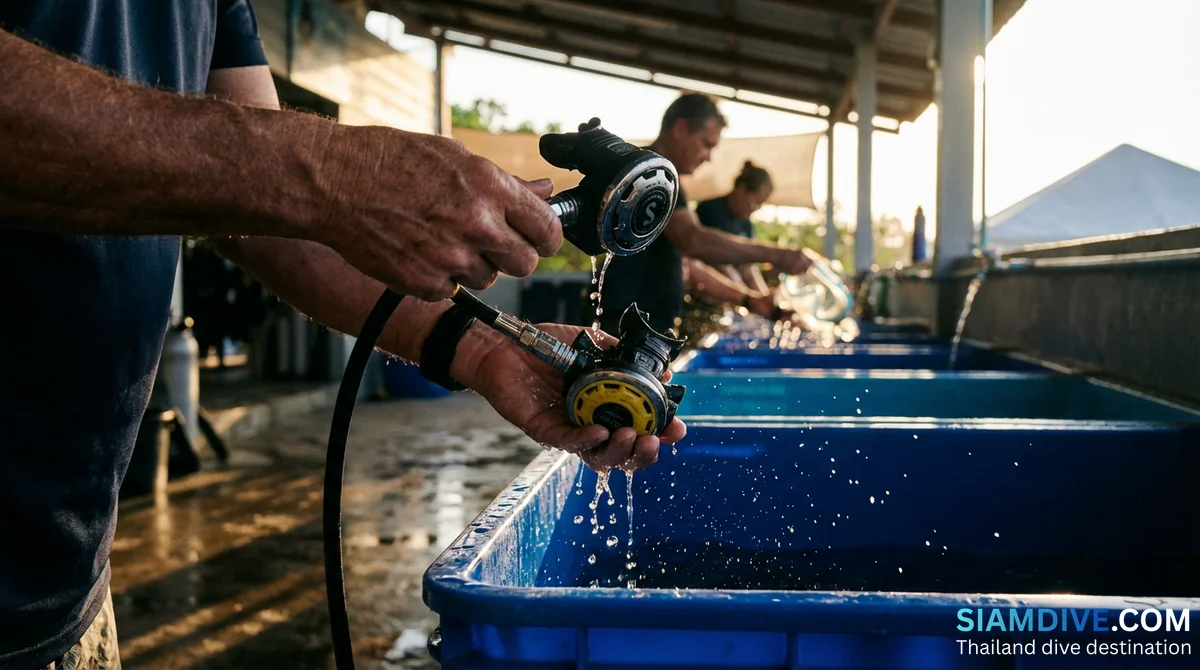
Related reading: the 15-minute post-dive rinse that doubles regulator life, storing your reg between seasons without ruining the seats, why the BCD bladder flush matters for pressure-sensitive gear, and what your mask and reg actually have in common in the rinse tank.
Sources
- ScubaDiving.com — Testing Scuba Regulators on the ANSTI Breathing Machine
- Wikipedia — Breathing performance of regulators (EN 250:2014 standard)
- DAN Alert Diver — Performance Under Pressure (Anthony & Mitchell gas density research)
- InDEPTH — Density Discords: Applying Gas Density Research
- ScubaDiving.com — Scubapro MK11 EVO/C370 ScubaLab Best Buy 2025
- Scuba Clinic Tools — Measuring Intermediate Pressure
- Aquamaster Thailand — Huish Outdoors Distribution Announcement (April 2026)